


TL; DR
The mechanism is now visible in the accounts. In twelve quarters, revenue growth rose from 17% to 93%, the sequential addition from $50 million to $303 million, and net dollar retention from 107% to 157%. Revenue is outrunning customer count while RPO, billings, and margins rise with it.
The Ontology is an institutional compiler. Foundation models supply generic intelligence; the Ontology translates a firm’s objects, permissions, workflows, and judgment into executable instructions. Better models make more workflows possible. The compiler makes them cumulative.
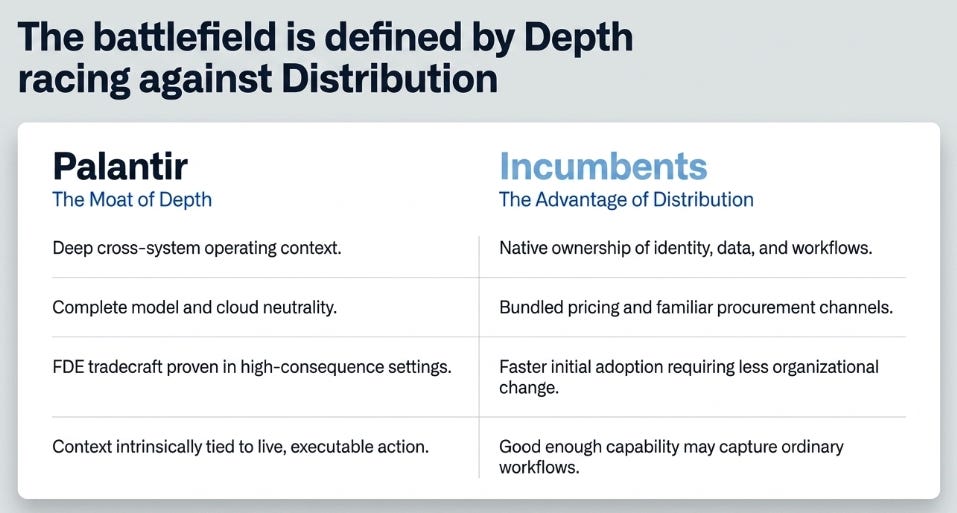
The race is depth against distribution. Palantir has the deepest deployed model of high-consequence operations; incumbents have far greater distribution. My end-2029 outcomes are approximately $72, $190, and $375.
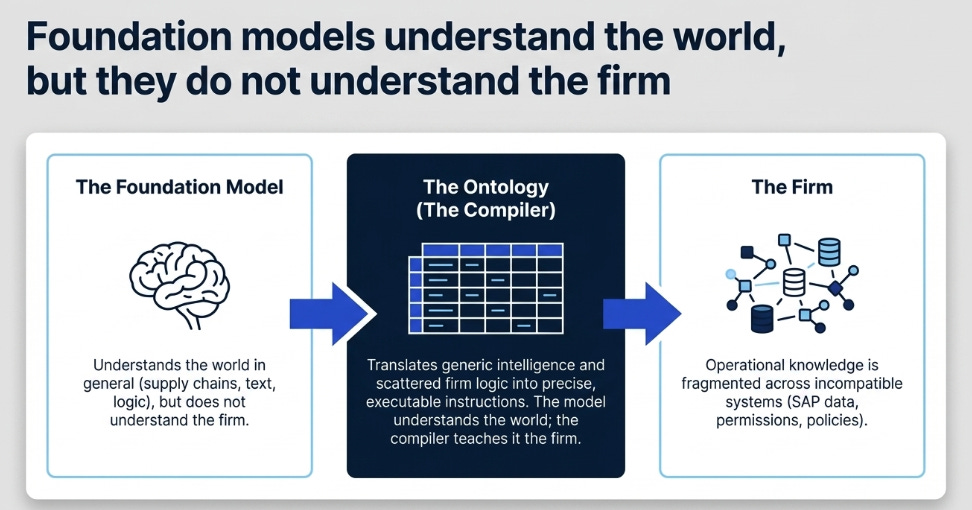
A compiler is invisible when it works. A programmer writes in human-readable language; the machine requires exact instructions. The compiler resolves definitions, links libraries, enforces rules, and turns intention into execution. The tenth program reuses what the first nine compiled.
Large organisations face the same problem. Their operating knowledge is scattered across software, employees, policies, permissions, exceptions, and accumulated judgment. A foundation model may understand supply chains in general; it does not know which substitution this company permits, who may approve it, what SAP must record, or whether the decision worked.
The model understands the world. It does not understand the firm.
Palantir calls the translation layer between the two the Ontology. It maps an institution’s objects and relationships, connects them to live systems, encodes who may act, and records what follows when an action is taken. I think a better description is an institutional compiler: Palantir turns the messy logic of an organisation into an executable model that employees, applications, and AI agents can use.
The big fundamental question is: can each compiled workflow increase the speed, scope, and value of the next before Microsoft, ServiceNow, AWS, Google, and SAP compile enough of the firm through systems they already distribute?
Q2 matters because the accounts now look like the compiler has begun to compound.
From Coordination to Compounding
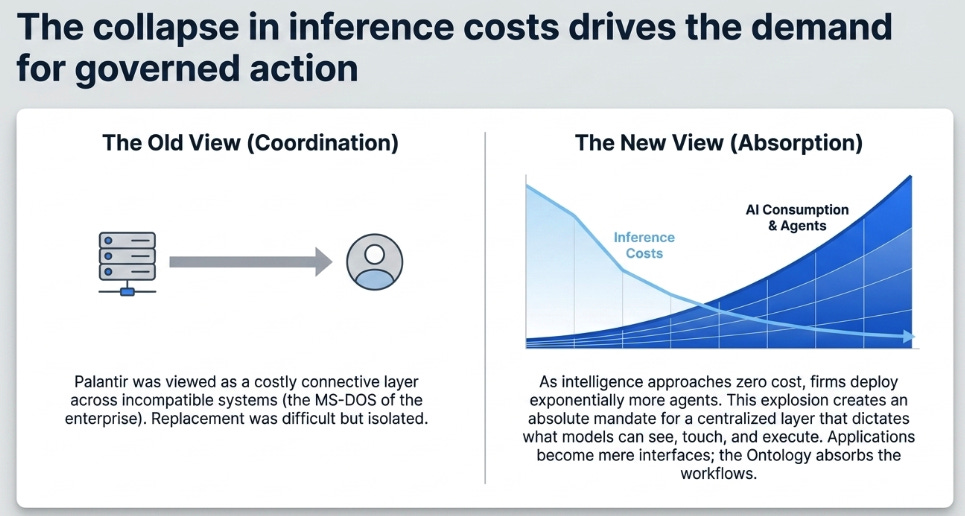
Our view of Palantir has changed in stages. In October, I described the Ontology as the modern equivalent of MS-DOS: a common language across incompatible enterprise systems. After Q4, the argument became stronger. Once an institution had mapped its objects, permissions, and operating relationships into Palantir, replacement was no longer a normal software switch; it required reconstructing the institution’s operating model.
Q1 moved the thesis from coordination to absorption. Workflows that once lived inside individual applications could increasingly move into the Ontology, while the applications became interfaces. Our Q1 article also applied the Jevons idea to enterprise AI: as inference prices fall, firms use more intelligence, which creates more agents, tool calls, and governed actions. The force commoditising models increases demand for the layer controlling what those models may see and do.
What I missed was the effect on Palantir’s own growth curve. I understood why cheap models should create more demand. I had not fully understood why every successful workflow might reduce the difficulty of the next one, allowing Palantir to accelerate even as its base became larger.
The Ontology does not merely govern more work. It preserves what was learned while that work was being compiled.
The Acceleration That Should Not Be Possible
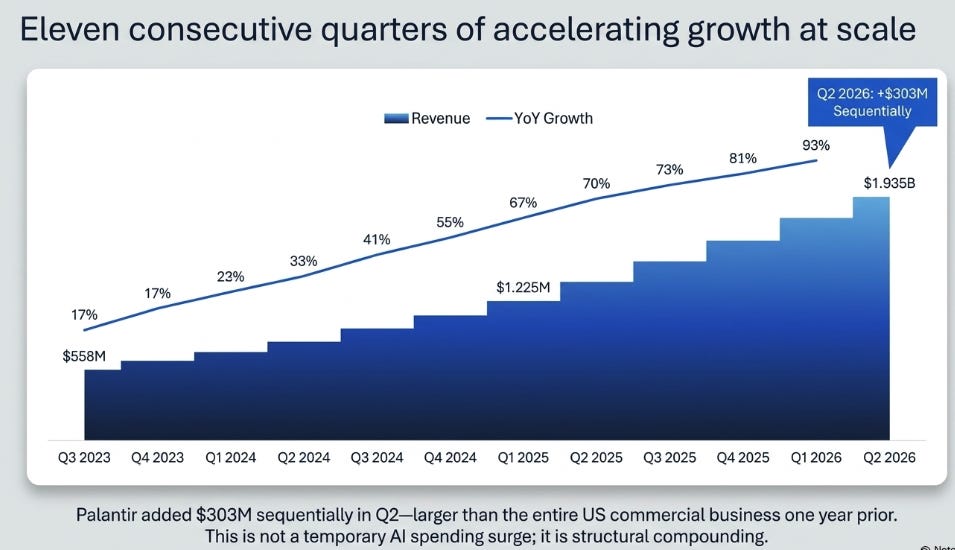
Palantir’s year-over-year growth has accelerated for eleven consecutive quarters. The percentage progression is striking; the absolute additions are harder to explain away.
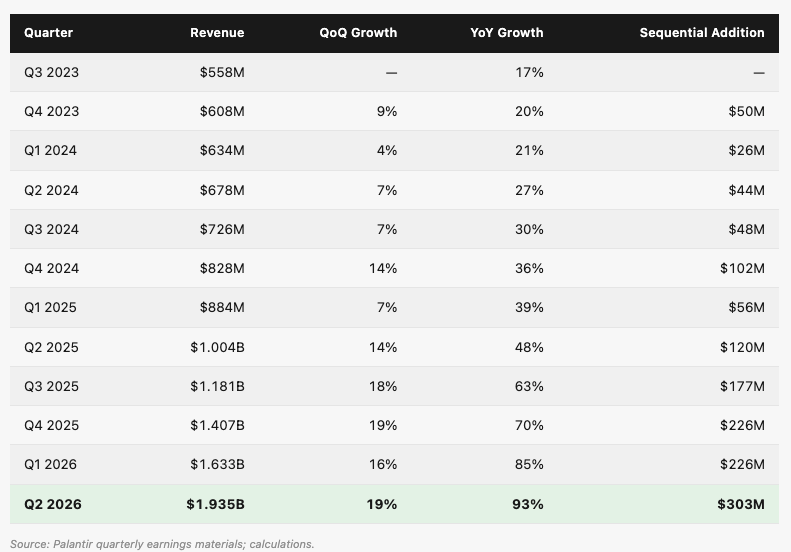
Source: Palantir quarterly earnings materials; calculations.
Palantir added roughly $326 million to its quarterly revenue base in the year ending Q2 2025. It added about $932 million during the following year. Q2’s sequential addition alone was larger than the entire US commercial business one year earlier.
A temporary AI spending surge could produce a few strong quarters. It would be less likely to produce accelerating percentage growth, larger dollar additions, higher retention, expanding contracted demand, and wider margins at the same time. Q2 revenue grew 93% to $1.935 billion; US commercial grew 149% to $764 million; US government grew 90% to $809 million. Adjusted operating margin reached 62%, and adjusted free cash flow was $1.22 billion at a 63% margin.
The most revealing comparison is revenue against customer count. Total customers rose 24% over the year while revenue rose 93%. US commercial customers increased 35%, from 485 to 653, while US commercial revenue rose 149%. Sequentially, customer count grew 6% and revenue grew 28%. The system is going deeper much faster than the customer base is becoming broader.
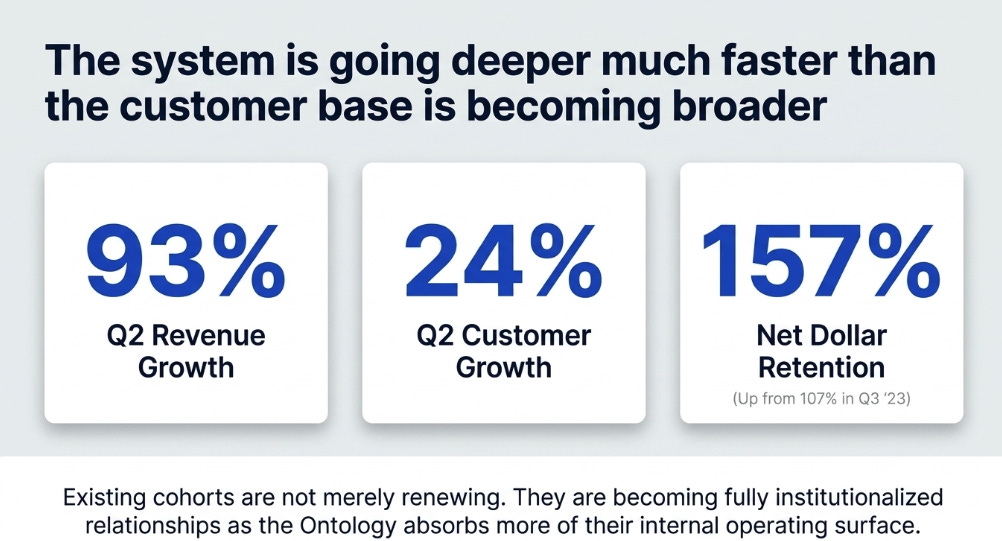
Net dollar retention confirms that interpretation. It was 107% in Q3 2023 and reached 157% in Q2 2026. Existing cohorts are not merely renewing; they are becoming much larger relationships.
The forward indicators trace the same progression:
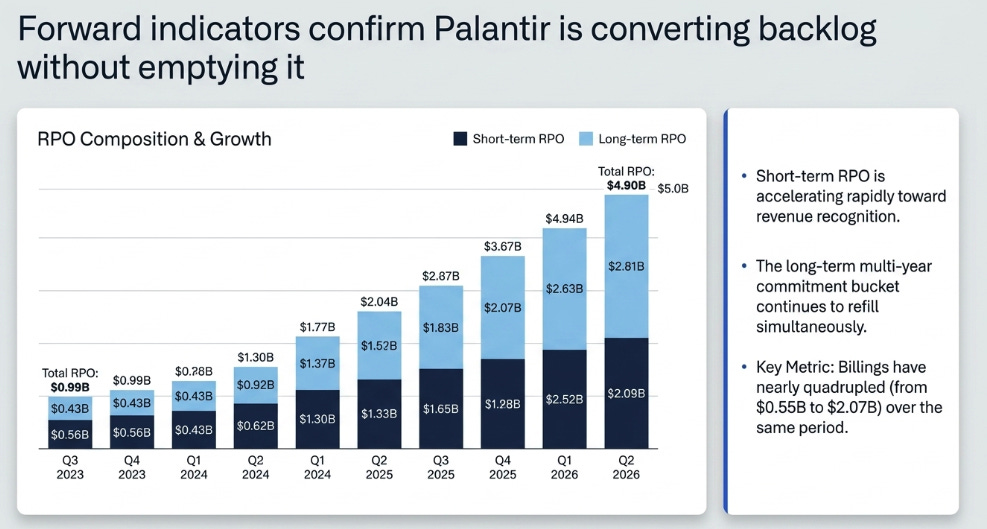
Source: Palantir quarterly presentations. Figures may not sum perfectly because of rounding.
Total RPO has increased almost fivefold; long-term RPO more than sixfold. Late 2025 brought a surge in multi-year commitments. Since then, short-term RPO has accelerated toward recognition while the long-term bucket keeps refilling. Billings have nearly quadrupled. Palantir is converting backlog without emptying it.
RPO also understates part of the government business because contracts with initial terms of twelve months or less, and obligations outside termination-for-convenience clauses, are excluded. Management says the reported balance is therefore primarily commercial.
The cost structure completes the argument. From Q2 2025 to Q2 2026, Palantir added about $932 million of revenue and $730 million of adjusted operating income, an incremental adjusted margin near 78%. Revenue grew 93%; adjusted expenses grew 37%. Those are not the economics of a business that repeats the same amount of labour for every new workflow. They imply reuse.
How the Compiler Compounds
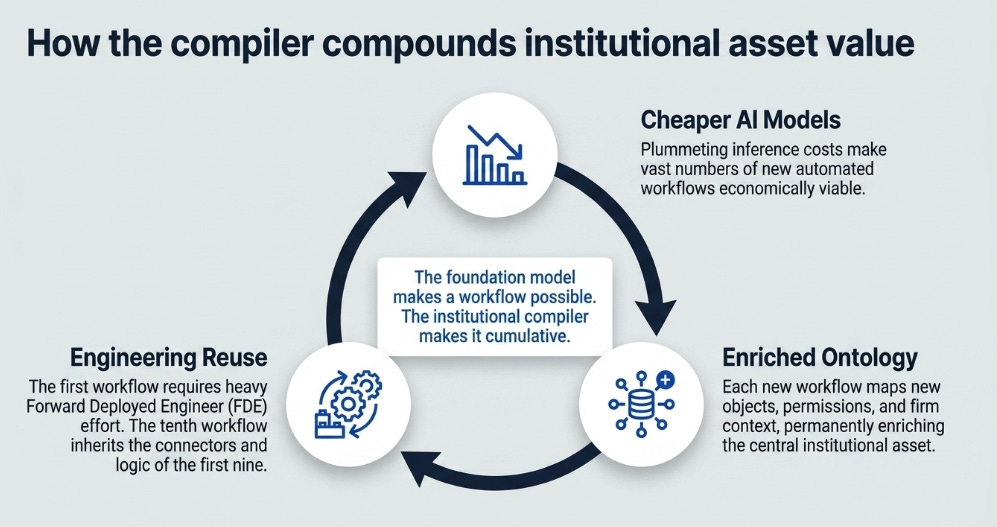
Every enterprise AI system contains two models. The first is a foundation model—GPT, Claude, Gemini, Llama, Nemotron—trained on broad information and supplying generic intelligence. The second is a model of the institution: its objects, relationships, permissions, policies, actions, decision history, benchmarks, and outcomes.
The two assets age differently. A foundation model begins losing relative value when a competitor releases a better or cheaper one. The model of the firm becomes richer each time it is used. The first workflow requires Palantir’s Forward Deployed Engineers to connect systems, define objects, encode policy, and establish safe actions. The second workflow inherits much of that work. The tenth inherits the first nine.
This is where the collapse in inference costs matters. Our Q1 article noted that inference prices had fallen roughly a thousand-fold in three years. That did not reduce AI consumption; it expanded the number of tasks that could be run economically. Each new task still needs institutional context, permissioning, auditability, and a way to act.
Three mechanisms reinforce one another. Cheaper models make more workflows viable. Each workflow enriches the customer’s Ontology, making adjacent work faster to compile. Each engagement adds connectors, industry patterns, and field knowledge that Palantir can reuse elsewhere.
Shyam Sankar described the result as an automated model factory inside the customer’s security boundary. Operational telemetry feeds customer-specific benchmarks and post-training, while the customer controls the resulting weights. He also said that a standard open model beat frontier models on five production tasks once Palantir tested it against the customer’s actual work. The important asset was not the model ranking; it was the institution’s own definition of success.
That is why “institutional compiler” is more precise than “control plane.” Palantir is not merely routing agents or governing tool calls. It is translating tacit institutional knowledge into a living system through which agents can reason, act, and learn. Forward Deployed Engineers are performing specification work. The Ontology turns that work into a reusable asset.
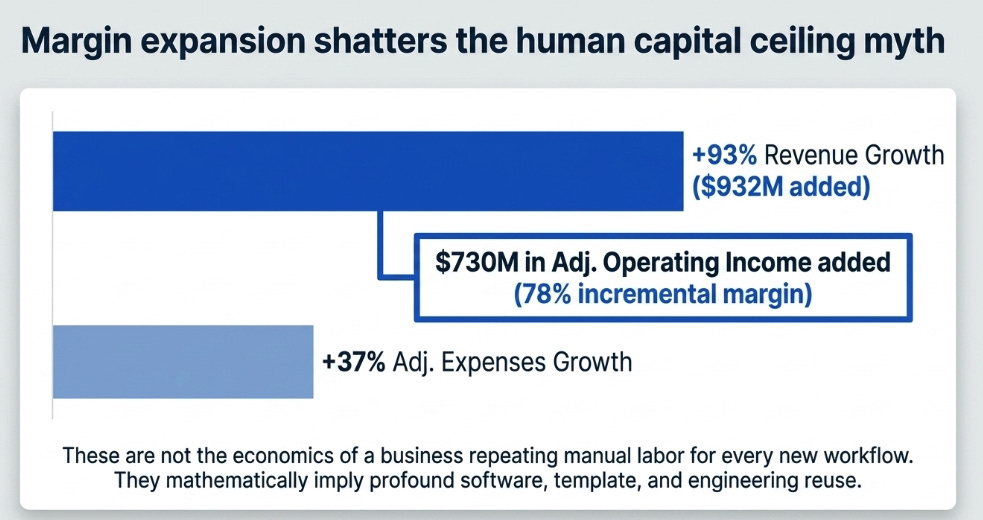
The old consulting critique is therefore dead, but a new risk replaces it. If every new institution still requires proportional FDE effort, Palantir has a human-capital ceiling. If templates, tools, partners, and prior deployments allow each engineer to compile more operating surface area, the ceiling rises. Q2’s incremental margins suggest that it is rising; the company does not disclose workflow-level economics, so this remains an inference rather than a settled fact.
The foundation model makes a workflow possible. The institutional compiler makes it cumulative.
The Other Compilers
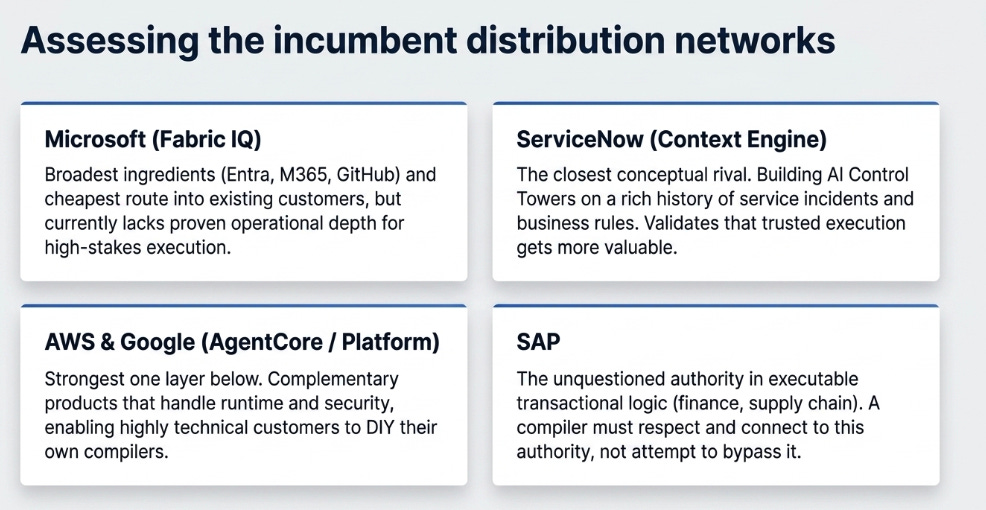
Palantir is no longer alone in understanding where value is moving. Microsoft, ServiceNow, AWS, and Google now describe products that govern agents, connect enterprise context, and translate intelligence into action. The strategic question is not whether these products exist. It is whose representation becomes authoritative when an agent must decide what an object means, which rule applies, and what action is allowed.
Microsoft starts with the graph of work: identity in Entra, documents and communication in Microsoft 365, code in GitHub, data in Fabric, and processes in Dynamics and Power Platform. Fabric IQ Ontology, still in preview, defines entities, relationships, and rules for agents and workflows. Microsoft has less proven operational depth, but the broadest ingredients and cheapest route into existing customers.
ServiceNow is the closest conceptual rival. It begins with the history of services, incidents, approvals, assets, cases, and business rules. Context Engine maps people, assets, policies, and operational history; ServiceNow says that intelligence “compounds with every workflow.” AI Control Tower governs agents across vendors, while Action Fabric exposes workflows to third-party agents. Its thesis now sounds like Palantir’s: “Intelligence will keep getting cheaper. Trusted execution will keep getting more valuable.”
AWS and Google are strongest one layer below. AgentCore lets customers use any model or framework while handling runtime, tool access, identity, tracing, evaluation, and security. Google’s Agent Platform offers runtime, registry, identity, gateways, policies, and observability for agent interactions. These products complement Palantir by making agents easier to run, but they also let technically capable customers assemble a good-enough compiler themselves.
SAP remains different. It already contains executable transactional logic for finance, procurement, supply chains, and manufacturing. Any cross-system compiler must respect that authority rather than wish it away; Palantir’s own prior examples treated SAP as a source system to connect and, at times, a workflow to simplify.
The contest can be reduced to one line: Palantir’s depth is racing the incumbents’ distribution.
The concept of an ontology is not the moat; everyone now understands it. Palantir’s possible moat is the installed system: a live model already connected to source systems, trusted to execute consequential actions, and accumulating knowledge faster than a rival can reconstruct it. Microsoft and ServiceNow do not need to beat that depth everywhere. They need to make a separate Palantir purchase unnecessary for enough workflows.
Sovereignty Cuts Both Ways
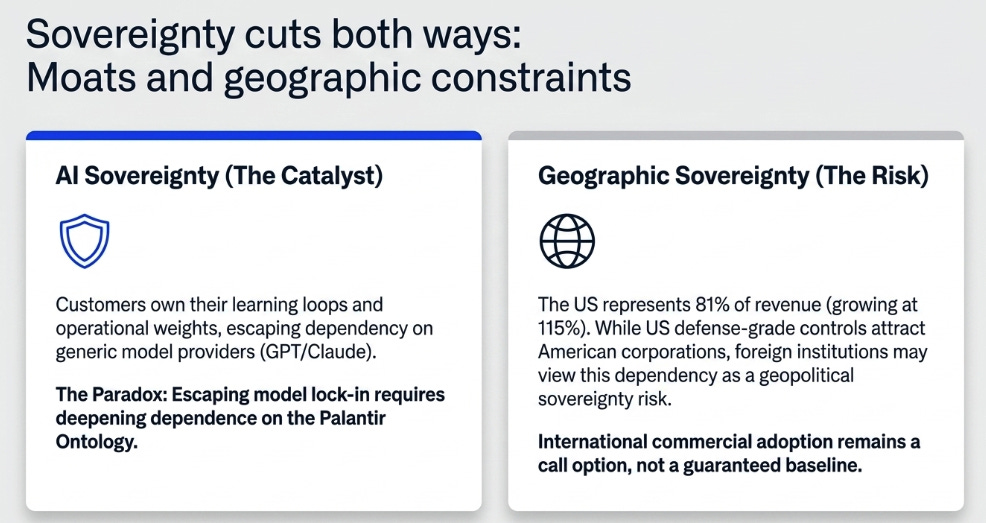
Management’s “AI sovereignty” argument is a claim about ownership of the second model. If a model provider captures a customer’s prompts, reasoning traces, benchmarks, and operating outcomes, the provider’s asset compounds while the customer rents the result. Palantir says the institution should own that learning loop. Its Q2 products extend this idea into model switching, post-training, agent orchestration, and customer-controlled weights.
There is an obvious contradiction: a company may reduce dependence on model laboratories by becoming deeply dependent on Palantir. The more operating logic compiled into the Ontology, the harder it becomes to leave. Palantir’s best answer is architectural rather than rhetorical—make the compiler open above and difficult to reproduce below. Let Microsoft, ServiceNow, AWS, Google, and customer-built agents use the Ontology; keep the advantage in constructing and maintaining the live institutional model.
Sovereignty also cuts geographically. US revenue grew 115% and now represents more than 81% of Palantir’s revenue. International commercial revenue grew 26% and only 2% sequentially. American companies may see a US vendor with defence-grade controls as an advantage; foreign institutions may see dependence on that same vendor as a sovereignty risk.
I would therefore treat international as upside, not as a required base-case input. The US opportunity is large enough to carry the next several years. A company valued as a universal institutional layer will eventually have to prove that the compiler can travel.
What Q2 Changed
Before Q2, I believed model commoditisation increased the value of governed action, the Ontology was absorbing workflows, and delivery capacity was the main constraint. I still believe all three. What changed is that increasing returns inside customers are no longer merely an architectural possibility. Revenue density, retention, contracted demand, billings, and margins now move together in the pattern the thesis predicted.
The new variant view is therefore about duration. Conventional software models assume each sale is another unit added to a larger base, so growth must eventually slow. Palantir’s relevant unit may be different: the amount of institutional operating surface compiled into the Ontology. Each new workflow can increase the value of the workflows already there.
The underappreciated risk also changed. It is no longer that Palantir is consulting in disguise. It is that Microsoft or ServiceNow becomes good enough for ordinary workflows before Palantir can industrialise its depth. The market may be underestimating both the duration of Palantir’s growth and the power of incumbent distribution.
Three Years From Now
I value the outcomes at year-end 2029 using FY2030 earnings, because that is the period public markets would then be pricing. The starting point is Palantir’s new FY2026 revenue guide of roughly $8.15 billion and a current reference price of $125.65.
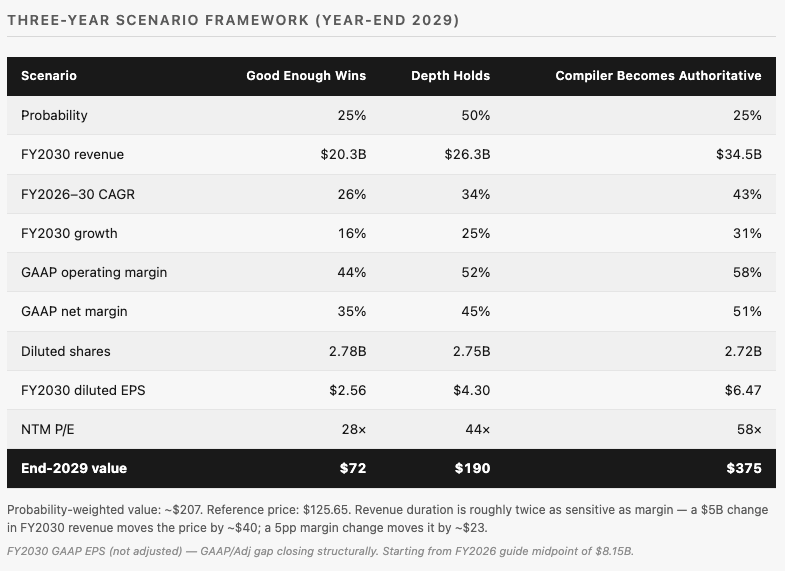
In the bear case, incumbents capture ordinary workflows while Palantir keeps the hardest government and industrial settings. In the base case, delivery scales and Palantir remains authoritative in high-value cross-system work. In the bull case, third-party agents consume Palantir’s context rather than replace it, making the compiler a neutral layer across clouds and models.
The probability-weighted value is about $207, roughly 65% above the current price, but it is not a precise target. The bull case contributes heavily, and small changes in growth duration or terminal multiple move the answer sharply. The $9.2 billion cash balance supports the downside, but I do not add it separately to a P/E-derived value because part of its benefit already appears through interest income and future capital allocation.
Palantir has proved the margin structure. The harder question is how much of the firm it can compile, and for how long.
What Would Prove Us Wrong
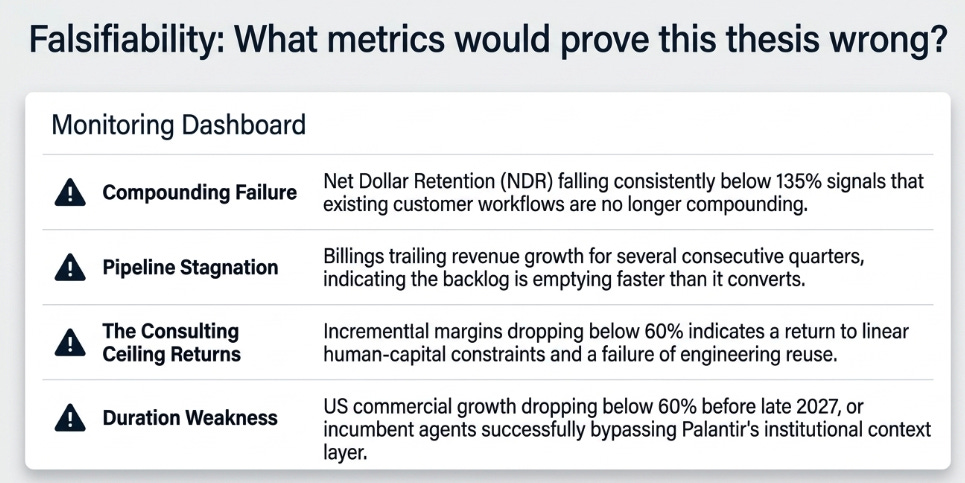
The thesis should remain falsifiable. Revenue must keep growing far faster than customer count; net dollar retention should stay above 145%, with a fall below 135% signalling weaker customer compounding. Short-term RPO must convert while long-term RPO continues to refill, and billings should not trail revenue growth for several quarters. Adjusted operating margin should remain above 55%, with incremental margins above 60%, or the human-capital ceiling deserves another look.
US commercial growth below 60% before late 2027 would weaken the duration case. International commercial growth above 30–40% would expand the runway; sustained growth below 20% would confirm a geographically narrower opportunity. The competitive test is more qualitative but just as clear: are Microsoft and ServiceNow agents using Palantir as the authoritative source of institutional context, or is Palantir becoming one tool inside their systems?
Compilers usually disappear into the systems built on top of them. Users do not think about the definitions, libraries, and dependencies being resolved beneath the surface; they notice that new work becomes easier because the hard translation was done before.
That is what Q2 may be showing. Model intelligence is getting cheaper. More work becomes automatable. Each Palantir workflow adds context that can be used again, while each deployment adds knowledge that can shorten the next one. Revenue accelerates, contracted demand refills, and marginal costs fall.
The model laboratories are teaching machines to understand the world. Palantir’s bet is that the greater prize lies in compiling each institution into something those machines can safely understand and act upon.
Q2 is the first quarter where that compiler looks capable of accelerating itself.
Disclaimer:
The content does not constitute any kind of investment or financial advice. Kindly reach out to your advisor for any investment-related advice. Please refer to the tab “Legal | Disclaimer” to read the complete disclaimer.