


TL; DR
The product thesis is stronger than before: Palantir is no longer just coordinating intelligence from external models; it is helping customers post-train open models on proprietary operational data, making the model itself more interchangeable while increasing the value of the Ontology and the surrounding learning system.
The commercial model is becoming less contract-heavy: U.S. commercial revenue is accelerating far faster than remaining deal value, and shorter initial contracts are becoming part of the sales motion. Management argues this reflects faster proof of value followed by expansion; the missing duration-adjusted bookings disclosure makes that claim harder to verify.
The real moat may be reconstruction cost, not contractual duration: if replacing Palantir means rebuilding permissions, workflows, evaluations and feedback loops, customers can remain economically locked in while still owning their models and signing shorter contracts. But at $178, investors need evidence that this dependence reliably becomes future spending.
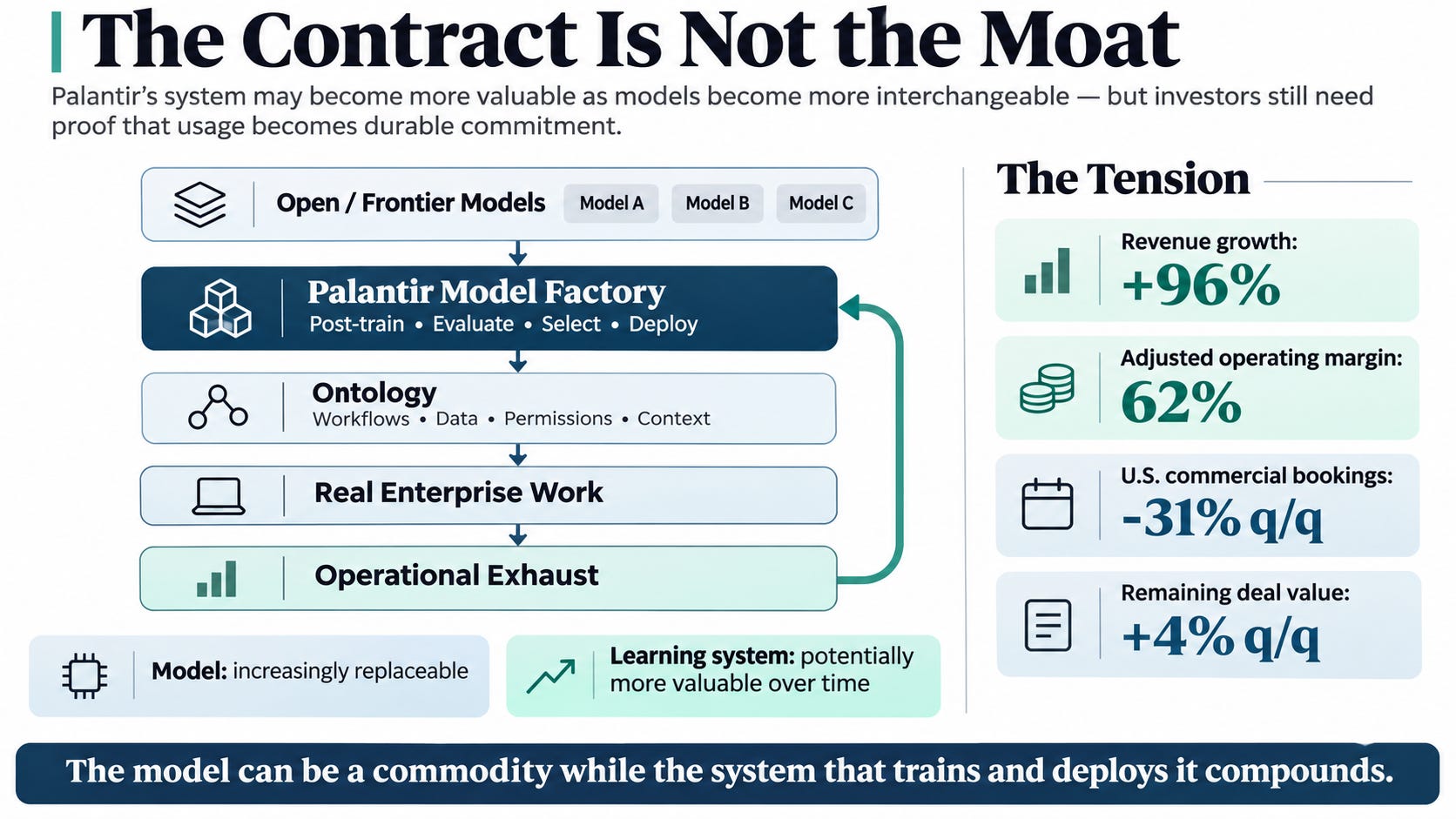
In February, Palantir’s appeal rested on a useful separation of responsibilities. Model laboratories would spend billions producing intelligence; Palantir would make that intelligence useful inside institutions. Our description was deliberately blunt:
Palantir doesn’t train models. They don’t care which model wins. They sit above the model layer, buying cognition at declining prices and selling coordination at increasing prices.
The economic argument still holds, but the product description needs updating. Palantir does not build general-purpose foundation models; it increasingly helps customers post-train open models on their own operational information. We identified this model factory in August. What Q3 adds is its growing importance to both the product proposition and the way customers buy it.
The operating results were extraordinary. Revenue grew 96% to $2.31 billion, U.S. commercial revenue rose 148% to $984 million, and adjusted operating margins remained at 62%. Full-year revenue guidance increased by nearly $380 million to $8.53 billion. U.S. commercial revenue exceeded U.S. government revenue for the first time.
Yet August’s description of Palantir as “converting backlog without emptying it” now requires qualification. U.S. commercial bookings fell 31% sequentially, remaining deal value grew just 4%, and long-term remaining performance obligations declined. The issue is not that the commercial order book shrank it did not, but that forward commitments grew much more slowly than current revenue. The business looks stronger; the evidence supporting its duration has become less straightforward.
The Compiler Now Trains
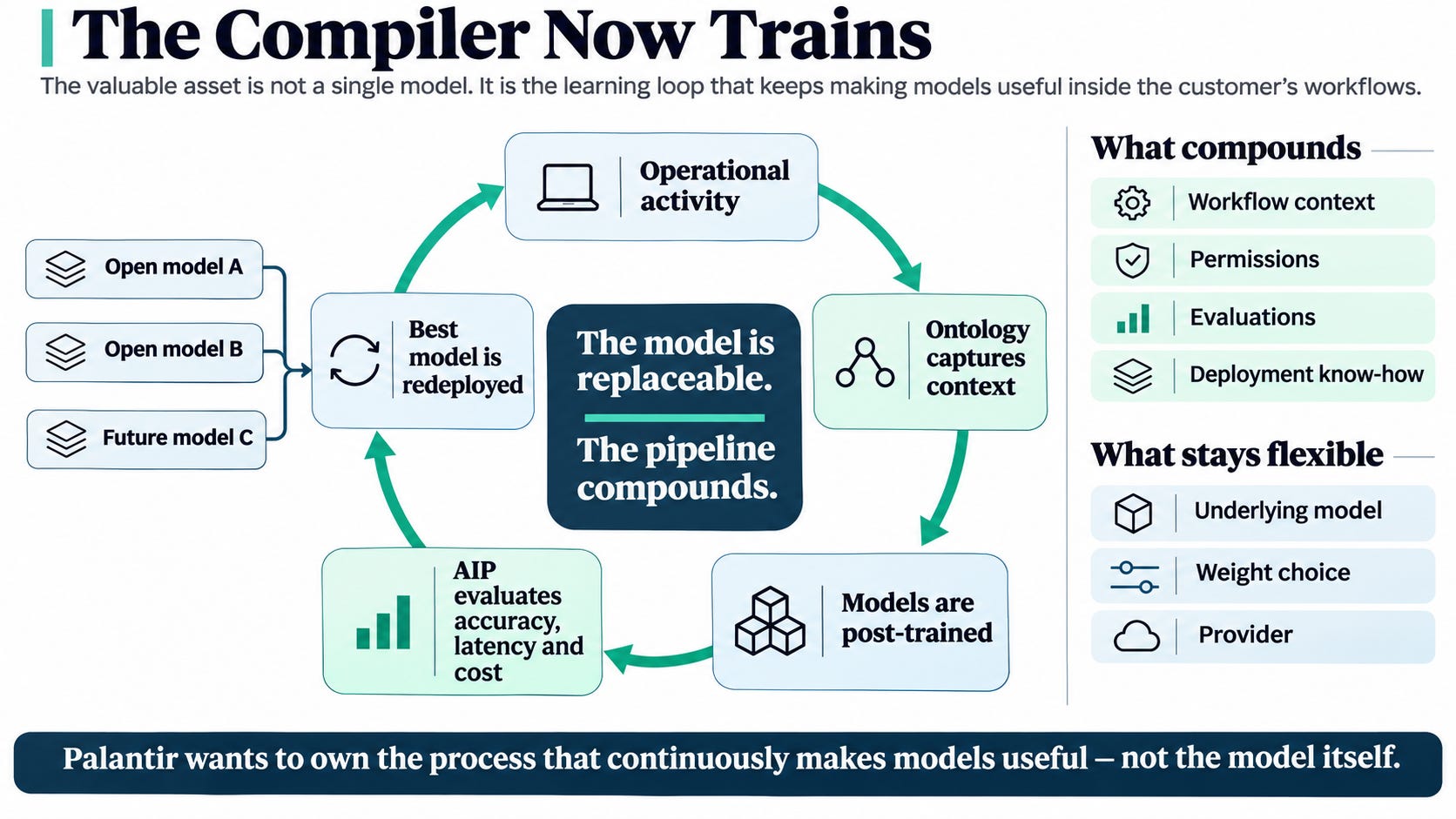
Palantir’s product argument begins with the workflow, not the individual worker. A procurement manager who analyzes prices faster creates limited value if the resulting decisions remain disconnected from production, inventories and logistics. The Ontology is intended to connect those activities; the model factory adds a learning loop that improves the intelligence operating within them.
CTO Shyam Sankar described the mechanism on the call. His explanation places the durable value in a continuously renewed process rather than a particular model:
It is clear that post-training on your specific operational data in Ontology enables better-than-frontier performance on weights you control, protecting your alpha. Yes, it is cheaper, but the dominant variable is that more use cases can actually get to the threshold of viability for machine intelligence to generate economic value when elegantly integrated into your enterprise. Our product investments in AIP to create a closed-loop model factory are making this easy and fast. The specific post-trained model is a commodity item. The compounding value is in the post-training pipeline that is constantly fed from your operational exhaust, captured in the Ontology, that drives automated post-training runs, model checkpoints, evaluations, and deployment across yesterday’s, today’s, and tomorrow’s open-weight ecosystem.
“Better-than-frontier” is management’s claim about performance on particular operational tasks, not evidence that Palantir has built a superior general-purpose model. Nevertheless, the strategic implication is important. Palantir no longer merely benefits when model laboratories reduce the price of intelligence; it can help customers create task-specific alternatives that make the underlying models more interchangeable.
NVIDIA’s supply-chain application illustrates the intended mechanism, using operational information to improve specialized Nemotron models. AIP Evolve is designed to select and optimize models against the customer’s desired accuracy, latency and cost. Palantir therefore still does not need a single model provider to win. Its opportunity is to make the system that chooses, adapts and deploys models more valuable than any individual model passing through it.
This also makes Karp’s description of the laboratories as “symbiotic” less surprising. They establish that AI matters; Palantir sells to institutions discovering that general intelligence does not automatically produce useful business outcomes. The laboratories can expand Palantir’s addressable market without owning the operational system through which that intelligence becomes valuable.
A Faster Sale, a Shorter Commitment
A more demonstrable product can change the sales process. Instead of negotiating a long commitment before showing an outcome, Palantir can demonstrate value, secure a shorter initial contract and expand once the customer sees the results. An industrial materials company moved from a roughly $3 million pilot to a $29 million annual contract commitment within two quarters. That is a selected example, not a disclosed conversion rate, but it illustrates management’s proposed mechanism.
The aggregate evidence is less conclusive. Across selected quarters, revenue has accelerated much faster than the remaining commercial contract base:
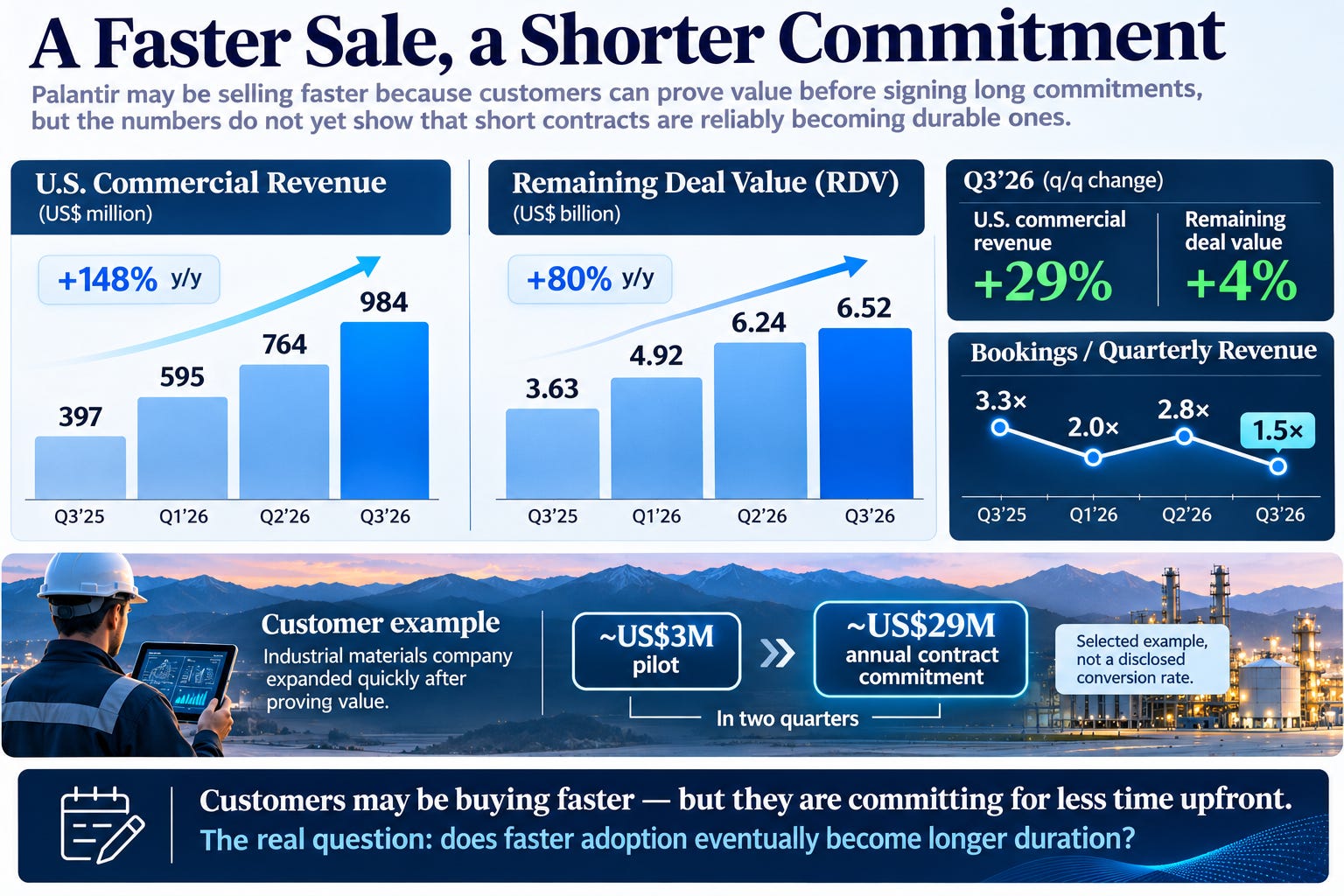
These measures need care: total contract value includes options, and remaining deal value is not guaranteed revenue. Nevertheless, revenue’s 29% sequential increase against roughly 4% growth in remaining deal value raises a legitimate question about forward visibility.
CFO Dave Glazer addressed the contract change directly. His explanation was that customers were beginning relationships differently, rather than becoming less interested in the product:
We signed multiple eight-figure deals in the quarter that were shorter in duration than usual as customers rapidly adopted initial Sovereign AI capabilities in their enterprise. [...] As we continue to deliver value with Sovereign AI, over time, we expect both the duration and size of these contracts to increase.
Shorter contracts can produce lower bookings without lower annualized spending. Certain contracts with original terms of twelve months or less are also excluded from reported remaining performance obligations. Glazer’s comments therefore offer a plausible explanation, although several unusually short contracts do not establish a company-wide reduction in average duration.
The problem is that Palantir omitted the disclosure best suited to testing that explanation. In Q2, U.S. commercial bookings grew 153% year over year, but 271% on a dollar-weighted duration basis. In Q3, when duration became central to management’s explanation, the release continued to define that measure without reporting it. That is not proof of deteriorating demand, but it makes the distinction between faster adoption and weaker forward visibility unnecessarily difficult to establish.
Sovereignty Cuts Both Ways
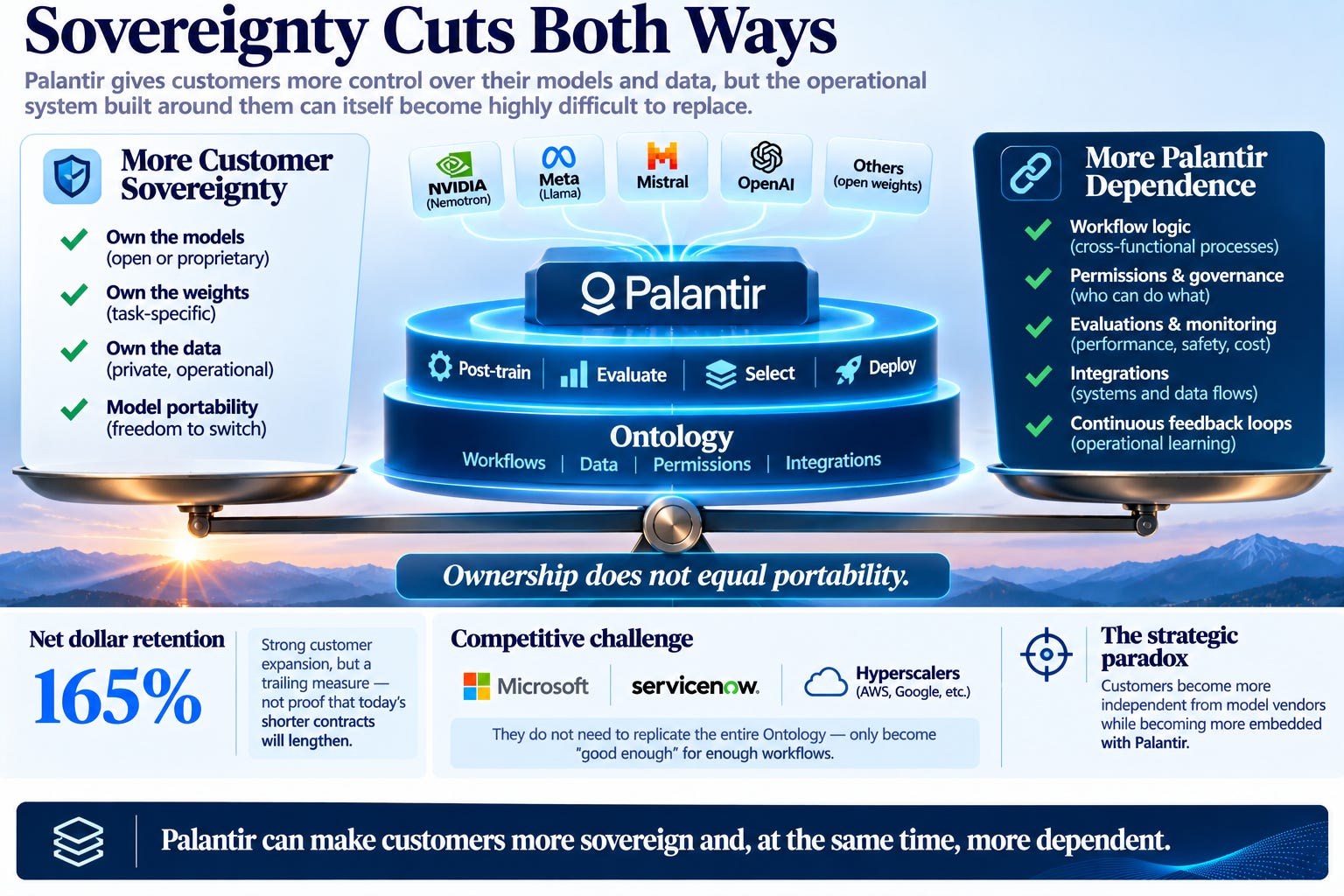
The sovereignty proposition contains a tension we identified in August. Customers are being told to own their intelligence, retain their proprietary knowledge and avoid dependence on model providers. Yet the more operational logic they encode into the Ontology, the more difficult replacing Palantir could become.
Karp’s explanation is that demonstrated value resolves that tension. He described a commercial process in which operational usefulness develops faster than contractual duration:
What Ryan and I are seeing on the front line in commercial is this much quicker interaction, much quicker to deployment, shorter duration of the contract, but then an ability to expand that contract dramatically. Because as soon as you go in there and you show them that you can, for example, train open-weight models in our Ontology, those models are valuable, and you have beyond Frontier capacity without losing the alpha, you just are hooked. What we have to do internally is figure out how to re-resource our company to focus exclusively on those people, because we don’t have even the bandwidth to do that.
There is another possible interpretation: customers persuaded of the importance of independence may want to preserve flexibility with Palantir too. That remains our hypothesis, not an observed explanation for shorter contracts. Management’s faster-adoption account has direct support from the call; both explanations could nevertheless coexist.
The strongest version of this business does not need contractual protection because replacement is economically irrational. Leaving would mean rebuilding the permissions, workflows, evaluations and feedback loops that make customer-owned models useful. But ownership of those models does not automatically give Palantir unlimited pricing power. It must remain the best place to operate the learning system, not merely the place where the system began.
Two different things must therefore compound. The customer’s operational knowledge must improve, while Palantir’s ability to deploy and extend the platform must become more repeatable. Strong growth and profitability are encouraging, but Karp’s capacity constraint leaves distribution unfinished. Microsoft and ServiceNow do not need to reproduce every element of the Ontology; becoming sufficiently capable for enough ordinary workflows could limit Palantir’s opportunity. Partner-led deployments delivering comparable outcomes and economics would help answer that challenge.
Net dollar retention of 165% supports the case that existing relationships become more valuable. It does not settle what today’s shorter contracts will become, because it is a trailing-twelve-month measure. The investment question is whether operational dependence consistently converts into sustained spending as both customers and competing platforms become more capable.
What the Stock Already Knows
The revenue outlook remains more attractive than the contract debate might suggest. Using the $12.4 billion consensus cited in our materials, and assuming Q4 revenue reaches approximately $2.83 billion, 2027 needs only about 4% sequential growth per quarter. My expectation remains $13–14 billion, although the Q4 starting point is an estimate rather than guidance. Revenue can beat expectations even while the durability of the relationships generating it remains imperfectly visible.
Valuation also requires correcting our earlier treatment of earnings quality. GAAP and adjusted EPS both reached $0.44, but unusually low GAAP taxation helped produce that equivalence, while stock-based compensation was $319 million. May’s assertion that the earnings-quality debate was effectively settled was too strong. The operating profitability is real; favorable tax accounting does not eliminate the economic cost of equity compensation.
I retain August’s approach: value the shares at the end of 2029 using FY2030 earnings. The revenue starting point increases, the projected 2030 share count is lower than in August, and the growth trajectories and terminal multiples remain unchanged. However, applying Palantir’s 23% normalized tax rate reduces the base and upside net margins. I also shift five percentage points of probability toward the downside scenario because forward visibility weakened, not because the operating thesis reversed.
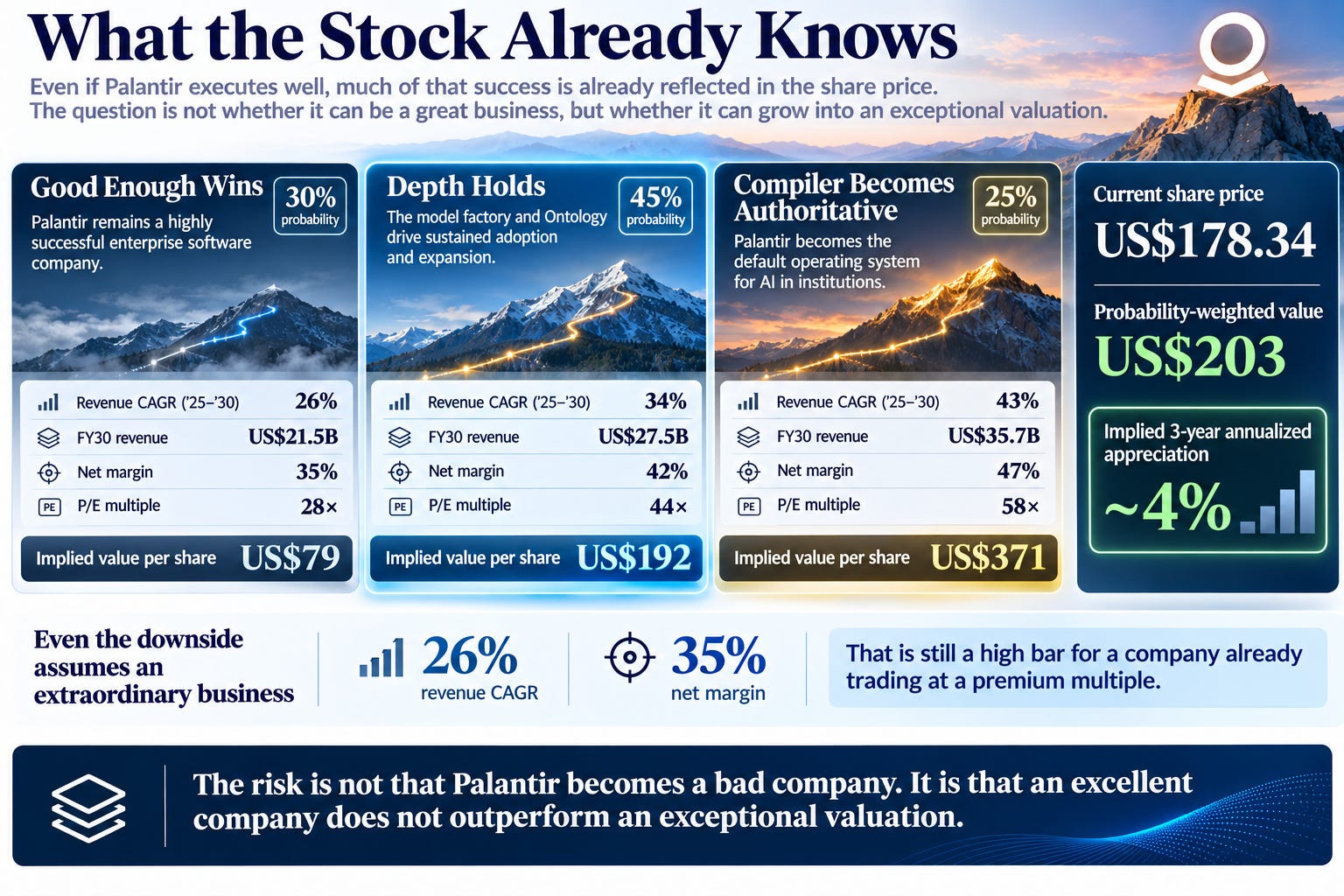
These scenarios assume approximately 2.6–2.7 billion diluted shares and add no separate cash premium. Even the downside case assumes 26% annual revenue growth and a 35% net margin. The risk is not confined to business failure; an excellent business can produce a poor investment when its valuation becomes less exceptional.
The probability-weighted end-2029 price is approximately $203. Better operating prospects are largely offset by the tax correction and revised scenario weights, while the reference share price rose 42%, from $125.65 to the November 2 pre-earnings close of $178.34. This does not establish that the entire share-price increase was multiple expansion. It does establish that the return available under our own framework has narrowed considerably.
What February Must Show
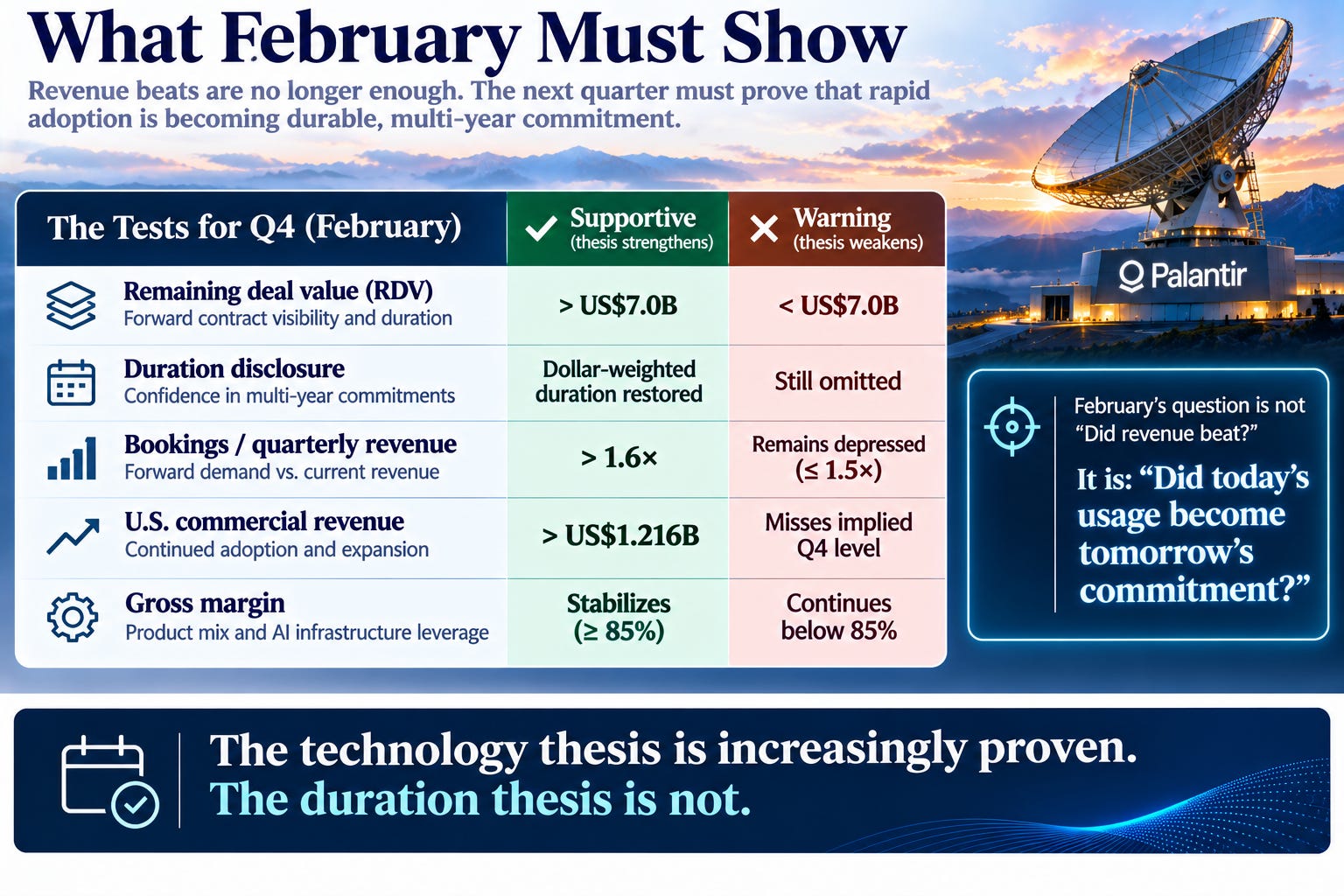
Management’s guidance implies U.S. commercial revenue above $1.216 billion in Q4, but another revenue beat would not answer every question. I would look for remaining deal value above $7 billion, the restoration of duration-adjusted bookings disclosure, and bookings above 1.6 times quarterly commercial revenue. Missing $7 billion would warrant reassessment alongside contract duration and expansion evidence, not automatically invalidate management’s explanation. Adjusted gross margin, down from 88% to 85% over two quarters, also deserves attention as the product and delivery model evolve.
Palantir has a credible opportunity to become more valuable as the models beneath it become more interchangeable. The strongest evidence is the combination of rapid growth, expanding customer relationships and extraordinary operating profitability; the unresolved issue is how reliably those relationships translate into future economic commitments. Customers need not surrender ownership of their intelligence for Palantir to become indispensable. But at this valuation, investors need evidence that customers will keep choosing it not simply evidence that the technology works.
Disclaimer:
The content does not constitute any kind of investment or financial advice. Kindly reach out to your advisor for any investment-related advice. Please refer to the tab “Legal | Disclaimer” to read the complete disclaimer.