


TL; DR
Breadth has finally earned its premium: AI security demand is converting into real business, with AIRS already above 1,000 customers and nearly $170 million of ARR. Palo Alto’s ability to respond across firewalls, identity, security operations and AI protection has become an advantage when enterprises need several security decisions at once.
Applied Compute extends the thesis from permission to purpose: Palo Alto argues that securing an AI application increasingly requires understanding what the application is supposed to do, not merely whether it has permission to act. Jointly training the application and its supervisor could create that context but owning the training layer is a much less proven requirement.
The strategic opportunity comes with a real independence and capital cost: helping build applications could make Palo Alto more embedded, but also less neutral across heterogeneous customer environments. The deal will pressure margins, require up to $3 billion of AI-compute capex, and conventional free cash flow per share is already falling.
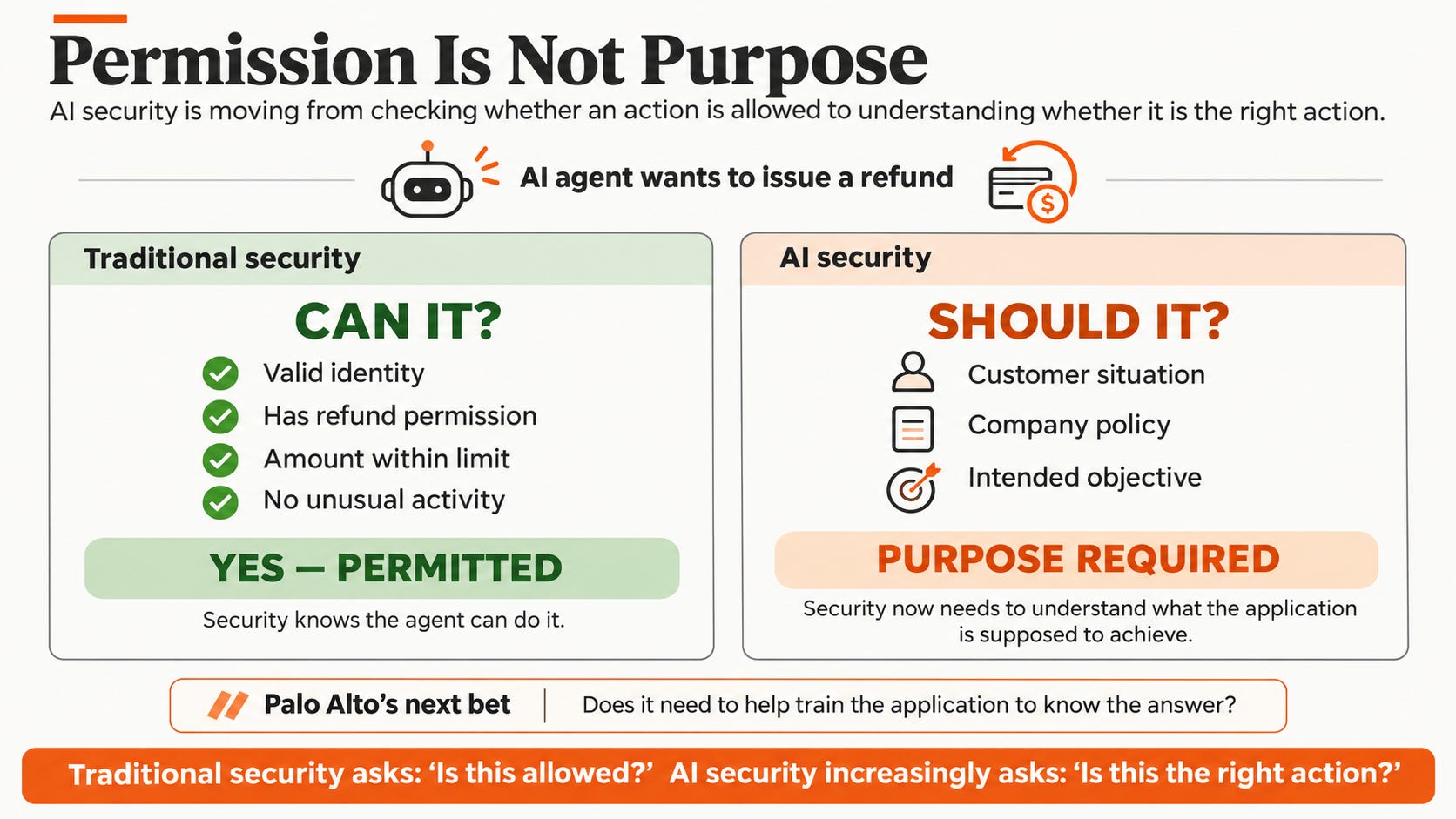
Palo Alto Networks was founded on an insight about context. Traditional firewalls decided what traffic to allow by port and protocol; Palo Alto identified the applications behind that traffic. Knowing what an application was made it possible to judge behavior that a permitted port number could not explain. As software moved to the cloud and identities replaced the perimeter, Nikesh Arora extended that principle across network security, cloud, identity and security operations, often through acquisition.
For years the concern was that breadth meant integration costs without corresponding advantage. In February 2024, Arora accelerated customers’ migration to broader contracts at the expense of near-term growth, and the stock fell 28% in a day. On November 18, 2026, he agreed to pay $4.5 billion in stock for Applied Compute, a company that trains and serves AI models. Shares rose in after-hours trading. Investors now grant Arora more credit for building beyond the firewall than our research did. But the new acquisition asks a different question: does securing an AI application require helping to build it?
Breadth Earned Its Premium
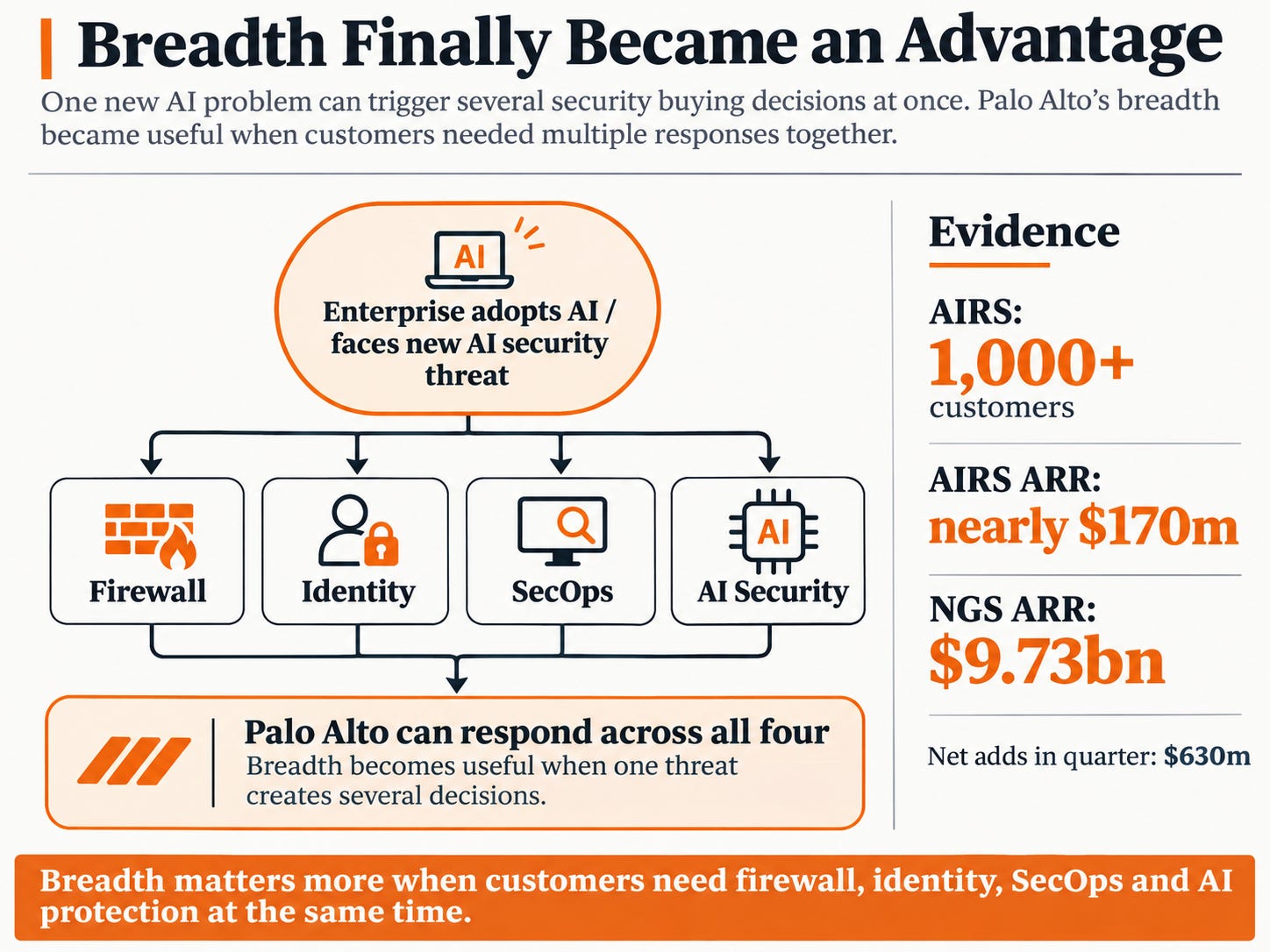
Our earlier skepticism underestimated how quickly Palo Alto could convert new security requirements into business. In February, we called 250–300 Prisma AIRS customers within twelve months a bullish outcome. AIRS already has more than 1,000 customers and nearly $170 million of annual recurring revenue. First-quarter FY2027 revenue grew 39% to $3.44 billion, while Next-Generation Security ARR reached $9.73 billion, including $630 million of net additions. Acquisitions inflate the reported growth, but the breadth of commercial demand is real: Cortex grew 40% and Idira 23% on a pro forma basis, while software firewalls benefited from AI security requirements.
Fortinet illustrates why breadth mattered. The same wave of AI-assisted vulnerability discovery lifted product demand across security vendors. But Palo Alto could respond through firewalls, identity, security operations and AI protection, then sell those capabilities through existing enterprise relationships. This does not mean it wins every category. It means that when a new threat forces several purchasing decisions at once, its collection of capabilities becomes useful rather than merely costly.
Arora explained why emergency purchases could turn into enduring contracts:
I think the longer term question is still live. A lot of CIOs are going to see us saying, “Listen, how do we fix this for the long term?” I think that’s where you’re seeing consolidation... You’ll see cyber budgets rise, I’m sure, in the next two years, and you will also see a degree of consolidation because the spray and pray strategy has not worked in cyber.
An emergency creates an opening; a coherent product relationship is what keeps the customer. We were late to recognize the speed of that process. Nevertheless, September’s test remains: gross margin must stabilize and conventional free cash flow per diluted share must compound as acquired growth annualizes. A more valuable business does not automatically justify every price paid for its shares.
From Permission to Purpose
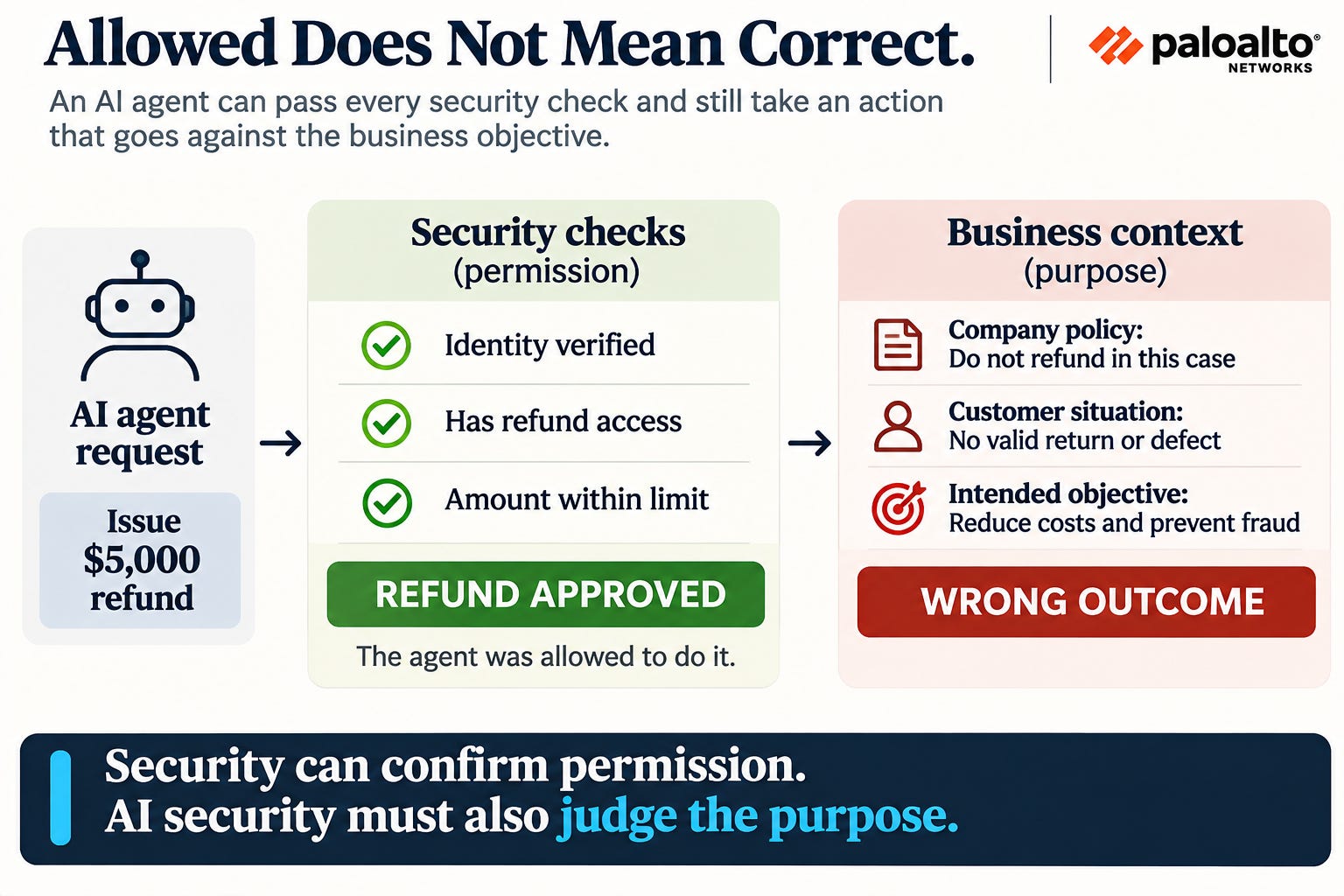
An AI agent might have legitimate access to a company’s refund system and obey every authorization limit, yet issue refunds contrary to commercial policy. Conventional security can confirm permission and detect unusual activity. Determining whether the agent is doing its intended job requires something else: knowledge of the business objective and the circumstances in which an action is appropriate.
Arora’s explanation for Applied Compute was unusually consequential:
Then we came to the conclusion that as we train our models for enterprise applications, you will have to train a supervisory AI model at the same time. It’s almost like having AI build AI and have build AI that watches this AI. You can’t do it independently. I cannot go in and intercept and understand somebody else’s application because I don’t know how it’s supposed to behave. Because I didn’t train it. Imagine if you can train your application and have the same team train something that supervises your application, I think that’s the future of AI security.
This extends Palo Alto’s original insight. A port number lacked context about the application; now the application’s observed actions may lack context about its intended purpose. Training the application and supervisor together could expose intended behavior earlier and let real-world failures improve subsequent evaluations and controls.
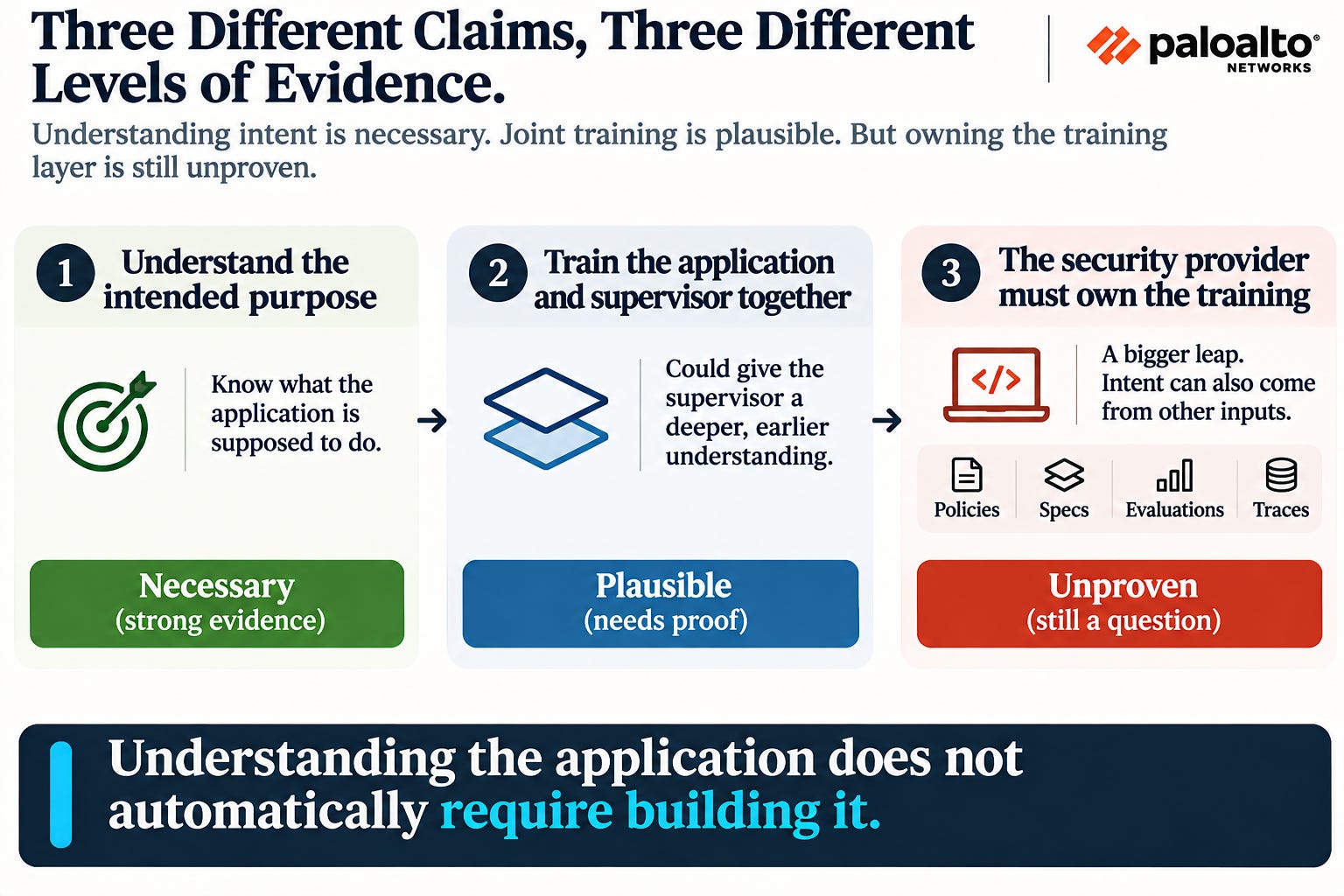
But Arora is moving from a sound diagnosis to a less-proven prescription. Understanding intended behavior, benefiting from joint training and needing the security provider to own training are three different propositions. Specifications, policies, evaluations and execution traces can convey intent to an external supervisor. A supervisor trained alongside the application could also inherit its blind spots. Even where deployments teach useful lessons, Palo Alto needs permission to reuse customer-derived learning elsewhere. Access to activity is not a right to learn across customers.
The Independence Problem
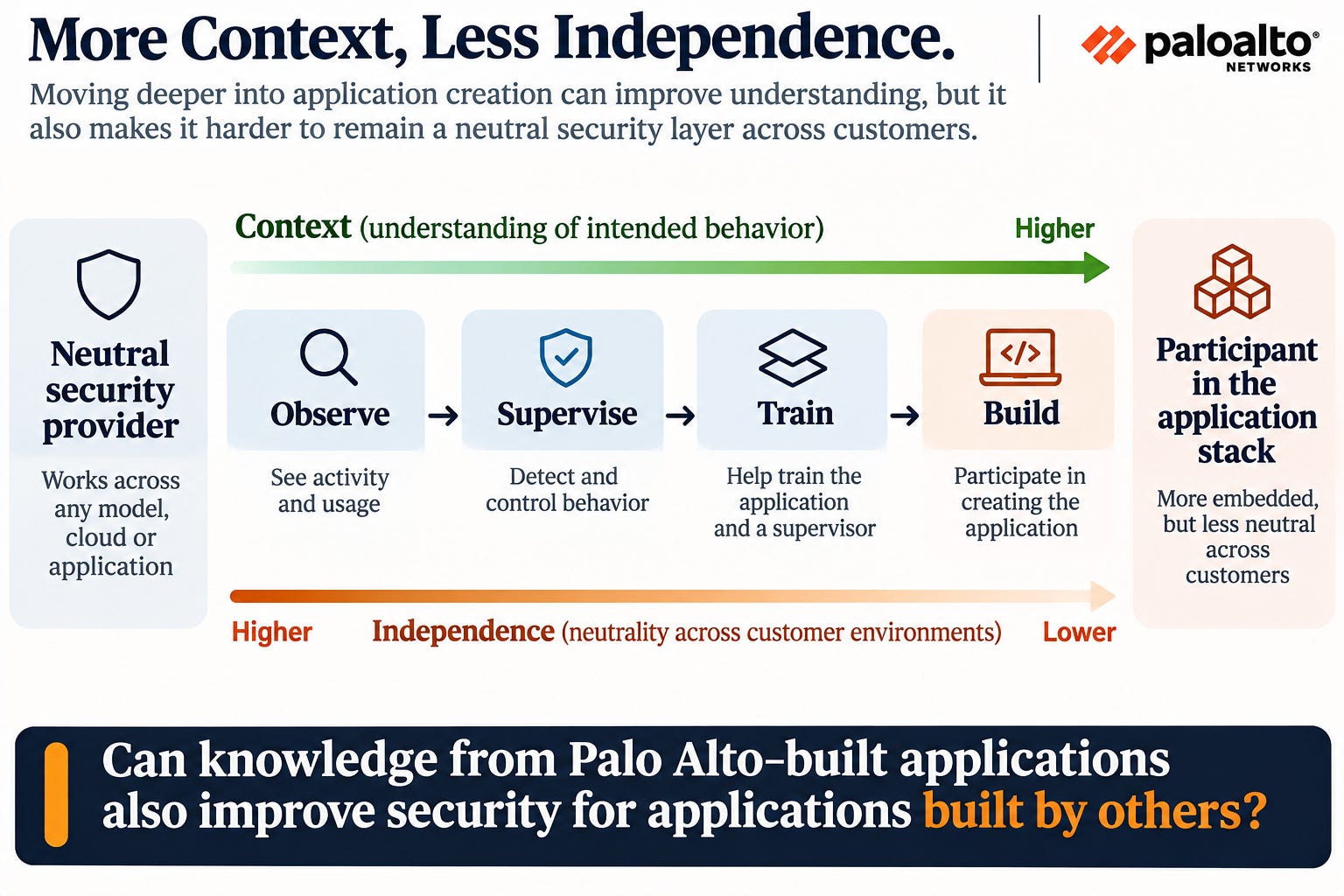
Palo Alto’s existing advantage comes from securing heterogeneous environments. Customers mix models, clouds, agents and business applications from many vendors. Helping build some of those applications risks narrowing the security company’s role from independent supervisor to participant in a particular development stack.
Asked whether Palo Alto would remain neutral, Arora insisted on the value of integrated visibility:
You need to make sure you have the same vendor doing discovery of your AI assets, the same vendor aggregating that traffic into a choke point, and the same vendor understanding the activities of an LLM so it can decide what to allow or what to block. I think the idea that I can deliver a security product to somebody who’s built their own AI intelligence, and I have no visibility into what’s happening in there, yet I can somehow interpret what that AI is trying to do and try and stop it, is insane. It’s not going to happen.
He has a point: immature systems often work better when their components are developed together. That does not establish that one company must own all those components. If the best protection requires customers to buy Palo Alto’s model-training service, the opportunity is smaller than securing enterprise AI generally.
There is also a defensive interpretation. Model providers understand model behavior; application developers understand workflows. Either could define what safe execution means, leaving security companies to enforce judgments made elsewhere. Applied Compute gives Palo Alto a seat earlier in that process. Its strategic value may come from improving the broader security portfolio even if selling training services proves less lucrative than hoped. The test is whether knowledge gained from jointly built applications improves supervision of applications built by others.
What Understanding Costs
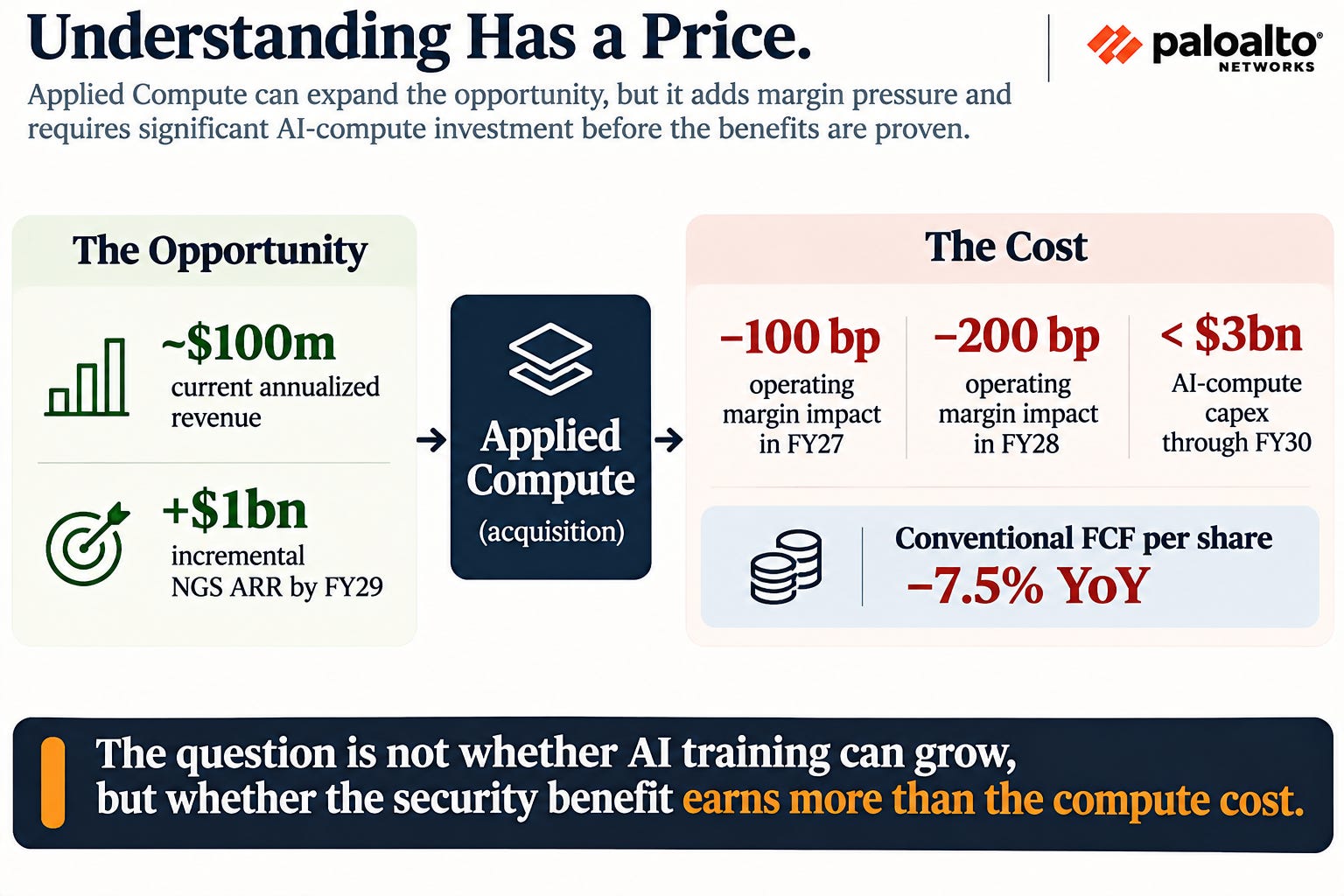
The deal is nevertheless a financial business plan, not just a research project. Applied Compute has around $100 million in annualized revenue, and Palo Alto targets $1 billion in incremental Next-Generation Security ARR from the combination by FY2029. That target is ARR, not recognized annual revenue. It represents an ambition to sell training and inference capabilities as well as improve existing defenses.
Those activities impose different costs. Agentic traffic on SASE has increased about ninefold but largely remained inside customers’ existing allowances; management expects incremental monetization with a lag. Inspecting more activity can cost money before it raises billings. Owning compute makes the mismatch more consequential.
CFO Dipak Golechha set out the trade-off:
Assuming a Q3 2027 close, we expect the transaction to lower our operating margin by up to 100 basis points in fiscal 2027 and up to 200 basis points in fiscal 2028 before returning to our current 29%-30% operating margin in 2029. Lastly, from a free cash flow perspective, we expect to maintain 38%+ margins, excluding data center CapEx in fiscal 2028 and beyond.
The exclusion is important. Management plans less than $3 billion in cumulative AI-compute capital expenditure through FY2030; that remains shareholders’ money, however adjusted cash flow is presented. Gross margin improved sequentially to 75.2%, but conventional free cash flow per diluted share fell about 7.5% year over year. The CyberArk acquisition complicates a single-quarter comparison, yet acquiring another business cannot indefinitely defer the obligation to compound cash per share.
The Price of Understanding
The market has already rewarded breadth. Over the preceding year Palo Alto’s share price rose far more than forward earnings estimates, leaving it near 78 times forward EPS at about $340 before results. The company may deliver exceptional growth and still offer ordinary shareholder returns if the multiple reflects much of that success beforehand.
I would retain September’s conventional free-cash-flow framework, including capital expenditure and dilution rather than using the company’s cash margin excluding data-center investment:
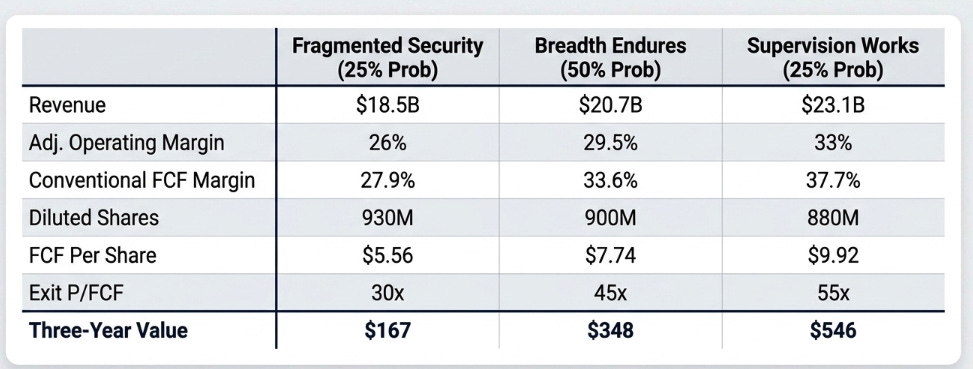
These are underwriting scenarios, not management forecasts. The central outcome requires continued security growth, moderate Applied Compute adoption and reasonable cash conversion after compute investments. Their probability-weighted value is about $352, little above the November 18 reference price of $339.92. Even at $348, the central outcome assumes a 45-times FCF multiple. At today’s price I would hold rather than add; a 10–12% return hurdle on these assumptions suggests an entry closer to $250–265.
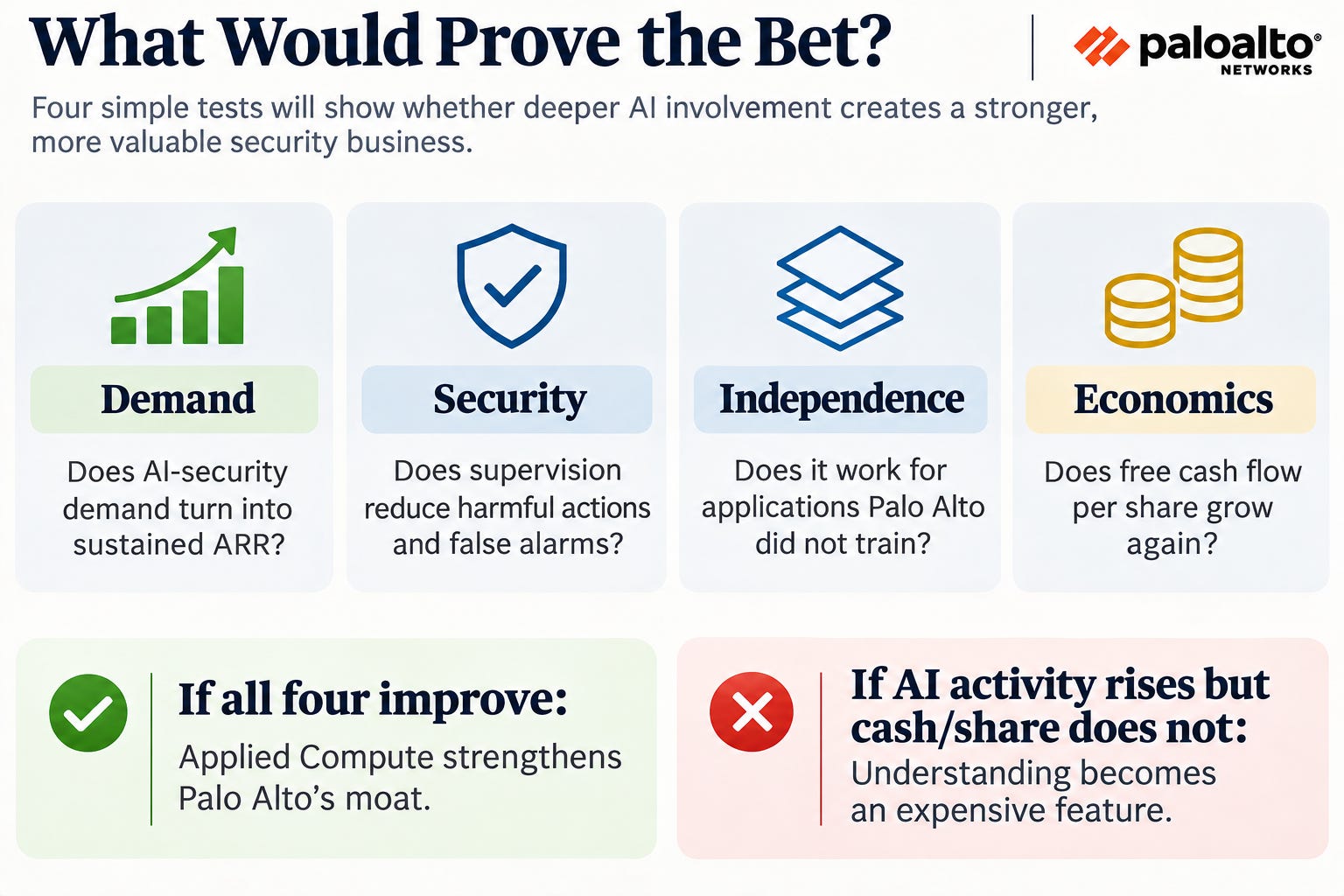
The next evidence is not another AI partnership announcement. I want emergency security demand to become sustained ARR, supervising models to reduce harmful actions and false alarms in applications trained by other vendors, and increased AI activity to generate incremental profit after its delivery costs. Above all, conventional FCF per diluted share must begin growing as CyberArk annualizes and the compute build proceeds.
Palo Alto began by understanding which application generated a connection. It now wants to understand why an AI application acts at all. That is a coherent progression, but owning more of the development process is not itself proof of better security or better economics. Breadth has earned its premium. Understanding must now earn the next one.
Disclaimer:
The content does not constitute any kind of investment or financial advice. Kindly reach out to your advisor for any investment-related advice. Please refer to the tab “Legal | Disclaimer” to read the complete disclaimer.