


TL; DR
Platformization is beginning to look like a genuine capability: CyberArk and Chronosphere are benefiting from Palo Alto’s distribution, cross-selling and integration, while XSIAM and Prisma AIRS add further evidence that the customer loop is strengthening.
But acquisitions have erased the organic baseline: headline NGS ARR and revenue growth increasingly mix acquired and internally generated growth, making it harder to know how much economic value Palo Alto is creating versus purchasing.
The decisive test is now per-share economics: gross margins are slipping, stock compensation remains substantial and dilution is absorbing a meaningful part of earnings growth. Palo Alto needs conventional free cash flow per diluted share to compound before the customer loop can truly become a shareholder loop.
“M&A is not a strategy. M&A is a consequence of stuff that we do from a product development perspective.”
— Nikesh Arora, Q4 FY2026 earnings call
Palo Alto Networks ended fiscal 2026 with what management described as a record finish. Revenue grew 34% to $3.41 billion, Next-Generation Security ARR rose 63% to $9.1 billion, remaining performance obligations reached $21.2 billion, and the company added almost $1 billion of net new NGS ARR in one quarter. The shares fell roughly 7%, continuing a pattern in which Palo Alto wins the operating quarter while investors question the economics underneath it.
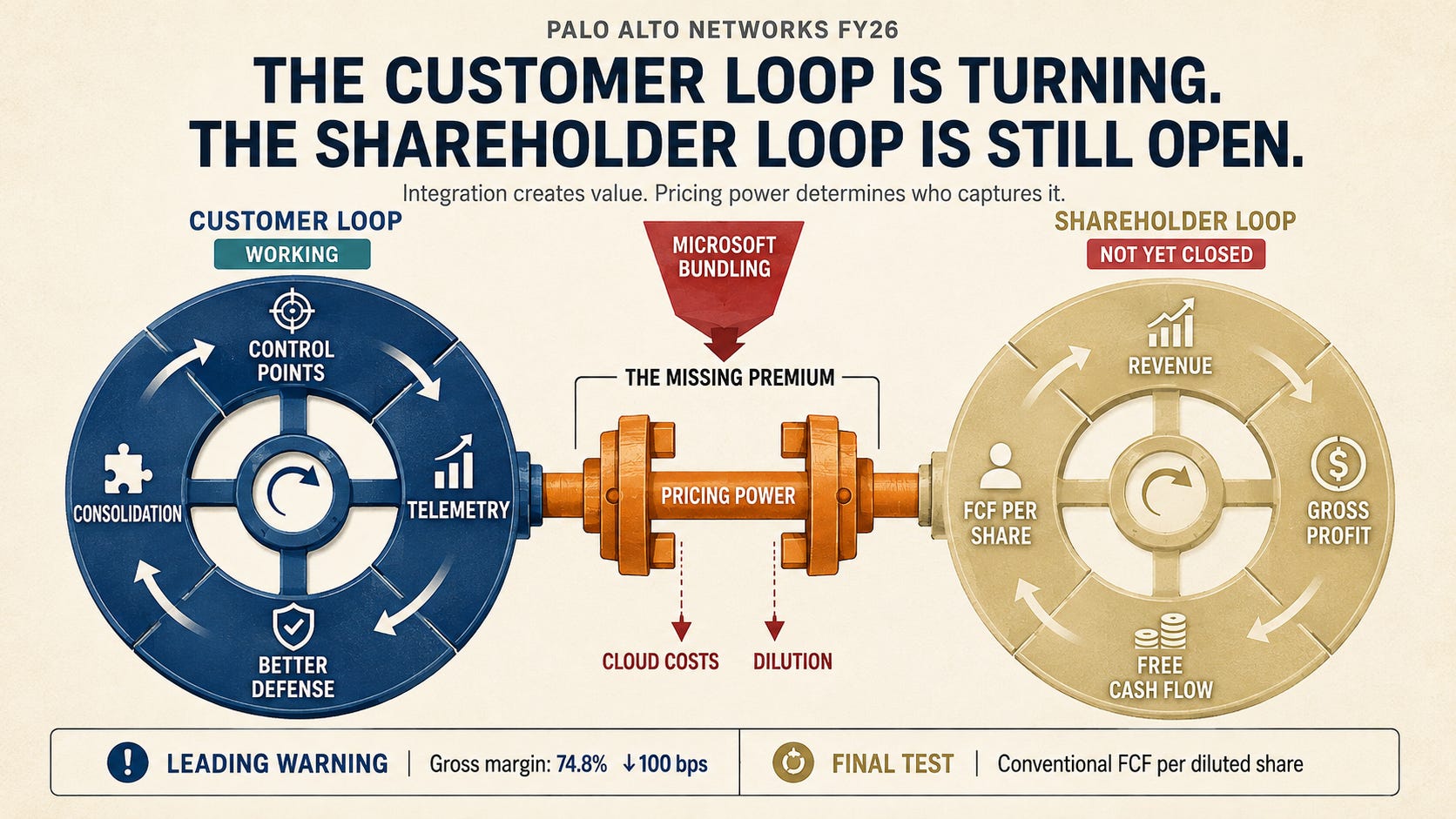
This is the fifth article in our Palo Alto series, and I think the disagreement has finally become clear. Management is selling a customer loop: AI makes attacks faster and identities more numerous, fragmented security becomes untenable, and each additional Palo Alto control point supplies more data and makes the remaining products easier to sell. The stock depends on a different loop, in which revenue becomes gross profit, gross profit becomes cash, and cash grows faster than the diluted share count.
Q4 is the strongest evidence yet that the customer loop is working. It is not yet evidence that the shareholder loop has closed. The big fundamental question is therefore: can Palo Alto convert a strengthening customer loop into a strengthening shareholder loop before Microsoft commoditizes the value its breadth creates?
The Customer Loop Starts to Close
Our first articles asked whether Palo Alto could move from gate to graph: from guarding a perimeter to observing identity, network, endpoint, cloud and application activity as one connected system. CyberArk and Chronosphere then turned this into the assembly test. Palo Alto was trying to coordinate products with different architectures, buyers and sales motions before AI made machine-speed control compulsory.
The previous article ended with the question:
“Can assembly become architecture before AI makes real-time control mandatory?”
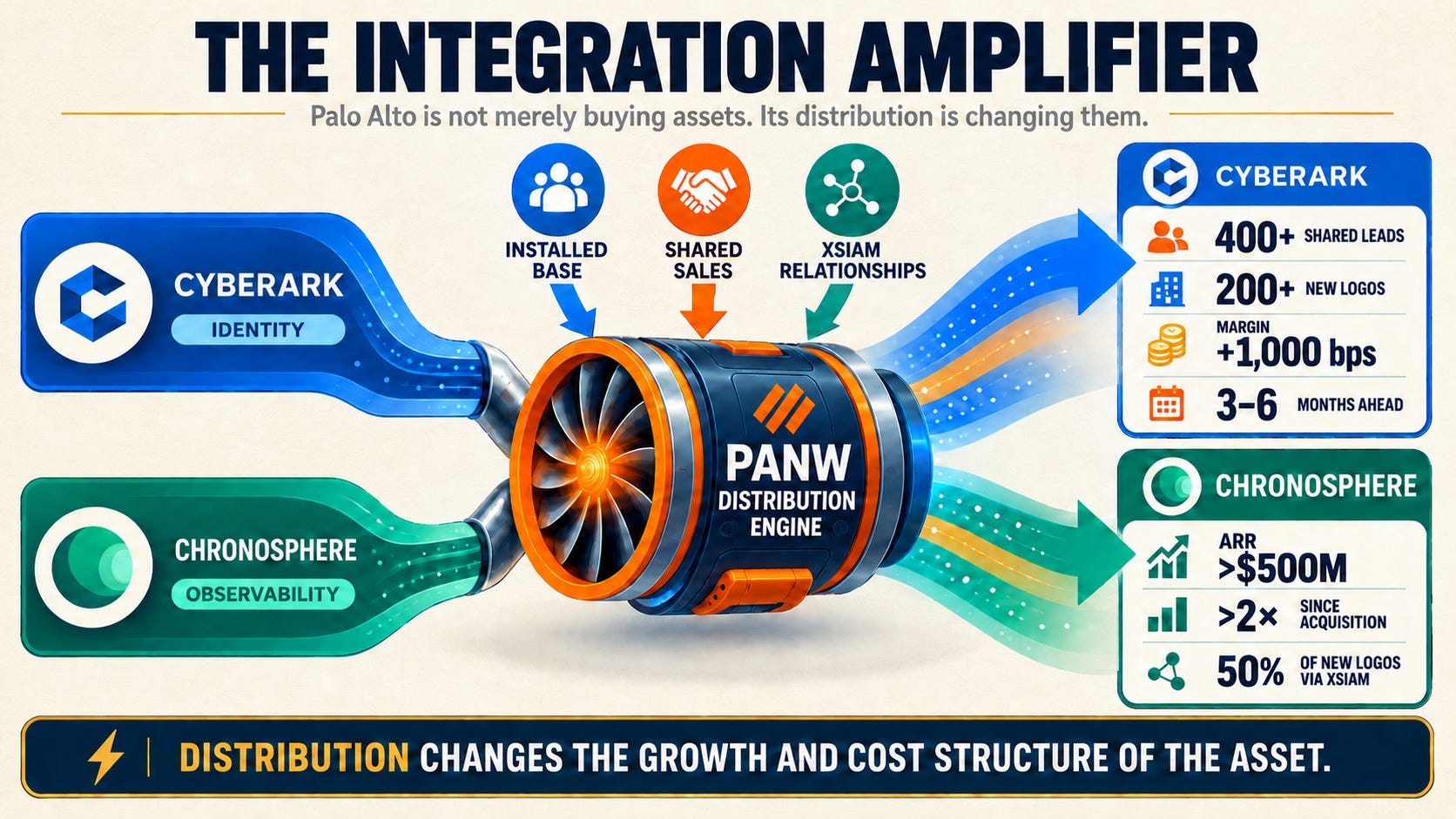
Q4 does not prove that the architecture is complete, but it changes the burden of proof. CyberArk produced more than 400 shared leads and more than 200 new identity logos from Palo Alto’s installed base. Deals worth at least $5 million increased 50%, CyberArk’s margin improved by more than 1,000 basis points in two quarters, and integration synergies were running three to six months ahead of plan. Palo Alto is not merely absorbing the asset; its distribution is changing the asset’s growth and cost structure.
Chronosphere supplies similar evidence. Observability ARR has passed $500 million after more than doubling since the acquisition closed, while XSIAM relationships generated about half of its net new logos in Q4. XSIAM itself ended the year above $700 million of ARR, growing 70%, and Prisma AIRS crossed $100 million within four quarters of general availability. Platformizations reached roughly 2,500 after a record 220 net additions, with net retention above 120% for the platformized cohort.
These numbers reveal the mechanism management wants investors to see. More control points create more telemetry; more telemetry improves detection and automated response; better outcomes encourage consolidation; consolidation gives Palo Alto another surface through which to distribute the next product. In that sense, integration is becoming a capability rather than a sequence of transactions.
Commercial integration is not the same as technical unity. Management acknowledged that Chronosphere still needs about six months of development before competing broadly for conventional enterprise workloads, while customer transformations can take one to three years. Q4 shows that Palo Alto can distribute acquired products faster than we expected; it does not yet show that their data models, policies and workflows operate as one architecture.
Success Has Erased the Baseline
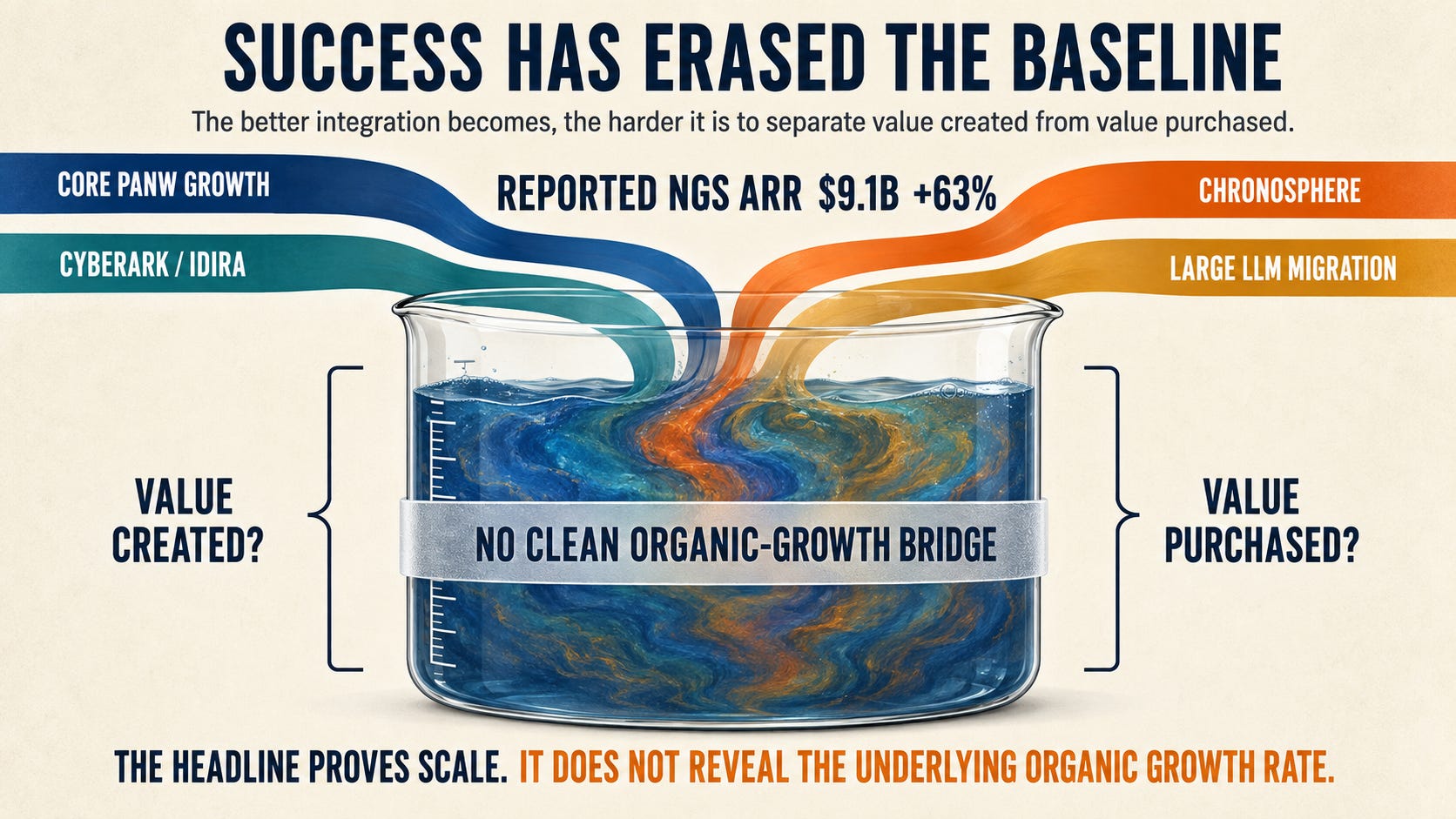
The awkward consequence of this strategy is that better integration produces worse visibility. Reported NGS ARR growth of 63%, revenue growth of 34% and RPO growth of 34% include the acquired identity and observability businesses. Chronosphere’s net new ARR also contained a nine-figure migration by one large language-model customer, a contribution management said will diminish after the first quarter of fiscal 2027.
The new category disclosures help, but do not solve the problem. Network and AI Security generated $8.35 billion of fiscal 2026 revenue and grew 17%, although that includes roughly $85 million from an acquired certificate-management business. Cortex grew 25% to $1.92 billion but now contains Chronosphere, while Idira is almost entirely acquired CyberArk revenue. Investors still cannot construct a clean bridge from the pre-acquisition Palo Alto business to the company that exists today.
This is not an accounting complaint. It is the central analytical problem. The better Palo Alto becomes at integration, the harder it becomes to distinguish value the company created from value it purchased. The headline numbers prove scale and commercial momentum; they do not establish the organic growth rate on which a premium valuation must eventually rest.
The balance sheet offers less cause for alarm than the absolute figures suggest. Approximate year-end DSO improved from about 106 days to 97 days as receivables grew more slowly than revenue, while financing receivables declined from roughly $1.72 billion to $1.54 billion. Revenue quality remains difficult to interpret because of acquisitions and customer financing, but the observable year-over-year trend did not deteriorate.
The Missing Premium
Microsoft was a central risk in our earlier work, and it should remain one. We wrote after Q1:
“Microsoft is security as a feature of the productivity suite you already own. It does not need to be the best. It needs to be good enough and already installed.”
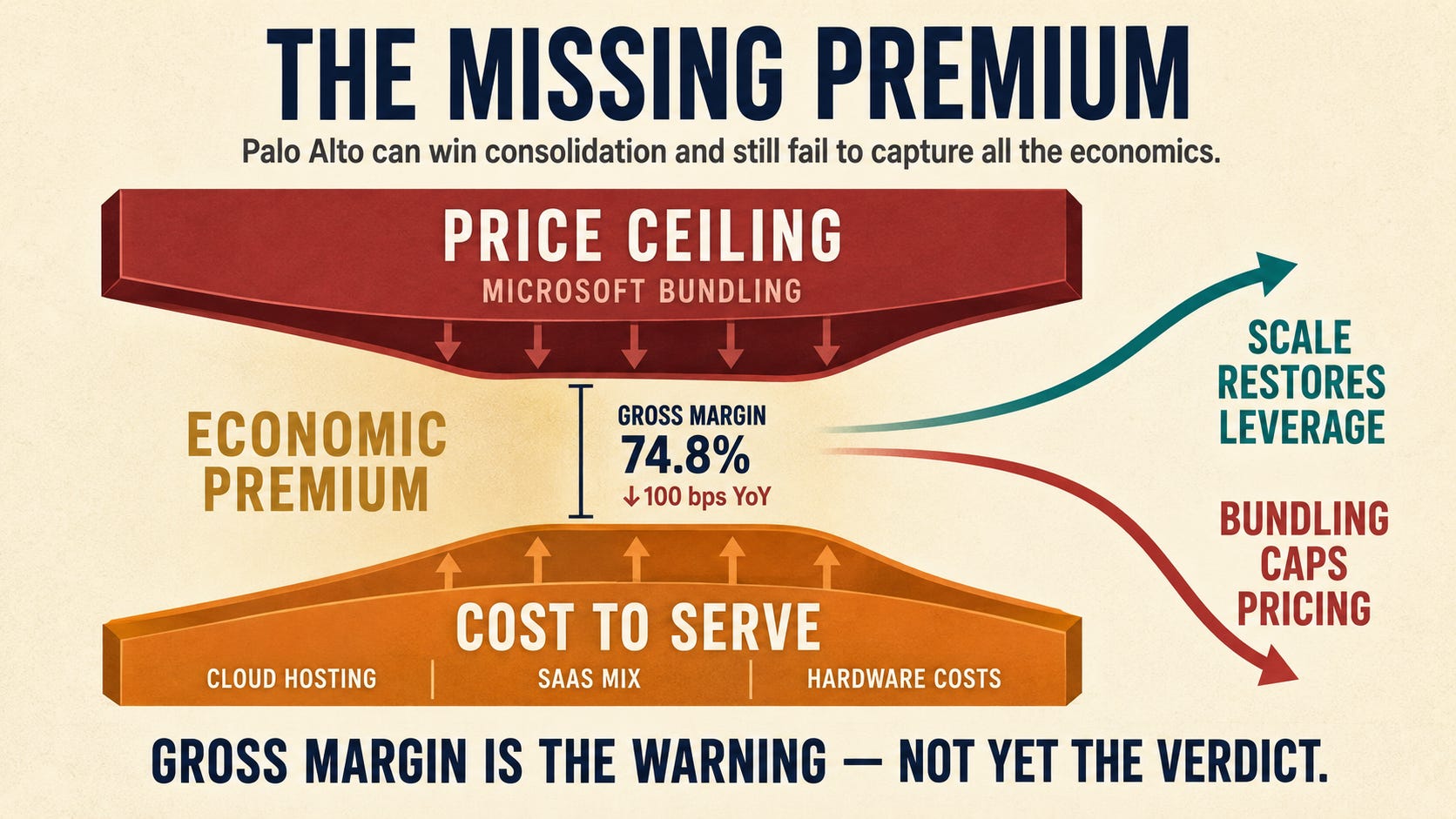
Microsoft does not need to displace Palo Alto at the largest enterprises to matter. Entra, Defender, Sentinel and Azure Monitor give it enough breadth to cap pricing, particularly where a CFO values bundling more than a security team values technical superiority. Palo Alto can win consolidation and still fail to capture all the economics of the value it creates.
That is why Q4 gross margin deserves more attention than we initially gave it. Gross margin declined 100 basis points to 74.8%, while the full-year figure fell 60 basis points to 75.8%. Management expects cloud-hosting costs to grow faster than revenue in fiscal 2027 and also cited hardware component inflation. Non-GAAP operating margin is guided to improve only 30 basis points to 29.5%, while adjusted free cash flow margin slips from 38.4% to 38% before the company attempts to reach 40% in fiscal 2028.
The bearish interpretation is that the enlarged suite wins through breadth but cannot command a premium because Microsoft anchors the price. The benign interpretation is that faster-growing SaaS and acquired products have not reached gross-margin maturity, after which scale and integration synergies restore leverage. Gross margin cannot distinguish those explanations by itself; pricing pressure must also appear in renewal economics, discounting, competitive win rates and organic growth.
Management emphasized AI demand, large transactions and the $20 billion FY2030 NGS ARR target. Analysts received that destination constructively, but their questions kept returning to CyberArk penetration, Chronosphere’s durability, AI-driven firewall demand and the conversion of cross-selling into revenue. The market’s skepticism is therefore broader than one margin line: it is asking whether expansion in corporate scale will become superior economics per share.
A Better Company Must Become a Better Share
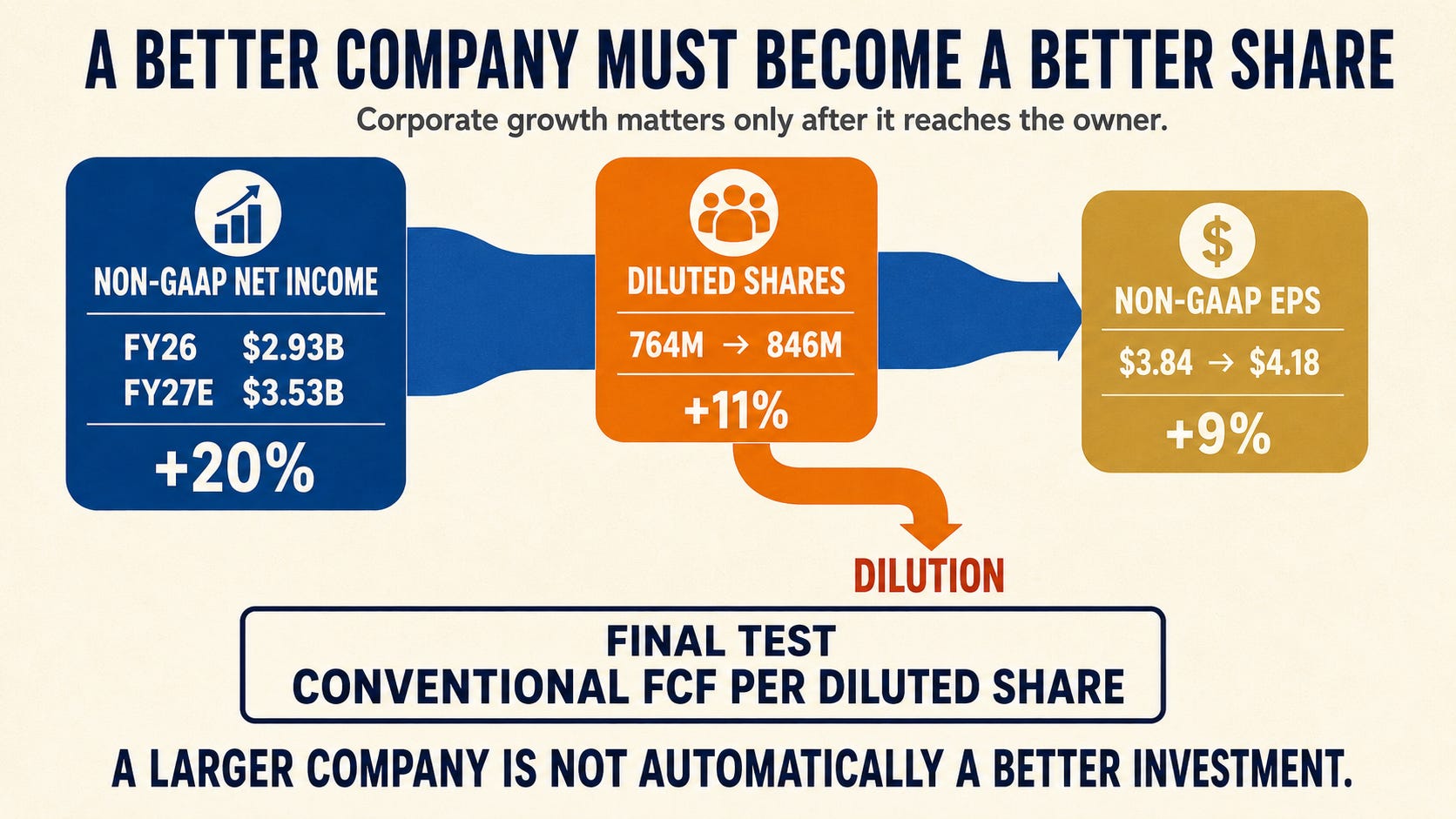
Fiscal 2026 generated $4.11 billion of conventional free cash flow and $4.41 billion of company-adjusted free cash flow. The difference matters because the adjusted figure adds back acquisition payments and selected capital expenditures, while neither measure deducts the $1.71 billion of stock compensation, equal to 14.9% of revenue. Acquired-intangible amortization added another $638 million to the gap between GAAP and non-GAAP earnings.
Dilution turns this from an accounting debate into an ownership issue. Full-year non-GAAP diluted shares increased 8.8% to 764 million, and the Q4 count increased 17.7% to 832 million. At the midpoint of fiscal 2027 guidance, non-GAAP net income rises roughly 20%, but EPS rises only about 9% because the guided share count reaches approximately 846 million.
Gross margin is the leading warning; conventional free cash flow per diluted share is the final test. It captures whether revenue growth survives hosting costs, integration spending, stock issuance and recurring capital requirements before reaching the owner. If that number compounds, the customer loop is becoming a shareholder loop. If it stalls while NGS ARR races toward $20 billion, Palo Alto will have built a more important company without necessarily building a better investment.
Three Prices, Three Worlds
At $355.21, Palo Alto trades near 85 times the midpoint of fiscal 2027 non-GAAP EPS guidance, while guided adjusted free cash flow implies a forward yield below 2%. The following scenarios value fiscal 2029 conventional free cash flow rather than the more flattering adjusted measure, and the arithmetic incorporates dilution explicitly.
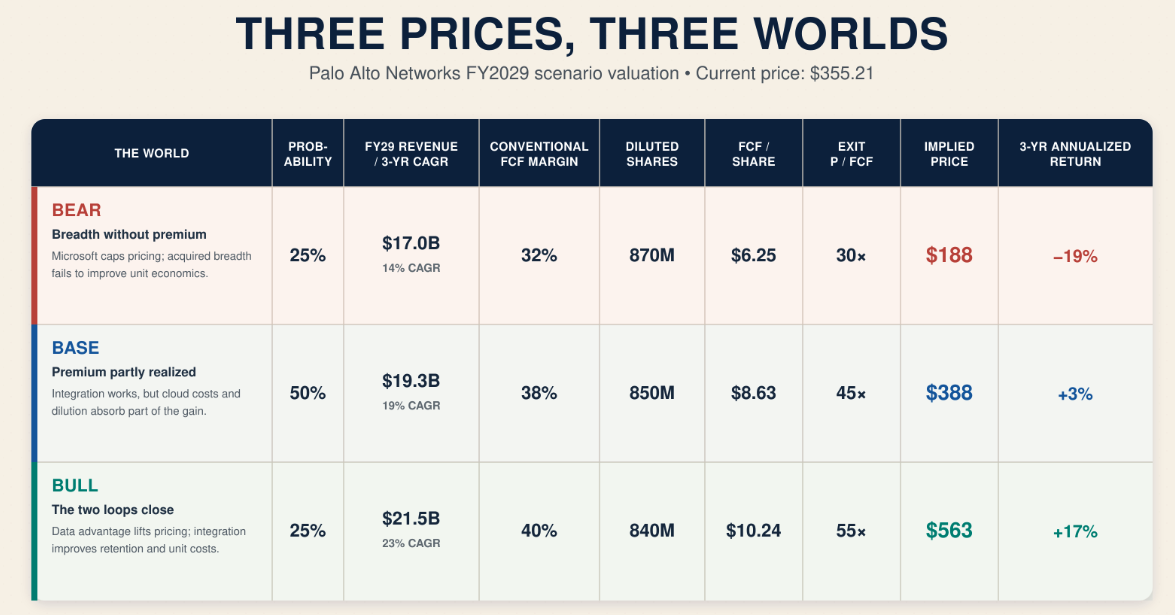
The probability-weighted value is approximately $382, implying only a low-single-digit annual return from the current price. The decisive assumption is not whether revenue grows 19% rather than 17% next year; it is whether Palo Alto can sustain a high conventional cash margin and premium multiple after acquired growth annualizes. Existing holders can justify holding for the strategic optionality, but the expected return does not support adding at $355. A price of $320–$330 would merit reassessment, while a genuine margin of safety appears closer to $290–$300 unless the evidence improves first.
Two Loops, One Stock
Q4 makes us more constructive about Palo Alto’s organizational capability. The company is integrating acquisitions faster, distributing them more effectively and using AI demand to make its breadth increasingly relevant. The assembly test has moved in Palo Alto’s favor, although technical unification remains unfinished.
The quarter does not prove that Palo Alto can retain the economic premium created by that breadth. Microsoft can constrain pricing, cloud costs can absorb scale benefits, acquisitions can erase the organic baseline, and dilution can divert corporate growth away from each share. The thesis now turns on whether gross margin stabilizes and conventional free cash flow per diluted share begins compounding as acquired growth annualizes.
Perhaps Arora is right that M&A is not a strategy. The strategy is to make fragmented security untenable, while the capability is to build or buy each missing control point and distribute it through an expanding customer system. Q4 shows that the customer system is beginning to compound; at $355, the stock already assumes that shareholders will receive the same benefit, which is why the right action remains to hold rather than add.
Disclaimer:
The content does not constitute any kind of investment or financial advice. Kindly reach out to your advisor for any investment-related advice. Please refer to the tab “Legal | Disclaimer” to read the complete disclaimer.