


Rubrik reported subscription ARR growth of 33%, revenue growth of 38%, and a 15% free-cash-flow margin in fiscal Q2. The company beat every guided metric and raised every full-year target. The shares had already risen 11% during Thursday’s regular session, however, and then fell roughly 10% after hours from a 52-week high.
My first reaction is that the market traded the right question and reached too clean an answer. The quarter was considerably better than the stock reaction suggests, but the metric Rubrik introduced to explain that strength was also unusually convenient. That makes the disclosure change not Glasswing, Agent Cloud or even the headline beat the most important development in the print.
Our Rubrik articles have followed a changing question. We began by asking whether the company was building something larger than backup. Q3 FY26 described the janitor becoming the bodyguard. Q4 called Rubrik’s time-indexed record of the enterprise “state infrastructure.” Q1 FY27 asked whether that record could extend from data into identity and autonomous agents.
The Question is now more precise: Can Rubrik turn its time-indexed recovery record into the default control plane for data, identity and agentic actions, so that every additional protected surface increase adoption, recovery confidence and switching costs faster than migration benefits disappear and native alternatives commoditize recovery?
The Scoreboard Graduated or Moved
Rubrik ended Q2 with $1.661 billion of subscription ARR, up 33%, while net-new subscription ARR increased 35% to approximately $96 million. Cloud ARR reached $1.480 billion, up 39%, but calculated net-new Cloud ARR was approximately $89 million, down 4%. The new metric adjusted net-new Cloud ARR, excluding migrations by existing maintenance and non-cloud customers was $86 million, up 20%.
Both measures are valid. Migrations moved existing economics between Rubrik categories without creating new demand, so removing them produces a cleaner organic measure. Yet companies rarely introduce adjusted metrics when the old measure is becoming less flattering. Rubrik introduced this one when the reported measure turned negative and management simultaneously redirected investors toward total subscription ARR.
That redirection can be an economic graduation. Cloud now represents 89% of subscription ARR, and private or sovereign deployments need not be strategically inferior if they carry similar recurring economics. It can also become an escape hatch through which weakening cloud demand disappears into a broader number. The correct response is to accept the adjustment while requiring Rubrik to publish reported Cloud ARR, adjusted Cloud ARR and the migration bridge until the last legacy migration has passed.
Before extending the thesis, we should score the promises embedded in the previous article:
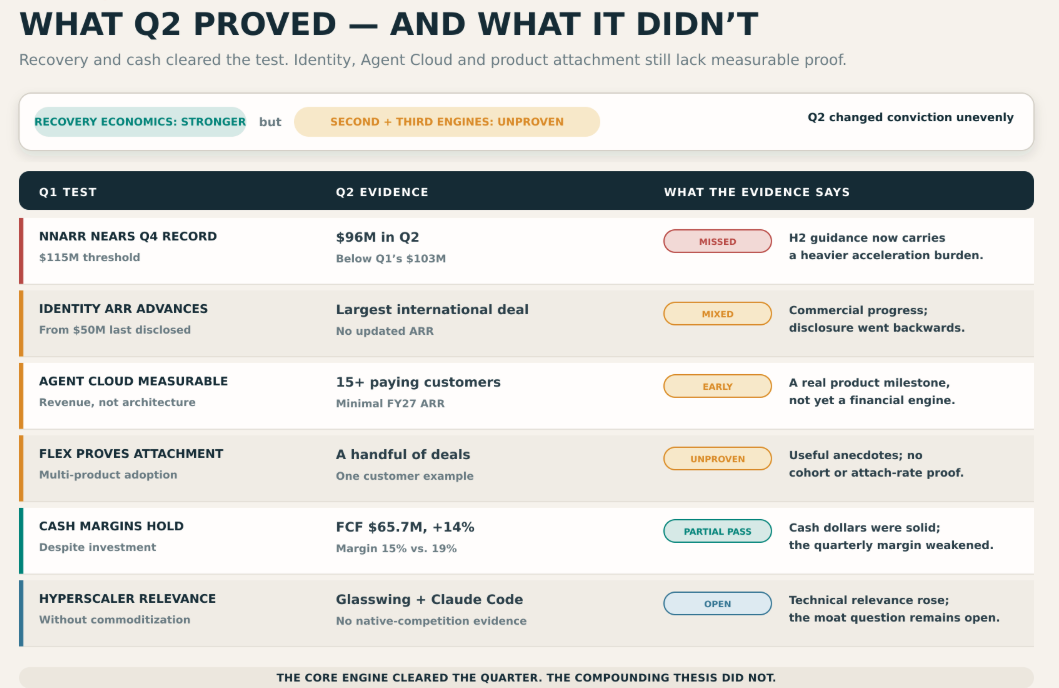
Sources: prior Rubrik Q1 FY27 article; Rubrik Q2 FY27 release; Q2 earnings-call transcript.
The scorecard says the recovery engine strengthened while the proposed second and third engines remained unproven. Our Q1 conclusion still holds:
Identity has crossed from narrative to metric. Agentic recovery has crossed from slideware to architecture. Agent Cloud has not yet crossed from architecture to disclosed revenue.
Q2 advanced the last sentence only slightly. That is meaningful progress for a product, but not enough evidence for a valuation category.
The cash-flow story is better than the quarterly margin suggests, but less simple than blaming Flex commissions. Q2 FCF rose 14% to $65.7 million while the margin fell four points. Across the first half, FCF increased 53% to $139.3 million and margin expanded to 17.1% from 15.4%. Cash invested in deferred commissions rose 40% to $69.1 million, but amortization also rose to $59.5 million; the deferred-commission asset increased only 3.6% from January. There is no disclosed evidence tying that increase specifically to Flex, and amortization does not reverse the original cash outflow. The raised $328 million FY27 FCF midpoint argues against structural deterioration. The more durable earnings-quality concern is $101 million of Q2 stock compensation 23.6% of revenue which separates corporate cash generation from per-share economics.
What Actually Compounds
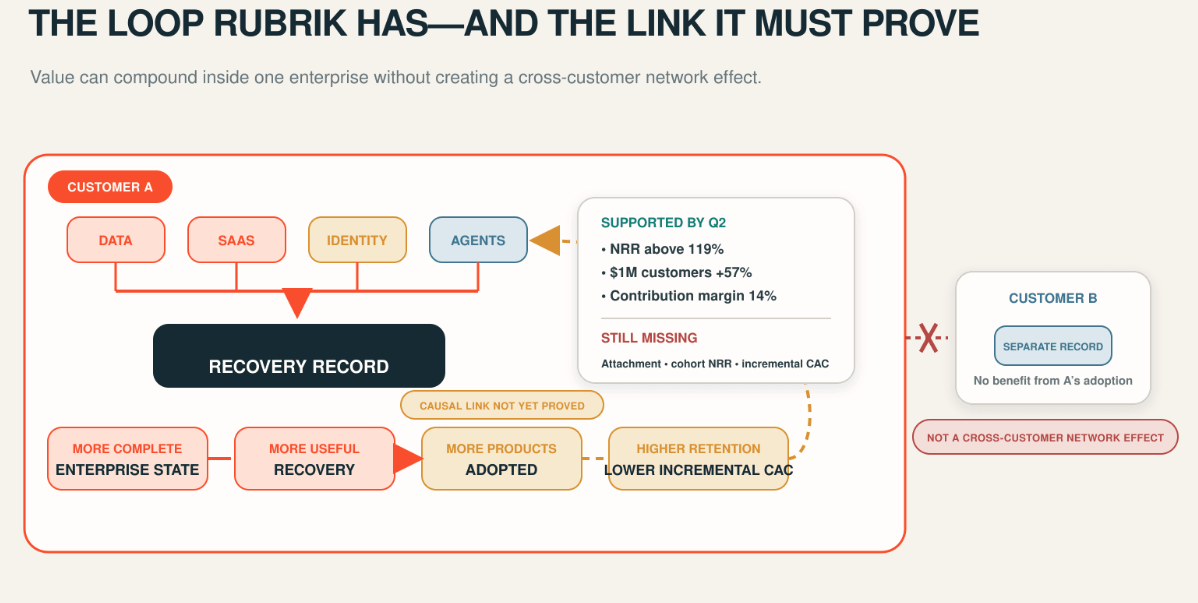
Bipul Sinha describes Rubrik’s products as creating “complementary network effects.” I think that claim is too generous. One company adopting Identity does not improve another company’s recovery. What Rubrik may possess is customer-level data gravity: each protected workload, SaaS application and identity system makes the historical record more complete; a more complete record makes recovery more useful; broader recovery encourages another product purchase; and every added integration makes displacement more disruptive.
The economics are compatible with this mechanism. Net retention remains above 119%, customers spending more than $1 million grew 57%, and subscription ARR contribution margin reached 14%, up 460 basis points. Those facts prove expansion and operating leverage. They do not prove that customers adopting Identity or Agent Cloud expand faster, renew better or cost less to serve than recovery-only customers. The missing evidence is product attachment and cohort NRR.
Q2 supplied three different kinds of evidence that should not be confused. The largest international Identity deal shows enterprise-scale demand, but the missing ARR update prevents us from measuring the second engine. Project Hourglass gives Agent Cloud potential distribution through five global integrators, but a go-to-market alliance is not converted pipeline. Project Glasswing validates Rubrik’s relevance to emerging AI-security research, but Anthropic describes a broad program spanning vulnerability detection, testing and patching with numerous security partners; it does not validate Rubrik’s commercial moat or recovery architecture.
Agent Rewind remains the most interesting and least settled extension. Restoring a file or directory to a known state is bounded. Reversing an agent is not. An email may already have been sent, a payment executed, a permission propagated or an external system changed. Rubrik’s historical record can establish what happened and help orchestrate recovery, but complete reversal requires authority across systems it does not control. The architecture is coherent; the product boundary is wider than the metaphor suggests.
A Complement Is Not Comparable
The after-hours decline was not a verdict that Rubrik’s business deteriorated. It was a repricing of trajectory after a strong run into the print. NNARR fell from $115 million in Q4 to $103 million in Q1 and $96 million in Q2. Management’s full-year ARR guide implies roughly $101 million in Q3 and $121 million in Q4. CFO Kiran Choudary answered the concern by reframing the annual comparison:
“The net new ARR growth rate implied by the new guidance … went from 7% to 14%.”
That is true, but the market focused on how much acceleration is still required. Management has raised the destination; the burden of reaching it has moved into Q4.
CrowdStrike is useful for understanding the job, not valuing the stock. Detection at machine speed and recovery at machine speed are complements, which is why both companies can participate in Glasswing without being substitutes. That does not mean the market is mistakenly denying Rubrik a CrowdStrike multiple. CrowdStrike has greater scale, cash flow, installed-base evidence and demonstrated product attachment. Rubrik should earn its own valuation through duration and cohort economics, not inherit one from a neighboring category.
One execution risk deserves attention, although it is not a new Q2 revelation. Both Q1 and Q2 releases identify Rubrik’s ability to manage a leadership transition in its global revenue organization; Q1 explicitly referenced organizational changes and their effect on growth. Management has not explained the transition on either call. That silence matters because the H2 guide requires reacceleration, but the repeated language means this is a carried risk rather than a newly added legal warning.
Valuing What Is Proven
At approximately $96 after hours, Rubrik’s equity value is about $21.9 billion using the FY27 diluted-share guide of 228 million. Because that share count includes the potential dilution from converting Rubrik’s notes, subtracting $1.75 billion of cash and investments produces an enterprise value of roughly $20.1 billion, or 11.9 times FY27 revenue guidance. That valuation already assumes growth lasts.
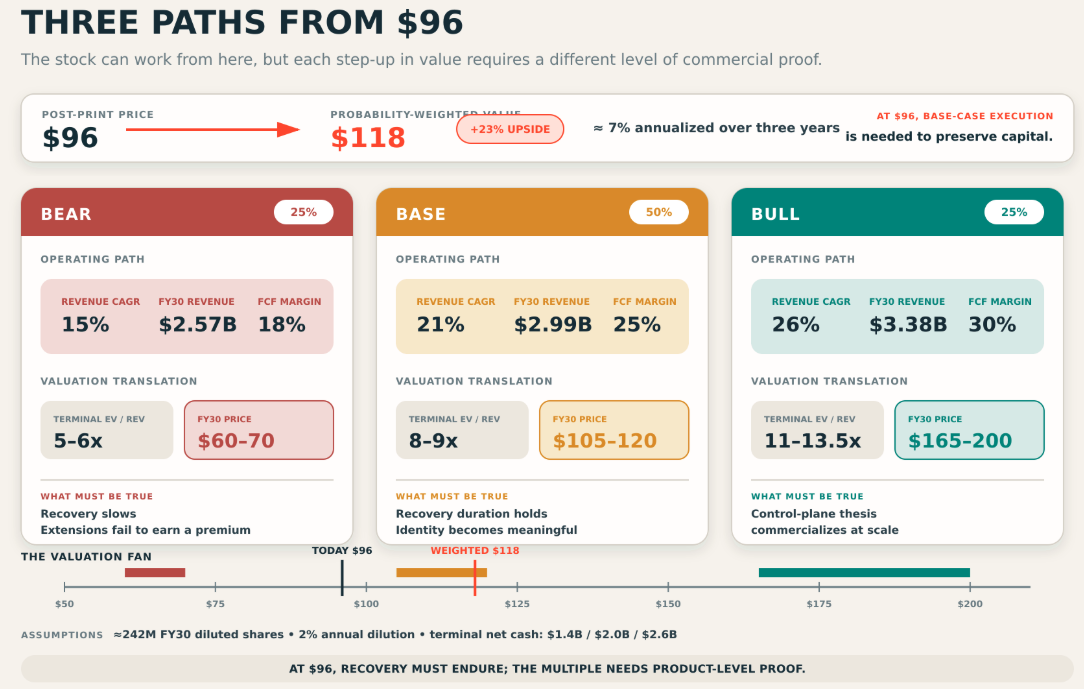
The midpoint probability-weighted value is approximately $118, implying only about 7% annualized over three years from the post-print price. The bear case is not $30 because even a slower Rubrik would produce meaningful recurring cash and retain net cash. The previous $135–160 base range was too generous because it combined high terminal revenue multiples with insufficiently explicit dilution and cash assumptions. At approximately $85, the same probability-weighted value offers an 11% annualized return; near $96, the stock requires new evidence rather than another narrative extension.
What Changed in Our View
Q2 increased my conviction that Rubrik owns a valuable recovery franchise with improving economics. It did not increase my conviction by the same amount that Identity and Agent Cloud form a self-reinforcing second act. The variant perception is therefore narrower than before: the market still underestimates the strategic value of a trusted historical record, while bulls overestimate how much of the wider control plane has already been commercialized.
The next quarter has four tests. NNARR at or above $100 million keeps the annual guide credible; below $95 million leaves an uncomfortable Q4 burden. Rubrik should preserve the adjusted-cloud bridge and keep organic growth near 20%. By Q4, Identity needs renewed quantification and Agent Cloud needs either 30-plus paying customers or meaningful ARR. During FY28, stock compensation must fall below 20% of revenue and management must show that the revenue-organization transition has not weakened productivity.
Rubrik has proven that enterprises will pay for a trusted record of their past. It has not yet proven that this record gives it the right to govern their future. Existing holders can remain patient, but new money should wait for approximately $85 or for product-level disclosure that proves the compounding loop. The recovery engine cleared the bar; the valuation already assumes that the rest of the map eventually will.
Disclaimer:
The content does not constitute any kind of investment or financial advice. Kindly reach out to your advisor for any investment-related advice. Please refer to the tab “Legal | Disclaimer” to read the complete disclaimer.