


TL; DR
The interface may no longer be the moat: as Claude, ChatGPT, Slack and custom apps increasingly own the user experience, Salesforce’s value shifts toward governed context, permissions, semantics and trusted execution.
AI may create a second user rather than replace the first: human usage remains resilient while machine access through MCP is scaling rapidly, creating a new consumption layer alongside seats.
Q2 finally connected the AI story to the core business: cRPO accelerated to 14% constant currency and production/refill activity strengthened, but Salesforce still needs to prove implementation intensity, and AI economics can scale without eroding margins.
The most interesting Salesforce customer right now may be Anthropic.
Claude is precisely the sort of product that is supposed to threaten Salesforce. If an intelligent model can answer questions, build interfaces, write software, and take actions, why should a salesperson need to open an expensive CRM application at all? The strongest version of the “SaaS apocalypse” argument is not that software disappears. It is that intelligence moves into the model, the interface moves into the chatbot, and the application sitting between the employee and the data loses the user.
And yet Salesforce disclosed something peculiar on its first-quarter earnings call. Chief Revenue Officer Miguel Milano described what was happening at Anthropic:
“Anthropic is one of our biggest users of CRM, of Sales Cloud, and obviously Slack. Their usage through Q1 has exploded fivefold because now they’re using Sales Cloud from a headless perspective… Sales Cloud has become more prominent and more strategic for them than ever because of Headless.”
Anthropic was using less of the Salesforce interface and more Salesforce.
I think that paradox explains both why Salesforce’s second quarter mattered and why my own view of the company has changed.
When Less Salesforce Means More Salesforce
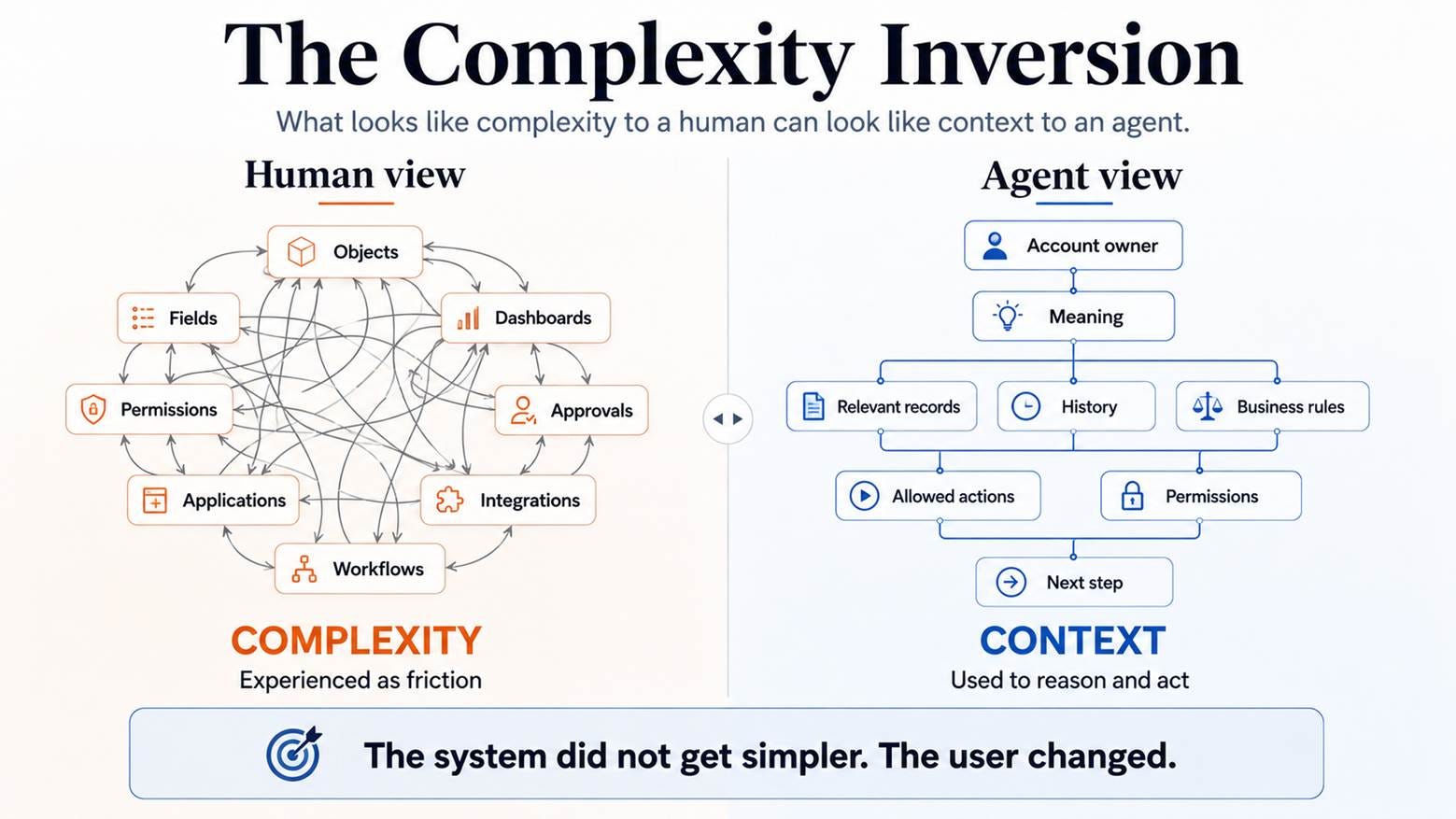
Last September, I argued that Salesforce had fallen into a complexity trap. The company that displaced Siebel by removing much of the pain from enterprise CRM had spent two decades accumulating Sales Cloud, Service Cloud, Marketing Cloud, Tableau, MuleSoft, Slack, industry clouds, Data 360, and eventually Informatica. Each acquisition increased what Salesforce could do while adding another set of schemas, permissions, workflows, interfaces, and integrations that had to work together.
AI appeared likely to expose that fragmentation. An autonomous agent cannot casually work around conflicting definitions of “customer,” uncertain permissions, or disconnected workflows in the way an experienced employee can. The agent needs context it can trust.
That concern has not disappeared. What I underestimated was the possibility that the user itself would change.
Complexity has two costs. One is the cost of constructing and integrating the system. The other is the cost imposed on the person who has to navigate it. Salesforce has not yet demonstrated that AI eliminates the first. Large enterprise deployments still require implementation work, customer data remains scattered across systems, and management still does not disclose the deployment intensity or AI unit economics that would let investors determine whether the underlying architecture is becoming materially cheaper.
AI can attack the second cost much faster.
A salesperson confronting Salesforce’s accumulated architecture sees objects, fields, dashboards, approval flows, permissions, and applications. An agent can see something else: who owns the account, what a field means, which records matter, what happened previously, which business rules apply, and which actions are permitted.
What looks like complexity to a human can look like context to an agent.
What the Agent Sees
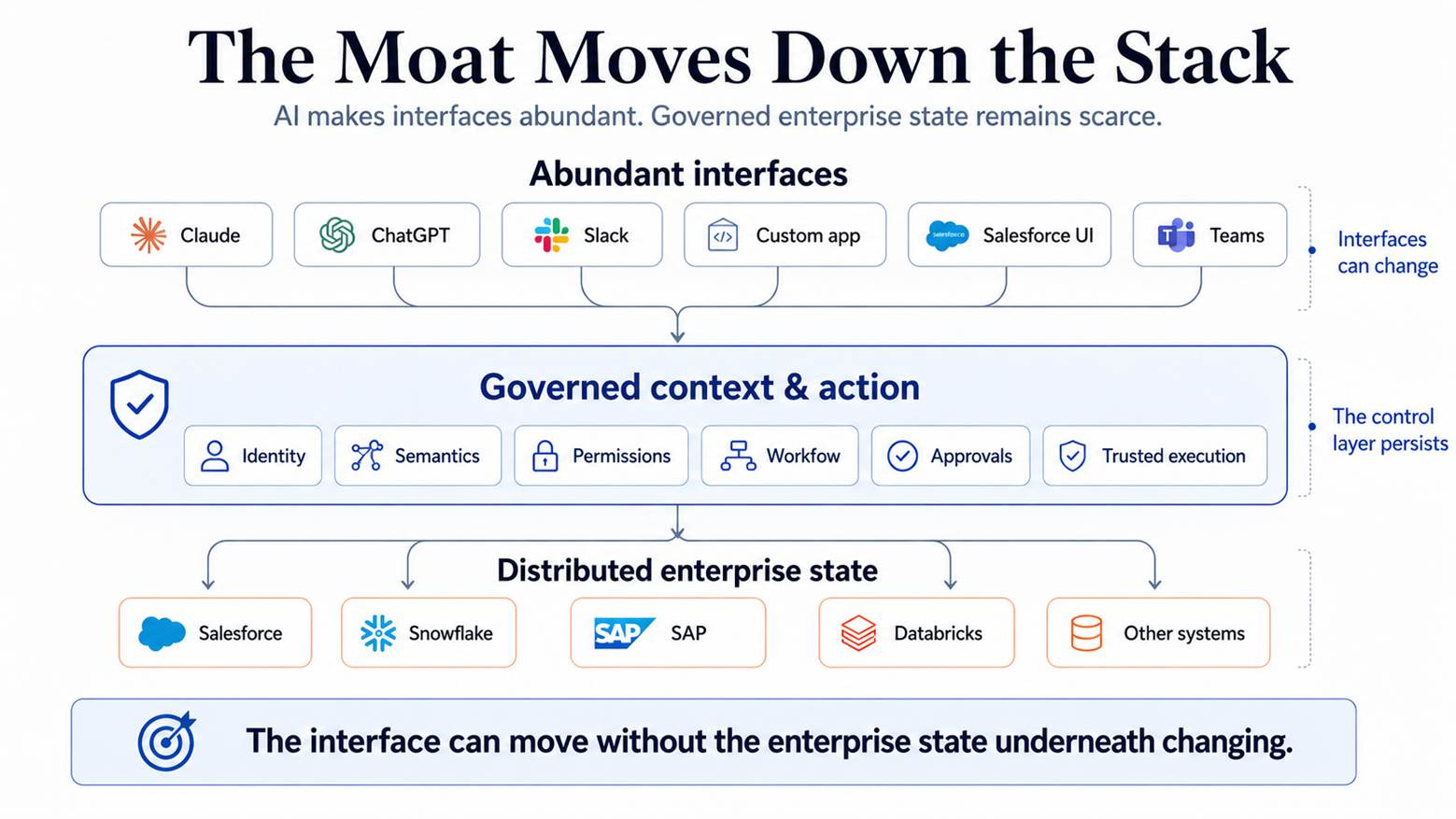
This distinction matters because large language models are making interfaces abundant. Claude can provide one. ChatGPT can provide another. Slack can become another. A company can increasingly build its own.
What does not become abundant nearly as quickly is enterprise state.
A model can reason that a discount probably makes sense. It cannot independently know that a particular quote requires two approvers, that the employee requesting it lacks authorization, that the customer has a contractual restriction, or which system must record the final action. Those are problems of identity, semantics, permissions, governance, workflow, and deterministic execution.
Salesforce has spent 25 years accumulating precisely those things.
Benioff described the strategic change unusually directly on the Q2 call:
“People don’t have to come to Salesforce to get work done. Salesforce comes to them in Claude, in Slack, in ChatGPT, in Teams, wherever they want to work. It is a shift from software as the interface to software powering every interface.”
That is more consequential than another Agentforce feature. Salesforce is explicitly accepting that somebody else may own the interface.
This also changes how I think about our previous concern around federation. I had treated Salesforce’s embrace of zero-copy access to data residing in Snowflake, Databricks, SAP, and elsewhere as evidence that Salesforce had ceded control of the most valuable layer. That now seems too categorical. An agent may care less about where the bytes physically reside than whether Salesforce can explain what those bytes mean, whether they can be trusted, who can access them, and what can safely be done with them.
The moat may be moving from owning the interface to owning governed context and action.
There is an additional irony. Salesforce spent years building its own AI capabilities through Einstein and Agentforce. Now one of its most strategically interesting propositions is that Claude can become the interface to Salesforce. That could be interpreted as defeat. I increasingly think the opposite is true. If Salesforce needs to own the best model for this thesis to work, the thesis is fragile. A genuinely valuable governance and execution layer should benefit whether Claude wins, OpenAI wins, Gemini wins, or model intelligence becomes increasingly commoditized.
The Second User
The architectural change matters to investors only if it changes the economics.
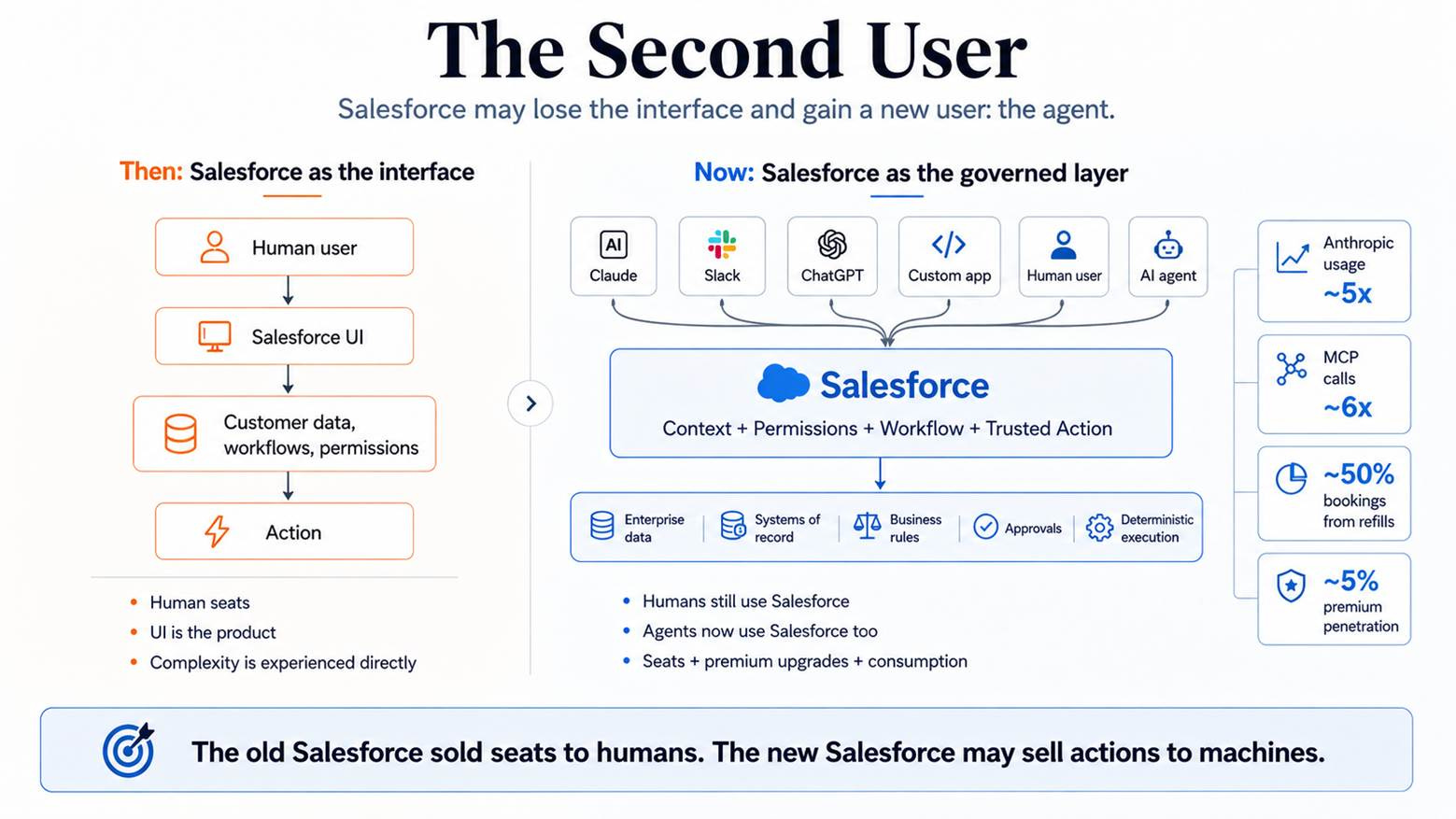
Salesforce laid out the mechanism in Q1. Existing users could migrate to premium editions. AI could make Salesforce economical for additional users. Customer-facing agents could consume Flex Credits. Headless could eventually monetize interactions initiated by third-party agents outside the Salesforce application itself.
The old Salesforce monetized people.
The emerging Salesforce may monetize people and machines.
Salesforce’s Q2 presentation says human application usage remained strong while weekly calls to its MCP server increased approximately sixfold. It is a management-provided chart rather than a formally disclosed usage series, so the human side should not be over-interpreted. Still, the direction is important: machine activity appears to be developing alongside the existing human franchise rather than simply replacing it.
The Q2 transcript gives us a better economic indicator. When Morgan Stanley’s Elizabeth Porter asked how much Agentforce activity was moving beyond pilots, Milano answered:
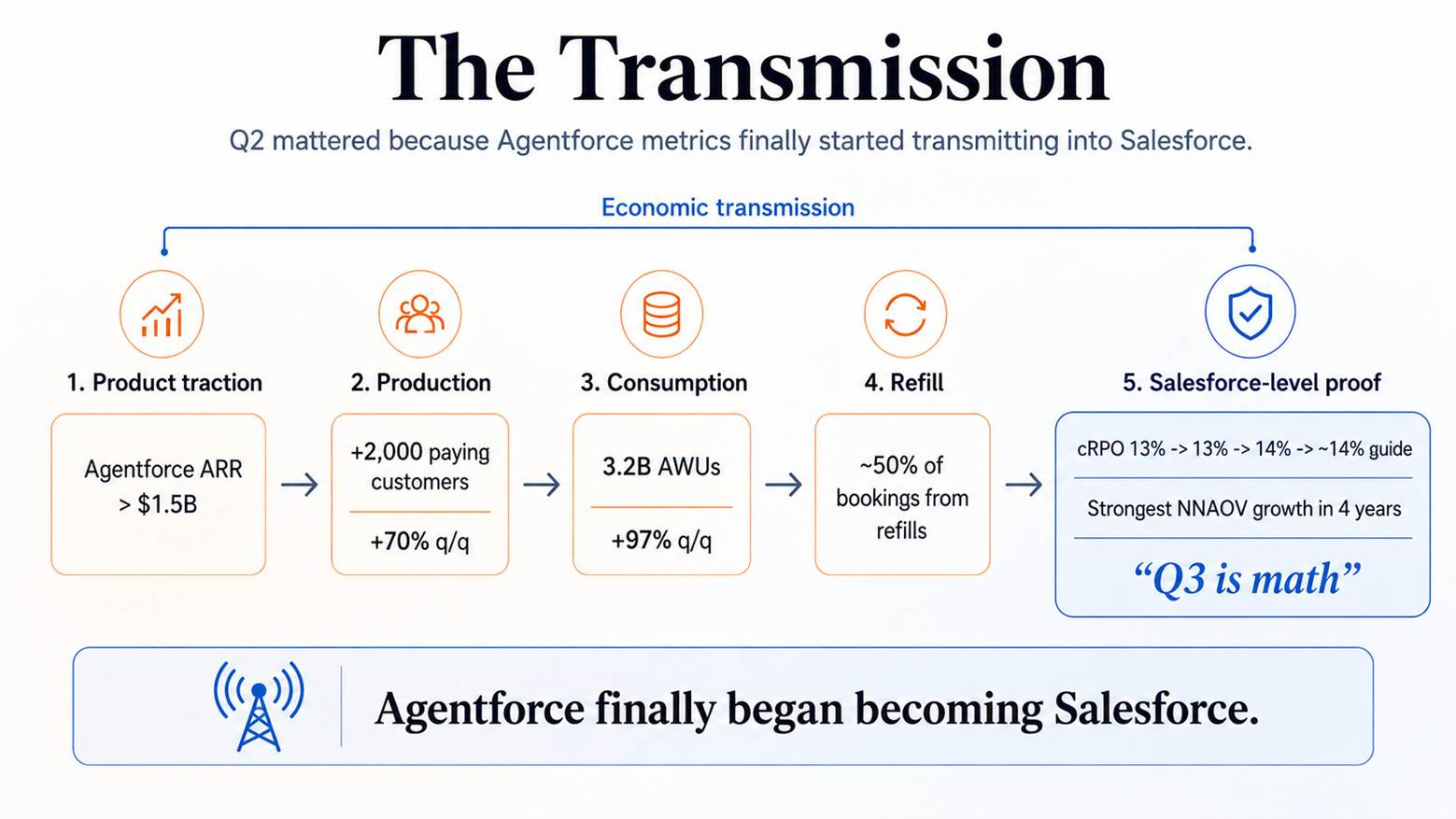
“50% of the bookings came from customers refilling the tank. So they consume, they use the Flex Credits, they want more… We added 2,000 paying customers into production. That is 70% more quarter on quarter.”
This is more useful than the headline Agentforce ARR number.
ARR proves Salesforce persuaded someone to buy an AI product. Production proves the implementation escaped procurement. Consumption proves customers used it. Refill proves they used enough of it to pay Salesforce again.
The refill itself is not new; similar behavior was visible in Q1. What matters is that it persisted while production deployments and Agentic Work Units scaled rapidly.
And the machine user does not yet appear to be replacing the human one. Sales and Service seats are still growing, while management says penetration of its premium editions remains remarkably low:
“Only 5% of the knowledge workers that use sales and service have upgraded to the higher-end editions. We get a 60% to 80% premium.”
That suggests a considerably more attractive economic possibility than the original SaaS bear case:
existing seats + premium upgrades + machine consumption.
The threat was that AI would reduce Salesforce’s number of users.
The opportunity is that AI creates an entirely new class of Salesforce user.
When Agentforce Became Salesforce
None of this would matter if it remained confined to Agentforce statistics.
Morgan Stanley’s Keith Weiss made exactly that point on the Q1 call. Agentforce usage looked terrific, but cRPO had merely met expectations; Tableau and Commerce were weak; where was the broader business acceleration?
It was the right question, and it echoed the questions we had been asking for nearly a year.
In December, Salesforce was increasing sales capacity by more than 20% while guiding to single-digit growth. I argued that either management had abandoned the discipline investors had spent years demanding or it could see demand that had not yet reached reported revenue.
In February, Agentforce ARR, premium bookings, consumption, and large deals all improved, but aggregate organic growth did not. The distinction I made then was between progress and proof.
Q1 explained the mechanism. Q2 is where the mechanism began transmitting into Salesforce.
Revenue was $11.35 billion, although $456 million came from Informatica, while reported non-GAAP EPS of $5.90 included $2.53 per share of strategic investment gains. Neither explains why the quarter mattered. cRPO does.
Current remaining performance obligations grew 14% in constant currency, up from 13% in Q1, while Salesforce guided Q3 to another approximately 14%, excluding Contentful and Fin. Management also said net-new annual order value growth was the strongest in four years.
Milano then made the accountability test unusually explicit:
“We are very confident. Definitely, we are committed to the H2 revenue re-acceleration. That’s already math. Q3 is math. Q4 is nearly math.”
Three months earlier, investors were being asked to trust a forecast. By Q2, management was describing the next quarter as arithmetic. That does not prove the acceleration will persist, but it tells us why this quarter is different: more of the Agentforce story has migrated from usage into signed contracts and therefore future recognized revenue.
Q2 matters not because Agentforce became more impressive. It matters because Agentforce finally began becoming Salesforce.
The Anchor
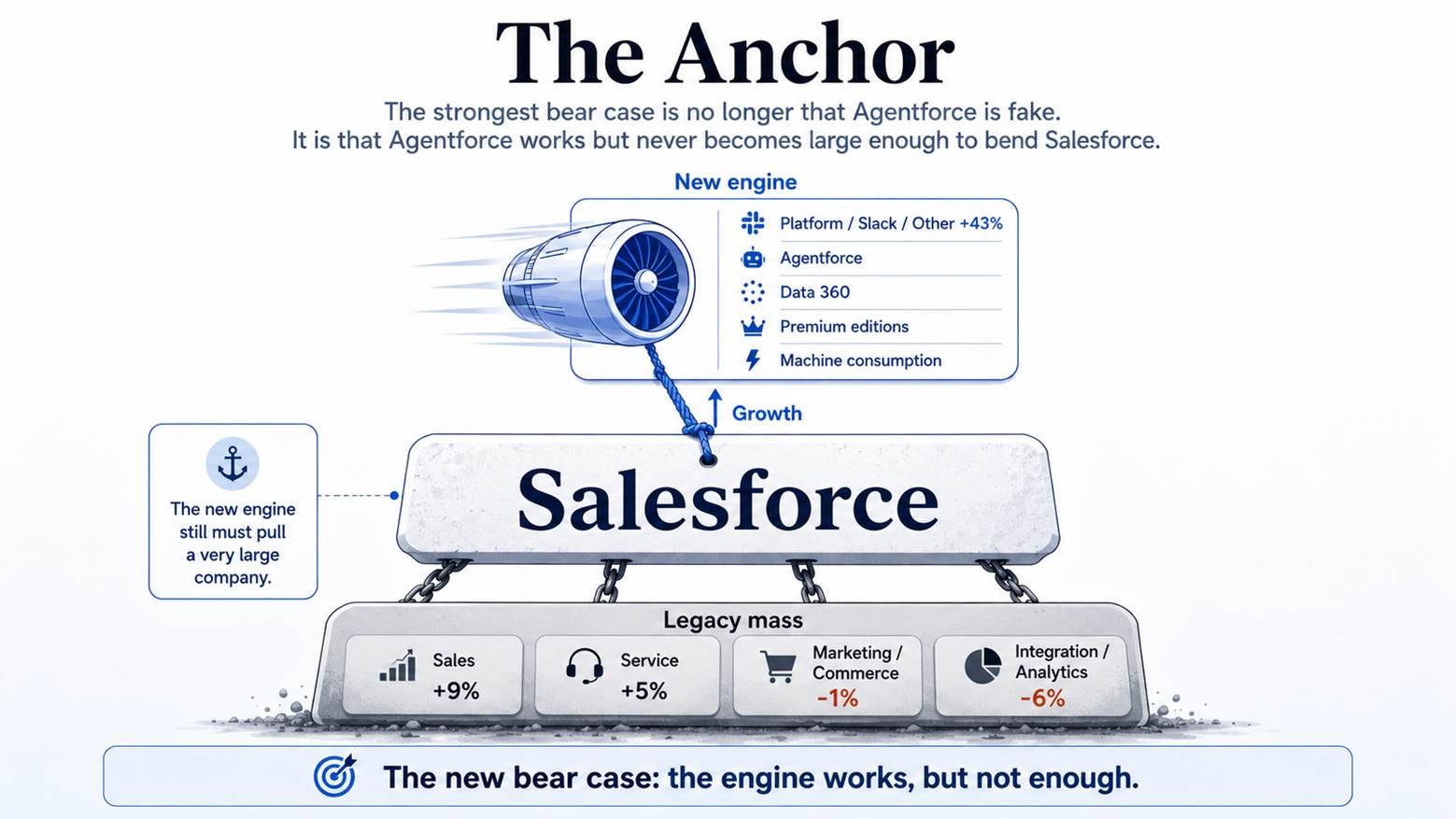
The new engine still must pull a very large company.
Under Salesforce’s legacy disclosure, Sales grew 9% in constant currency in Q2, Service 5%, Marketing and Commerce declined 1%, and Integration and Analytics declined 6%. Platform, Slack and Other grew 43%.
That changes the strongest bear case. It is no longer that Agentforce is fake. It is that Agentforce works but never becomes large enough to bend Salesforce.
The complexity question also remains open. PenFed described Salesforce engineers and architects working directly alongside its team, while UCLA said its first customer-facing Agentforce use case took eight months to deploy.
Our December capacity call therefore looks increasingly prescient, as does the focus on refills. The Informatica semantic-layer hypothesis has gained credibility, but I would not declare it proven: we still cannot isolate Informatica as the reason consumption or deployment economics are improving.
Until Salesforce shows declining implementation intensity, strong AI gross margins, and sustained organic revenue acceleration, the Complexity Inversion remains a thesis rather than a conclusion.
The Price of Being Right
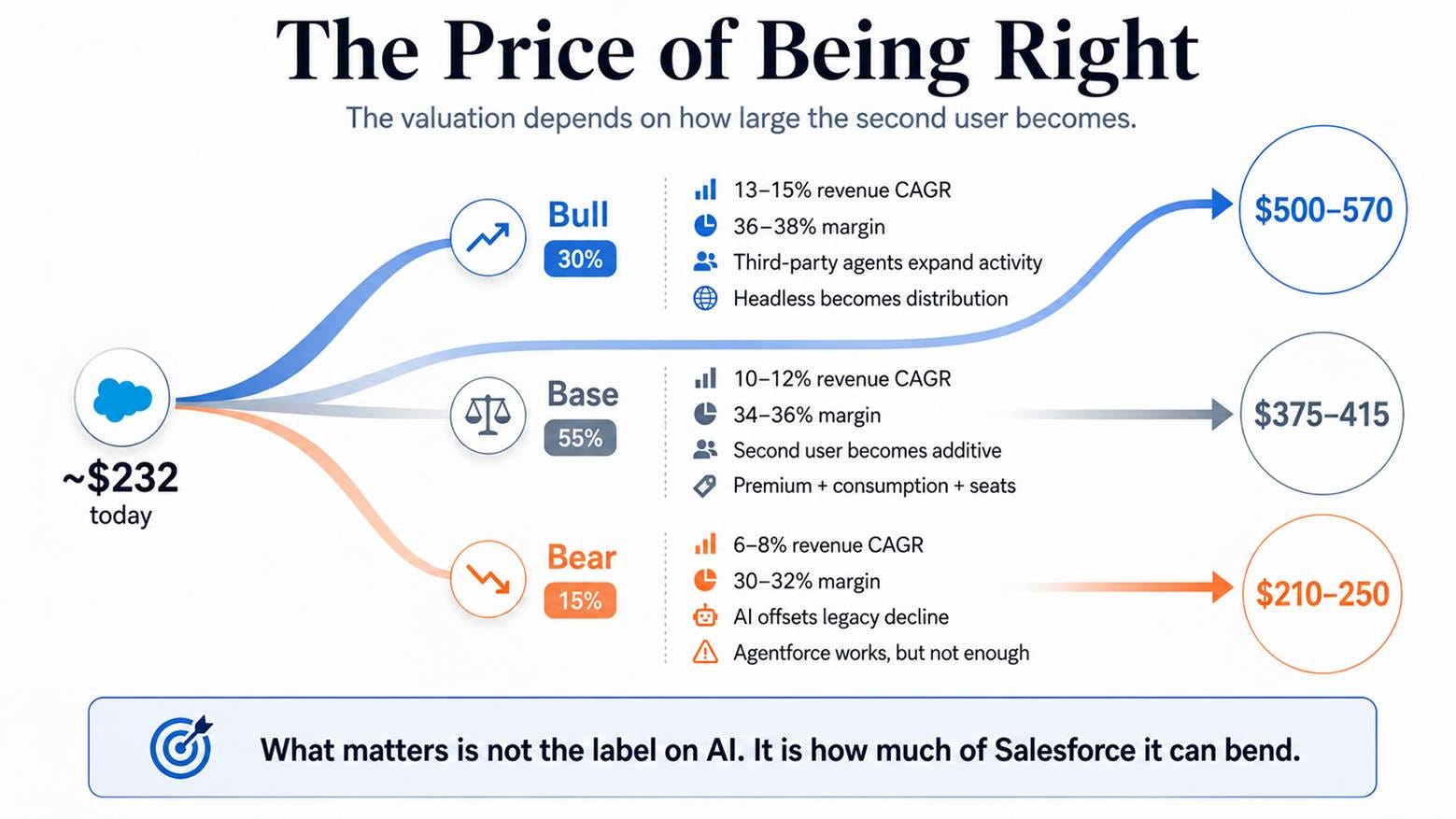
At roughly the post-earnings price, I would now assign a 15% probability to a bear case in which Agentforce succeeds but largely offsets legacy deterioration. Revenue grows 6–8% annually through FY30, non-GAAP operating margins settle around 30–32%, and earnings of roughly $16–18 support a stock around $210–250.
My 55% base case assumes the second user becomes economically meaningful but develops progressively. Revenue grows around 10–12%, cRPO stays in the low-to-mid teens, premium upgrades and consumption remain additive to seats, and margins hold around 34–36%. FY30 EPS around $22–23 at 17–18 times earnings implies roughly $375–415.
The 30% bull case is the Complexity Inversion fully expressed. Third-party agents dramatically expand Salesforce activity; premium penetration moves far beyond today’s 5%; Headless turns frontier models into distribution rather than competitors; implementation becomes easier; and Salesforce sustains 13–15% revenue growth with 36–38% margins. EPS around $25–27 at 20–21 times supports roughly $500–570.
The prices matter less than what each world requires. Q3 organic revenue now needs to visibly accelerate because management has made the promise falsifiable. cRPO needs to stay around 14% or better. Agentforce Apps, currently growing 8% in constant currency, needs to move toward double digits. Refills must persist as usage scales. Human seats need to remain resilient. And eventually Salesforce needs to disclose enough about implementation intensity and AI economics to demonstrate that the complexity underneath the abstraction is genuinely scalable.
No Salesforce
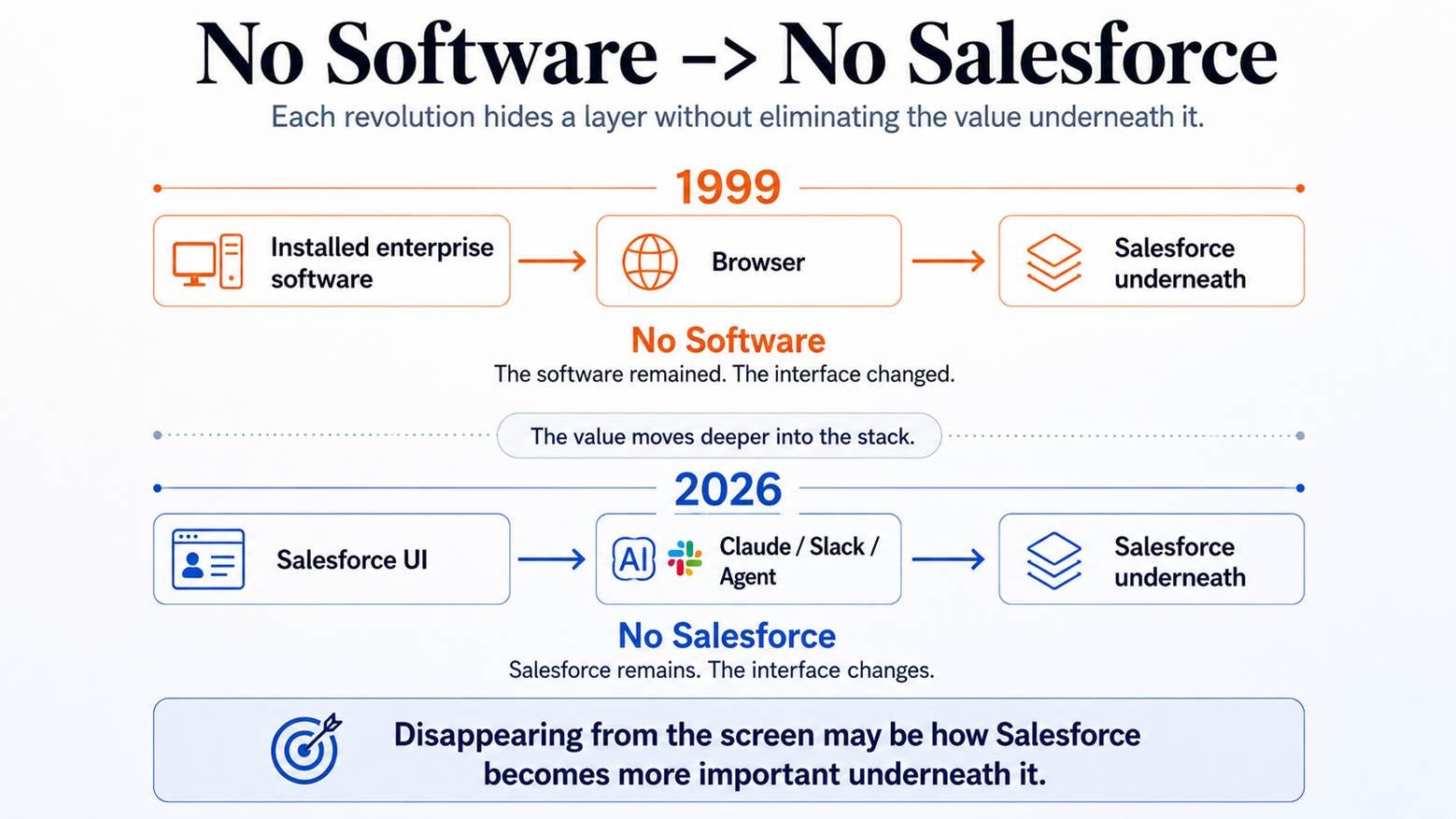
Twenty-seven years ago, Salesforce’s breakthrough was captured in two words: “No Software.”
The software did not actually disappear. Customer records still had to be stored, permissions enforced, workflows maintained, servers operated, and upgrades shipped. Salesforce simply hid enough of that complexity behind the browser that customers no longer had to think about it.
AI may force Salesforce to repeat the trick on itself.
Claude can replace the screen. Slack can replace the screen. A company’s own agent can replace the screen. What remains is the customer state, the permissions around it, the semantics that explain it, and the trusted system authorized to act on it.
The bear case assumes losing the screen means losing the customer.
Q2 offers the first financial evidence of a more interesting possibility: Salesforce may lose the screen and gain a second user.
Salesforce’s first revolution was “No Software.” Its second may be “No Salesforce” — at least not where the user can see it.
The irony is that disappearing from the screen may be how Salesforce becomes more important underneath it.
Disclaimer:
The content does not constitute any kind of investment or financial advice. Kindly reach out to your advisor for any investment-related advice. Please refer to the tab “Legal | Disclaimer” to read the complete disclaimer.