


TL; DR
The operating model is changing in the right direction: Sandisk realized less price than peers, shipped more bits, and still expanded margins. That is exactly what a more contracted, supply-disciplined NAND business should begin to look like.
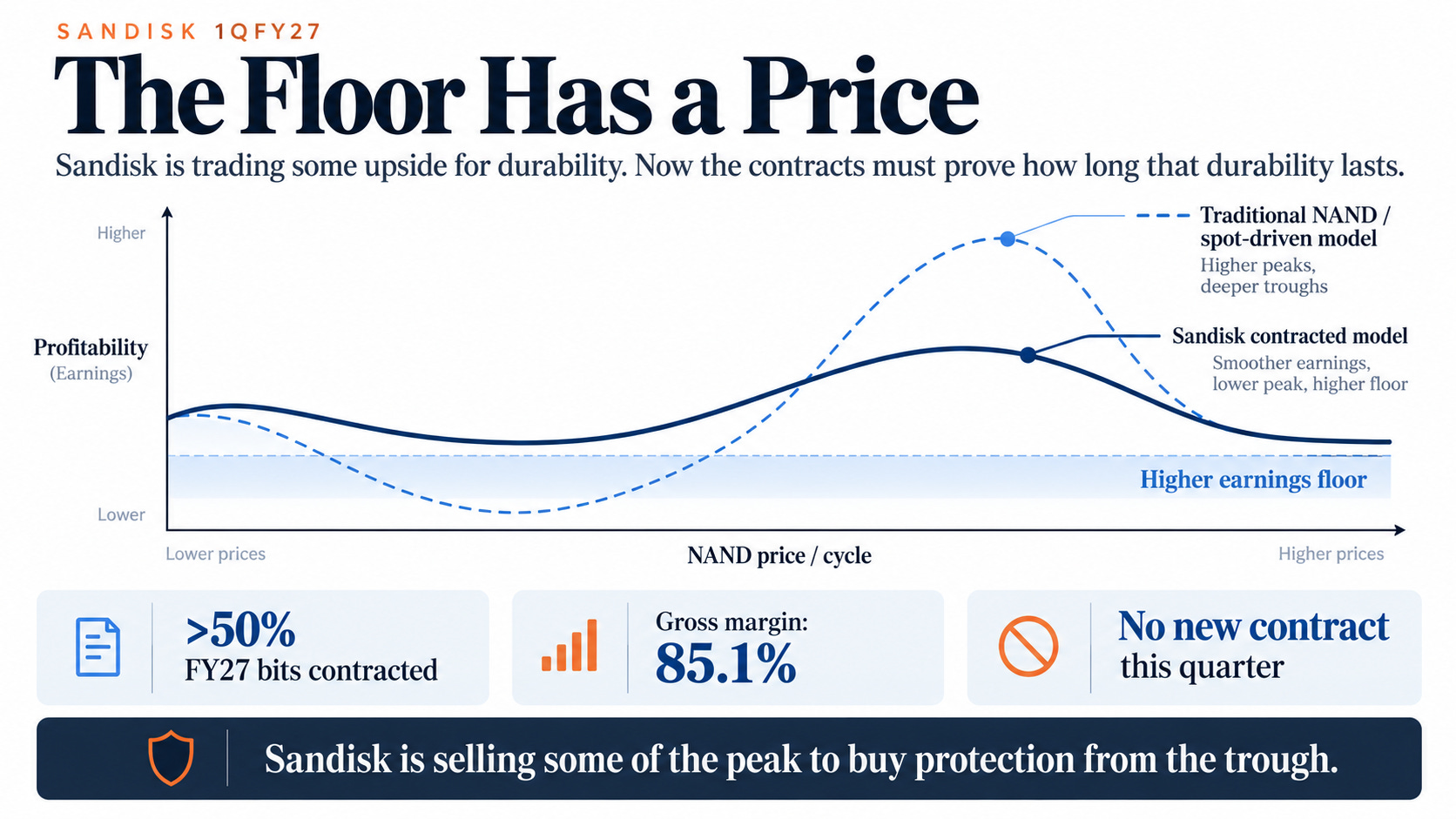
The important shift is from cyclicality toward a floor: management is refusing to accelerate bit growth despite demand exceeding supply, while multi-year commitments and fixed or semi-fixed pricing reduce dependence on spot NAND. The hard-drive industry shows how valuable that discipline can become if it persists.
But duration is still the unresolved variable: no new contract closed this quarter, prepayments slowed, and management is talking about customer “signals” beyond FY30 rather than signed commitments. The rerating case depends on extending contracted coverage beyond FY28 on attractive terms.
The Most Valuable Word on the Call
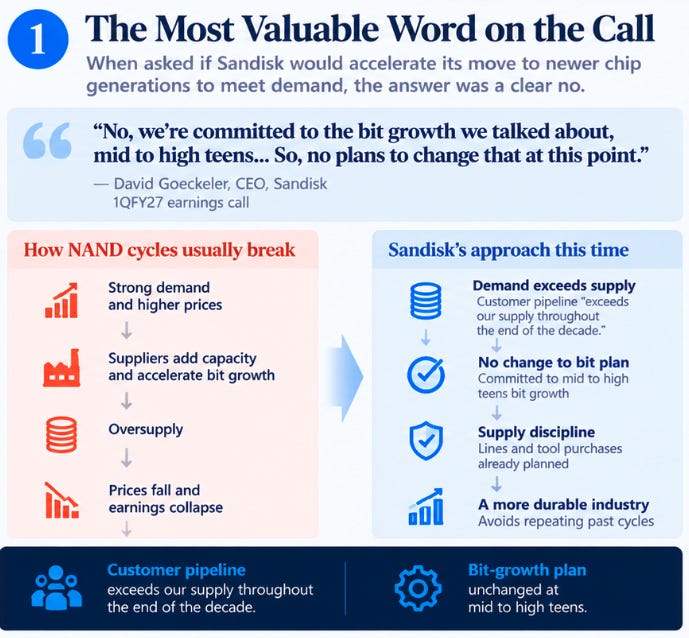
MST’s David Gibson asked whether Sandisk would speed up its move to newer chip generations to meet demand. David Goeckeler did not hedge:
No, we’re committed to the bit growth we talked about, mid to high teens. Those nodal transitions require a lot of planning and tool purchases and where lines are set up. So, we have that fab plan set up for the kind of bit growth we’ve been talking about for a long time. So, no plans to change that at this point.
For twenty years, every NAND cycle ended when someone said yes to that question and flooded the market. Sandisk said no, in a quarter when its CFO said the customer pipeline “exceeds our supply throughout the end of the decade.”
The quarter was strong: revenue of $11.03 billion, up 23%, an 85.1% gross margin, EPS of $49.51 against a $44-46 guide, and a next-quarter guide of $12.2-12.6 billion at about 85%. The numbers matter less than the trade they reveal.
Right on Direction, Too Small on Size, Wrong on One Thing
In August, at about $1,350, I argued Sandisk was “trading upside for duration” and that I would own it. It is $1,330 today, after touching $1,887 in September. First, a scorecard.
My May tracking items mostly passed. I said Datacenter above 35% of revenue would mark Sandisk as a core AI supplier; it is now 43.5%. Most important, I wrote that bit-led growth was “needed for durability.” This quarter, for the first time, growth came mostly from volume. Contract coverage, which crossed 50% of FY27 bits in August, did not move. And one warning I set in January is flashing: I said inventory above 125 days of supply would signal softening demand. It is about 166 days, down from 178 last quarter but well above my line. The likely reason is stock built for datacenter shipments, but that is a question for management, not an answer.
Two admissions. First, I was wrong about why customers sign. In May I wrote that customers “will not pre-fund the same commitments with Micron or SK Hynix,” because Sandisk’s joint venture with Kioxia makes its promises more credible. They do pre-fund them. Micron has $32 billion of customer commitments, mostly in cash. SK hynix has long-term agreements with 14 customers. Samsung wants 60% to 70% of its capacity on multi-year terms. That argument is withdrawn. Second, in May I wrote that “the multiple is roughly right”; in August I argued for a higher one. I changed my mind, and this quarter is the evidence for the later view.
The bigger pattern is magnitude: every bull case in this series became the next floor. My August base case put FY30 earnings at $151 a share; Sandisk will earn about $105 in this fiscal year’s first half alone. That was a downturn case, corrected below.
Less Price, More Bits, Higher Margin
The most revealing number came from CFO Luis Visoso. Asked by Bernstein’s Mark Newman about price and volume, he began, “We normally don’t break this, Mark, into its pieces.” He already had. Revenue growth was “approximately 60%... attributable to volume growth and 40% to higher pricing.” On a 23% revenue increase, that is roughly 13% more bits at roughly 9% higher prices.
Compare that with the rest of the industry in the same three months:
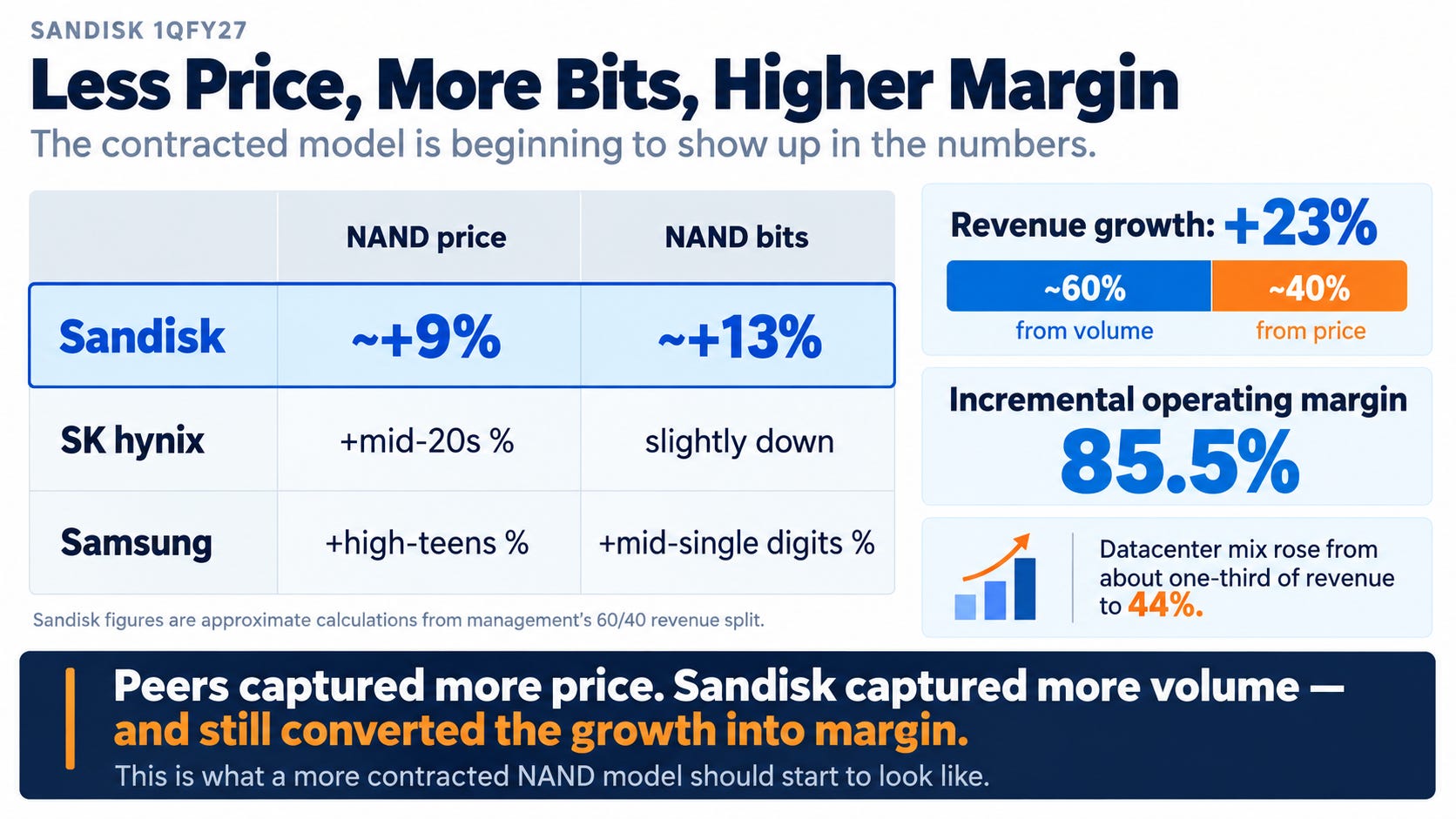
In August I described Sandisk as “two books, one income statement”: a contracted book at mostly fixed near-term prices, and an uncontracted book that floats with the market. The pattern above is what that structure should produce. If half the bits were priced roughly flat under contract, a 9% blended increase implies the spot half rose about 18%, close to Samsung. Treat that as an illustration, not a finding. The contracts have variable components, Sandisk’s product mix differs from its peers’, and its contracted share of revenue may differ from its contracted share of bits. What the numbers show is that Sandisk realised less price and more volume than its peers. What they suggest is that contracts are part of the reason.
Either way, margin rose. Operating profit grew $1.77 billion on $2.07 billion of extra revenue, an incremental margin of 85.5%, because Datacenter went from a third of revenue to 44%, cost per bit fell, and Consumer was allowed to shrink 29%.
Hard Drives Already Ran This Experiment
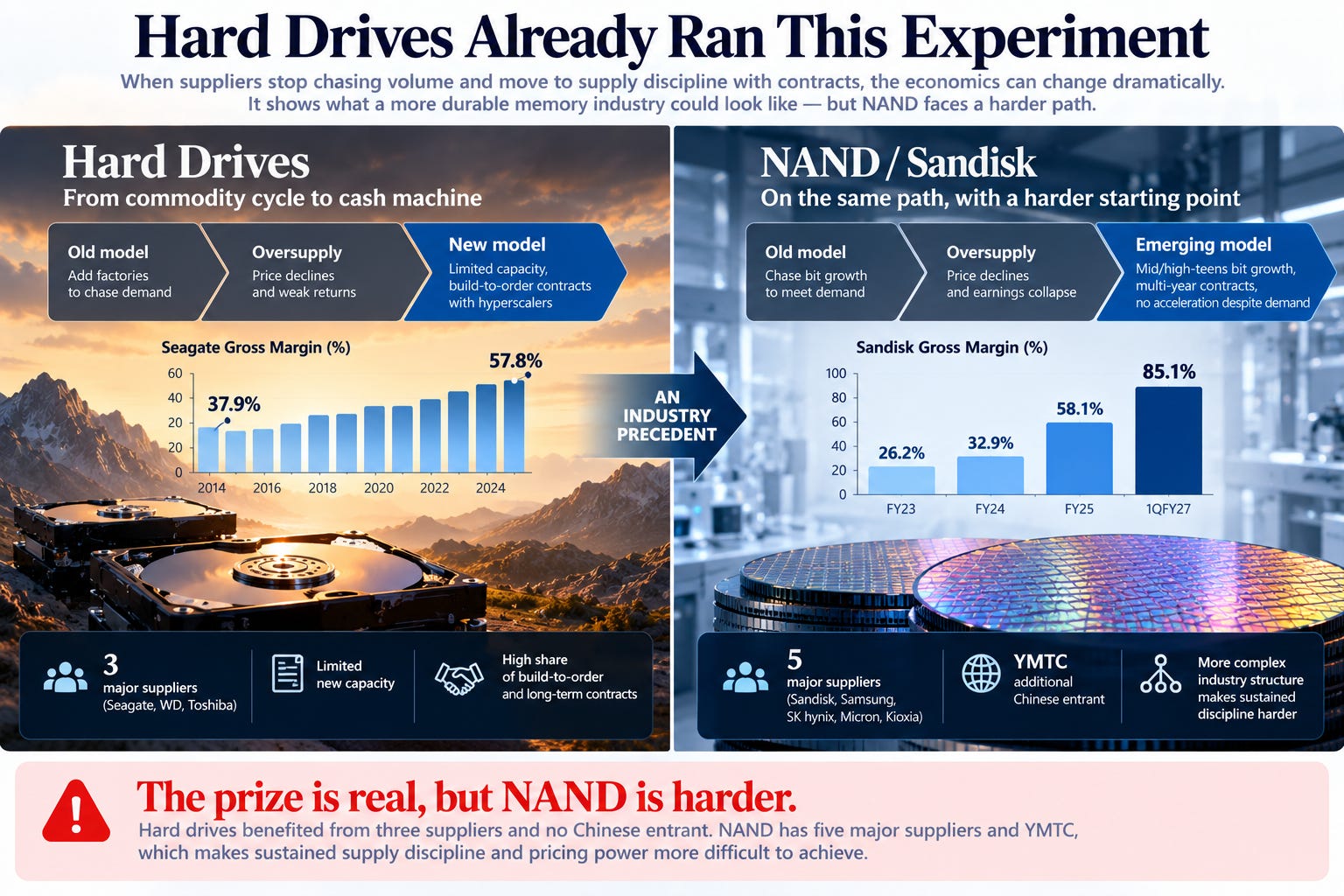
My first piece on Sandisk, in January, argued that NAND was following hard drives “twenty years behind,” and that “profitability came from market structure, not innovation.” I also wrote that even the hard drive duopoly “hasn’t generated spectacular returns.” That line has not aged well.
Hard drive makers stopped adding factories and sold to hyperscalers on build-to-order contracts. Seagate’s Dave Mosley, last year: “We believe BTO contracts are also beneficial for our customers by providing predictable assurance of supply.” Seagate’s gross margin went from a record 37.9% in mid-2025 to 57.8% this week. The market pays about 19 times earnings for Seagate and 16 times for Western Digital.
Sandisk runs the same playbook: multi-year commitments, supply growth set by technology rather than new fabs, and a “No” to chasing demand. Goeckeler to Melius’s Ben Reitzes:
In general, we’re hearing from our customers that they have underestimated the amount of NAND they need to run their infrastructure. We have multiple customers coming back for a second round, and then balancing that against bringing new customers into the portfolio.
The honest limit is structure. Hard drives have three makers and no Chinese entrant; NAND has five, plus YMTC, whose revenue share has risen from 8% to 13%. And my January warning that Samsung would respond if Sandisk pushed for share still applies: Sandisk grew bits about 13% this quarter, and Samsung guided fourth-quarter bits up in the mid-teens.
A Signal Is Not a Contract
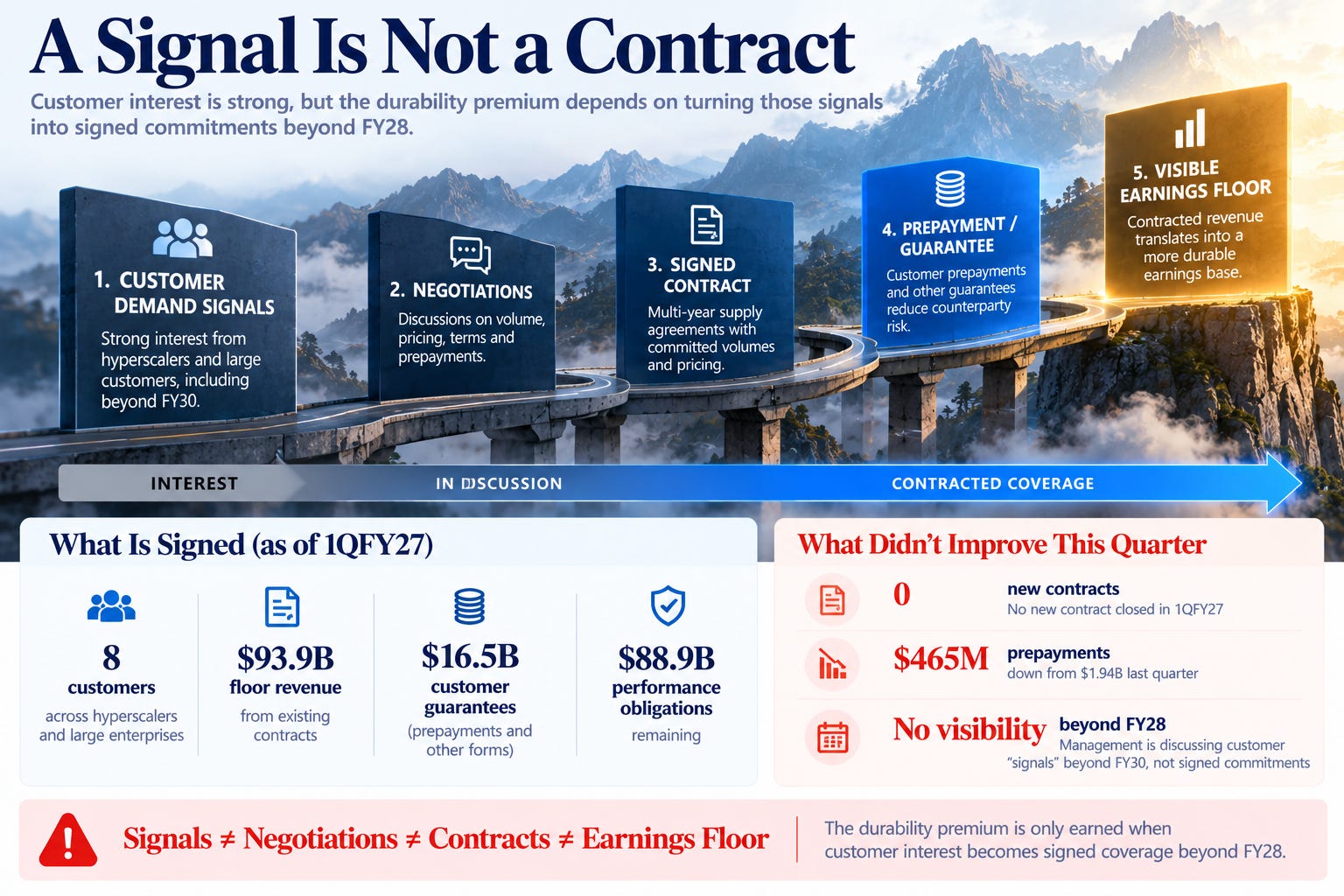
No new contract closed. Customers (eight), floor revenue ($93.9 billion) and guarantees ($16.5 billion) are unchanged, contract obligations slipped to $88.9 billion from $91.1 billion, and new prepayments and deposits fell from $1.94 billion to $465 million. Asked by Cantor’s C.J. Muse about the pipeline, Goeckeler was candid: “But we’re just not there yet, right? We got to go through negotiations on all of those.”
Management’s word of the night was “signals”: “customer signals now extending beyond fiscal year 2030.” A signal is not a contract. I think Sandisk is waiting on purpose. Prices are rising, half its bits still float, and Visoso said the right share under contract is “likely higher than our current levels.” Smart, but it means duration is still a forecast. Even more coverage would not settle it alone: more bits under contract raise the floor only if the floor prices are good, and Sandisk has never disclosed where they sit.
On funding, the worry behind October’s sell-off, Visoso was specific: 95% of contract partners are investment grade, and demand is “if anything, strengthening.” Receivables, up from about 48 to 54 days of sales, are the number to watch.
The Variant Perception
The market prices Sandisk at about 6 times this year’s earnings, level with Micron, as if it still rides spot prices. But Sandisk realised less of the price spike than its peers, shipped more bits, and still lifted its margin. That looks like a lower-swing earnings stream. The hard drive makers show what investors pay once they believe in supply discipline. The gap closes when Sandisk’s contracts extend past fiscal 2028. If they do not, the market is right.
Three Prices for 2029
A three-year price is what the market will pay in late 2029 on fiscal 2030 earnings: revenue × operating margin × (1 − 14.3% tax) ÷ shares × multiple. Fiscal 2026 revenue was $20.25 billion and fiscal 2027 is about $50 billion. Prices are pre-split; divide by eight after 20 November.
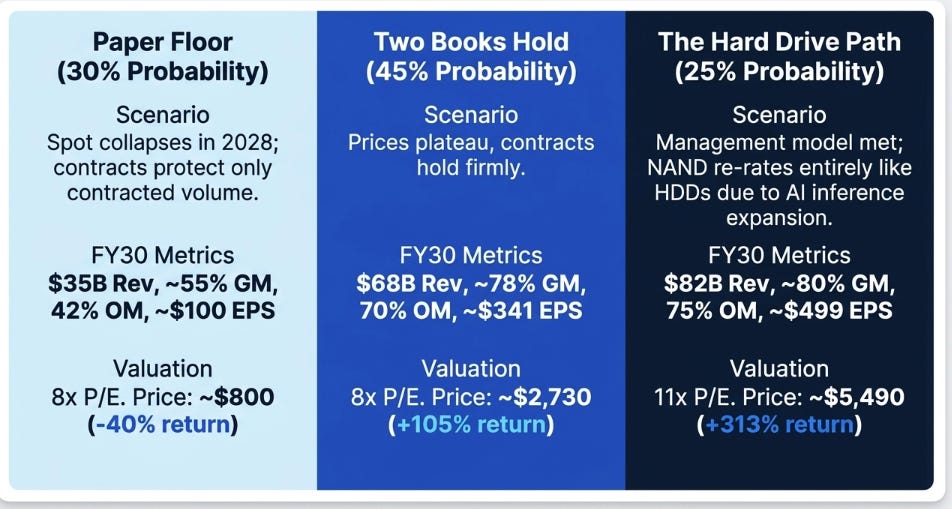
Two Books Hold sits below management’s model on both revenue and margin, and its 78% gross margin is under the “around 80%” Visoso says contracts earn even at floor prices. Getting from 154 million to 120 million shares needs about $61 billion of buybacks at $1,800; fiscal 2027 free cash flow alone is about $29 billion, at an adjusted 52% margin. One caution: before stripping out contract deposits, free cash flow covered only 83% of earnings this quarter as receivables grew, and capex rises through the year. The Hard Drive Path caps margins at management’s own targets and needs a reason to grow 18% a year. That reason is NAND moving into more inference tiers: cache for long contexts, QLC data lakes, and possibly SLC in place of some DRAM, where Goeckeler cited a “20x-40x” cost gap. Paper Floor is wrong if Sandisk discloses fiscal 2029 coverage of at least 40% of bits by mid-2027, if gross margin stays at or above 80% through fiscal 2028, or if Samsung and SK hynix keep 2027 NAND bit growth at or below 20%.
The probability-weighted value is about $2,840, up 114%. In August my scenarios were $250, $1,815 and $3,270, weighted to about $1,790. The $250 case assumed the contracts failed outright; I now treat that as a small risk inside Paper Floor’s weight, not a scenario of its own. August’s middle case was a downturn; now the downturn is Paper Floor. The variable that matters most is operating margin: every five points moves Two Books Hold by about $195.
What Would Change My Mind
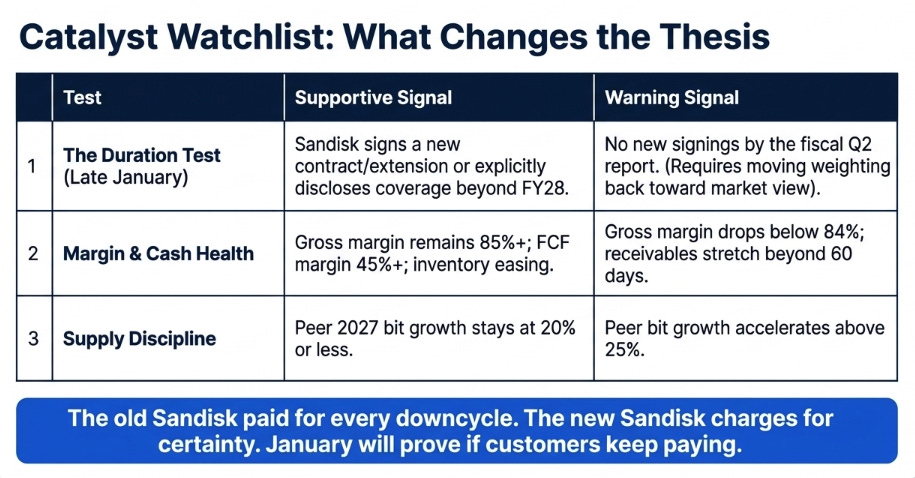
One threshold, no excuses: by the fiscal second-quarter report in late January, Sandisk either signs a new contract or extension, or discloses coverage beyond fiscal 2028. If it does neither, the existing contracts still stand, but the duration premium in my numbers is unearned, and I will move my weights toward the market’s view.
In June 2023 this same business ran a gross margin of negative 11.9%. The old Sandisk said yes to every upcycle and paid for it in every downturn. The new one is saying no, and charging customers for certainty instead. This quarter proved it can do that and still earn 85%. January will show whether customers keep paying.
Disclaimer:
The content does not constitute any kind of investment or financial advice. Kindly reach out to your advisor for any investment-related advice. Please refer to the tab “Legal | Disclaimer” to read the complete disclaimer.