


TL; DR
The quarter was exceptional, but the thesis has moved: Sandisk reported an 84.6% gross margin and $39.25 of adjusted EPS, yet the more important development was $93.9 billion of minimum contracted revenue at floor prices.
Sandisk is trading upside for duration: more than half of FY2027 bits and roughly two-thirds of FY2028 bits are already committed, creating a contracted core with multi-year agreements, price protection and financial guarantees.
The market may be using the wrong trough: current margins are not sustainable, but the old boom-and-bust framework may no longer apply. The investment case now depends less on further estimate upgrades and more on how much normalized earnings persist through the next downturn.
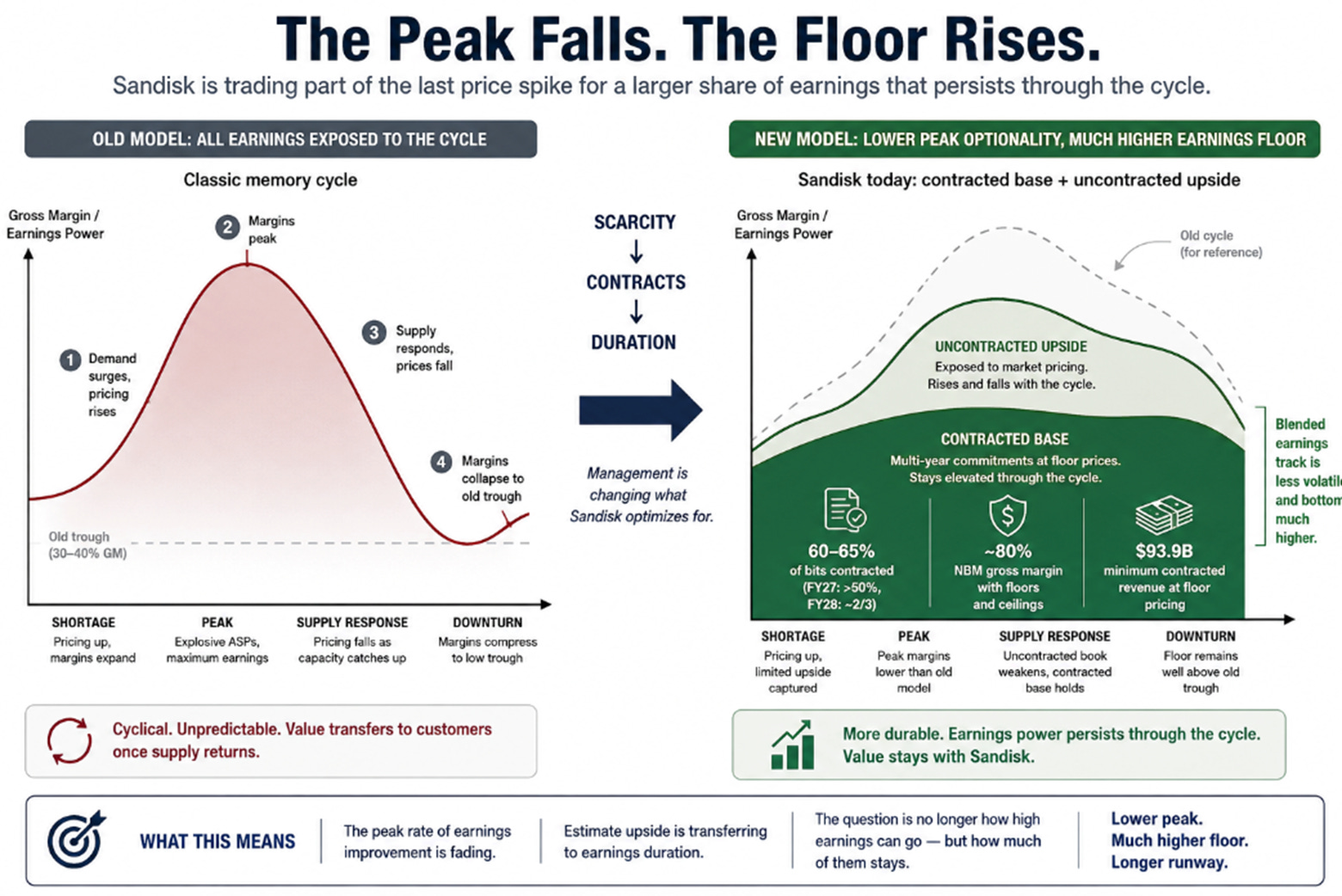
“We want to increase the visibility and the durability of the franchise. We want to get this kind of boom and bust out of it.”
David Goeckeler gave that answer when Cantor’s CJ Muse asked why Sandisk’s next-quarter gross-margin guide was not higher even though NAND pricing was still rising. The wording matters. A chief executive whose company had just reported an 84.6% gross margin described the mid-80s as a fair return, then immediately changed the subject from price to duration. Management is no longer trying only to extract the highest possible margin from the shortage. It is trying to make an extraordinary margin last.
The quarter was certainly extraordinary. Revenue reached $8.97 billion, gross margin was 84.6%, adjusted EPS was $39.25, and adjusted free cash flow was $5.04 billion. Datacenter revenue doubled sequentially, while Datacenter’s share of bits rose from 12% a year ago to 38%. Sandisk guided the next quarter to $10.3–10.8 billion of revenue, an 83–85% gross margin, and $44–46 of adjusted EPS. Yet the most important disclosure was not in the income statement. It was that Sandisk now has $93.9 billion of minimum contracted revenue at floor prices.
The question is no longer how high earnings can go. It is how much of them stay.
The Thesis Has Moved
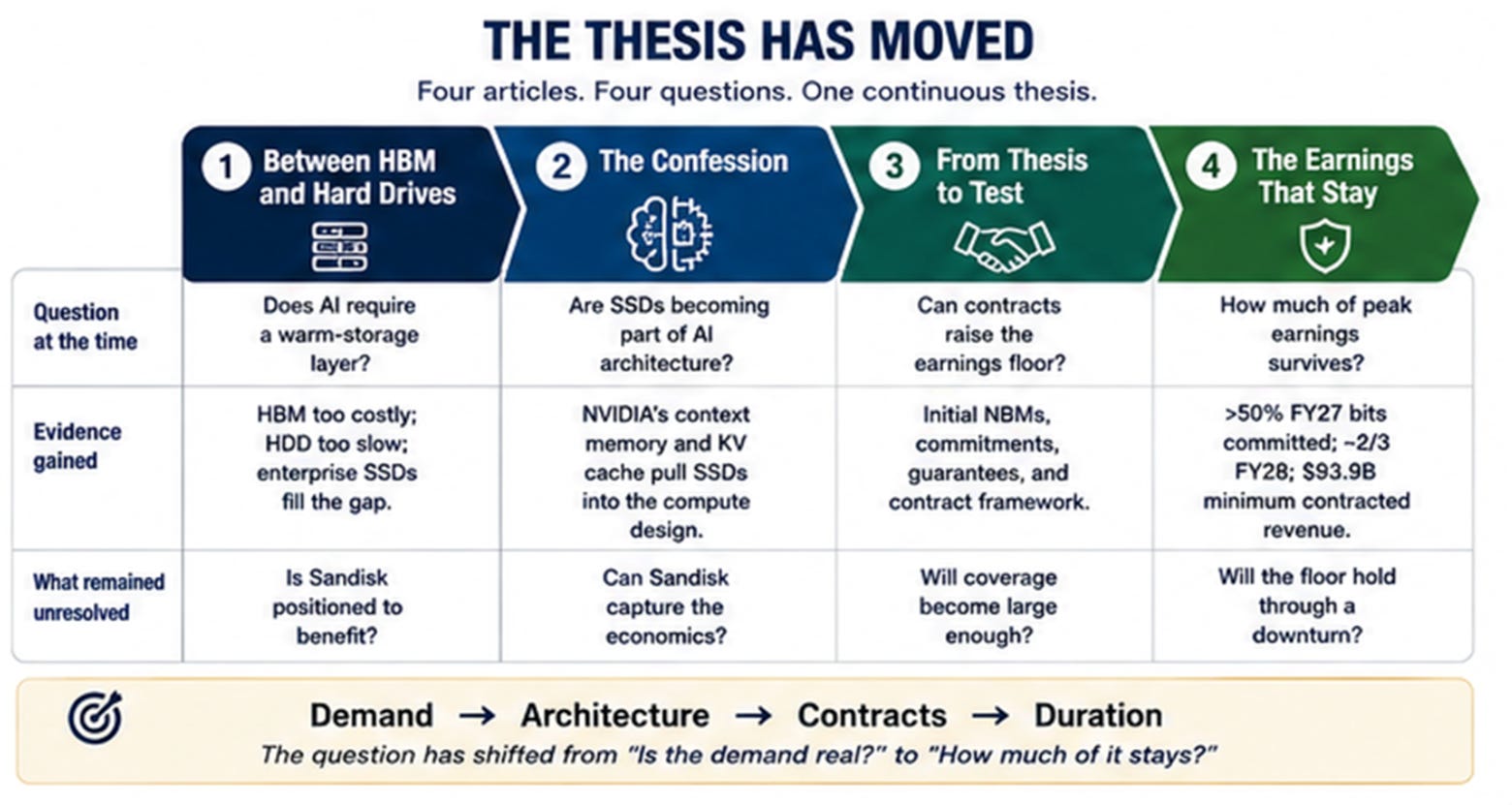
I have written three pieces on Sandisk. The first argued that AI created a missing storage layer between HBM and hard drives. The second connected that layer to context memory and KV cache inside new AI systems. The third accepted that the demand thesis had been proved and shifted the debate to contracts: could Sandisk turn temporary scarcity into a higher earnings floor?
I ended that article by asking whether the gross-margin floor was 55%, 45%, or 30%. At the time, New Business Models covered just over one-third of FY2027 bits. I said coverage needed to cross 50%, Datacenter needed to become a larger part of the business, and the contracts needed enough financial protection to matter when pricing eventually weakened.
FY4Q crossed those thresholds. More than half of FY2027 bits are committed, roughly two-thirds of FY2028 bits are spoken for, QLC Stargate is shipping for revenue, and customers that signed only one quarter ago are already asking for more supply over the next three to five years. The contract mechanism is no longer a thesis. It is becoming the business.
That changes my view. I no longer think Sandisk should be analysed mainly as a memory producer enjoying the strongest cycle in its history. It is building a contracted core inside that cyclical business, and the size of that core is now large enough to change normalised earnings.
A Fair Return
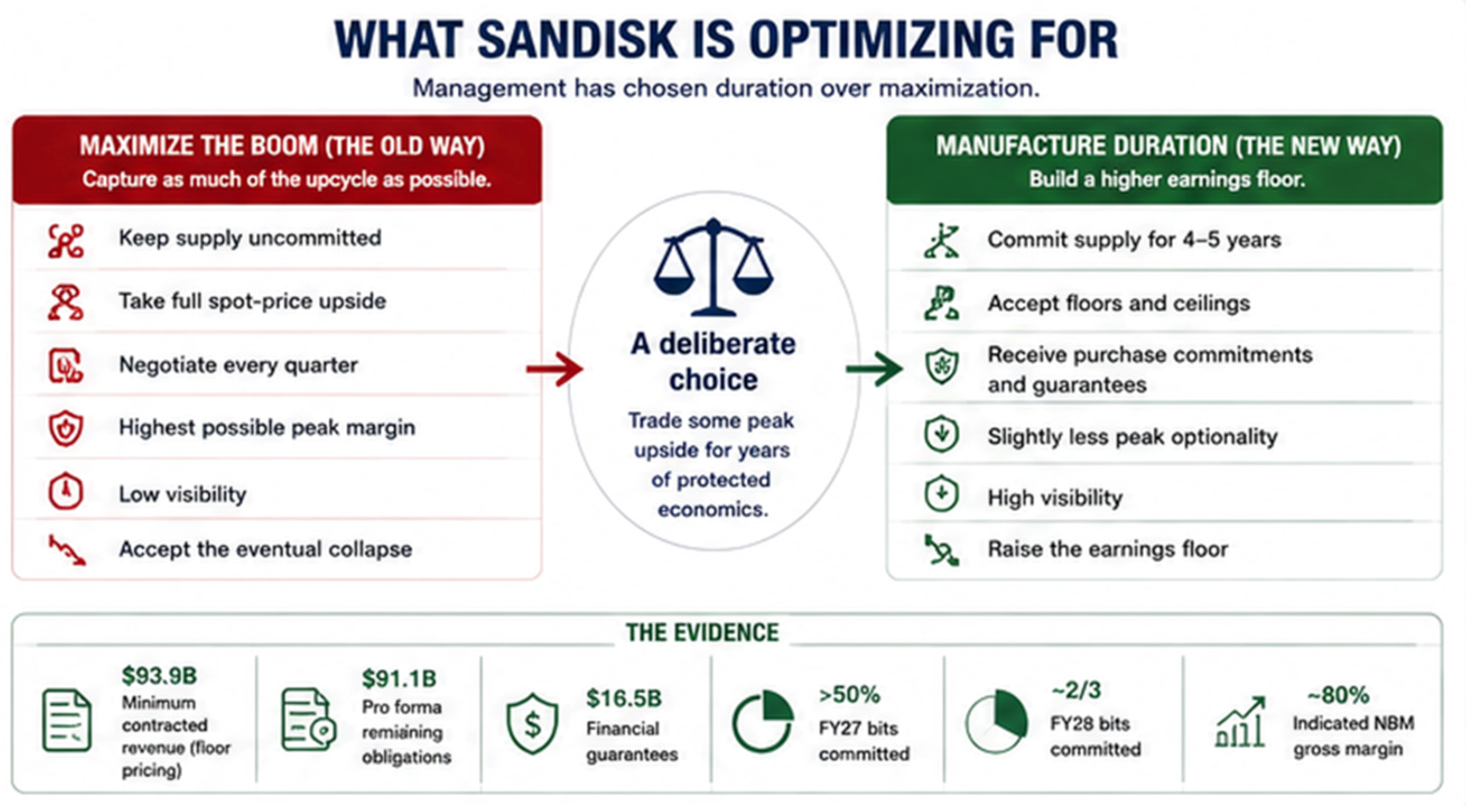
Sandisk has agreements with eight Datacenter and Edge customers. Their weighted-average duration is more than four years. Pro forma remaining obligations are $91.1 billion, backed by $16.5 billion of financial guarantees. Pricing combines fixed and variable components, with floors and ceilings, while supply and demand are specified by year and quarter.
This is a different commercial relationship from the one memory companies have traditionally had. In the old model, Sandisk invested against an industry forecast and renegotiated with procurement teams every quarter. The company carried the capacity risk; the customer retained the right to wait for lower prices. In the new model, customers secure future supply by committing volume, product mix, and financial protection years ahead.
Management says NBM gross margins should remain around 80%, with some upside when market prices rise. That means Sandisk is giving up part of the final price spike in exchange for a floor. The choice is deliberate. Management is choosing duration over maximising every last dollar of the boom.
The customer relationship may matter as much as the price floor. Sandisk says the agreements include detailed forecasts of product mix and deployment timing. That pulls the company closer to the architecture decisions that determine which capacities, controllers, and performance characteristics future AI systems require. A supplier that learns about demand after the product is designed competes on price. A supplier involved while the product is being designed competes on execution and trust.
The buyback reinforces the same choice. Sandisk repurchased $4.5 billion of shares during FY4Q and has $15.5 billion of authorisation remaining. A contracted earnings base makes future cash flow easier to plan; a low memory multiple lets the company turn that cash into a larger claim on future earnings for each remaining share.
From Acceleration to Duration
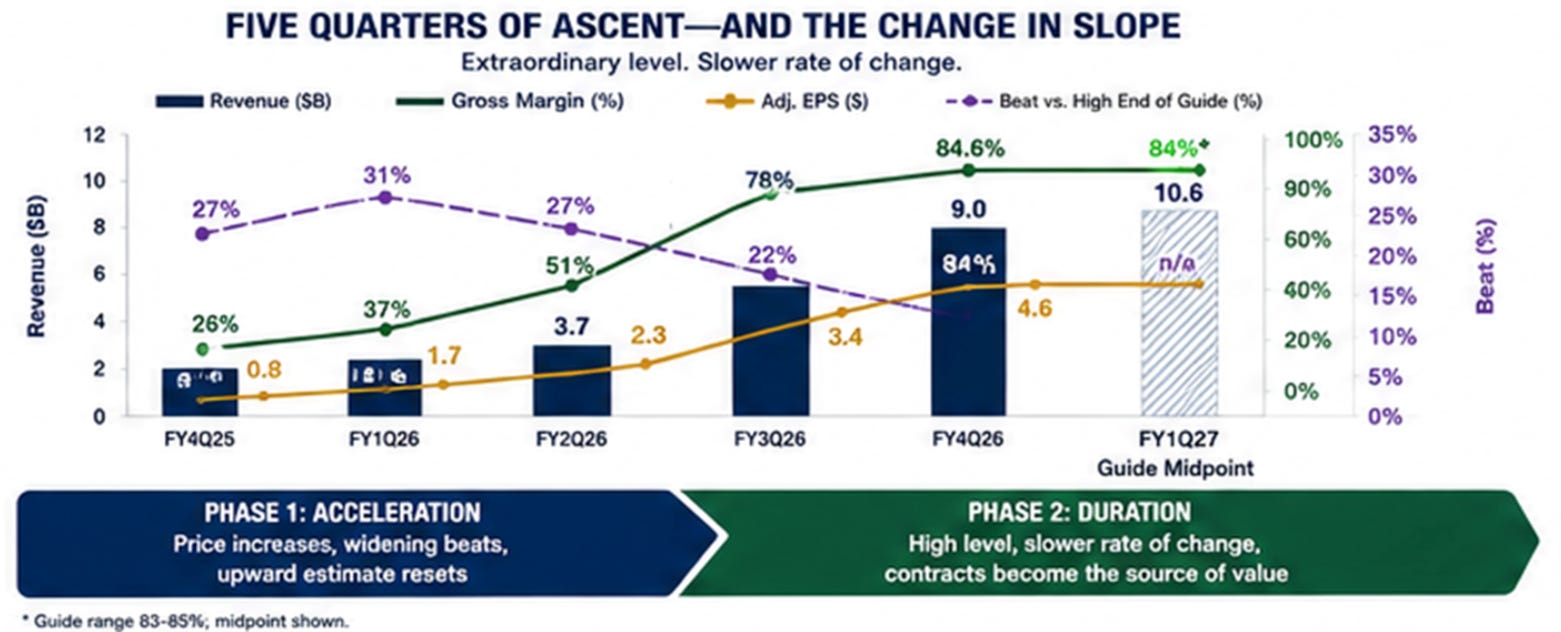
Two things moved in opposite directions this quarter. Contractual duration became much stronger, while cyclical acceleration weakened.
Revenue grew 51% sequentially, but one-third of the increase came from bits and two-thirds from pricing. The next guide assumes both bit growth and only modest further price increases. Gross-margin guidance is roughly flat. The business remains at an exceptional level, but the slope is changing.
That is not just a Sandisk issue. Memory spent five quarters as the cleanest expression of AI scarcity: every report brought larger price increases, larger beats, and another estimate reset. The TMT discussion described the current phase well: the business has reached cruising speed. Across the sector, beat magnitudes are shrinking, some Asian suppliers are missing, and leadership is rotating toward other parts of the AI buildout. Part of the selling is fundamental, not merely a crowded-position unwind.
CJ Muse framed the new debate directly:
“The challenge for semi investors is moving less of a focus on margin and EPS revisions, but rather buying into the durability of this cycle.”
The rest of the call followed that question. Bernstein’s Mark Newman pressed on the lighter revenue guide. Analysts asked why margins were not rising further, whether customers could walk away, and when supply would catch demand. They were not challenging whether AI demand exists or whether the contracts are real. They were challenging management’s larger claim that those contracts have changed the cycle.
I think both sides have part of the answer. The rate of estimate improvement is peaking. The old source of stock upside—another ASP surprise followed by another guide raise—is fading. But slower acceleration is not deteriorating durability. Sandisk is building more duration just as memory supplies less momentum.
Two Books, One Income Statement
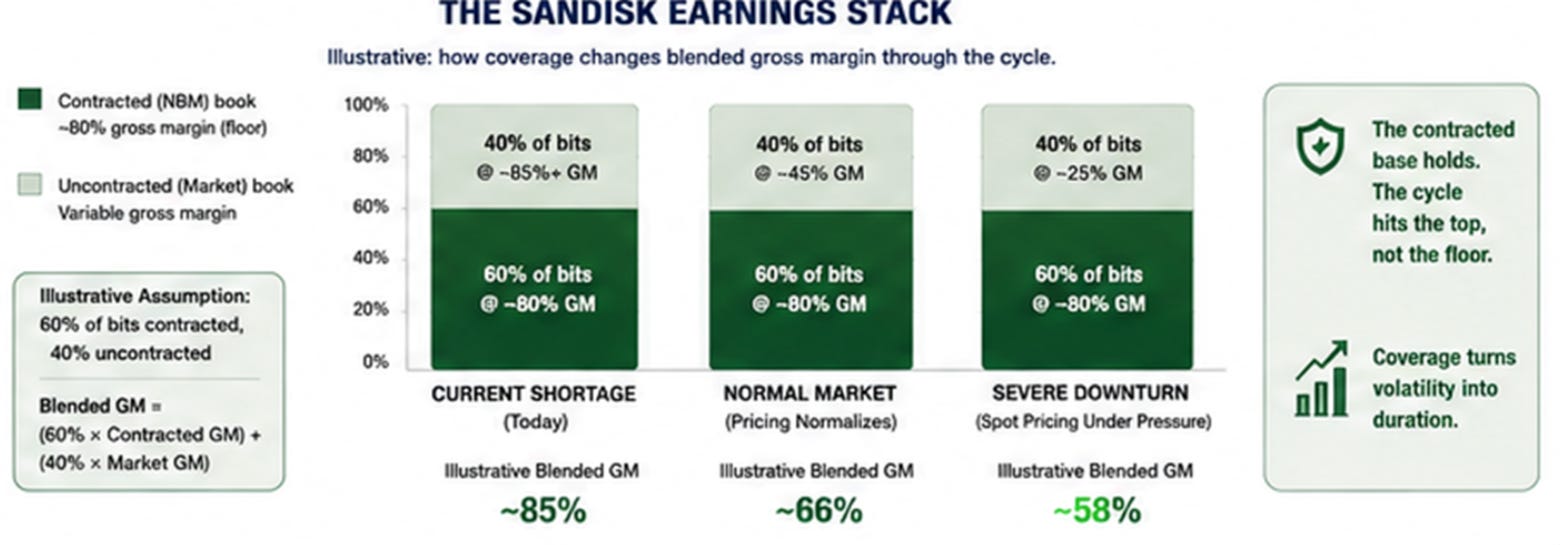
Sandisk now contains two economic books. The contracted book has multi-year purchase commitments, price floors, financial guarantees, and detailed product visibility. The uncontracted book still floats with the NAND market.
The valuation debate comes down to how those books blend when spot pricing falls. If 60% of output earns an 80% gross margin and the residual 40% falls to 25%, the blended margin is still 58%. At two-thirds coverage, it is about 62%. Revenue per bit will differ across products, so this is not an earnings forecast. It is the reason the old trough framework no longer fits.
The market is right that an 84.6% company-wide gross margin is not a sensible terminal assumption. It is wrong to assume that Sandisk must therefore return to old-cycle margins. That would require contract coverage to reverse, contract economics to fail, or both.
I would not build the thesis around management’s forecast that the NAND market approaches $500 billion in 2027. Sandisk did not show how much of that forecast comes from bits, price, or mix, and the number requires extraordinary pricing to persist. The contracts are better evidence. They show what named customers have agreed to buy, the minimum economics Sandisk expects to earn, and how much future production is already committed.
This is the updated variant perception: the next phase of the Sandisk thesis is a transfer from estimate upside to earnings duration. The company can earn less than the most aggressive FY2027 forecast and still be worth more if the remaining earnings persist for longer and the share count keeps falling.
The Test That Comes in a Downturn
There is an awkward feature to this thesis: the floor can only be proved when the cycle turns. At today’s margins, it is invisible. A downturn will initially look like the thesis is failing because spot pricing and the uncontracted book will weaken first. Only then will we see whether the contracted economics hold.
The $16.5 billion of guarantees matter, but I would not treat them as the whole enforcement mechanism. The stronger commercial deterrent may be allocation. A customer that breaks a commitment during a shortage risks losing preferred access to Sandisk’s future supply when qualified capacity is hardest to replace. That is an inference, not a disclosed contract term, but it explains why customers are willing to sign and then expand multi-year commitments. Management expects bits to remain on allocation beyond calendar 2027, while the guarantees rise in coverage relative to the remaining obligations as the agreements mature.
I do not need to wait for a downturn to decide whether the earnings floor has moved. The contract coverage, margin framework, purchase orders, and customer expansions are enough to conclude that it has. The downturn will determine the exact height of the floor, not whether one exists.
Three Futures
A three-year stock price should be based on the earnings available to investors at that point, so I use FY2030 EPS as the forward number for a 2029 valuation. The scenarios below are my estimates, not company guidance.
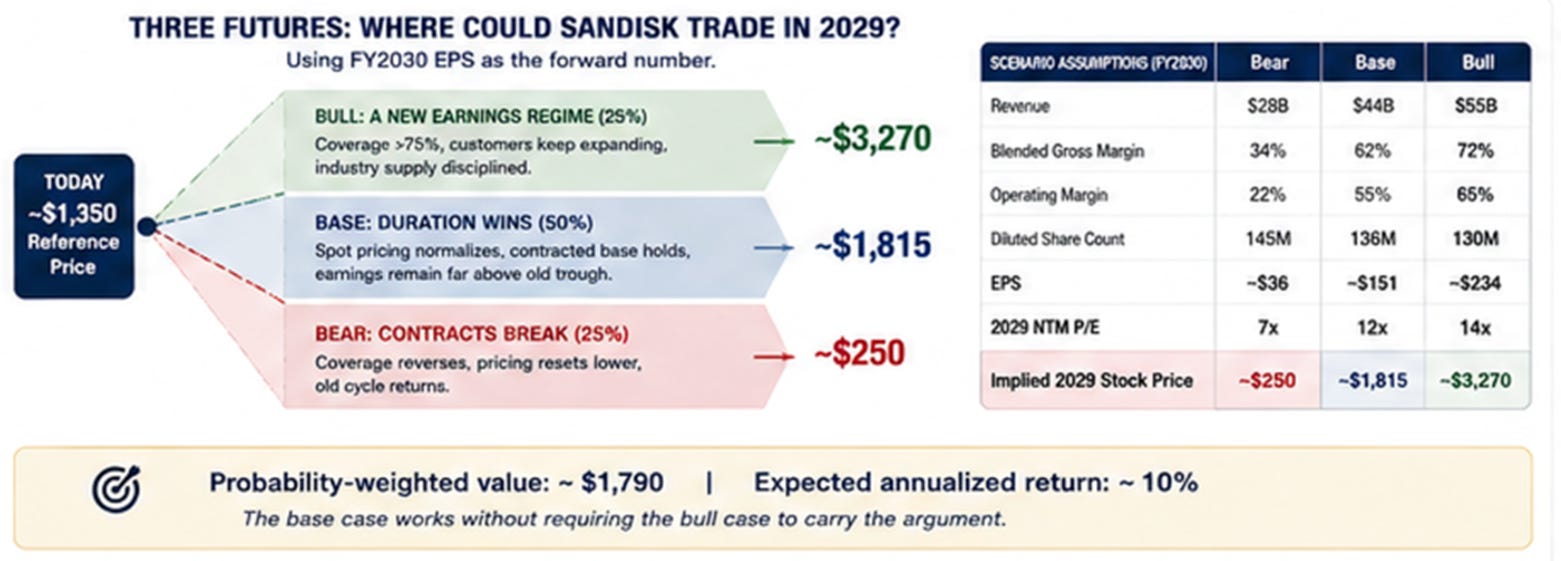
The bear case assumes the commercial model fails the test: customers renegotiate, variable pricing resets lower, coverage retreats, competitor capacity returns, and the uncontracted book collapses. This is a real bear case, not a softened base case.
The base case does not require Sandisk to escape the cycle. Revenue reaches $44 billion, margins normalise well below current levels, and EPS falls far below peak-cycle expectations. The return comes from applying 12 times earnings to a more dependable $151 rather than 7–8 times an apparently temporary $200.
The bull case requires contract coverage above 75%, continued customer expansions, disciplined industry supply, and aggressive buybacks. Under those conditions, Sandisk would have created a new earnings regime rather than merely a better cycle.
At roughly $1,350, the probability-weighted value is about $1,790, or close to a 10% annual return over three years. More important, the base case works without requiring the bull case to carry the argument. I would own Sandisk here.
What I Track Now
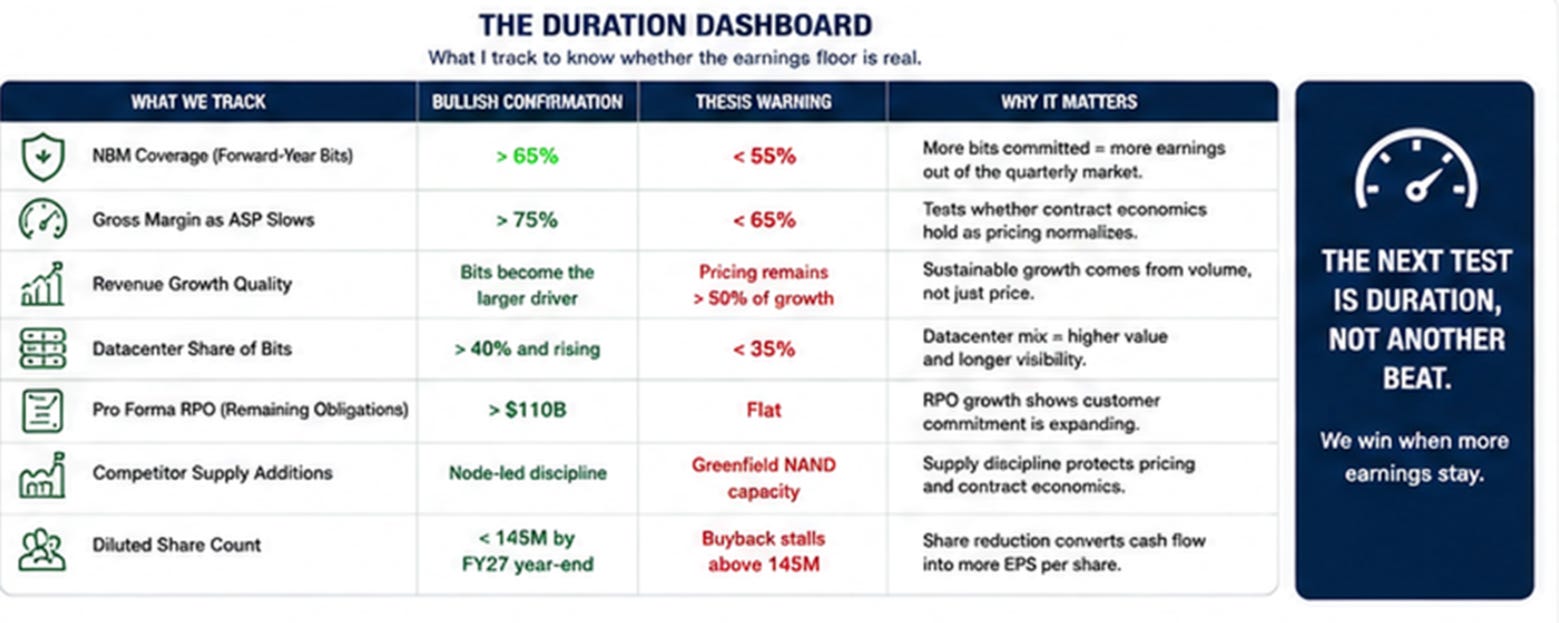
The first three items matter most. Coverage tells us how much of the business has been moved out of the quarterly market. Gross margin tells us whether the promised floor is real. The mix of bits and price tells us whether Sandisk can grow after the pricing cycle stops doing the work.
The Earnings That Stay
Management is no longer choosing between a slightly higher or lower quarterly margin. It is choosing what kind of company Sandisk becomes when the shortage ends.
The old Sandisk maximised the upcycle and accepted the bust. The new Sandisk is contracting supply, sharing risk with customers, planning products several years ahead, and using the resulting cash to shrink the share count. The peak rate of earnings improvement may be behind it. That is not the end of the thesis.
Sandisk spent five quarters proving how high earnings could go. FY4Q showed why far more of them may stay.
Disclaimer:
The content does not constitute any kind of investment or financial advice. Kindly reach out to your advisor for any investment-related advice. Please refer to the tab “Legal | Disclaimer” to read the complete disclaimer.