


TL; DR
The thesis has moved beyond peak earnings: contracts now provide multi-year demand visibility, while Sandisk is deliberately keeping actual bit growth below technological productivity.
The real compounding mechanism is per share: technology lowers capital needs, contracts stabilize cash flow, supply discipline limits reinvestment, and buybacks permanently shrink the denominator.
The key risk is time: Sandisk does not need NAND cyclicality to vanish. It needs current economics to persist for three to four years long enough for buybacks to permanently reshape per-share earnings before the next downturn.
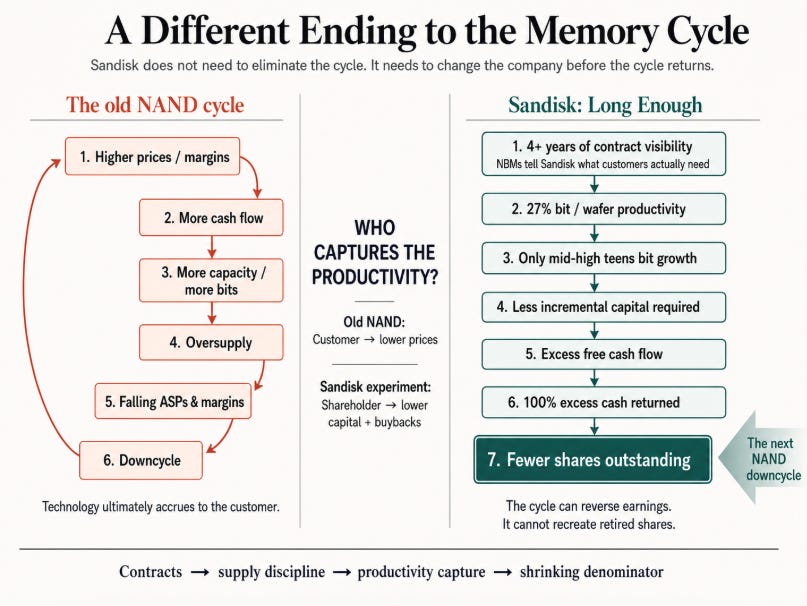
This is my fifth piece on Sandisk in nine months. Each previous piece revised the last as the business kept transforming faster than the framework could hold, and I am wary of doing that again on the strength of an Investor Day that has not yet been tested by a difficult quarter. What follows is not a re-modelled forecast. It extends the argument I made eight days ago in The Earnings That Stay, which was that the debate had moved from peak earnings to duration. Investor Day did not invalidate that thesis. It showed the machinery management believes sits between the contracts we had already identified and the shareholder value we were still unwilling to assume.
How Long Is Long Enough?
The bear argument on Sandisk is that eighty percent gross margins cannot persist because memory always mean-reverts. The bull argument is that management has guided to eighty percent, so the stock should trade at ten times three hundred dollars of earnings. Both arguments treat the level of earnings as the only thing that matters. Neither engages with the question that Investor Day actually posed.
The real question is not whether current economics are sustainable forever. The real question is whether they need to be. Suppose Sandisk remains highly profitable for three or four years, even if margins ultimately settle below management’s targets. During those years, contracts make cash generation predictable, technology supplies most of the required bit growth, capital intensity stays low, and management returns the surplus through repurchases. The next downturn would then strike a company with materially fewer shares outstanding. It could reduce corporate earnings. It could not recreate the shares already retired.
That is the consequence I underweighted after fiscal fourth quarter. The question is not merely how much of today’s earnings stay. It is what those earnings can permanently change while they are here. The mechanism has four moving parts and they reinforce each other. Technology continues to reduce the capital required to produce each bit. Contracts convert the demand side into forecastable cash flow. Supply discipline lets management hold actual bit growth below what the technology could deliver. And buybacks compound the resulting cash into a permanently smaller share count. Any one of these in isolation is corporate finance. The four together are how a cyclical business quietly restructures its per-share economics before the cycle has a chance to reset them.
Why Sandisk, Why Now
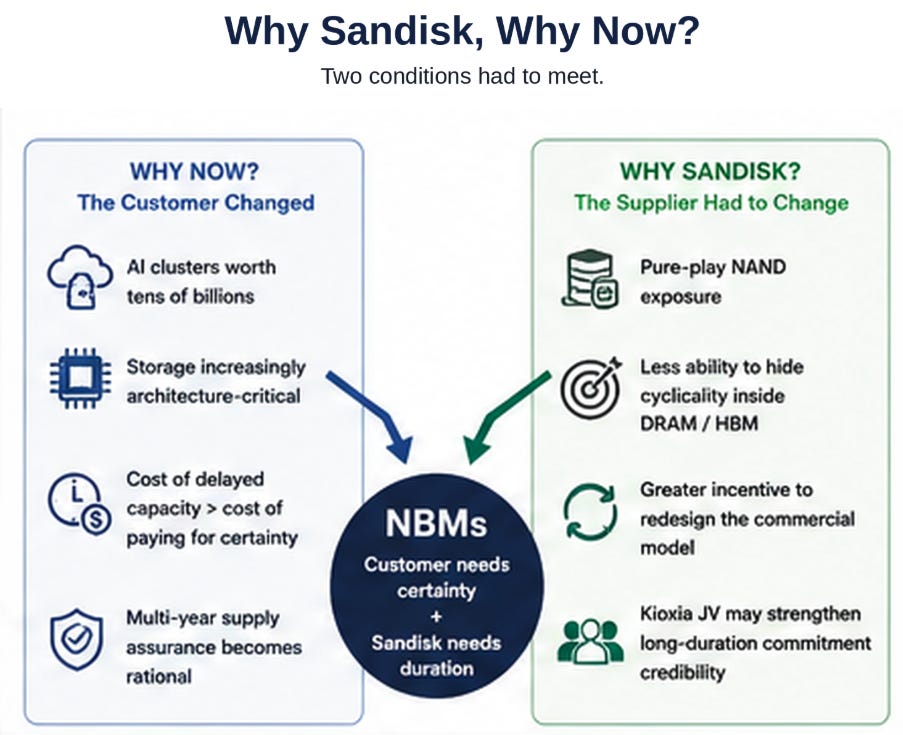
The strategic question worth asking is why Sandisk is the company attempting this and not one of the four larger memory manufacturers. Samsung has more scale, more capital, and more customer relationships. SK Hynix has better balance sheet flexibility and an integrated HBM business. Micron is larger and more diversified. Any of them could theoretically have moved first on multi-year contracts with financial guarantees. None of them did.
Sandisk moved first because Sandisk had to. The company came out of the Western Digital separation with a market capitalisation that was, at the low, less than the replacement cost of a single leading-edge NAND fab. In that context, management had two options: run the business as a smaller version of its competitors and wait for the cycle, or restructure the commercial model in a way that would force investors to reconsider what the company actually was. The first option would have produced a fine business and a decade of oscillation between forty dollars and two hundred. The second was strategic in the sense Michael Porter used the word: a deliberate decision to compete on a different dimension than the industry.
There may also be an irony in Sandisk’s manufacturing structure worth naming, though I would not build the thesis around it. Investors have historically treated the Kioxia joint venture as a constraint because it limits Sandisk’s ability to unilaterally redirect capacity. That same structural limitation may make long-duration customer commitments more credible, because Sandisk cannot easily walk away from a contract even if the math turns against it. This is inference rather than something management disclosed, and it would be one factor among several including financial guarantees, quarterly volume specifications, and strategic engagement. Kioxia’s own commercial interests could still disrupt the arrangement, which is why the argument sits at the level of a plausible contributor rather than a load-bearing claim. But it is worth flagging that the feature usually described as weakness may function differently in a contracted world.
Contracts Change Time
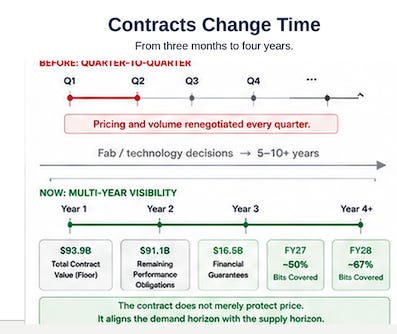
Sandisk’s New Business Models now cover eight customers, including three American hyperscalers. Weighted-average duration exceeds four years, total contract value at floor pricing is $93.9 billion, remaining performance obligations are $91.1 billion, financial guarantees total $16.5 billion, and coverage rises from roughly half of FY2027 bits to about two-thirds in FY2028. Two customers have already expanded their commitments within weeks of signing.
The previous article treated these agreements primarily as protection against falling prices. Investor Day showed their second function: they are an information system. Sandisk previously made decade-long investments while learning every quarter what customers wanted and what they would pay. It now receives product, volume, and timing commitments several years ahead. That visibility does not guarantee forecasts are correct. It makes disciplined supply possible in a way quarterly auctions never did. The contracts therefore do more than raise an earnings floor. They tell Sandisk which bits customers have committed to buy, and which production the company should not create merely because its technology allows it.
Who Captures the Productivity
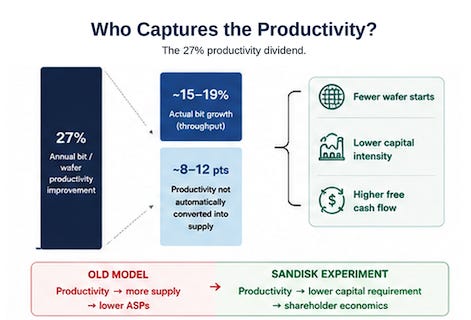
Management says the BiCS technology roadmap can produce roughly twenty-seven percent annual bit-per-wafer productivity while Sandisk intends to grow actual volume only in the mid-to-high teens. The gap is not an idle technical detail. It determines whether innovation becomes future oversupply or retained economics.
The old memory model converted every cost reduction into more bits, lower prices, and value transferred to the customer. Goeckeler’s declaration at Investor Day that Sandisk’s cost reductions are “ours” was more consequential than it sounded. Management wants market pricing to determine revenue while technology reduces the wafers and capital required to serve committed demand. Sandisk cannot impose that discipline on Samsung, Micron, SK Hynix, or Kioxia. Industry supply can still break the economics. What Sandisk can control is whether its own productivity becomes additional capacity or free cash flow. Investor Day made clear which outcome management prefers.
What Happens to the Cash
Sandisk intends to return one hundred percent of excess cash after funding the business and maintaining a debt-free balance sheet, with repurchases as the current mechanism. This is usually presented as capital allocation. In a memory company, it is also supply discipline expressed through the balance sheet.
The traditional cycle contains its own destruction: high prices produce high cash flow, high cash flow funds more capacity, more capacity destroys prices. Sandisk is proposing to let technology provide most of the bit growth and send the residual cash to shareholders instead of recycling it into wafers. The buyback is not merely financial engineering. It is the mechanism through which the current regime becomes permanent even if the regime itself does not last.
It also makes the share count endogenous. If the market remains sceptical and the stock trades at a low multiple, each dollar buys back more of the company. If investors accept the duration argument and rerate the stock, repurchases become less accretive but shareholders receive the rerating immediately. The genuinely bad outcome is not that the multiple stays low. It is that the earnings disappear before the denominator changes.
The Category Question Follows
If this system works through even one full downturn, the market will eventually have to decide whether Sandisk still belongs in the peer group it currently sits in. A memory specialist asks where NAND pricing will be next quarter. A generalist can begin asking how much four years of contracted cash flow will reduce the share count. Those investors do not pay the same multiple because they are not underwriting the same object. But category change is the consequence of the mechanism working, not the thesis. It is what happens if the argument is right, not the argument itself.
Three Futures
The scenarios below use FY2030 earnings as the forward basis for a stock value roughly three years from now. They are estimates, not management guidance.
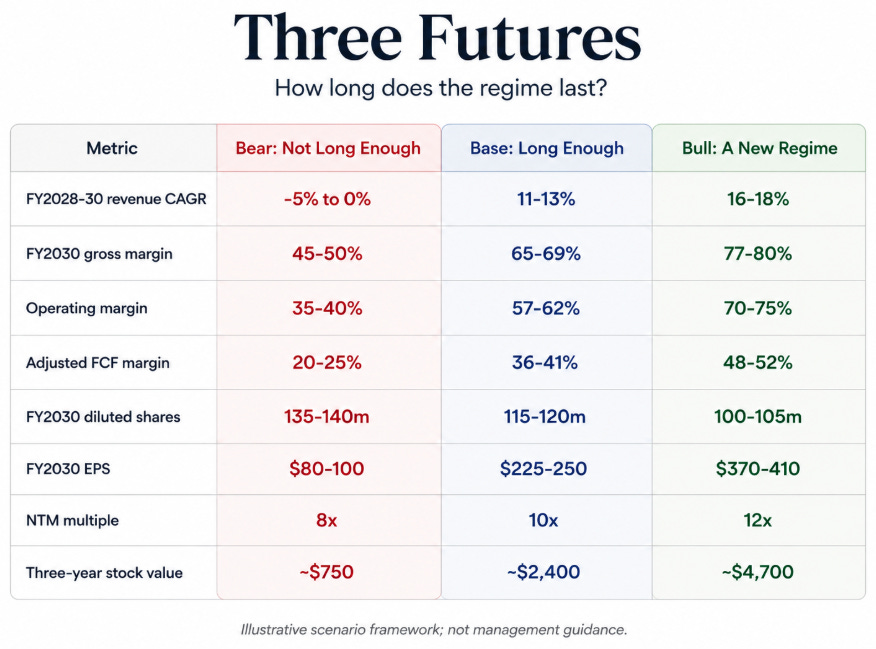
The bear case assumes customers renegotiate when spot prices fall, competitor supply returns, and buybacks lack the time and scale to alter the share count materially. The base case assumes management is too optimistic on margins but broadly right on duration: NAND remains cyclical, HBF contributes nothing material, and three to four years of high cash generation permanently improve per-share economics. The bull case requires NBM coverage to keep rising, industry supply discipline to persist, and management’s framework to prove broadly achievable. I would weight these 20 / 55 / 25, implying a rough central value near $2,650. The base case matters most because it does not require Sandisk to abolish the NAND cycle. It requires the current regime to last long enough.
What to Watch
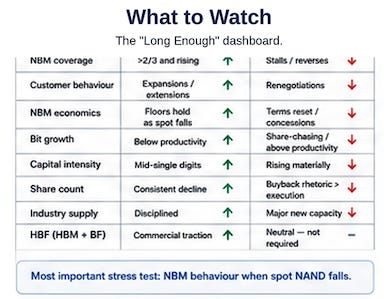
NBM coverage must continue past two-thirds rather than stall. Customer expansions must continue rather than reverse. Contract economics must remain intact when spot pricing weakens. Sandisk must hold actual bit growth below technological productivity, keep capital intensity in the mid-single digits, and reduce the diluted share count rather than merely announce repurchase authorisations. Competitor capacity remains the external variable the company cannot contract away. HBF should be tracked separately as upside rather than requirement.
Long Enough
The previous article asked how much of Sandisk’s earnings would stay. Investor Day did not answer that question. It suggested we may have been asking it too literally. The earnings do not need to stay forever. They need to stay long enough for technology to reduce the capital required to produce them and for the cash they generate to reduce permanently the number of claims against them. The NAND cycle may return. The shares Sandisk bought back cannot.
General Disclaimer: The information presented in this communication reflects the views of the author and does not necessarily represent the views of any other individual or organization. It is provided for informational purposes only and should not be construed as investment advice, a recommendation, an offer to sell, or a solicitation to buy any securities or financial products.
While the information is believed to be obtained from reliable sources, its accuracy, completeness, or timeliness cannot be guaranteed. No representation or warranty, express or implied, is made regarding the fairness or reliability of the information presented. Any opinions or estimates are subject to change without notice.
Past performance is not a reliable indicator of future performance. All investments carry risk, including the potential loss of principal. This communication does not consider the specific investment objectives, financial situation, or particular needs of any individual.
The author and any associated parties disclaim any liability for any direct or consequential loss arising from the use of this material and undertake no obligation to update or revise it.