


TL; DR
Shopee’s underlying economics are improving: advertising grew more than 70%, core marketplace revenue rose 65.6% on 28.4% GMV growth, and logistics unit costs continued falling.
The missing margin is being reinvested: Sea beat revenue expectations by nearly $700 million but delivered EBITDA roughly in line, as better economics funded customer acquisition, fulfillment, VIP and credit expansion.
The integration moat has limits: Monee’s economics are strongest inside Shopee. Off-platform lending and Brazil introduce higher provisions and will test how well Sea’s advantage travels beyond its core ecosystem.
“Our improving operational efficiency and growing scale have strengthened our unit economics. We can now profitably serve a wider range of users, enabling us to lean further into user acquisition.”
— Forrest Li, Sea Q2 2026 earnings call
Sea reported $7.8 billion of second-quarter revenue, nearly $700 million above the Bloomberg consensus we had going into the print. Adjusted EBITDA was $917 million. Consensus was $919 million.
That juxtaposition is more interesting than either number by itself.
Sea generated far more revenue than investors expected and almost none of that upside appeared as incremental reported EBITDA. The obvious conclusion is that the company is still spending aggressively. The more important question is whether that spending reflects poor underlying economics or increasingly attractive opportunities to reinvest economics that are improving.
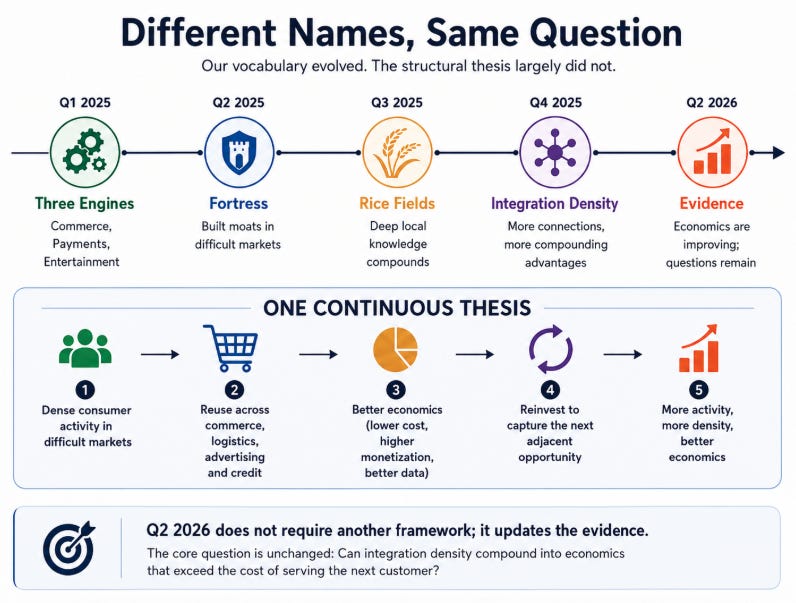
I have been writing about Sea for five quarters, and there is a useful correction to make before answering that question. I have called essentially the same thesis a flywheel, a fortress, the rice-field advantage, and finally integration density. The terminology moved around more than the investment thesis did. I am going to stop renaming it.
The thesis is simply that Sea builds dense consumer activity in difficult emerging markets and can reuse that density across commerce, logistics, advertising, and financial services. More activity should lower service costs, make access to consumers more valuable to sellers, and generate better information for underwriting. If those improvements exceed the cost of acquiring the next customer, the economics can finance still more activity.
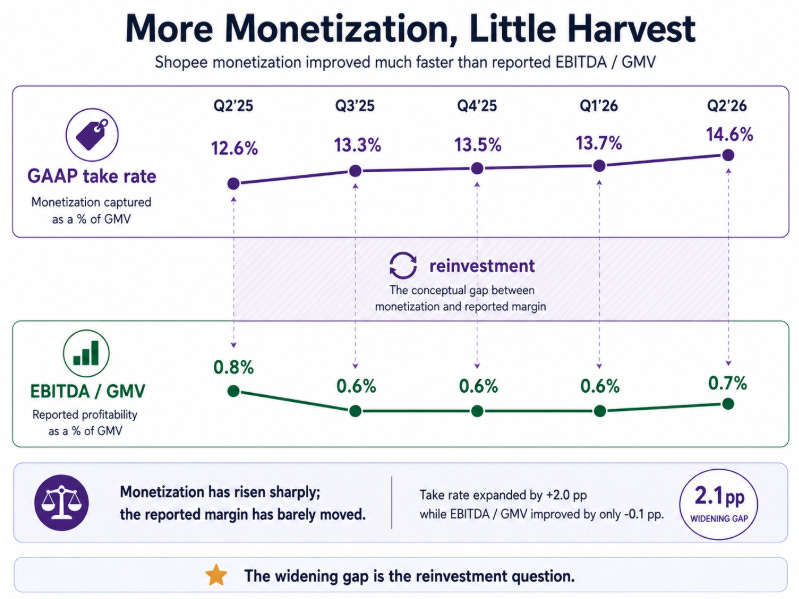
Six months ago, in The Choice Not to Harvest, I admitted that I had been early on when those economics would appear in Shopee’s reported margin. Q2 does not erase that mistake. Shopee adjusted EBITDA is still only around 0.7% of GMV. What Q2 does provide is the strongest evidence yet that the machinery underneath that margin is beginning to work.
What We Said, What Happened
The best way to avoid changing the story every quarter is to score the old one.
In Q3 2025 I laid out several explicit signposts for Q2 2026. Two worked considerably better than expected; the one that mattered most for reported profitability did not.
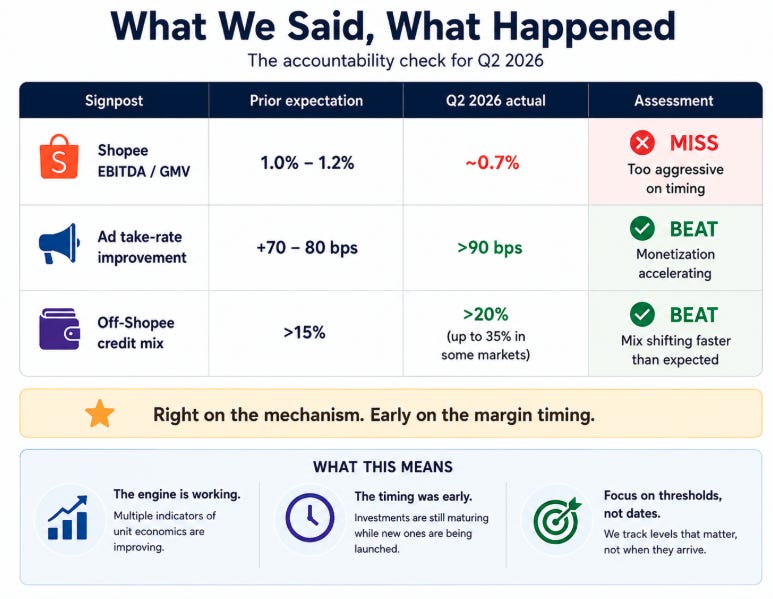
The margin miss matters. I had assumed that investments made through 2025 would begin maturing and visibly release profit by now. Some are maturing, but Sea keeps finding new things worth funding: fulfillment, instant delivery, VIP, content distribution, Brazil, and new Monee customers.
That suggests my old mental model was incomplete. I implicitly assumed:
invest → mature → harvest.
Sea increasingly looks more like:
invest → economics improve → more customers or use cases become economically attractive → reinvest.
That distinction is crucial because successful investment can delay the reported margin precisely because it is successful.
Forrest Li’s statement that Shopee can now “profitably serve a wider range of users” is the clearest expression of this. Better economics have not simply produced more EBITDA. They have expanded the pool of customers Sea believes it can acquire profitably.
The Investment Cycle That Keeps Renewing
The evidence begins with customers. Average monthly new active buyers grew more than 35%, active buyers increased 18%, and purchase frequency rose 8%. Shopee was simultaneously adding customers and extracting greater engagement from existing ones.
Then there is monetization. Advertising revenue grew more than 70%, ad take rate increased over 90 basis points, the number of ad-paying sellers rose around 45%, and average ad spend per seller increased more than 15%. Core marketplace revenue — transaction fees plus advertising — grew 65.6%, more than twice Shopee’s 28.4% GMV growth.
This is a healthier form of monetization than simply increasing commissions. Management acknowledged that the pace of fixed commission increases will probably slow, but sees substantial remaining opportunity in advertising, where AI is improving targeting, campaign diagnosis, personalized vouchers, and seller returns.
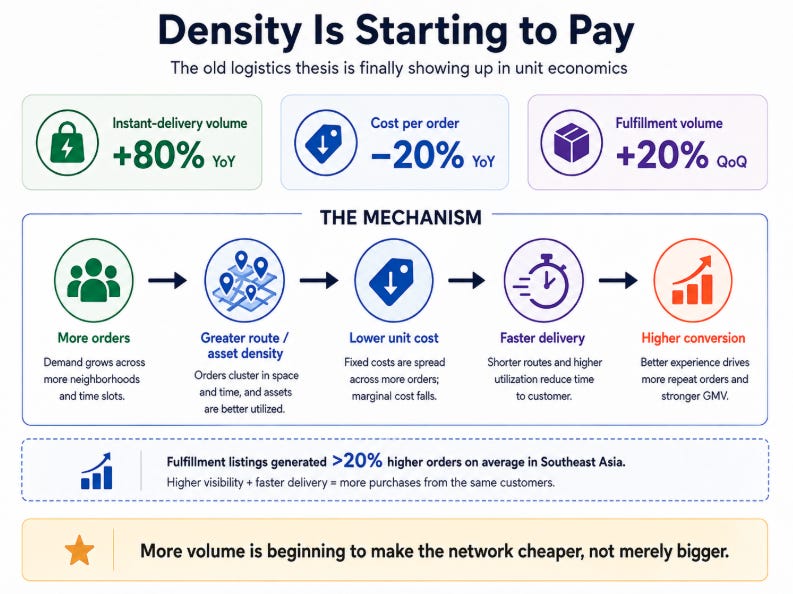
The physical economics are even more revealing. Instant-delivery volumes in Indonesia grew roughly 80% while cost per order fell around 20%. Fulfillment volumes increased more than 20% sequentially, and listings shifted into fulfillment generated more than 20% higher orders on average in Southeast Asia.
That is the old rice-field idea finally appearing in economics rather than anecdotes:
Fulfillment remains early. Sea says its penetration is still well below several peers, particularly in Brazil, but its economics are improving as seller participation increases, warehouses integrate more tightly with SPX, utilization rises, and automation lowers cost. Importantly, Sea rents fulfillment facilities rather than owning the underlying land and warehouses, limiting the capital required to pursue the opportunity.
This is why the $917 million of group EBITDA matters. The extraordinary revenue beat did not produce an EBITDA beat because Sea is still reinvesting aggressively. That does not mean Sea could simply have reported whatever EBITDA it wanted; different revenue streams carry different incremental costs. What the quarter does tell us is that reported profitability continues to understate how rapidly some of the underlying economics are improving.
The comparison with Amazon’s long reinvestment period is tempting, but it should not be taken too far. The relevant lesson is not that Sea is another Amazon. It is that reported margins can be a poor measure of economic progress when successful investments repeatedly create adjacent opportunities worth funding. Sea still has to prove that those opportunities earn attractive returns.
So far, Shopee increasingly is.
Management reaffirmed that 2–3% EBITDA/GMV remains within reach and described a straightforward bridge: investment programs mature, logistics and fulfillment costs decline, and take rate improves through advertising and other monetization. It also confirmed that absolute Shopee EBITDA in the second half should exceed the first half.
That does not tell us when 2–3% arrives. It does tell us why 0.7% need not be the ceiling.
Where the Advantage Gets Thinner
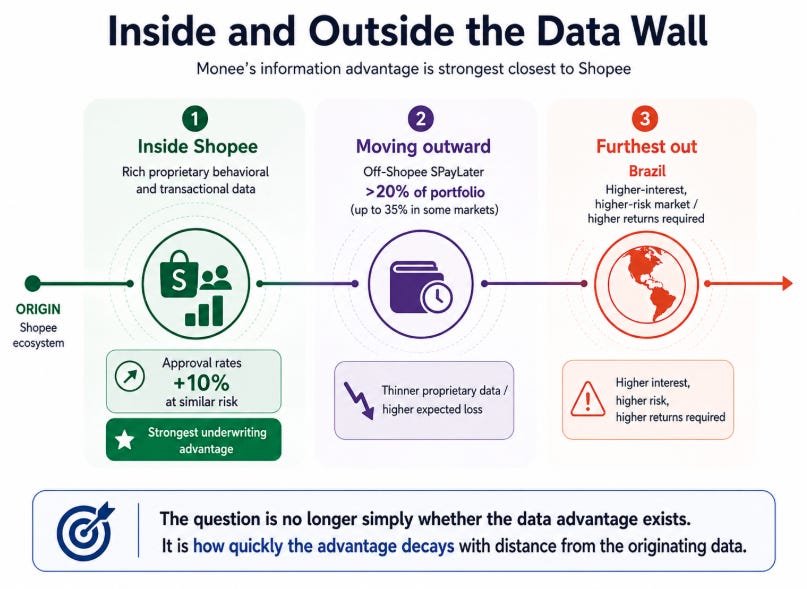
Monee is where the integration thesis is both most impressive and most vulnerable.
The loan book grew 62% to $11.1 billion while 90-day NPLs remained at 1.0%. Sea’s newer underwriting models, trained on sequences of behavioral and transactional information, increased approval rates by around 10% without increasing observed risk. The company added 5.3 million first-time borrowers, active credit users rose 34% to more than 40 million, and average balances per user increased 20%.
This is the mechanism we have been arguing for several quarters: commerce produces information that allows Monee to make better credit decisions.
But Q2 also revealed the boundary.
Off-Shopee SPayLater now exceeds 20% of the portfolio, reaching 35% in some countries, while Sea is preparing a standalone financial-services application in Brazil. Management explicitly said higher credit provisions reflect greater exposure to off-Shopee lending and Brazil, which it described as a higher-interest, higher-risk market.
Monee’s numbers show the trade-off:
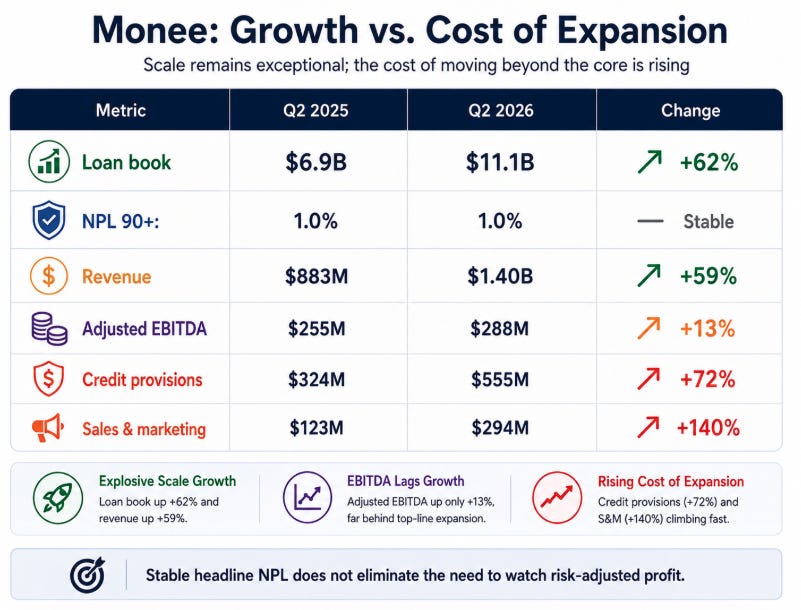
Source: Sea Q2 2026 results.
The old question was whether Sea’s proprietary data advantage existed. Q2 makes that increasingly difficult to dismiss.
The better question is now how quickly that advantage decays as Monee moves farther from Shopee.
Management says every product, segment, and country must maintain stable risk and positive returns on assets. That may make higher provisions perfectly rational if higher-risk markets also produce appropriately higher yields.
But this is exactly where the thesis should be tested rather than celebrated.
The Brazil Test
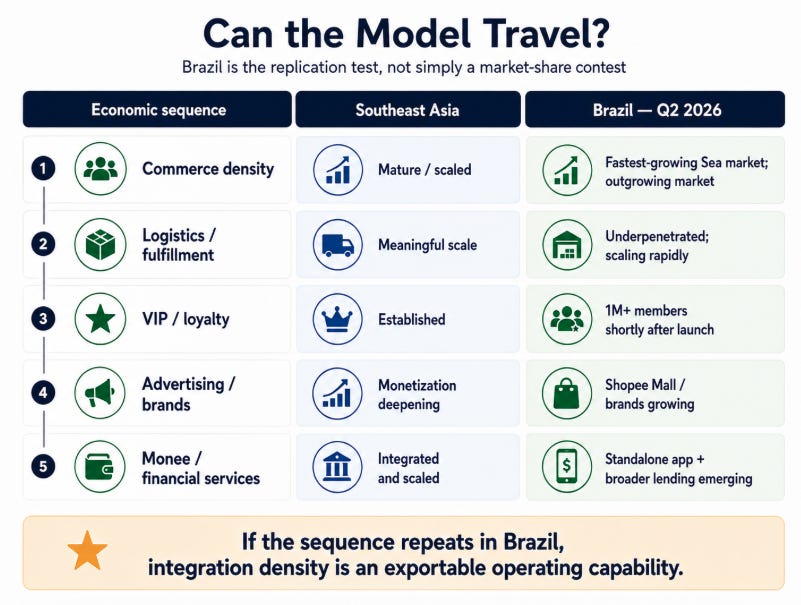
Brazil increasingly matters because it tests whether Sea’s operating model travels.
Shopee remains Sea’s fastest-growing market there. Management says it is growing faster than both the market and close competitors despite competitive changes to shipping thresholds and pricing and expects to continue outgrowing the market profitably.
At the same time, fulfillment remains underpenetrated, VIP has already exceeded one million Brazilian members, Monee lending is expanding, and Sea plans to launch a broader financial-services application with capabilities comparable to existing local competitors.
Sea does not need to defeat MercadoLibre for this thesis to work. It needs to demonstrate that the sequence developed in Southeast Asia, commerce density, lower service costs, higher monetization, and eventually broader financial services can be reproduced somewhere else.
If Brazil does that, integration is not simply a regional accident. It is an operating capability.
What We Know Now
The variant perception is not that investors have failed to notice the $1 billion Shopee EBITDA guide. They have.
The more interesting possibility is that the market still treats Shopee’s reported margin as a reasonable proxy for its underlying economics. Q2 suggests that assumption is becoming less safe. Logistics costs are declining with density, advertising is monetizing that density at much higher rates, and Sea is simultaneously adding customers without resetting Shopee EBITDA.
That does not mean management can manufacture any margin it wants. It means the eventual margin may be considerably higher than the current P&L implies.
My three-year framework therefore depends less on predicting perpetual 25–30% GMV growth and more on how much of these improving economics eventually reaches earnings.
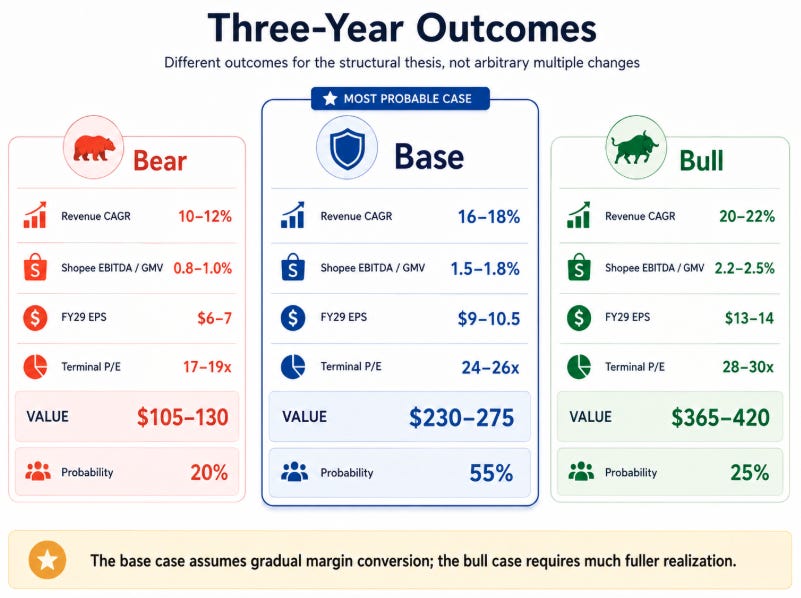
At roughly $127–128 following the print, the broad probability-weighted value lands around $250–260, roughly a mid-to-high-20s annualized return over three years. The base case does not require Sea to reach 3% margins. It requires transaction density to continue improving economics gradually while Monee scales without a material deterioration in risk.
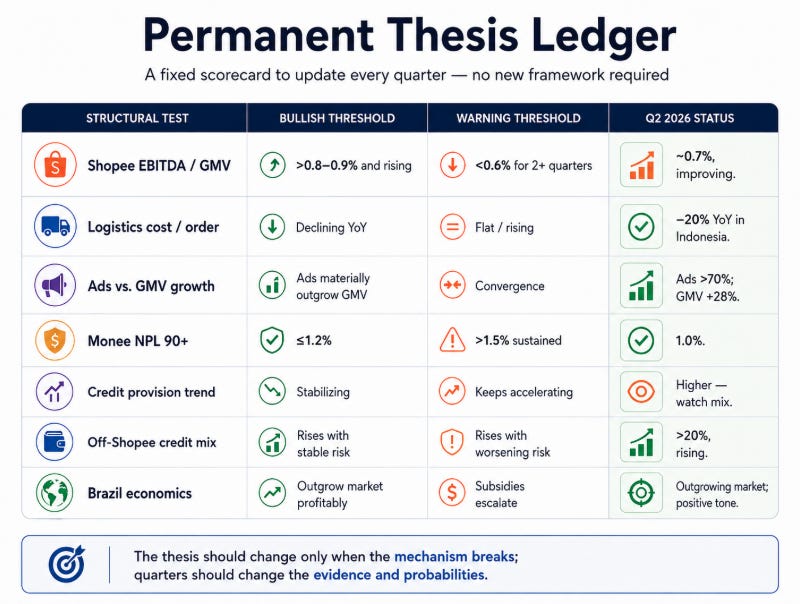
The tracking ledger from here should therefore remain fixed: Shopee EBITDA/GMV sustainably above 0.8–0.9%; advertising continuing to materially outgrow GMV; logistics unit costs continuing to fall; Monee NPL staying around 1.0–1.2%; credit provisions stabilizing as off-Shopee lending grows; and Brazil maintaining above-market growth without requiring escalating subsidies.
Six months ago, I wrote that the fields were not ready to harvest. I still would not declare them ready today.
What Q2 changes is our understanding of why.
The investments we expected to mature are maturing. The problem, if it can be called one, is that their success keeps revealing another economically attractive place to invest. That makes Sea’s eventual margin harder to time.
It also makes the underlying earnings power easier to believe.
Disclaimer:
The content does not constitute any kind of investment or financial advice. Kindly reach out to your advisor for any investment-related advice. Please refer to the tab “Legal | Disclaimer” to read the complete disclaimer.