


TL; DR
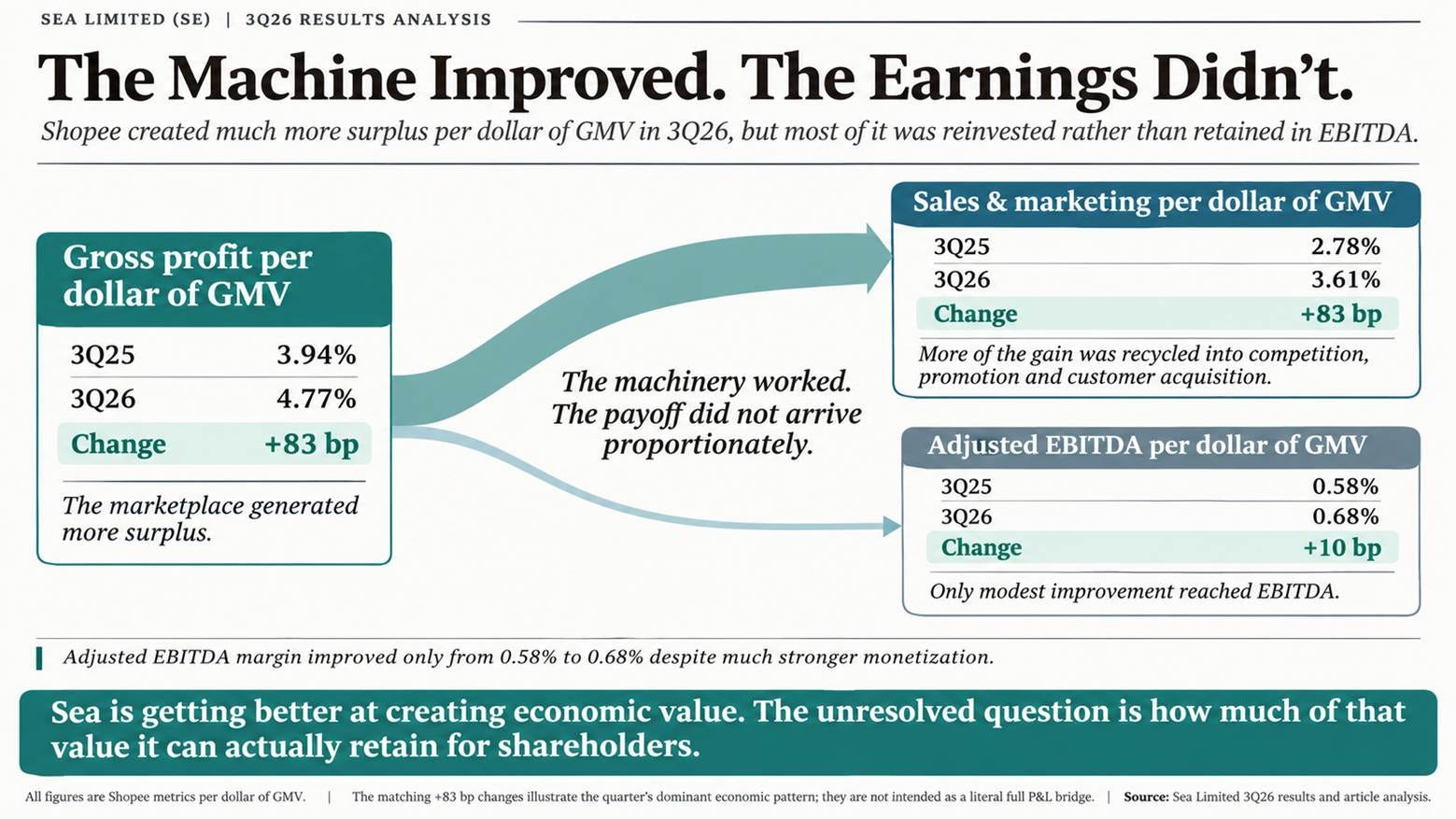
The operating thesis worked: Shopee generated 83 basis points more gross profit per dollar of GMV year over year. But sales and marketing also rose by 83 basis points, leaving EBITDA margin only modestly better. The machinery improved; the earnings did not arrive proportionately.
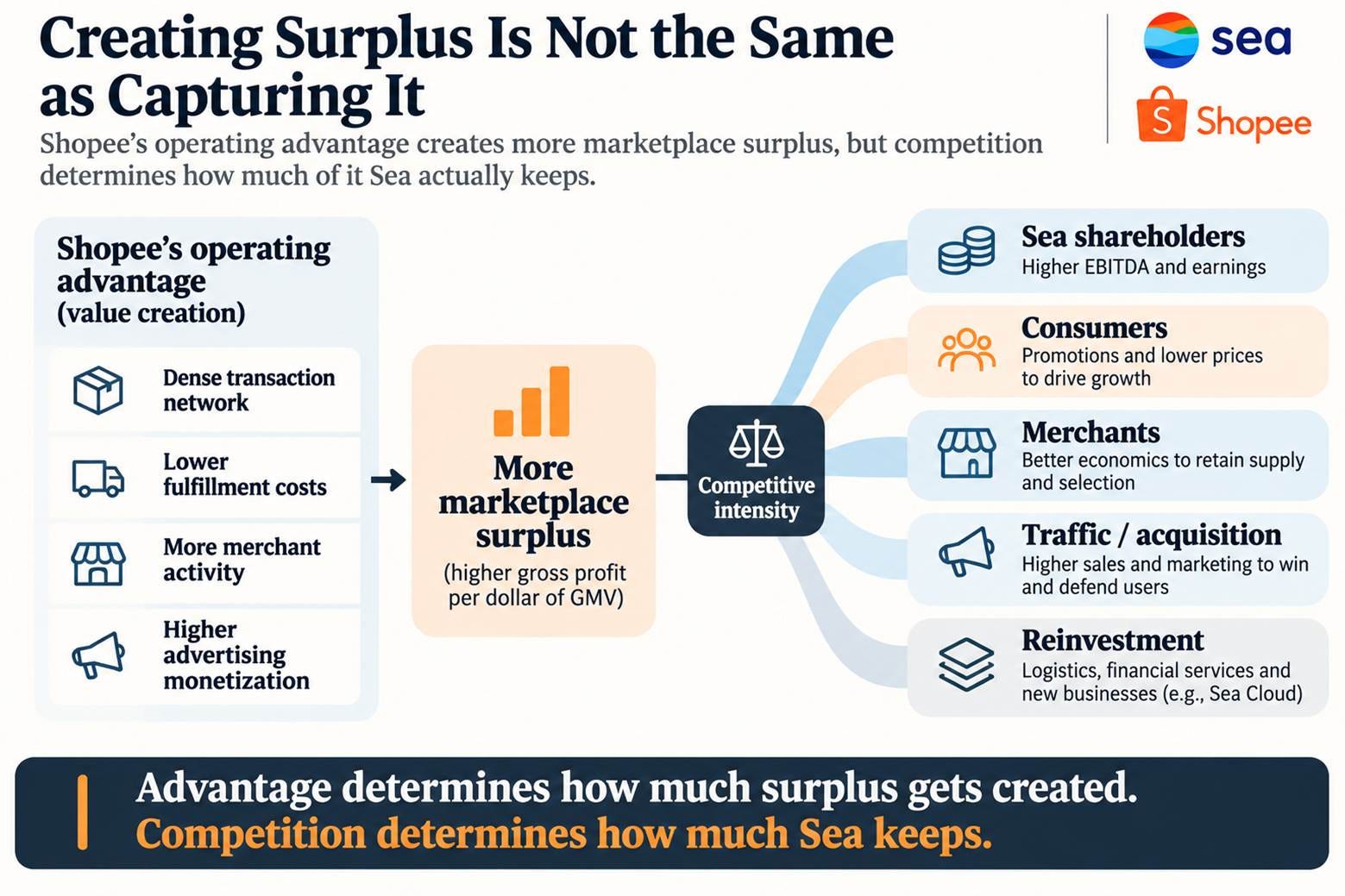
The problem is now economic capture, not capability: better logistics, advertising and monetization can create real surplus while competition forces much of it back into promotions, customer acquisition and ecosystem investment. A better marketplace is not automatically a more profitable one.
New businesses create additional claims on the surplus: Monee is becoming more capital-intensive and less obviously advantaged as lending moves off-platform, while Sea Cloud remains commercially unproven. Garena can fund these bets, but that also allows reinvestment to continue without forcing an immediate return test.
In November 2025, I wrote:
At $142 and 27× forward earnings, you’re paying bear-case prices for base-case outcomes. The rice field advantage is worth $255–290 if real, $140–170 if not. Six to nine months clarifies which.
Twelve months later, Sea closed at $76.80, below even the downside range I had published. The operating business, meanwhile, has become considerably stronger. Third-quarter revenue increased 43% to $8.6 billion, Shopee’s GMV grew 23%, advertising revenue advanced more than 55%, and Garena continued generating exceptional cash profits.
The uncomfortable conclusion is that we were largely right about the business and wrong about what that meant for the stock.
Across six articles since February 2025, our thesis has evolved from Shopee’s logistics density to advertising monetization, financial services and increasingly integrated customer relationships. Each development strengthened our confidence in Sea’s underlying economic capabilities. When margins failed to follow, we attributed the difference to another attractive opportunity to reinvest.
That explanation became too convenient. It allowed almost any earnings disappointment to be interpreted as evidence of a larger future opportunity.
Third-quarter results finally give us a way to separate the economics Sea is creating from the economics its shareholders are receiving.
The Improvement We Mistook for Earnings
Our original Shopee thesis was straightforward. Dense transaction networks lower fulfillment costs, attract merchants and increase the value of advertising. Greater monetization, combined with cheaper delivery, should eventually produce substantial operating leverage.
In November 2025, I expected Shopee’s adjusted EBITDA to reach 1.0–1.2% of GMV by the second quarter of 2026. I also established a failure condition: margins remaining below 0.7% through that quarter would challenge the thesis if unit costs were not declining.
The condition was breached. Second-quarter margin was 0.67%, followed by 0.68% in Q3. Ye t the operating improvements we predicted were occurring.
This is the quarter’s most important financial disclosure. Shopee generated 83 basis points more gross profit per dollar of GMV and spent an additional 83 basis points on marketing. Adjusted EBITDA improved modestly, while operating income increased by even less as depreciation rose.
The machinery worked. The additional profit did not arrive.
The error was in our failure condition. I assumed disappointing margins would indicate that Shopee’s operating costs were not falling. I had not adequately considered that costs could decline while the resulting surplus was continuously reinvested in promotions, advertising, logistics and customer acquisition.
In August, I wrote:
The investments we expected to mature are maturing. The problem, if it can be called one, is that their success keeps revealing another economically attractive place to invest. That makes Sea’s eventual margin harder to time. It also makes the underlying earnings power easier to believe.
The mistake lies in economically attractive. That was an assumption, not something we had demonstrated.
Asked where Shopee’s improving monetization would go, management explained:
We expect going forward, our monetization will also be better, primarily from the ad side, less from the fixed commission side. Part of that will flow to the bottom line adjusted EBITDA improvement over time. Part of that might go to the investment to grow our market further as well.
The word part matters. Advertising revenues can rise because Shopee’s marketplace has become more valuable, while advertising and promotions elsewhere become more expensive because competitors are fighting for the same customers.
Some spending strengthens the business. Some defends the position it already holds. Some may be the permanent price of maintaining growth.
The financial statements establish where the gains went. They do not tell us how much could be retained without weakening the network.
That distinction changes our understanding of Sea’s competitive advantage. Logistics density and advertising monetization may create substantial surplus, but competitive intensity determines how that surplus is divided among Sea, merchants, consumers and the platforms supplying traffic.
A better marketplace is not necessarily a more profitable marketplace.
The Next Claims on the Surplus
The question becomes more consequential as Sea expands beyond its core transaction system.
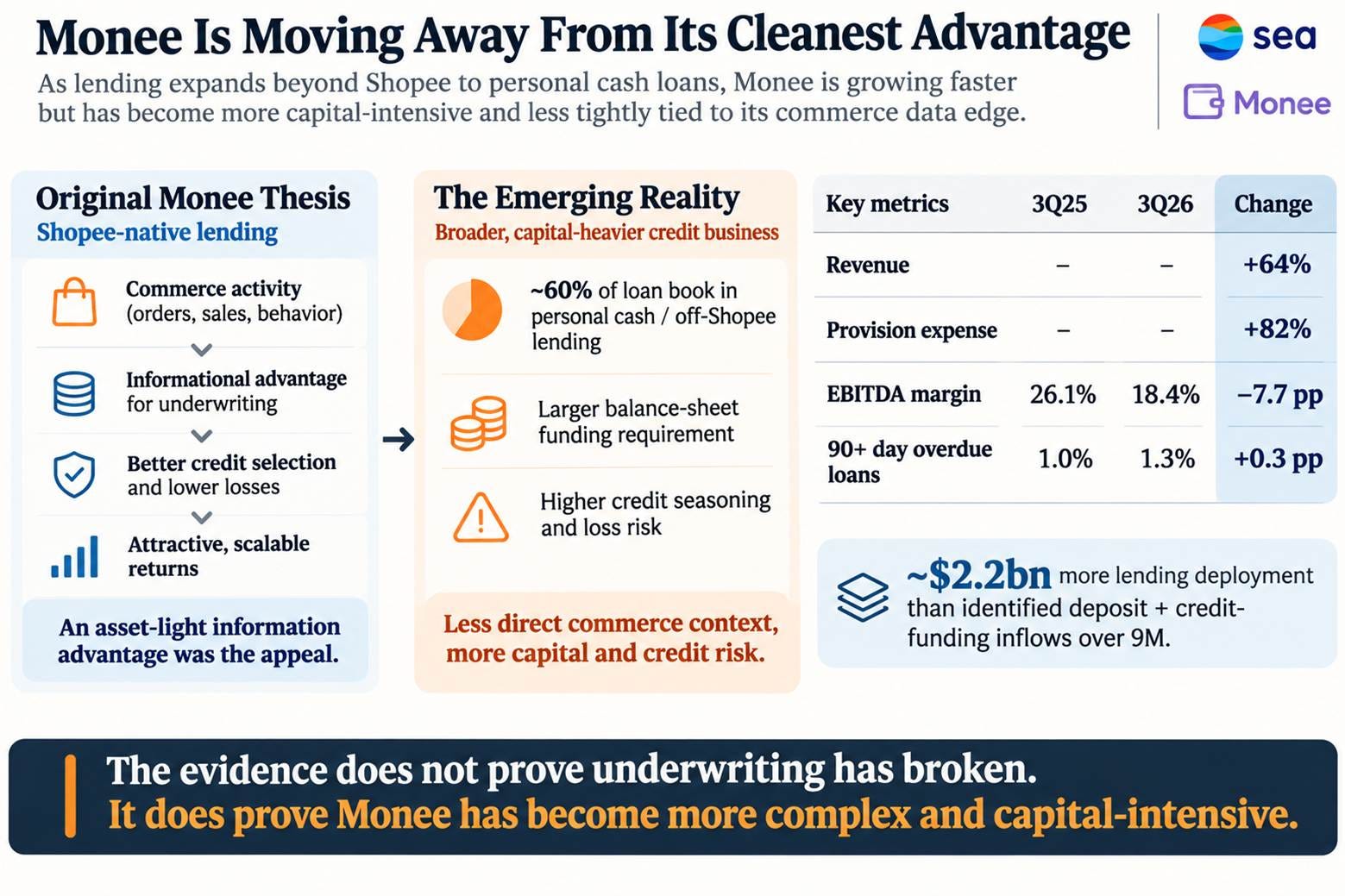
Monee was originally compelling because lending appeared to benefit from information generated inside Shopee. A merchant whose sales, orders and repayments are observable should be easier to underwrite than a borrower known only through a conventional credit application.
In August 2025, I described this as underwriting with “perfect information” and argued that extraordinarily rapid loan growth alongside low delinquencies suggested an exceptional structural advantage. That language was unjustified. More information can improve underwriting without eliminating credit risk, particularly when loans are young and losses have not matured.
The business is now moving farther from its original information advantage. Personal cash loans and off-Shopee lending account for approximately 60% of the loan book. Monee’s revenue increased 64%, but provisions rose 82%, EBITDA margin declined from 26.1% to 18.4%, and loans more than 90 days overdue rose from 1.0% to 1.3% in one quarter.
These developments do not establish that underwriting is deteriorating across every cohort. Management cited Thailand, Brazil and changes in market and product mix. Rapid origination also makes aggregate delinquency ratios difficult to interpret because newer loans have not aged sufficiently.
They do establish that the credit business is becoming more complex and capital-intensive.
Over nine months, lending deployment exceeded identified deposits and credit-funding inflows by approximately $2.2 billion. That represents capital invested in earning assets, not an operating loss, but shareholders must still finance it. A potential Monee listing could provide additional capital, although its value depends on the price, dilution and returns earned on the enlarged loan book.
The distinction between commerce and lending matters. Shopee can increase transaction density without putting the full value of those transactions on its balance sheet. Monee must finance loans and absorb credit losses. Its information advantage may be real, but the economics cannot be valued like software or advertising.
Sea Cloud introduces a different claim on resources.
Management argues that GPUs purchased for Garena, Shopee and internal AI workloads create an infrastructure base that can also serve external customers:
We are already making this investment for our own businesses. By serving external customers on top of that existing base, we can spread our fixed costs across more users and earn attractive incremental returns on capital.
The logic is familiar. Reuse an existing infrastructure investment, spread costs across more activity and create an additional revenue stream.
But management also acknowledged that Sea Cloud had not secured enterprise contracts. GPU investment continues regardless. Group capital expenditure reached $1.04 billion over nine months, more than twice the amount spent throughout 2025, although not all the increase is attributable to Cloud.
The opportunity could become valuable. At present, the external commercial returns remain hypothetical.
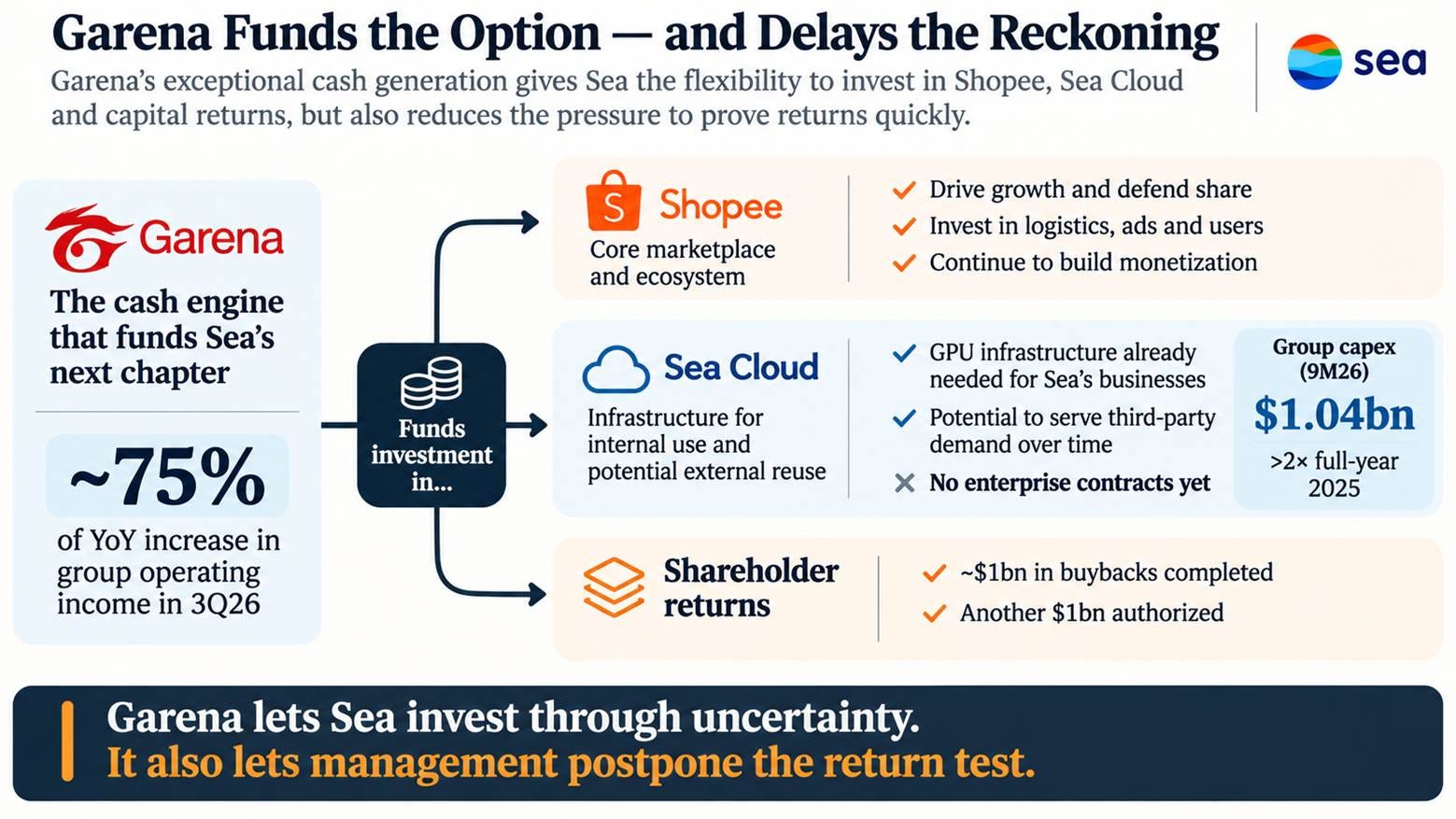
Garena provides Sea with the resources to pursue both opportunities. It contributed approximately three-quarters of the year-over-year increase in group operating income, and Sea has completed nearly $1 billion of buybacks while authorizing another $1 billion.
This combination is both a strength and a risk. A highly profitable gaming franchise allows management to invest through difficult cycles. It can also allow investments to continue longer before their returns become visible.
The common question across Shopee, Monee and Sea Cloud is not whether management can identify additional markets to enter. It is whether capital allocated to those opportunities earns more than the shareholders could have retained elsewhere.
What the Stock Is Pricing
Our previous variant perception was that Sea’s underlying economics were considerably better than the market appreciated. That may no longer be differentiated enough.
FactSet expects approximately $4.08 of GAAP EPS in 2027, implying 18.8 times earnings at $76.80. Investors are already assuming substantial profit growth. The stock’s decline does not establish that the market expects Shopee’s margins to remain depressed forever.
I increasingly agree with consensus about the underlying progress at Shopee. My remaining disagreement is narrower: whether Sea can eventually retain more of its operating improvements without sacrificing competitive strength, and whether Monee’s lending economics will prove more durable than the recent deterioration suggests.
August’s weighted valuation of approximately $250–260 is no longer defensible. The following revised outcomes value FY2029 earnings at the end of 2029, with stock compensation, depreciation, taxes and credit funding reflected in the assumptions. No separate premium is assigned to a Monee listing or Sea Cloud.
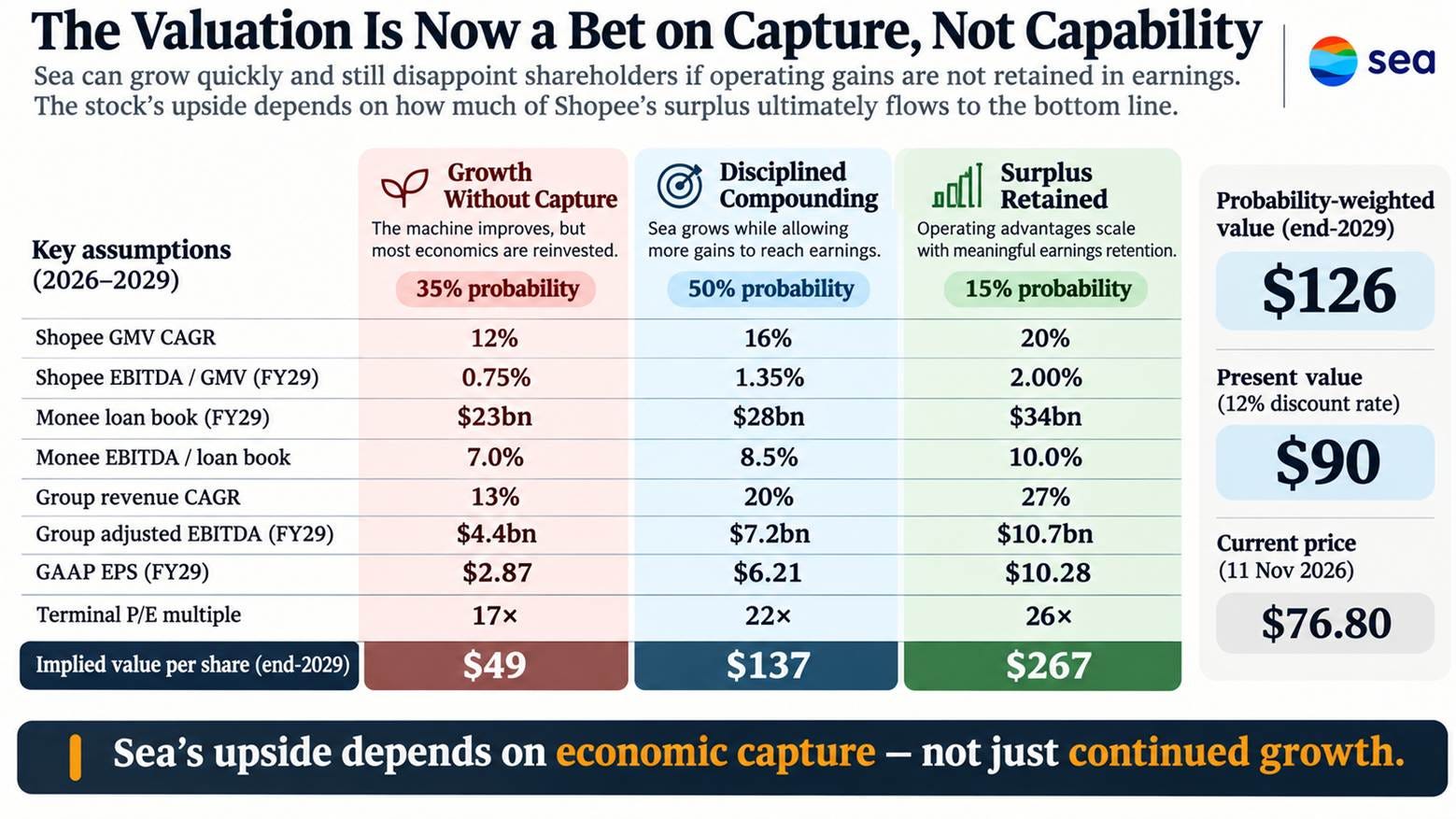
The probability-weighted terminal value is approximately $126, implying roughly 18% annualized appreciation from $76.80 over three years. Discounted at a 12% required return, that outcome is worth approximately $90 today. There is potential upside, but not enough certainty to return to our earlier conviction.
The central case requires Shopee’s margin to approximately double from today’s level. It does not demand the 2–3% management once described as achievable, but it still assumes a meaningful change in how much improvement reaches earnings. Monee must also deliver attractive returns after credit losses and funding requirements.
The downside is particularly instructive: Sea can continue growing at double-digit rates while its shareholders receive relatively little benefit. That is the possibility our earlier analysis systematically underweighted.
What Would Make the Harvest Real?
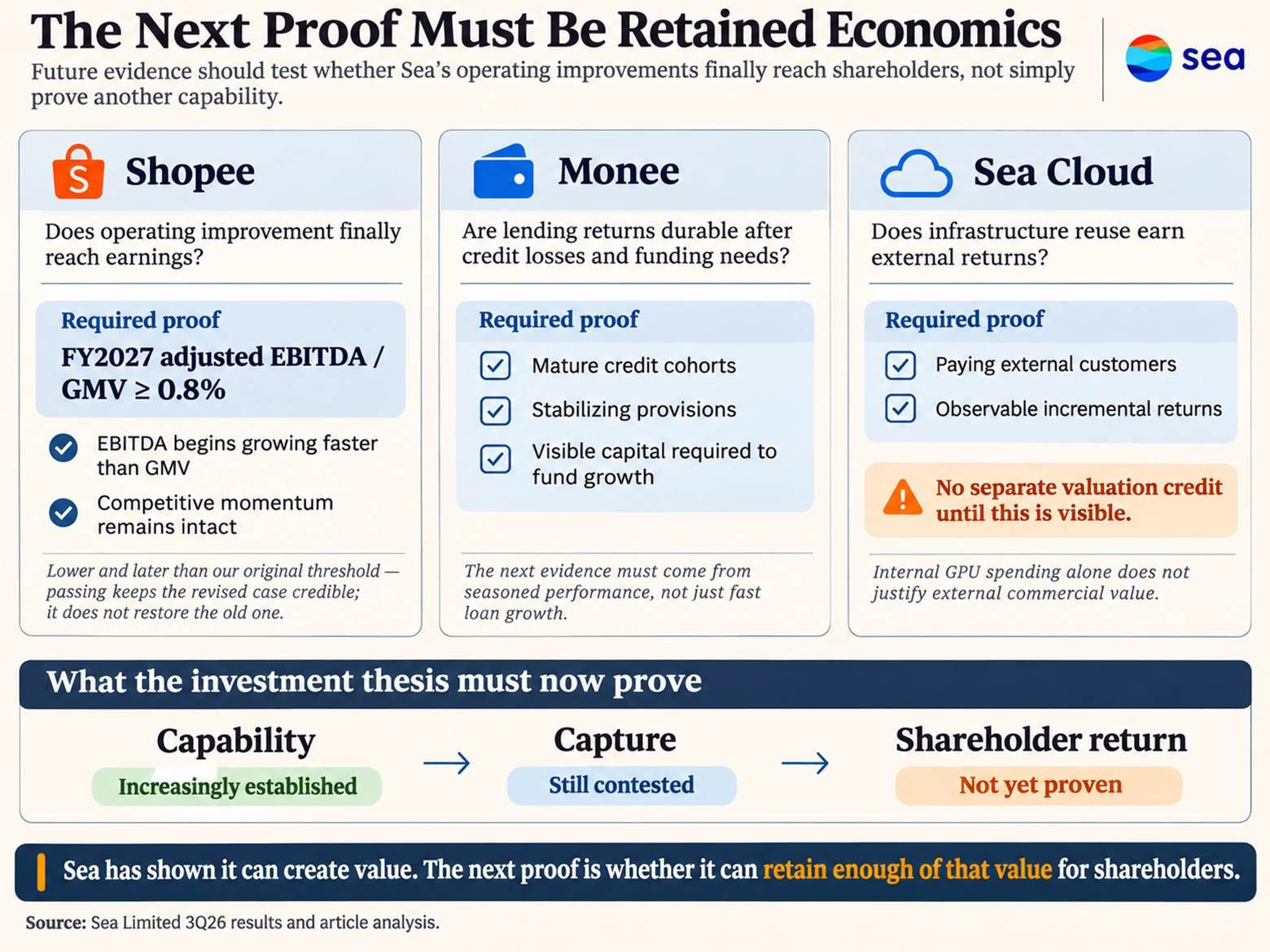
The next evidence should concern retained economics rather than another demonstration of operating capability.
For Shopee, the critical test is whether EBITDA begins growing faster than GMV without sacrificing competitive momentum. I would require full-year 2027 adjusted EBITDA of at least 0.8% of GMV, against approximately 0.64% expected for 2026. That is a lower and later threshold than our original forecast. Passing it would keep the revised investment case credible, not restore the old one.
For Monee, the evidence must come from mature credit cohorts, stabilizing provisions and the actual capital required to fund growth. Sea Cloud should receive no separate valuation credit until paying customers and incremental returns become observable.
I would hold the shares but not add before the next guidance and credit disclosures give us stronger evidence. If management continues demonstrating better monetization without improved retained margins, the appropriate response is to reduce the earnings we underwrite, not extend the timetable again.
In November 2025, I used the rice fields as an analogy for Sea’s advantage. A dense network of commerce, logistics and financial services was supposed to become more productive with every additional transaction. That argument remains credible. What I assumed, incorrectly, was that the owners of the network would necessarily receive the resulting harvest.
Sea has become better at creating economic value. Q3 forces us to recognize that creating value, capturing it and returning it to shareholders are three different accomplishments. The first is increasingly well established. The second is still contested. The third is what the investment thesis must now prove.
Disclaimer:
The content does not constitute any kind of investment or financial advice. Kindly reach out to your advisor for any investment-related advice. Please refer to the tab “Legal | Disclaimer” to read the complete disclaimer.