


TL;DR
The control-layer thesis is becoming commercially real. AI demand is pulling IT operations, security, data, permissions, and workflows into broader ServiceNow deployments rather than allowing agents to bypass the platform.
Agentic AI may expand ServiceNow’s economic unit beyond seats. As machines perform more enterprise work, ServiceNow can potentially monetise governed actions and completed tasks rather than depend solely on human users.
The architecture is ahead of the economics. Organic demand remains near 20%, but falling gross margins, acquisition costs, and weaker cash-flow quality mean ServiceNow has earned greater confidence, not a monopoly valuation.
“Whichever chip wins, whichever lab wins, whichever price per token regime prevails, the enterprise needs one governed layer of record for work. ServiceNow offers needed certainty in an uncertain stack. Our platform is optionality on all AI outcomes, not a bet on any one.”
— Bill McDermott, Chairman and CEO, ServiceNow Q2 2026 Earnings Call
Three months ago, we wrote that the ServiceNow thesis was not broken, but remained unproven on the market’s terms.
That distinction mattered. We had spent several quarters tracing the company’s movement from integration layer to front door, then gatekeeper, control tower, and governed execution layer. The architecture kept becoming more convincing. The stock kept falling.
The temptation was to say the market was missing the point. In retrospect, that was too easy. The market had simply moved on to the harder question.
It no longer wanted to know whether ServiceNow might become more important as AI spread through the enterprise. It wanted proof that this growing importance would produce cleaner organic growth, durable margins, and cash economics that did not require investors to mentally strip out acquisitions, currency, and adjustments to find the underlying business.
Q1 did not provide that proof. Q2 did.
Partly.
The gap between the strategic thesis and the financial evidence narrowed materially this quarter. It did not close.
From Recording Work to Governing Action
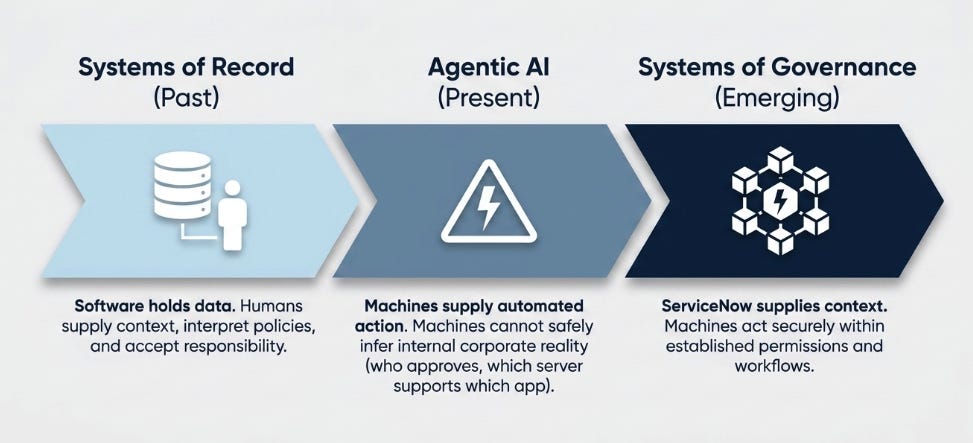
Enterprise software was built around systems of record.
SAP recorded transactions. Salesforce recorded customer relationships. Workday recorded employees. ServiceNow began by recording and coordinating IT work.
Humans sat above those systems. They understood the request, moved between applications, checked permissions, interpreted company policy, and accepted responsibility for the action taken. The software held information; the person supplied context.
AI changes that division of labour.
An agent can interpret a request, choose a tool, and execute a task. What it cannot safely infer is the internal reality of the company: which employee may approve the request, which server supports which application, which policy applies, whether a device is compromised, or what happened the last time someone attempted the same action.
The smarter the agent becomes, the more dangerous it is without that context.
That creates the fundamental question for ServiceNow:
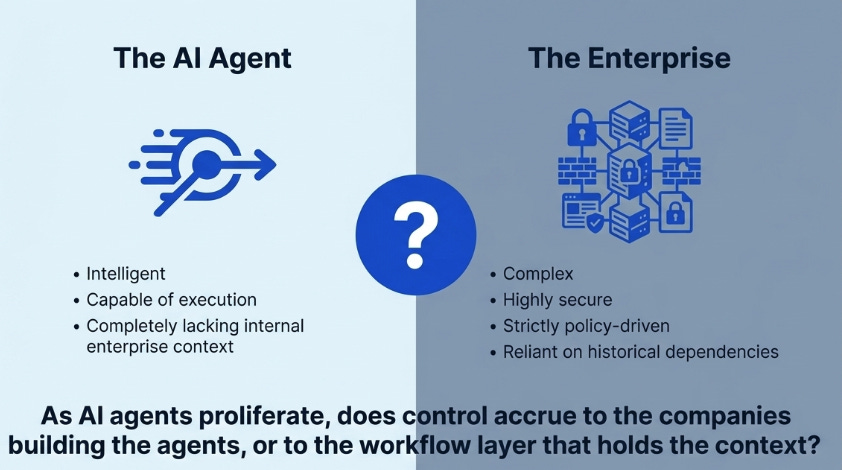
As AI agents proliferate across the enterprise, does control accrue to the companies building the agents, or to the workflow layer that already holds the context, permissions, and process logic those agents need to act?
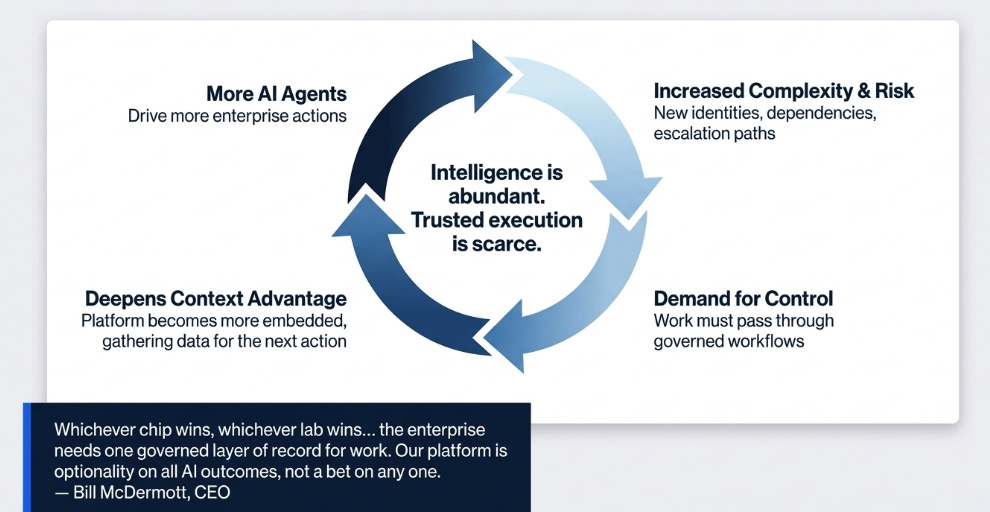
ServiceNow’s answer is that intelligence will become abundant while trusted execution remains scarce.
I think that is the right lens.
The company’s structural advantage is not one AI model, one interface, or even the CMDB by itself. It is the accumulated operating knowledge of the enterprise: assets, identities, dependencies, approvals, policies, escalation paths, workflow history, and links into other systems.
The loop is straightforward. More agents create more actions. More actions create more identities, dependencies, and risks. That increases the need for shared context and governance. More work then passes through ServiceNow. Each new workflow makes the platform more embedded across the organisation and gives it more context for the next action.
More agents create more complexity. More complexity creates more demand for control. More control deepens the context advantage.
The loop breaks if cloud providers or agent companies can reconstruct that context across mixed enterprise systems, or if the cost of governing machine activity rises faster than what customers will pay for it.
Q2 matters because it gives us the first serious evidence about which loop is forming.
The Agents Are Consuming the Platform
The headline numbers were strong. Subscription revenue reached $3.877 billion, growing 23% in constant currency. cRPO grew 21.5% in constant currency, two points above guidance. Renewal returned to 98%, and ServiceNow closed 123 transactions above $1 million in net new ACV, up almost 40% from a year ago.
The revenue beat was not perfectly clean. Management said roughly half of the upside came from U.S. Federal on-premise revenue moving from Q3 into Q2. Armis also helped reported growth. The full-year subscription revenue midpoint increased by only $15 million.
That is why cRPO matters more.
After adjusting for the acquisition contribution, organic cRPO appears to be holding near the boundary between the high teens and low twenties. That is not a clean reacceleration above 20%. It is also far better than the rapid slide toward the mid-teens that the stock had begun to discount.
ServiceNow is at the doorstep. Not through it.
The more interesting evidence came from the composition of demand.
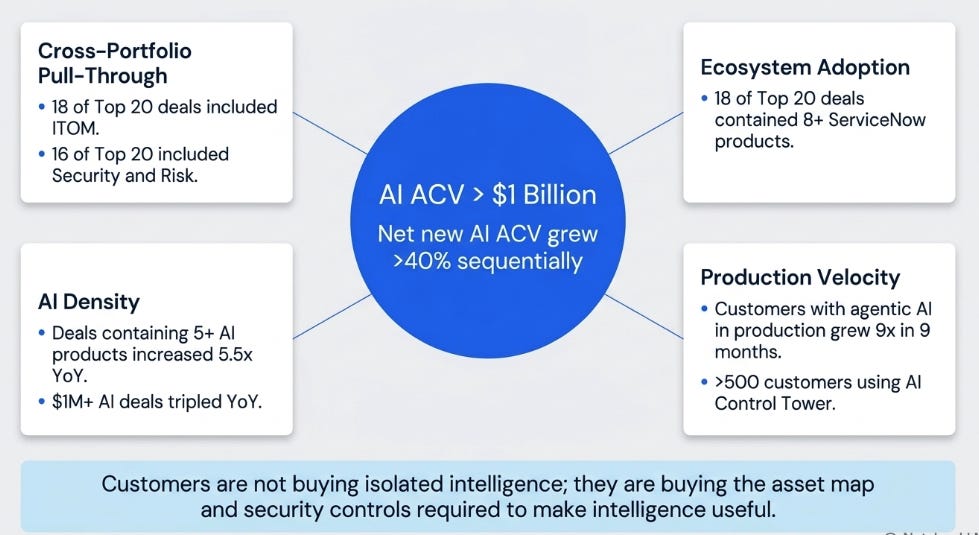
AI ACV crossed $1 billion. Net new AI ACV grew more than 40% sequentially. Deals containing at least five AI products increased 5.5 times year over year, while million-dollar AI deals tripled. The number of customers with agentic AI in production grew ninefold in nine months. More than 500 customers were already using AI Control Tower.
Yet the important point is not that customers bought AI.
It is what they bought around it.
IT Operations Management appeared in 18 of the top 20 deals. Security and Risk appeared in 16. Workflow Data Fabric appeared in 17. Eighteen of the top 20 deals contained at least eight ServiceNow products.
Customers were not buying intelligence as an isolated feature. They were buying the asset map, data context, security controls, permissions, and workflows required to make that intelligence useful.
The agents are not yet bypassing ServiceNow. They are consuming it.
That distinction changes the seat-compression debate.
Management said half of net new business is already non-seat based. ServiceNow is retaining predictable subscription pricing where customers want it, while adding consumption and activity-based elements as agents perform more work.
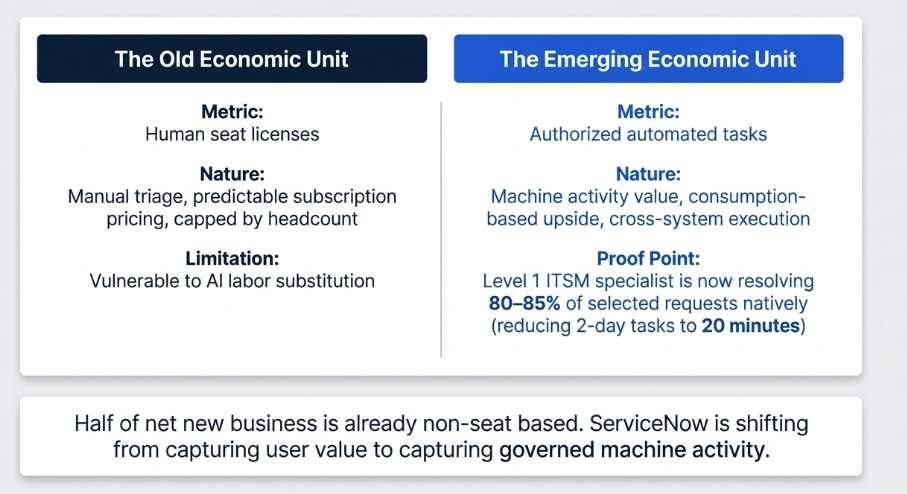
The old economic unit was a person licensed to use an application. The emerging unit may be an authorised task completed across systems.
Goldman Sachs’ Gabriela Borges asked about ServiceNow’s Level 1 ITSM specialist. Amit Zavery said the product was resolving 80% to 85% of selected requests without human involvement, reducing tasks that could take two days to around 20 minutes.
That is more than software assistance. It is labour substitution.
If ServiceNow can participate in the value of the work completed, then fewer human seats need not mean less revenue. The company can lose value attached to a user and gain value attached to machine activity.
Q2 does not prove that transition has succeeded. It proves it has started.
Control Has a Cost
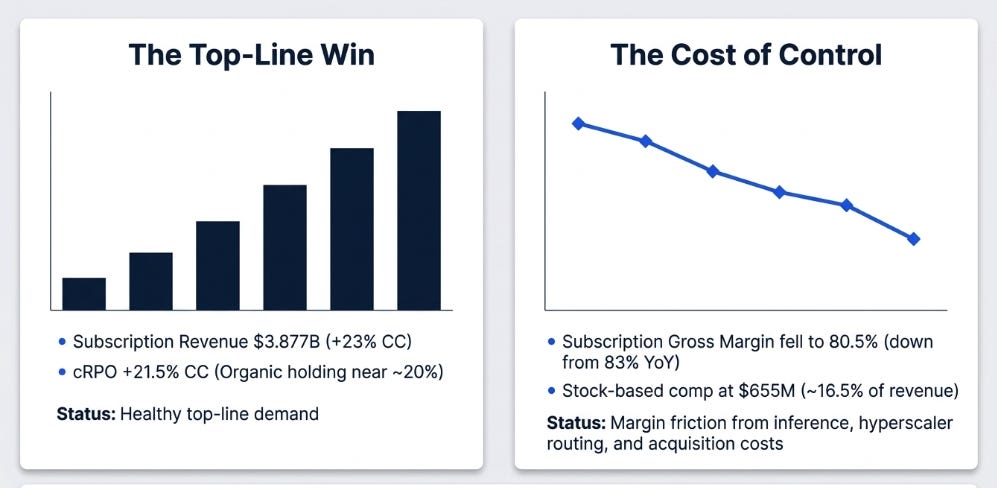
Our Q1 article set a specific threshold: if subscription gross margin fell below 80% without a credible framework for where it would bottom, the economic thesis would require a material reassessment.
Q2 came in at 80.5%.
The threshold held. The margin did not stabilise.
Subscription gross margin was 83% a year ago and 81.5% in Q1. The full-year guide now stands at 81%. ServiceNow says the pressure reflects faster AI usage and more customers running through hyperscaler partners. Those are favourable demand signals. They are still costs.
This is the tension the architectural story cannot solve.
Trusted execution is scarce only if ServiceNow can capture more value from each governed action than it spends delivering it. Inference, hosting, third-party models, acquired technology, and cloud infrastructure all sit above the old cost structure.
Management argues that model costs will fall, workloads can be routed to cheaper specialised models, and scale will improve the economics. I think that is plausible. The reported gross-margin line says it has not happened yet.
The gap between GAAP and adjusted earnings makes the same point from another angle. Stock compensation was $655 million, around 16.5% of revenue. GAAP operating income was $162 million, compared with $1.173 billion on a non-GAAP basis. Reported non-GAAP free cash flow of $634 million included a $161 million add-back for acquisition-related cash costs.
The company is asking investors to accept weaker economic optics today because the future control point will be larger.
Maybe. But that bridge still has to be built.
The same applies to cybersecurity.
Every agent is an identity. Every identity has access rights. Every action touches data, software, or devices. Every failure eventually requires a response.
Veza adds identity and permission context. Armis adds asset and device visibility. ServiceNow provides the workflow that turns discovery into action.
The strategic sequence is coherent:
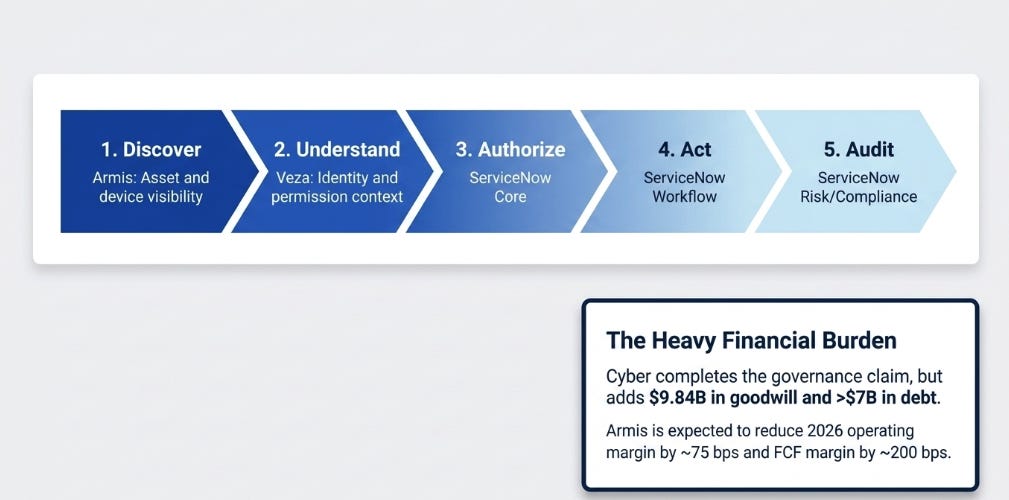
That is why cyber belongs inside the control-layer thesis rather than beside it as another market opportunity.
The commercial evidence is encouraging. Security and Risk appeared in 16 of the top 20 transactions, and management said the acquired products were pulling through the core IT portfolio.
The financial burden is also large. Goodwill rose to $9.84 billion. Debt exceeded $7 billion. Armis is expected to reduce 2026 operating margin by around 75 basis points and free cash flow margin by about 200 basis points.
Cyber makes ServiceNow’s governance claim more complete. It also raises the standard by which capital allocation must be judged.
The Layer ServiceNow Does Not Control
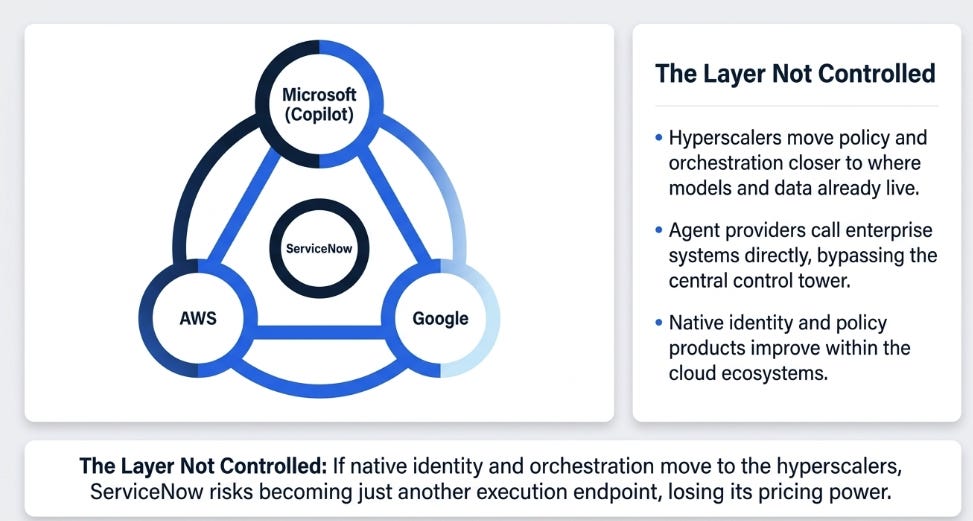
There is a credible opposing loop.
Microsoft combines identity, productivity distribution, cloud infrastructure, and agent tooling. AWS and Google can move policy and orchestration closer to where models and data already live. Agent providers can become better at calling enterprise systems directly.
In that future, ServiceNow remains useful but loses the control point.
More agents run inside hyperscaler ecosystems. Native identity and policy products improve. Orchestration remains with the cloud or agent provider. ServiceNow becomes one execution endpoint among many. The workflow logic shifts outside the platform, and the economics accrue elsewhere.
ServiceNow’s openness is an advantage only if every integration makes the company more central. It becomes a weakness if Claude, Copilot, or another agent uses ServiceNow while identity, governance, and pricing power remain with somebody else.
That is why “governance monopoly” is too strong.
ServiceNow has a claim. It has not established ownership.
What We Thought, and What We Think Now
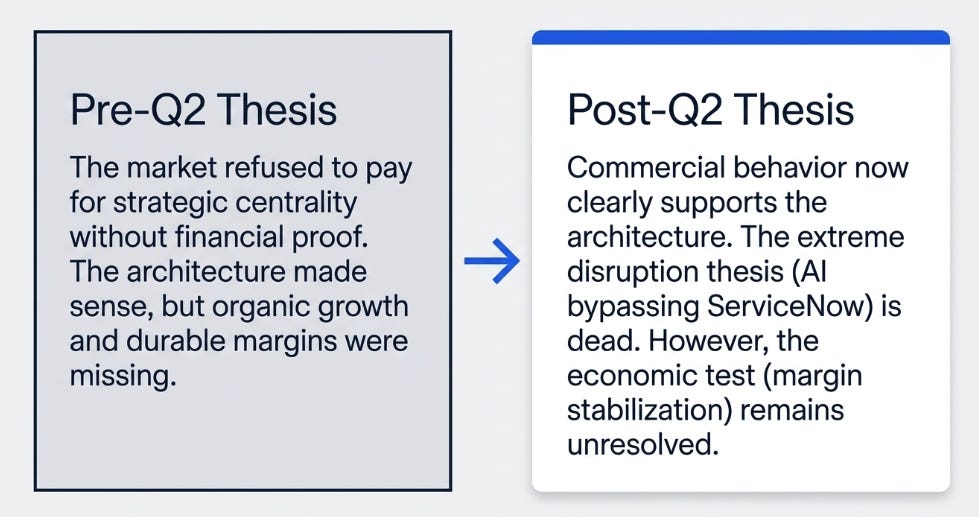
Before Q2, our view was that ServiceNow had probably chosen the right architecture for the agentic enterprise, but the market was justified in refusing to pay for strategic centrality without cleaner financial evidence.
That view has changed but not reversed.
The architecture is now better supported by commercial behaviour. AI is pulling ITOM, security, data, and broader workflows into the same transactions. Agents in production are creating more demand for context and control. Contracted forward demand remains close to 20% organically rather than collapsing toward the mid-teens.
That materially weakens the extreme disruption thesis.
What has not changed is the economic test. Gross margins continue to fall. Acquisition integration makes cash quality harder to read. Organic growth is near the threshold for reacceleration, not decisively beyond it.
The variant perception is therefore no longer that ServiceNow has discovered the control tower. Management says that openly.
The variant is that agent proliferation may expand the amount of governed work ServiceNow can monetise, rather than merely helping it defend a shrinking seat base. Q2 is the first quarter where that argument appears in contracts, not just product slides.
Three Paths from Here
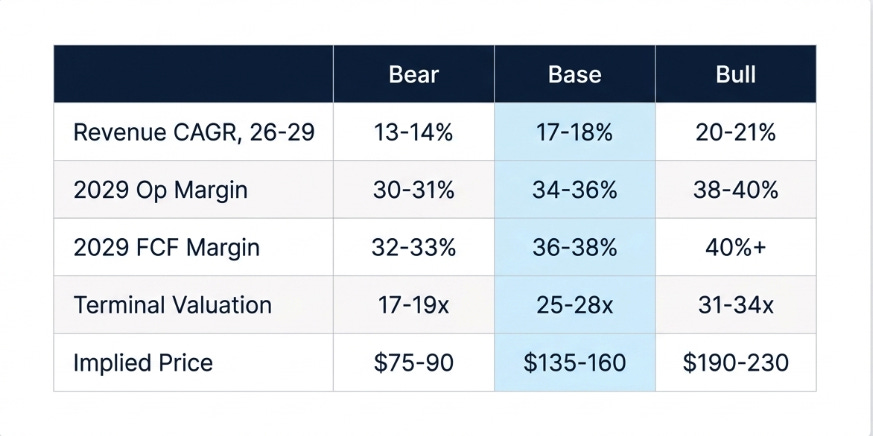
The bear case is not that the architecture is wrong. It is that the architecture fails to produce attractive economics. AI substitutes for seats, gross margin falls below 79%, and cloud-native governance limits ServiceNow’s control.
The base case is less dramatic. Organic cRPO remains between 18% and 20%, AI offsets seat pressure, gross margin finds a floor around 80% to 81%, and ServiceNow becomes a strong GARP compounder without a category re-rating.
The bull case requires more. Organic cRPO must remain above 20% for several quarters. Subscription gross margin must recover toward 82%. AI and security must increase wallet share while acquisition-related cash costs fade. Only then does the market have reason to treat trusted execution as a new growth engine rather than a defensive extension of the old business.
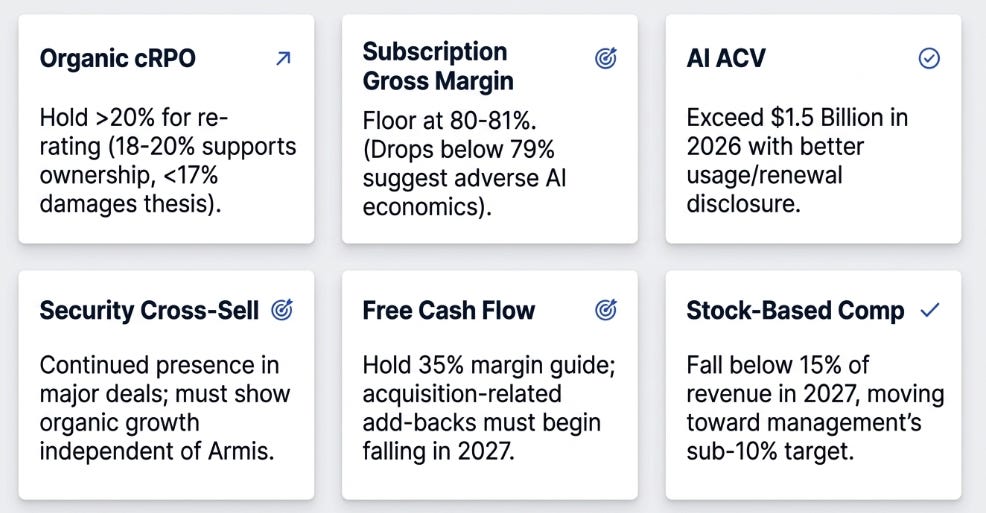
The tracking items follow from that distinction:
Organic cRPO above 20% for two quarters earns the re-rating; 18% to 20% supports ownership; below 17% damages the thesis.
Subscription gross margin must hold around 80% to 81%, then recover. Below 79% would suggest adverse AI economics.
AI ACV must exceed $1.5 billion in 2026, followed by better disclosure on usage, renewals, and cash contribution.
Security must continue appearing across major deals and eventually show organic growth apart from Armis.
The 35% free cash flow margin guide must hold, while acquisition-related add-backs begin falling in 2027.
Stock compensation needs to fall below 15% of revenue during 2027 on the way to management’s sub-10% target.
I am more constructive after Q2.
The stock no longer requires belief in a theoretical control tower. Some commercial proof has arrived. Around the current valuation, I would own ServiceNow on the expectation that organic demand can hold near 20% and the economic model can gradually catch up.
I would not pay a monopoly multiple.
The integration layer came first. Then the front door, the gatekeeper, the control tower, and governed execution. Q1 showed that the architecture could be right while the economics remained unproven.
Q2 adds the first serious evidence that agents are consuming ServiceNow’s layer rather than routing around it.
ServiceNow has a credible claim on the scarcity of trusted execution. It has not yet shown that it owns it.

Disclaimer:
The content does not constitute any kind of investment or financial advice. Kindly reach out to your advisor for any investment-related advice. Please refer to the tab “Legal | Disclaimer” to read the complete disclaimer.