


TL; DR
The control-layer thesis is getting more concrete: enterprises may need governance before they deploy agents at scale, giving ServiceNow a chance to sell visibility, permissions and safety first and then participate in the workflows and consumption that follow.
ServiceNow does not need to own the AI interface: ChatGPT or another assistant can initiate the request while ServiceNow executes the governed workflow underneath and still monetizes the activity. That makes the company potentially more valuable as infrastructure beneath multiple front doors, rather than as the exclusive front door itself.
But the economic proof is still incomplete: cRPO guidance weakened, gross margins remain under pressure, deployment support is absorbing resources, and management has not yet shown how much incremental customer spending AI creates. The strategy is clearer than the financial acceleration.
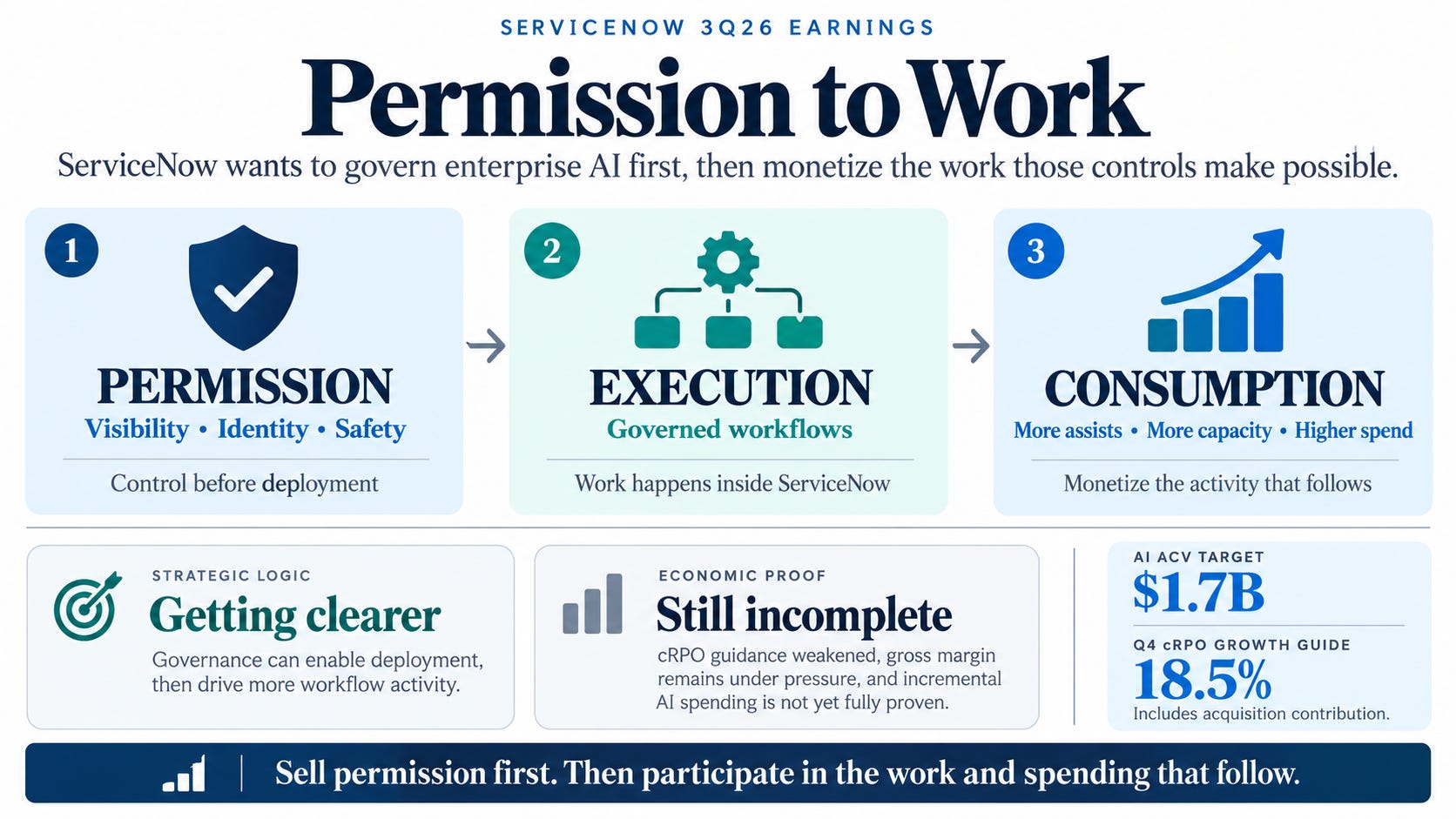
ServiceNow reported $3.988 billion in subscription revenue, growing 20.5% in constant currency, and raised its year-end AI annual contract value target to $1.7 billion. But fourth quarter contracted-revenue guidance disappointed, and shares fell approximately 18% in after-hours trading. Investors were being asked to believe in accelerating AI adoption while the principal forward indicator suggested slower growth.
I think the quarter deserves a better explanation than either “the market missed the strategy” or “AI has failed to accelerate the numbers.” Our July article had already distinguished the two: ServiceNow’s operating context was becoming more valuable to agents, but strategic relevance had not established better economics. Q3 explains how management intends to connect them. Past articles on ServiceNow
The most revealing exchange was not about the revenue beat. An analyst asked whether enterprises were purchasing Control Tower before deploying agents at scale. Amit Zavery answered that governance was coming first. That sequence matters: ServiceNow is not simply waiting for AI adoption to generate demand for its platform. It is trying to sell the capabilities that make adoption possible, then participate in the activity that follows.
Control Before Consumption
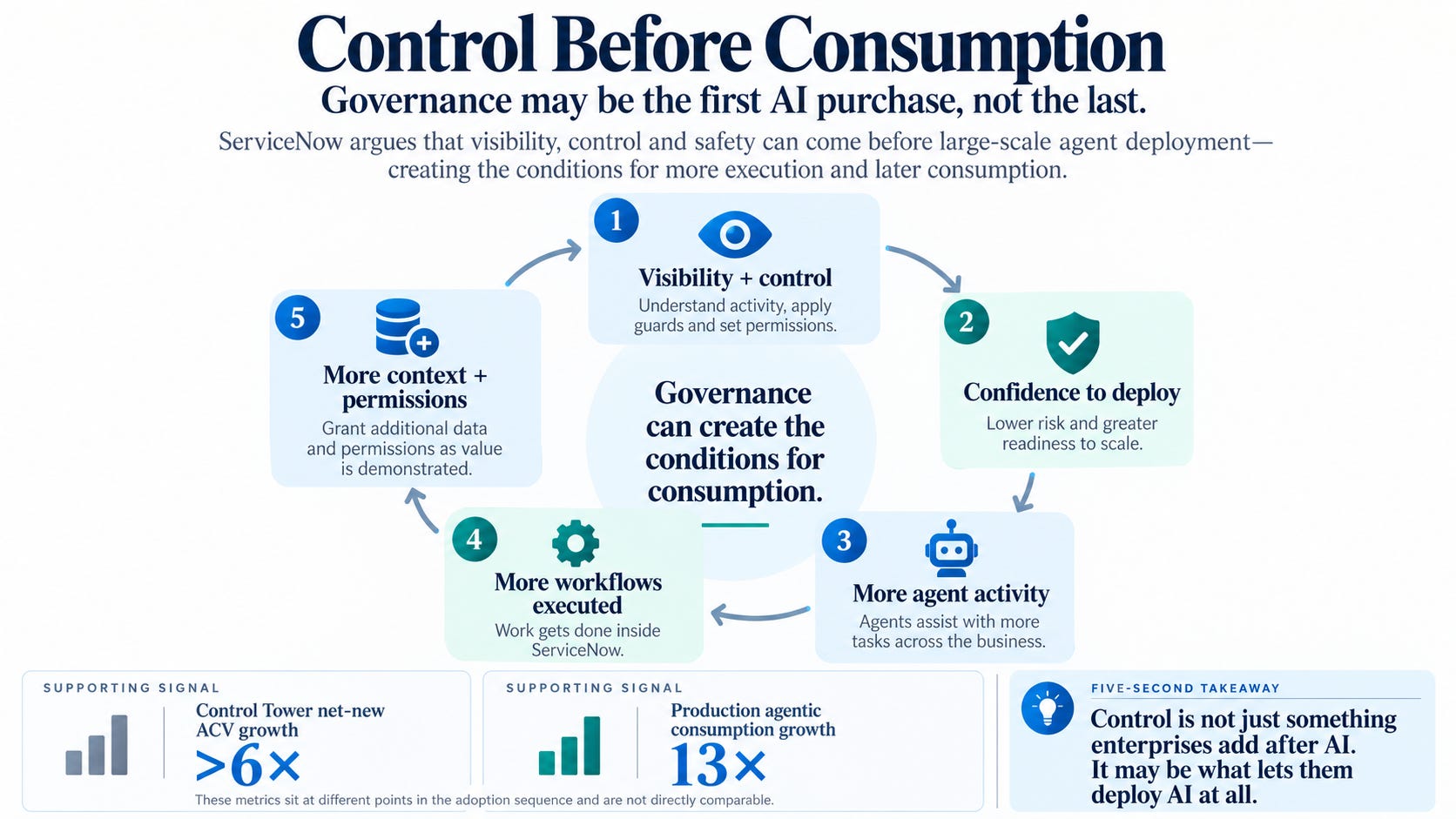
Enterprise AI creates a distinction between being capable of an action and being authorized to perform it. An agent may know how to change a firewall configuration without knowing whether the change is permitted, which applications depend on it, or who must approve it. Greater intelligence does not eliminate those requirements; more autonomous activity can make them more consequential.
This was the foundation of our control-layer thesis. What Q3 added was management’s description of how that need becomes a customer purchase. Zavery told Evercore:
It’s coming in first before AI goes in production and the volume of usage just starts going up because as you start building out more AI, as you get confidence, we are really helping them manage it. It’s not about orchestration really. It’s really the visibility, the control, and the safety. Then we can orchestrate many things underneath the covers depending on what systems customers might be using.
The implication is more interesting than another governance product. A customer can purchase control capabilities before its agents perform much work. Successful deployment can then generate demand for execution, additional workflows and more control. Governance is potentially both a revenue opportunity and an enabler of subsequent consumption.
Security belongs inside this mechanism. Armis contributes asset visibility; Veza contributes identity and permission context; ServiceNow’s existing workflows provide a route from discovering a problem to resolving it. Management’s ambition is to connect discovery, authorization, execution and remediation rather than sell disconnected tools. Security and Risk appeared in sixteen of the twenty largest Q3 deals, although acquisitions prevent that figure from establishing organic growth on its own.
This also explains why treating Armis only as an adjustment to the growth calculation misses half the investment question. The acquired revenue must be separated when evaluating demand, but the capabilities must be assessed when evaluating the platform. Strategically coherent acquisitions can still earn poor returns; neither their coherence nor their cost settles the matter.
The resulting advantage would be accumulated operating context within each customer: more workflows, more dependencies, more permissions and greater difficulty replacing the system. That is not proof of a universal network effect or an exclusive control point. It is a plausible mechanism through which serving more enterprise work makes ServiceNow harder to displace.
The Interface Can Belong to Someone Else
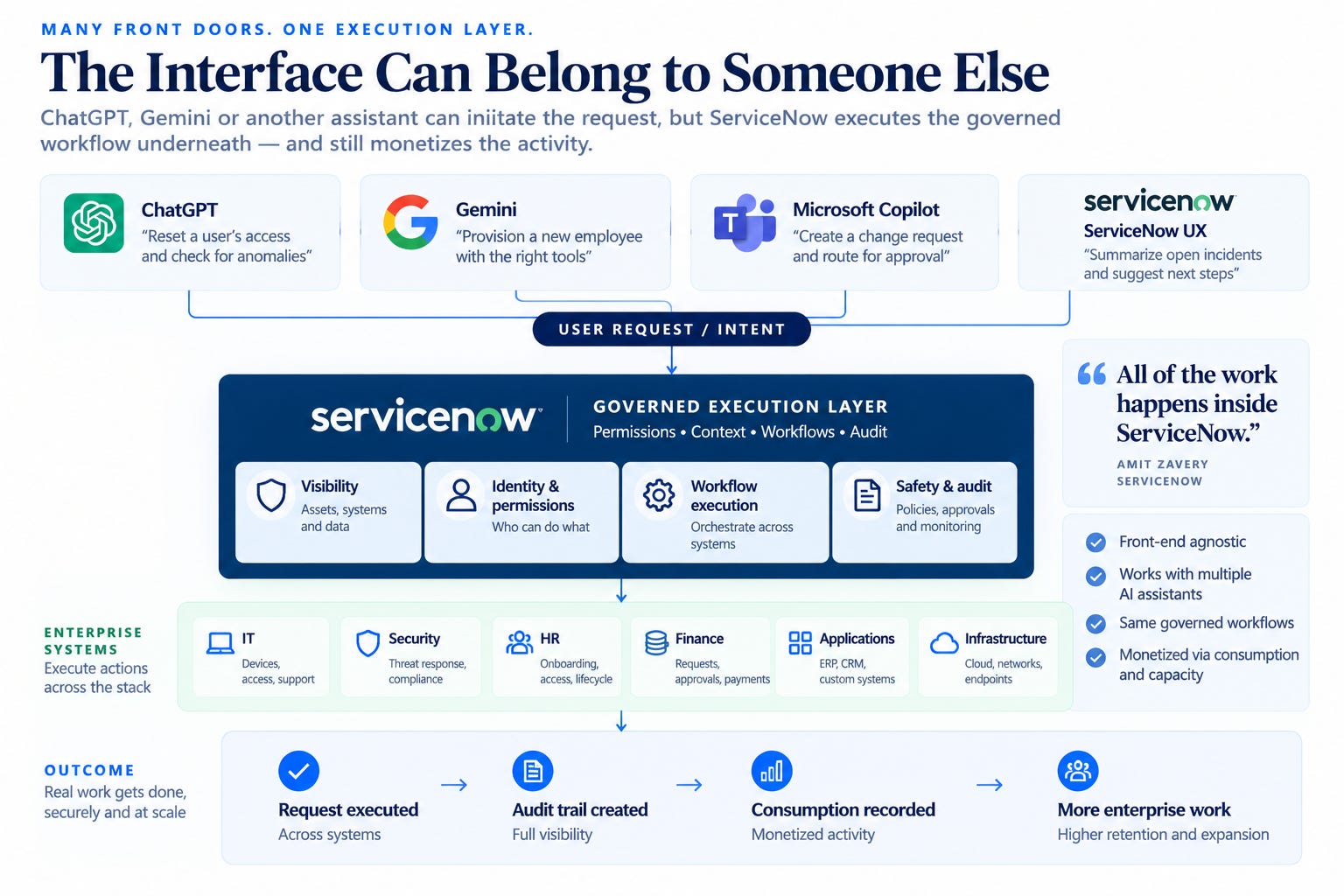
Our earlier writing sometimes put too much weight on ServiceNow owning the AI front door. The stronger thesis is that it can remain valuable behind several front doors. Q3’s OpenAI and Google integrations make that distinction concrete: an external assistant initiates the request, while ServiceNow executes the relevant governed workflow. Past articles on ServiceNow NOW 3Q26 PR
Zavery explained the commercial arrangement in the final question:
What we’re doing with OpenAI is allowing ChatGPT as a way to interface into ServiceNow. But all of the work happens inside ServiceNow. It’s just a call coming from ChatGPT. Then the work which we were doing, typically through our user experience, now happens through this interface, and we get full value for it from the monetization perspective because you are burning down assist for every work you’d ask ServiceNow to do.
This is not an abandonment of its own interface. EmployeeWorks reached $100 million in ACV in fewer than three quarters; management argues that its planning, reasoning and specialized agents offer capabilities beyond simply calling a workflow. ServiceNow wants both opportunities: a differentiated employee experience and distribution through other assistants.
The important upside is not merely replacing a lost seat with an equivalent consumption charge. McDermott described a chance to increase revenue per user fivefold once customers become productive consumers. That is an ambition, not an achieved result, but the underlying proposition is intelligible: a person supported by agents can initiate substantially more work than that person previously completed manually.
More activity does not automatically create another invoice, because assists can be consumed from existing entitlements. The economic expansion arrives when customers purchase additional capacity or renew at higher spending levels. Here the evidence is incomplete but not absent: Zavery described customers expanding from initial use cases into broader deployments and renewing with higher token allowances.
AI net-new ACV growth of 65%, Control Tower net-new ACV growth above sixfold and thirteenfold growth in production agentic consumption belong at different points in that progression. Together, they show adoption and commercial demand. They do not establish consolidated acceleration, but dismissing them because the final profit bridge is missing would be as mistaken as treating them as proof of it.
Nor must ServiceNow defeat every competing control layer. Microsoft, cloud providers and application vendors can retain important roles while ServiceNow earns attractive returns from the processes it handles. The relevant competitive question is whether its context and execution remain sufficiently valuable to support pricing not whether every enterprise action becomes its exclusive property. Past articles on ServiceNow
Paying to Put the Agents to Work
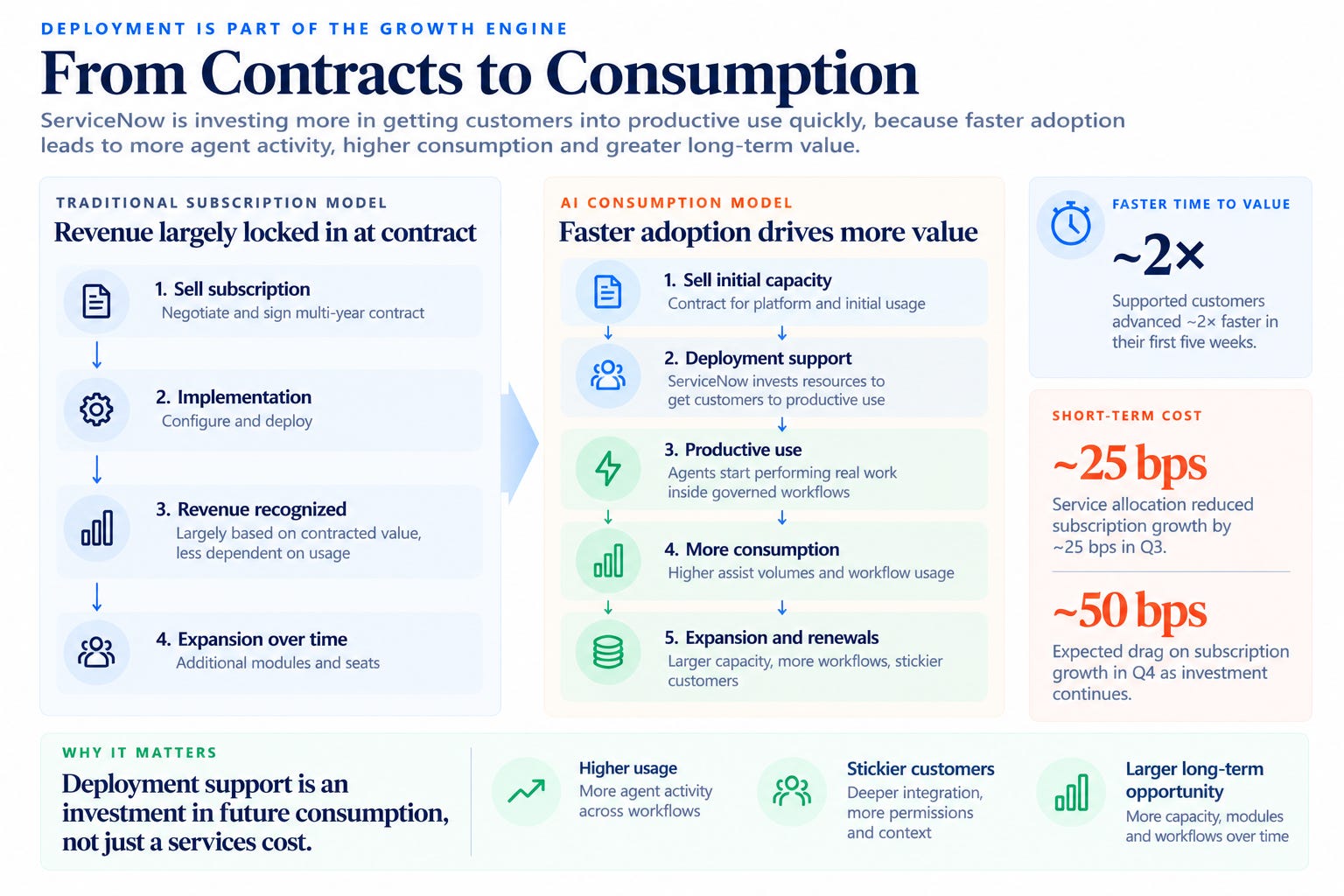
The missing link is deployment. Under a contracted subscription model, an application can generate revenue while the customer implements it slowly. If future expansion depends on consumption, getting the customer into productive use becomes more directly connected to growth. Implementation support starts to resemble an investment in future spending rather than merely a service obligation.
ServiceNow is therefore including deployment expertise in selected large AI contracts. Management says supported customers advanced twice as quickly during their first five weeks and consumed more assists. Gina Mastantuono described the intended economics:
We do not expect to include this delivery expertise over the long term. As with other new technology adoption cycles, it is about optimizing the first wave of adopters and leveraging the know-how in a repeatable and scalable way. As the AI gets better, the ability to autonomously deploy gets easier.
Our earliest articles anticipated a renewed role for services in enterprise AI. Q3 makes that role financially tangible. Some contract value is allocated to professional services rather than subscriptions, reducing subscription growth by approximately 25 basis points in Q3 and an expected 50 in Q4. A later return of that allocation to subscription revenue would improve the reported category; it would not, by itself, prove higher total customer spending. Past articles on ServiceNow NOW 3Q26 Slides
There is a revealing tension here. The complexity that makes ServiceNow difficult to replace also makes new deployments difficult to activate. Management must make implementation repeatable without commoditizing the operating knowledge customers value. Its self-service Flow product attacks the adoption problem from the opposite direction: a lightweight service desk for customers not ready for a full enterprise implementation.
July’s article established the economic test before these deployment disclosures. It remains the right one:
Trusted execution is scarce only if ServiceNow can capture more value from each governed action than it spends delivering it. Inference, hosting, third-party models, acquired technology, and cloud infrastructure all sit above the old cost structure. Past articles on ServiceNow
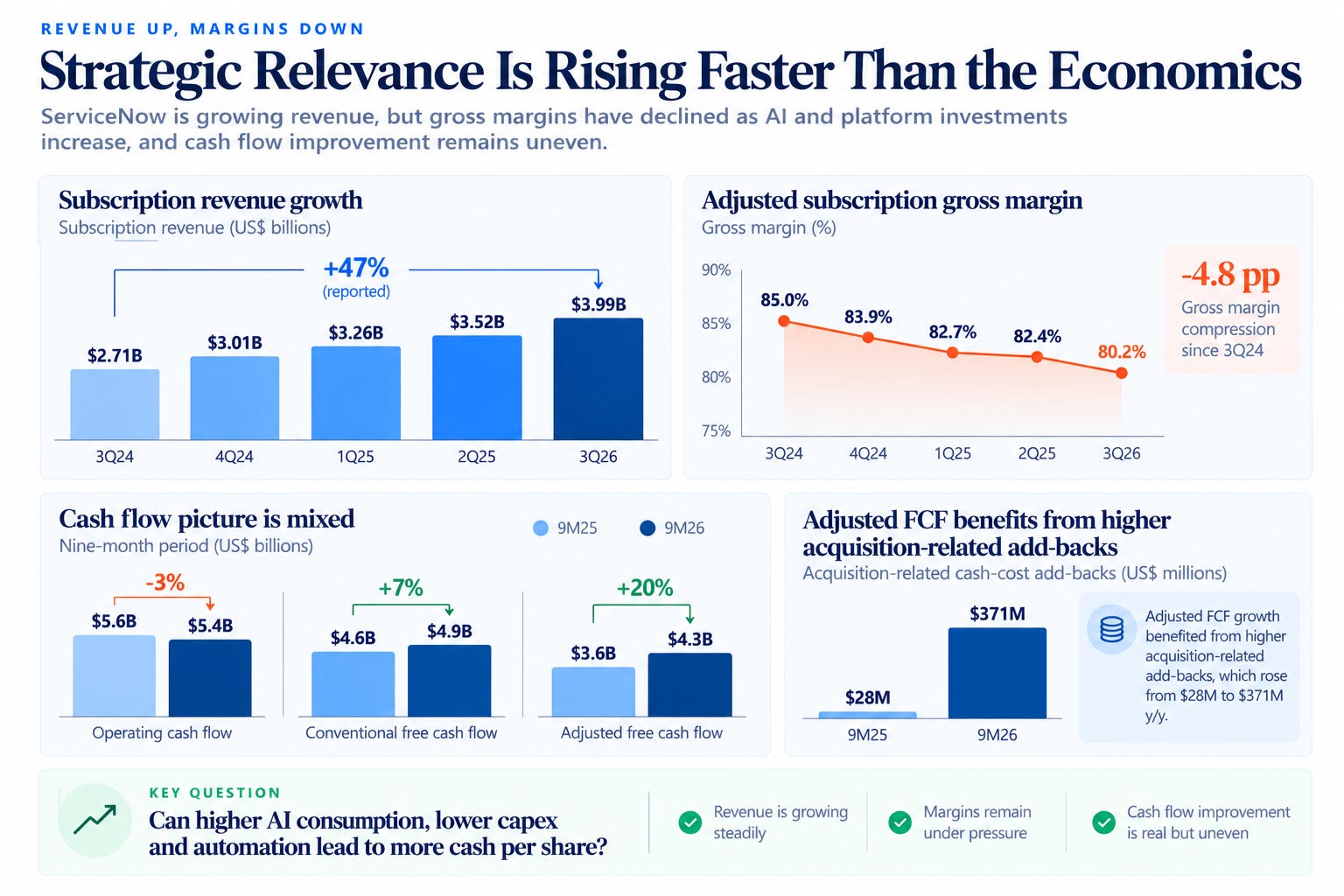
Our expectation that gross margins would stabilize around 82–83% was wrong on timing. But recovering the old percentage is not the only route to better economics. Renting more infrastructure can reduce capital requirements, while internal automation can reduce operating expenses. Management says quota-bearing sales headcount increased by double digits even as support functions contracted; total headcount fell from 30,457 to 28,855 during Q3.
ServiceNow need not finance frontier-model development to benefit from it. Cheaper intelligence could lower its input costs while increasing the work customers automate—the strongest reading of McDermott’s capital-light claim, rather than an assertion that compute is free.
These are plausible offsets, not permission to ignore cash quality. Nine-month operating cash flow declined 3%, while lower capex helped conventional free cash flow grow about 7%. Company-adjusted FCF grew 20%, benefiting additionally from acquisition-related cash-cost add-backs rising from $28 million to $371 million. The higher 36% full-year adjusted FCF-margin target therefore needs to be read alongside how the cash is generated.
The economic test is broader than gross margin: can additional consumption, less capital spending and internal productivity produce more cash per share after deployment costs and dilution? Q3 supports parts of that operating model, but not the complete return.
The Contracts Still Have a Vote
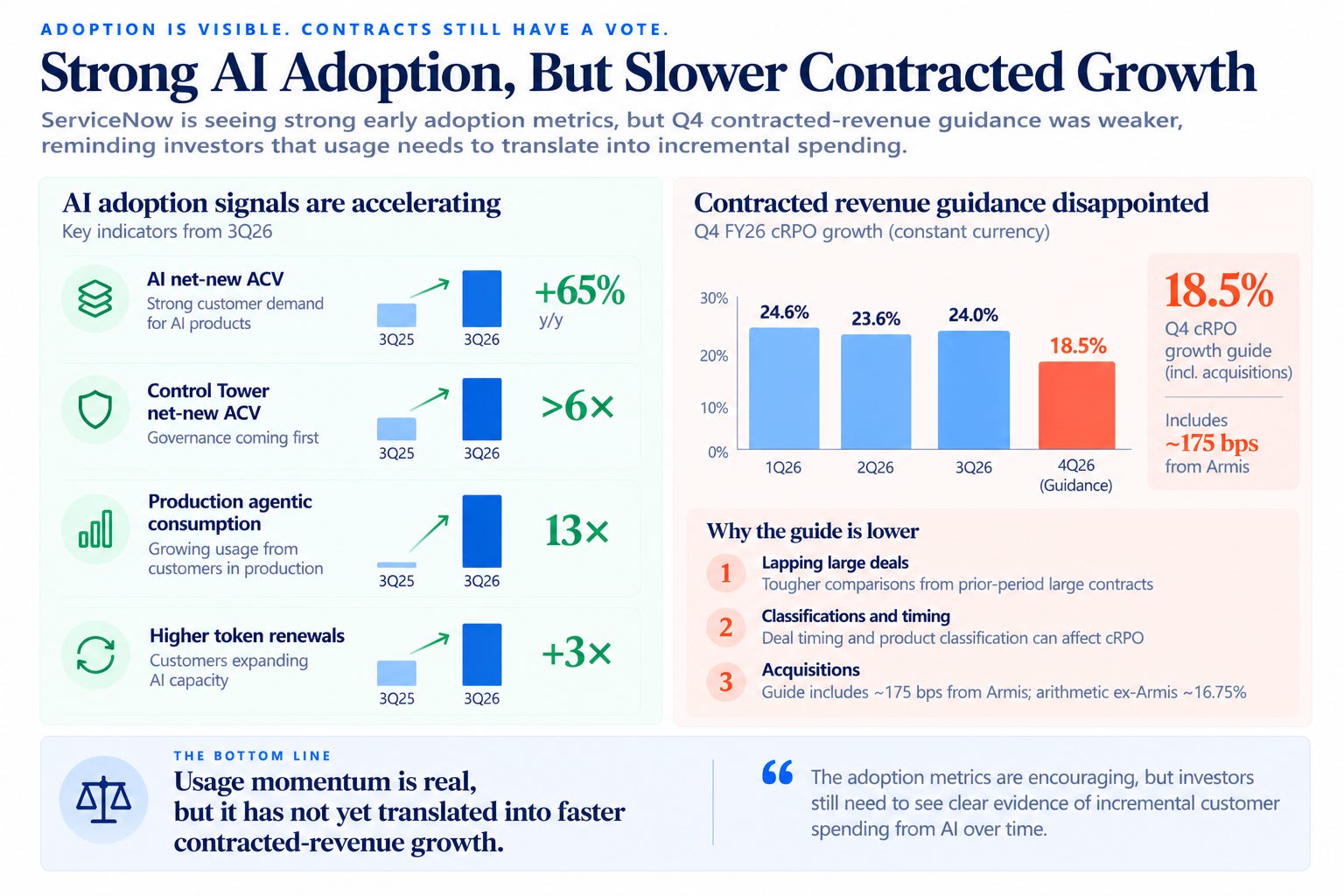
None of this makes the weak forward indicator disappear. Current remaining performance obligations measure committed revenue expected over the next twelve months; they are not simply a measure of the old seat business. The Q4 growth guide of 18.5% includes approximately 175 basis points from Armis, leaving an arithmetic 16.75% before other acquisition, timing and classification adjustments.
Management identified early renewals pulled from Q4, more on-premise business, service allocations and cancellable contracts excluded from cRPO. These effects are legitimate, but their different denominators prevent a clean synthetic “underlying growth” calculation. Moreover, $12 million of the $15 million full-year subscription-guidance increase came from currency.
The useful conclusion is not that every accounting explanation is an excuse. It is that the evidence still does not support raising our organic growth assumption. The omission of Q2’s headline count of million-dollar transactions and the earlier quantified non-seat mix also leaves less continuity in disclosures precisely where the transition needs measuring.
William Blair asked the right question: how had total spending changed among the most advanced AI customers? Management offered usage expansion and higher token renewals, but no comparable spending figure. That is encouraging evidence short of the information needed to establish how much incremental business the model creates.
What the Price Requires
My view has changed, but not because the company has discovered another name for its platform. July showed that agents were creating demand for ServiceNow’s context and controls. Q3 explains how governance can enable deployment, external assistants can distribute its workflows, and deployment investment can feed consumption. The strategy is more complete; the path to consolidated acceleration remains slower than we anticipated.
The potential variant is consequently not a governance monopoly. It is that ServiceNow can become a larger business by monetizing more work across an entrenched customer base, without owning every assistant or restoring every point of historical gross margin. Its 98% renewal rate and 680 customers above $5 million in ACV provide a substantial foundation, although neither substitutes for incremental growth. These are the three-year outcomes I would underwrite.
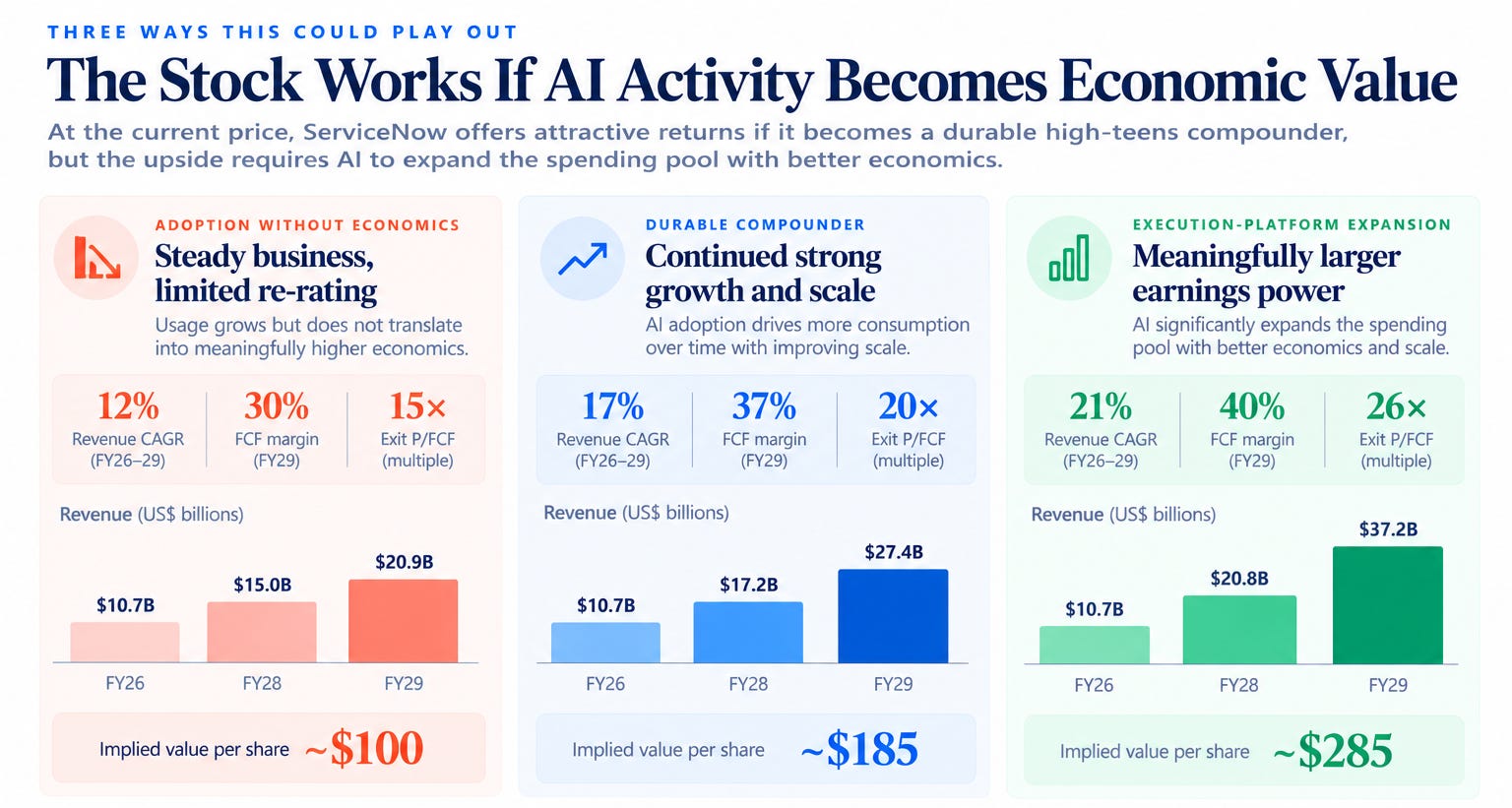
The central case requires neither fivefold spending per user nor universal control. It assumes high-teens growth, manageable delivery costs and moderate cash-margin expansion, valued at 20 times FCF. The upside requires consumption to create a meaningfully larger spending pool; the adverse case assumes a useful platform whose new activity earns disappointing returns. The adverse price is not a guaranteed floor.
The next evidence should connect adoption to money: higher customer renewal spending net of seat reductions, organic contracted growth holding in the high teens and eventually exceeding 20%, and conventional cash generation catching up with adjusted results. A persistent organic trajectory below 17%, or subscription margins below 79% without compensating cash returns, would undermine that judgment.
ServiceNow is trying to sell enterprises permission to deploy AI and the execution that follows. Q3 made that commercial sequence more credible while exposing the investment required to activate it. The opportunity is not that the company has already become the control tower for everything; it is that making more enterprise work safe and executable may be enough to build a materially more valuable business.
Disclaimer:
The content does not constitute any kind of investment or financial advice. Kindly reach out to your advisor for any investment-related advice. Please refer to the tab “Legal | Disclaimer” to read the complete disclaimer.