


TL;DR:
Support stays targeted: More help where cost pressures are highest, without blowing out spending.
Business focus remains strong: Competitiveness, productivity, and innovation continue to be core themes.
Long-term signal: Budget 2026 reinforces Singapore’s “stability + strategic investment” playbook.
I. “That Era Has Now Come to an End”
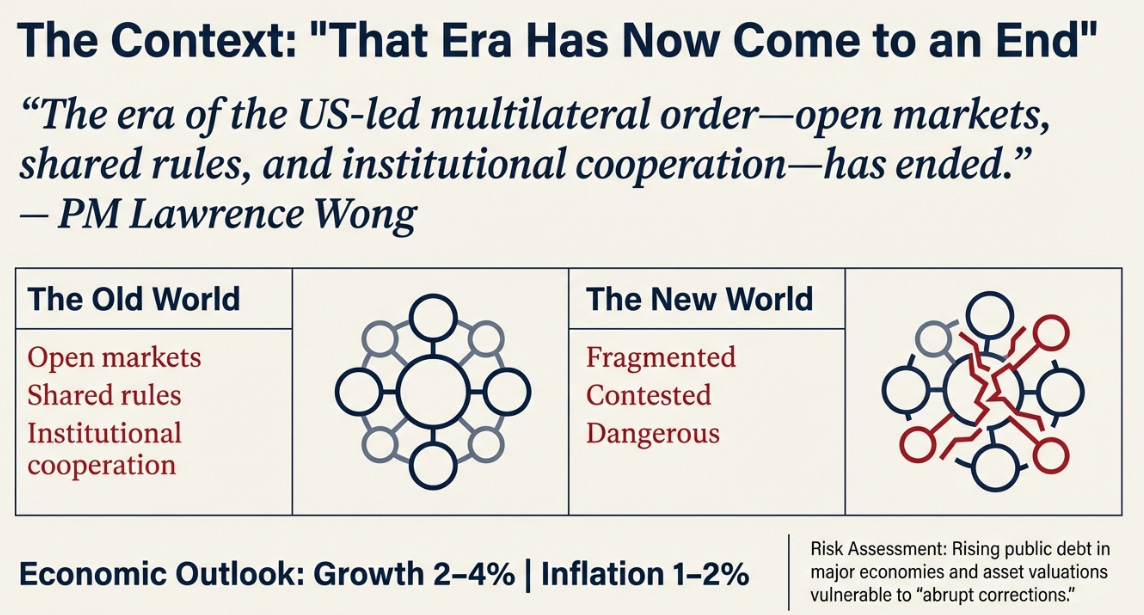
Singapore’s Finance Ministers don’t do drama. Which is why PM Wong’s opening on February 12 was so striking. He stated plainly that the US-led international order, the system that underwrote global security, championed open markets, and enabled Singapore’s rise over eight decades, is over.
“That era has now come to an end.”
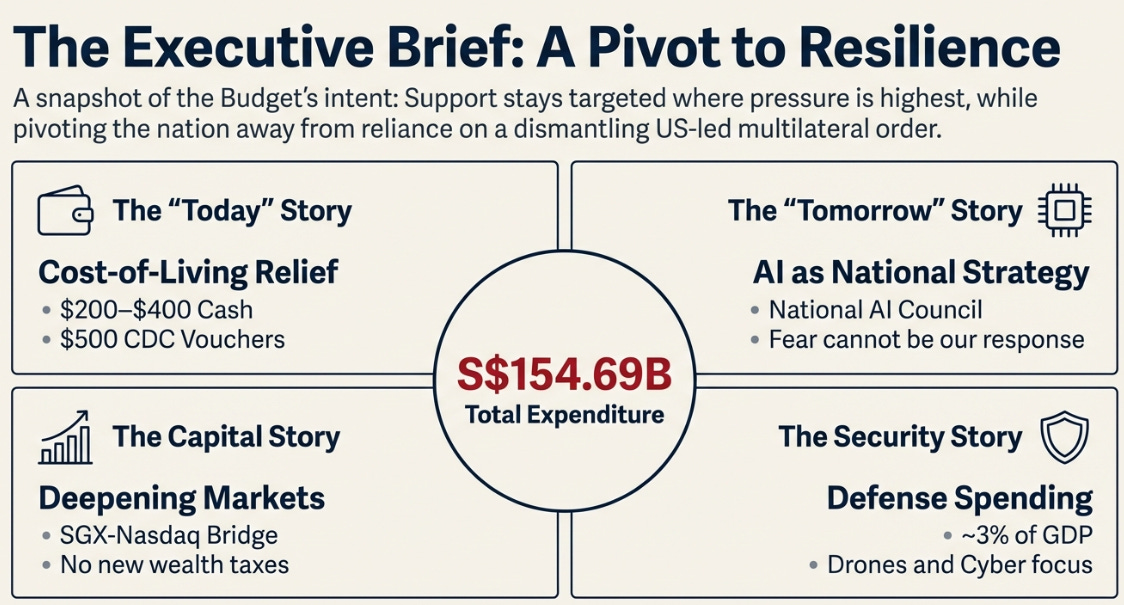
Four words. No hedging. This wasn’t geopolitical commentary tucked into an appendix. It was the foundational premise of a S$154.69 billion national budget.
What followed works on two levels. On one level, it’s a practical support package, cash, vouchers, subsidies, CPF top-ups, for Singaporeans navigating persistent cost-of-living pressures. On another, it’s a strategic repositioning blueprint, reshaping capital markets, placing national bets on AI, and building infrastructure to capture global flows in a fracturing world.
Both stories matter. And they’re more connected than they appear. The relief measures buy time and social stability. The strategic moves are designed to ensure Singapore remains relevant, and prosperous, when the dust settles on whatever new world order emerges. This article unpacks both. Whether you’re checking when your CDC vouchers arrive or reassessing your portfolio allocation to Singapore, what follows is what Budget 2026 actually means for your money.
II. The Macro Picture: Strong Today, Cautious Tomorrow
Singapore delivered 5% growth in 2025. The government ended FY2025 with a surplus of $15.1 billion (1.9% of GDP). Corporate income tax collections hit 4% of GDP, significantly above historical norms, reflecting the AI-driven tech boom and early inflows related to the Global Minimum Tax on multinational corporations.
But the 2026 outlook is deliberately tempered: growth at 2% to 4%, inflation at 1% to 2%. And the government’s language about the global backdrop was unusually stark:
“Rising public debt in many major economies will strain financial stability… heightened risk-taking in financial markets has pushed up asset valuations, leaving them vulnerable to abrupt corrections.”
For households: The economy is still growing, but the government is building in buffers. The relief measures aren’t just generosity, they’re preparation for bumpier conditions.
For investors: When a Finance Minister explicitly warns about stretched valuations and global debt fragility, treat it as a signal. Singapore’s surplus is a genuine moat. But the external environment is fragile.
III. Your Wallet, Your Family, Your Cost of Living
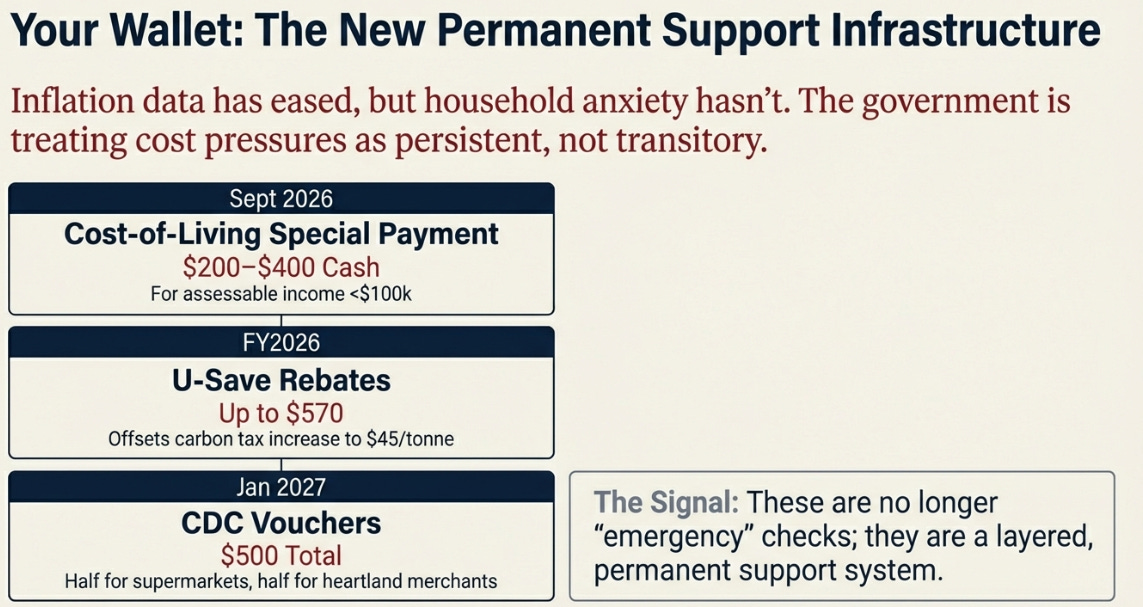
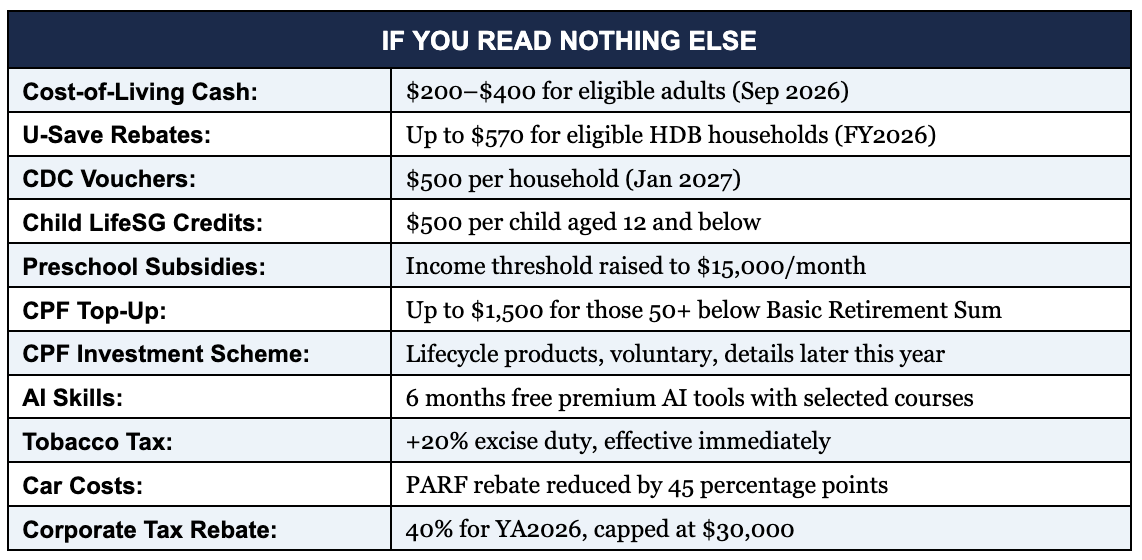
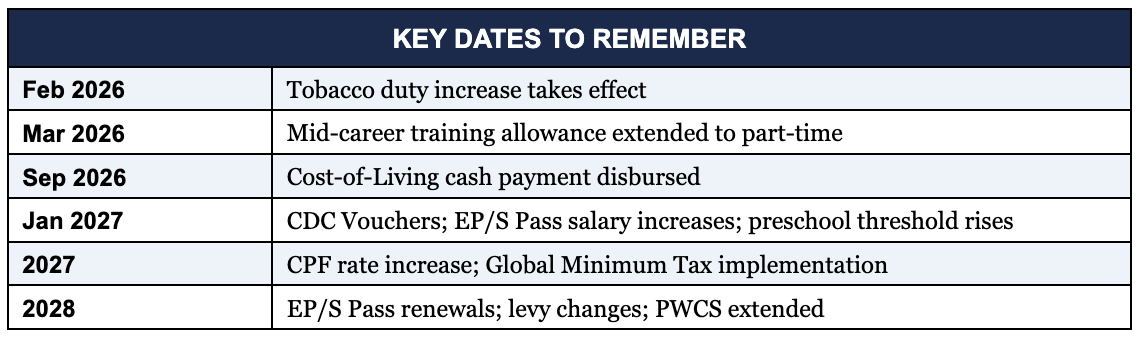
Cost-of-Living Special Payment (September 2026): $200 to $400 cash for adults earning up to $100,000 and owning no more than one property. No application needed.
U-Save Rebates (FY2026): Up to $570 for eligible HDB households, 1.5 times the regular amount. Also cushions the carbon tax increase to $45/tonne.
CDC Vouchers (January 2027): $500 per household. Half for supermarkets, half for heartland merchants and hawkers.
Child LifeSG Credits: Another $500 per child aged 12 and below. Preschool subsidies expanded, income threshold rising to $15,000/month, benefiting 60,000+ families. This is a direct play for the squeezed middle, dual-income families earning $10,000 to $15,000 who previously fell just outside the line. Student Care Fee Assistance threshold rises to $6,500.
ComLink+ Progress Packages enhanced, families with two children can receive ~$10,000/year in cash and CPF top-ups. More payouts now in cash rather than CPF-only.
What it signals: These measures are now in their fourth consecutive year. The government sees cost pressures as structural, not transient. The shift toward more cash in ComLink+ reveals a larger evolution, meeting people where they are, rather than where the system thinks they should be.
IV. CPF and Retirement: The $1,500 Top-Up and a Game-Changing New Scheme
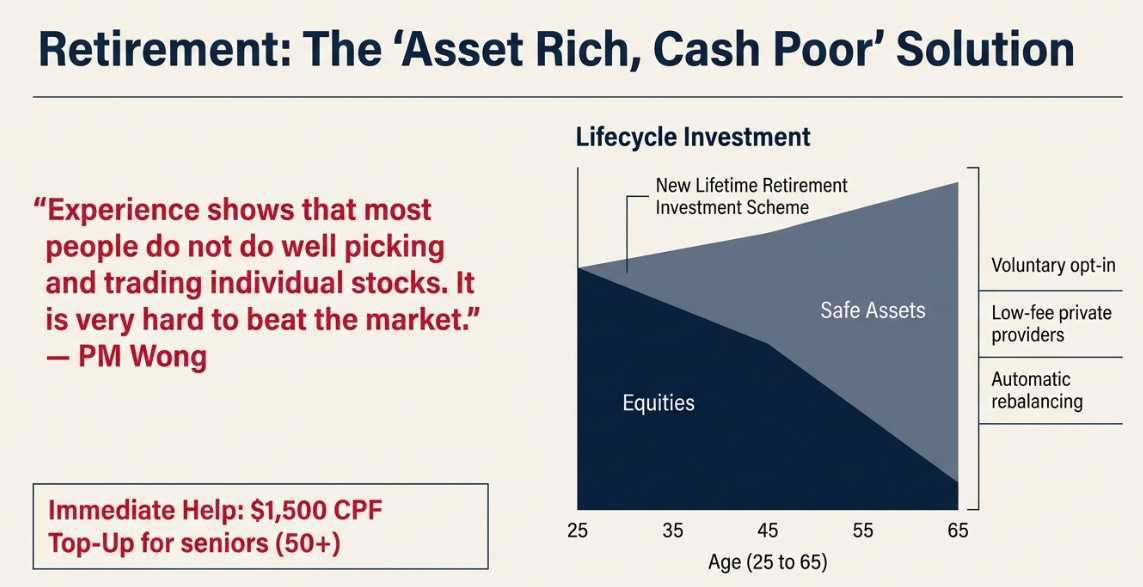
CPF top-up: Up to $1,500 for Singaporeans aged 50+ with retirement savings below the Basic Retirement Sum. Progressive, lower balances receive more.
Senior worker contributions rising again in 2027, with the government covering half the employer increase.
The game-changer: the Lifetime Retirement Investment Scheme. PM Wong was unusually candid:
“Experience shows that most people do not do well picking and trading individual stocks. It is very hard to beat the market consistently.”
The scheme uses a lifecycle approach, more equities when young, auto-rebalanced toward safer assets as retirement approaches. The government will select two to three low-fee providers. Participation is voluntary.
For everyday Singaporeans: If you’re under 45, this could meaningfully improve your outcomes beyond the risk-free CPF rates (up to 6% p.a.). But it introduces market risk. Wait for the details before deciding.
For investors and the wealth industry: The CPF pool exceeds $500 billion. Opening even a fraction to lifecycle products creates a significant new institutional channel. The provider selection will be closely watched.
V. “Fear Cannot Be Singapore’s Response”: The AI Bet
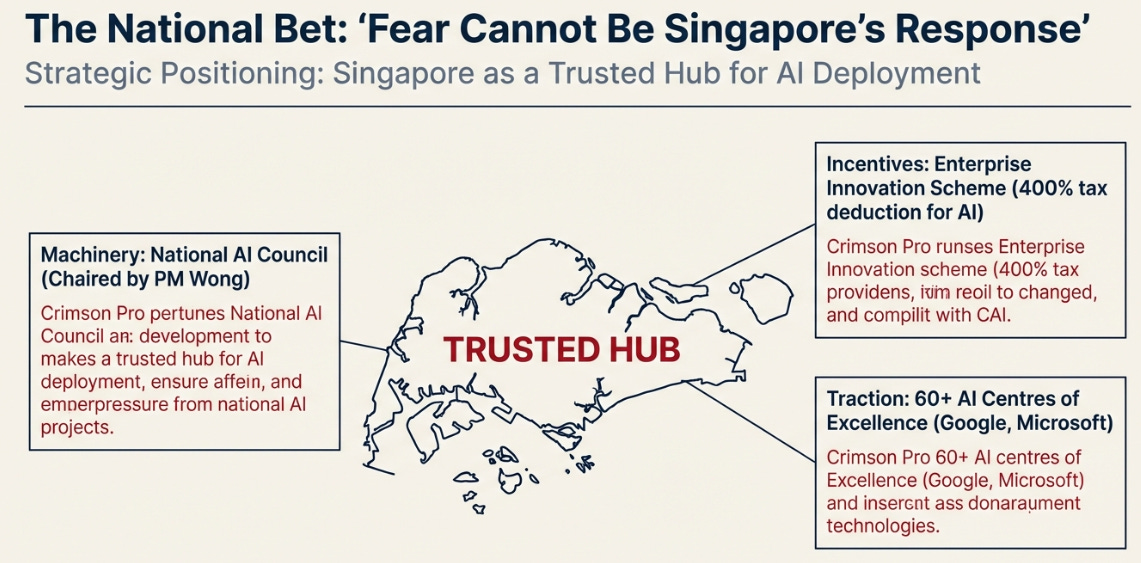
“Fear cannot be Singapore’s response. If we allow uncertainty to paralyse us, we will fall behind in a world that is moving rapidly ahead.”
Singapore concedes it can’t build the biggest frontier models. Instead, it’s positioning itself as the place where AI is deployed effectively, responsibly, and at speed. More than 60 firms have already established AI Centres of Excellence here.
The architecture: a new National AI Council chaired by PM Wong. AI Missions in four sectors, manufacturing, connectivity, finance, healthcare. A Champions of AI programme for end-to-end enterprise transformation. The Enterprise Innovation Scheme expanded to include AI expenditure (400% tax deduction, capped at $50,000/year, YA2027–2028). An AI park at One-North. SkillsFuture redesigned for AI pathways. Six months of free premium AI tools for those completing selected courses.
The workforce commitment was the most politically significant line:
“We will not allow technological change to come at the expense of our workers.”
The transition starts with accountancy and legal, two professions where AI is already automating routine cognitive work. The Productivity Solutions Grant is being expanded for AI-enabled tools so that every firm, regardless of size, can access practical solutions.
For workers: Your job will change. The question is whether you change with it. The profession-specific approach means this will hit specific workforces on specific timelines. The free premium AI tool access is small but practical, take it seriously.
For investors: When the government publicly acknowledges AI will automate white-collar work, it validates the enterprise AI automation thesis. DBS and Grab were singled out as leaders, implying most Singapore firms are still behind. The adoption curve is early.
VI. Jobs, Skills and the Workforce Rewiring
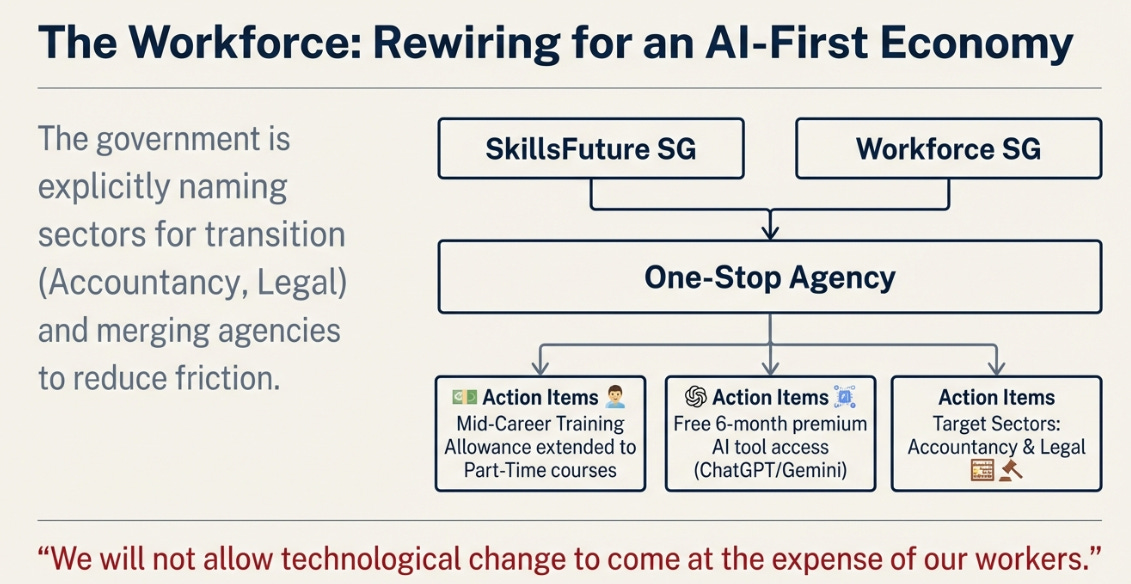
SkillsFuture Singapore and Workforce Singapore will merge into a single agency, a one-stop shop for training, career guidance, and job matching. This sounds bureaucratic. It isn’t. The two-agency model created real friction for workers navigating mid-career transitions. The Mid-Career Training Allowance now extends to part-time training, removing a major barrier for anyone who can’t afford to stop earning.
On wages: Local Qualifying Salary rises from $1,600 to $1,800. EP minimum qualifying salary rises to $6,000 from January 2027 ($6,600 for financial services). S Pass to $3,600 ($4,000 for financial services). Progressive Wage Credit Scheme co-funding increases to 30%, extended to 2028.
For employers and investors: The EP and S Pass increases are mildly inflationary for labour costs. Factor this into Singapore-listed company margins, particularly in financial services.
VII. Singapore as a Wealth and Capital Hub: What Just Got Stronger
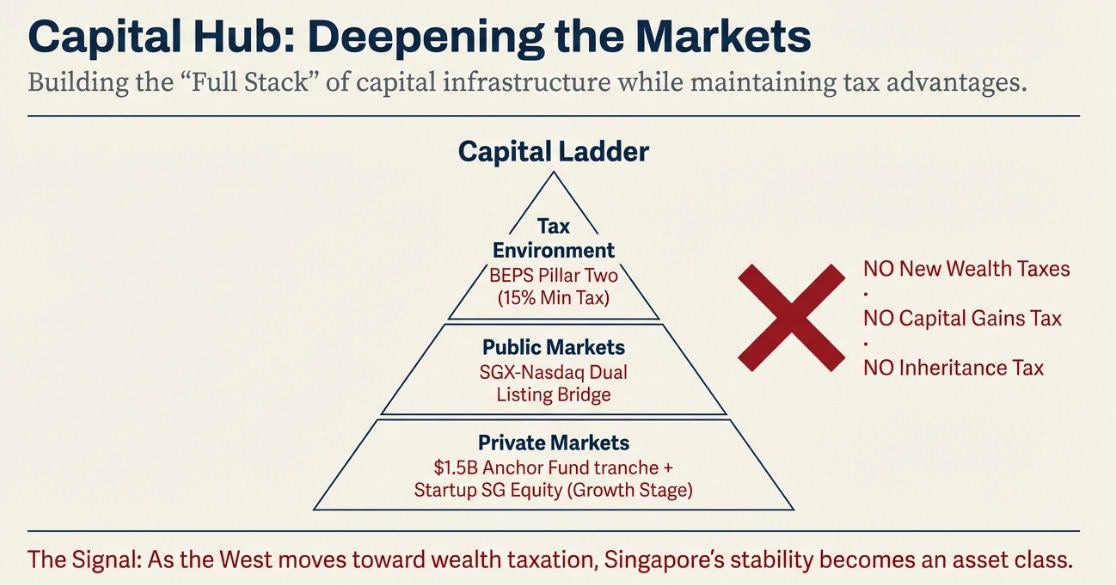
This section received far less media attention than the vouchers. For anyone with investment capital, it may matter the most.
Capital markets are being deliberately deepened: $1.5 billion second tranche Anchor Fund, $1.5 billion top-up to the Financial Sector Development Fund, ~$4 billion allocated to nine asset managers, and a dual-listing bridge connecting SGX and Nasdaq. Listing rules are being streamlined for high-growth companies.
Growth-stage funding gets $1 billion in new capital through Startup SG Equity, expanded beyond early-stage. EDB is shifting focus to attract high-growth companies with potential to become future industry leaders.
The tax signal that matters most: No new wealth taxes. No capital gains tax. No inheritance tax. No signals of change. Rising expenditure is funded by the Global Minimum Tax (BEPS Pillar Two) from FY2027, raising the effective rate on large MNEs to 15%, and existing surpluses. In a world where the UK, US, and Australia are moving the other direction, Singapore’s stance is increasingly rare.
The Global Minimum Tax does narrow the headline advantage for certain holding structures. Family offices and HNWIs using Singapore vehicles should review now, the runway is ~12 months.
For retail investors: More listings, deeper liquidity, cross-listed products via the Nasdaq bridge.
For HNWIs and family offices: Co-investment alongside government capital, cross-border exposure, and the CPF channel as an emerging platform. Singapore’s wealth-friendly posture is intact, but monitor the fiscal trajectory as spending rises.
What it signals: Singapore is building the infrastructure to capture capital flows in a fragmenting world. The bet is that being the most trusted, best-governed hub in Asia is a competitive advantage that compounds over time.
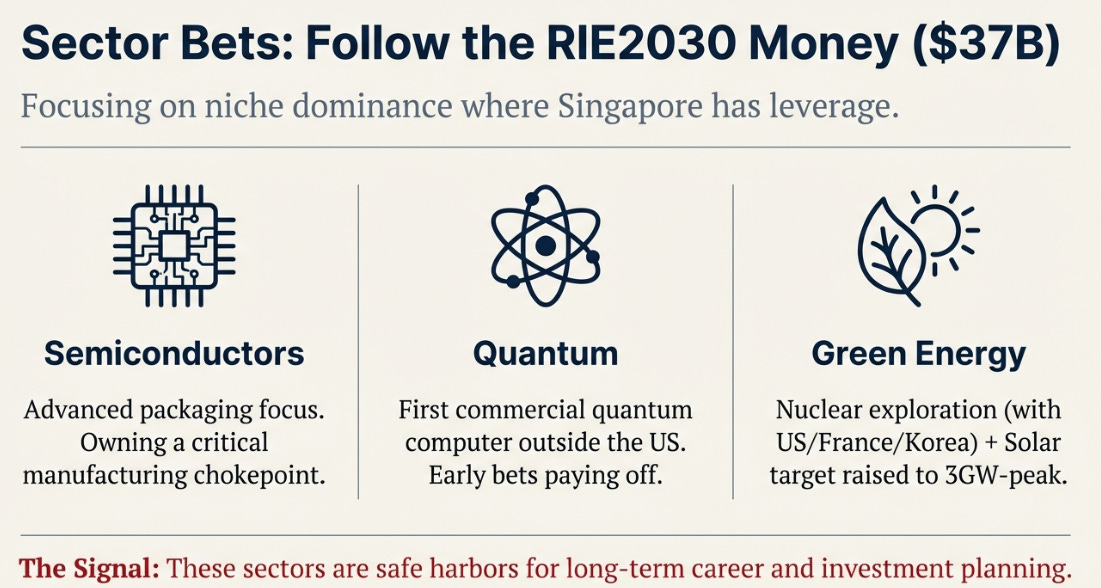
The government is also placing concentrated sector bets with $37 billion under the RIE2030 plan. Semiconductors and advanced packaging, a two-decade R&D investment now bearing fruit, anchors the strategy. Quantum technology is the emerging play: Quantinuum will host its latest quantum computer here, making Singapore the first country outside America to do so. Green energy is advancing with pragmatism, solar target raised to 3 gigawatt-peak by 2030 (ahead of schedule), nuclear being explored, but the carbon tax trajectory softening if global peers don’t follow. Internationalisation support is ramping up with grants of up to 70% for SMEs going overseas and new diplomatic presence in Latin America, Africa, and the Middle East.
VIII. The Costs, the Risks, and the Fiscal Foundation
Costs you’ll notice: Tobacco excise duty up 20% (immediate). PARF rebate reduced by 45 percentage points, cap lowered to $30,000, car ownership gets more expensive. Carbon tax at $45/tonne, but the government is signalling it may position toward the lower end of $50–$80 by 2030 if global peers don’t follow.
What it signals: The carbon tax recalibration is a real policy shift. For households, utility costs may rise more slowly than projected. For businesses, carbon compliance costs won’t escalate as aggressively. For ESG investors, reassess how Singapore assets are positioned relative to green mandates.
The fiscal picture: FY2025 surplus of $15.1 billion. FY2026 projected at $8.5 billion. Revenue growth expected from the Global Minimum Tax. Spending pressures growing across defence, economic competitiveness, social needs, and infrastructure.
“Our sound public finances give us the ability to act decisively… This puts Singapore in a very different position from many other countries, where governments are constrained by debt and deficit pressures.”
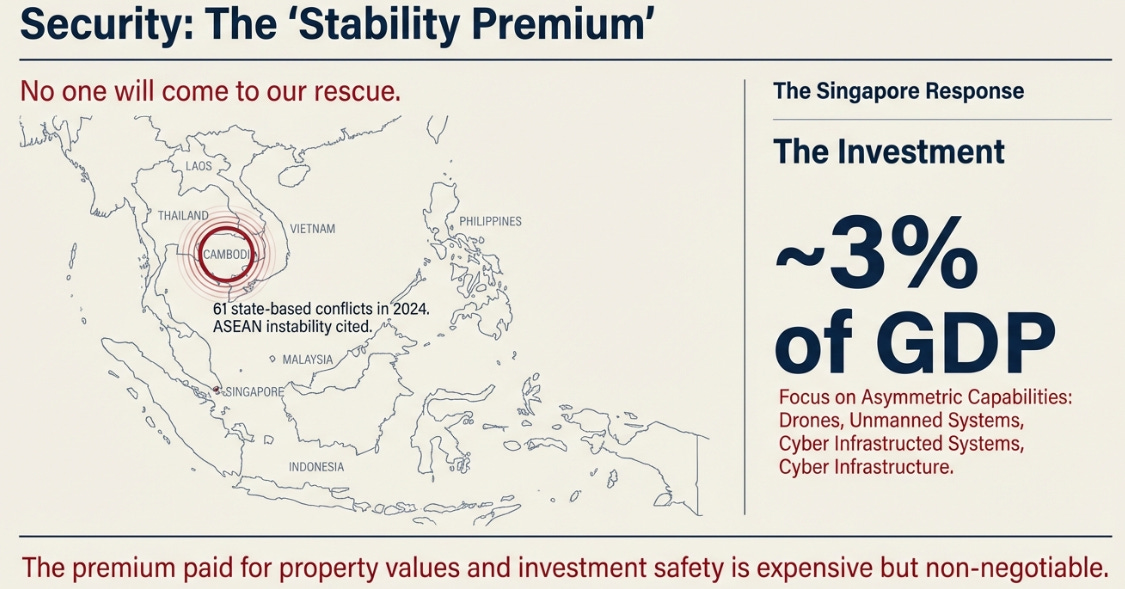
On security: PM Wong cited Cambodia-Thailand armed clashes involving drones, rocket launchers, and fighter jets, unusual for a budget speech. For a Singapore leader to highlight intra-ASEAN military confrontation is a deliberate choice. It serves notice: the security environment is deteriorating, and the public is being prepared. Defence at ~3% GDP, “prepared to spend more.” Cybersecurity partnerships deepening with private sector. The stability premium underpins everything, from property values to the reason global capital parks here.
No new broad-based taxes signalled. But the arithmetic is clear: if spending growth outpaces revenue, something eventually gives.
IX. “Not Mere Spectators”
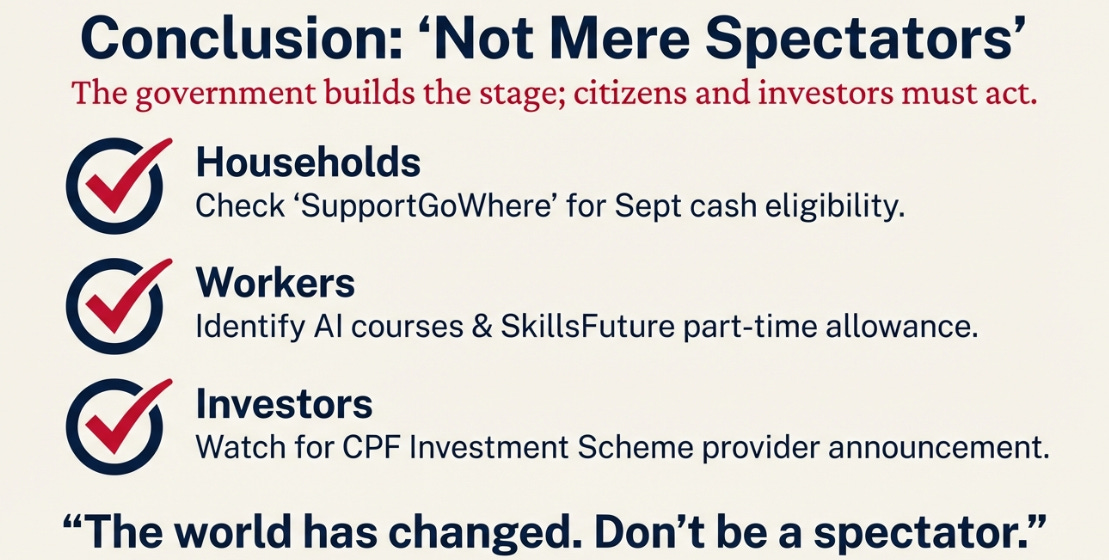
Budget speeches reveal what governments truly fear and what they’re genuinely betting on. This one says three things clearly.
First, the old rules are gone. The multilateral system that Singapore thrived under for eight decades is fracturing, and the government has moved past hoping for a return to normal. It’s actively retooling, trade partnerships, industry clusters, capital markets, workforce systems, for a different world.
Second, stability is now a scarce asset. In a fragmenting global economy marked by debt, conflict, and institutional erosion, Singapore’s fiscal discipline, governance quality, and security investment give it a compounding advantage. The budget reinforces every dimension of this.
Third, everyone is being asked to move. Workers to upskill, with real support but real urgency. Families toward self-reliance through goal-linked programmes. Businesses toward transformation. Investors toward a deeper, richer Singapore market.
For everyday Singaporeans, the immediate deliverables are real and welcome. Collect the vouchers, check your CPF, review the preschool subsidies, explore the AI courses. These things add up.
For investors, the strategic message is what matters: Singapore is building the infrastructure to be where capital, talent, and trust converge in a fractured world. Whether you manage a family household or a family office, this budget is worth paying attention to.
The question it leaves you with is PM Wong’s own: will you be a spectator, or a participant?
Disclaimer:
The content does not constitute any kind of investment or financial advice. Kindly reach out to your advisor for any investment-related advice. Please refer to the tab “Legal | Disclaimer” to read the complete disclaimer.