


TL; DR
The prediction arrived: product-revenue growth accelerated from 29% to 37%, and management says AI contributed roughly half of that seven-point improvement.
CoCo is becoming more than an interface: by shortening migrations, reducing implementation friction and helping customers build faster, it can pull future Snowflake consumption into the present.
The moat is still unproven: growth has accelerated, but retention has not yet reaccelerated, AI gross margins are lower, and Snowflake still needs to show that faster creation leads to deeper customer dependence rather than just more expensive consumption.
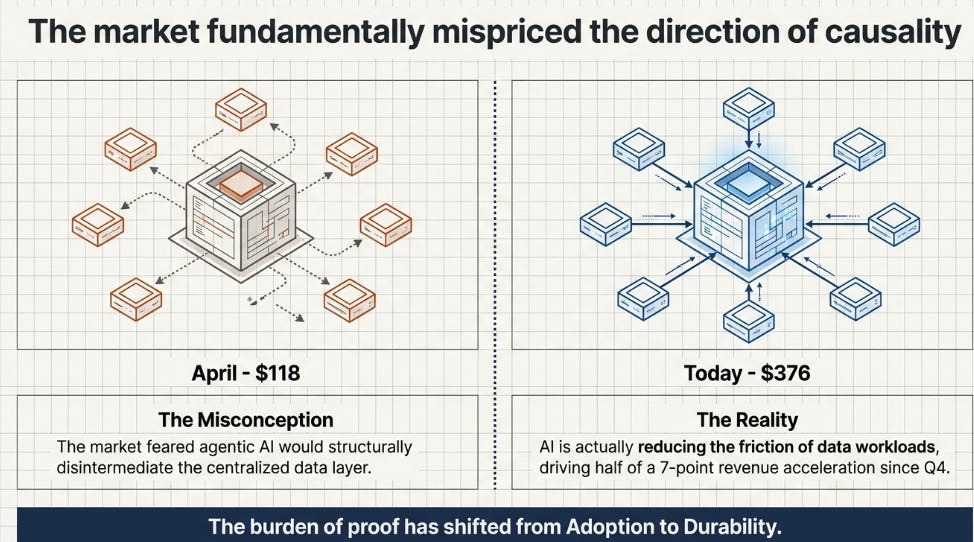
In December 2025, after Snowflake reported product-revenue growth of 29%, I argued that the most important number was not revenue but the 800-basis-point gap between revenue growth and RPO growth. Enterprises were committing faster than they could deploy (Snowflake 3QFY26 Earnings: The 800 Basis Points Nobody Noticed) I ended with a prediction: “The ‘slowing growth’ narrative has about two quarters left to live.”
The stock fell 8%, then kept falling. By April it had reached $118, down 56% from year-end. The market’s argument was no longer that Snowflake was experiencing a temporary optimization cycle. It was that agentic AI would make the company structurally less necessary. If agents could reach into enterprise systems, retrieve data and act on it directly, why would anyone need a centralized data layer standing in the middle?
That was the point of maximum discomfort because the architecture made sense before the consumption evidence did. RPO accelerated, enterprises signed record nine-figure commitments, and Snowflake’s governed context became more valuable as models became interchangeable. Yet net revenue retention remained stuck near 125%, product growth had slowed, and management could not show how much AI was contributing. We were not arguing merely that the stock was cheap. We were arguing that the market had the direction of causality wrong: agents would increase the need for governed data and reduce the difficulty of creating workloads on Snowflake.
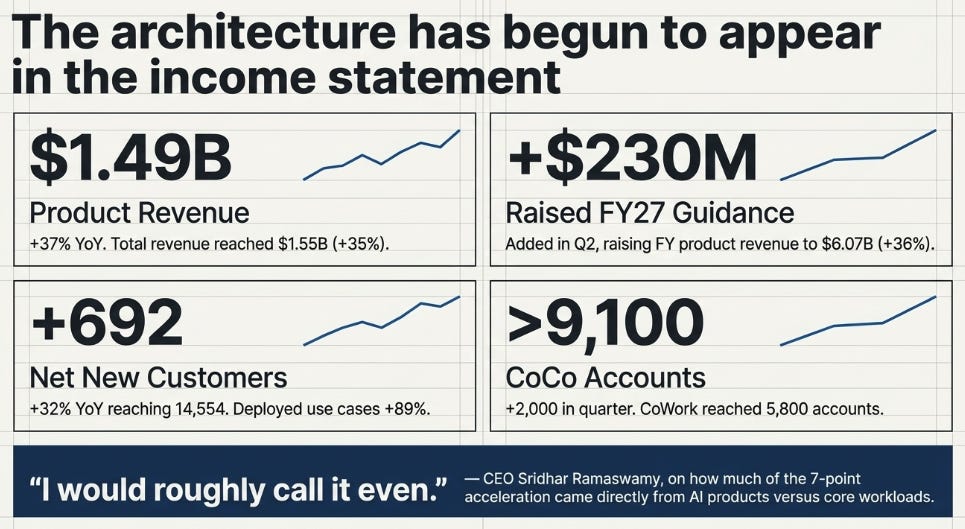
The evidence then arrived. Product-revenue growth accelerated to 34% in Q1 and 37% in Q2. Full-year guidance rose by $180 million last quarter and another $230 million this quarter. Asked how much of the seven-point acceleration since Q4 came from AI products, CEO Sridhar Ramaswamy answered: “I would roughly call it even.” Faster migrations and other core workloads supplied the balance. The two-quarter prediction turned out to be almost literal.
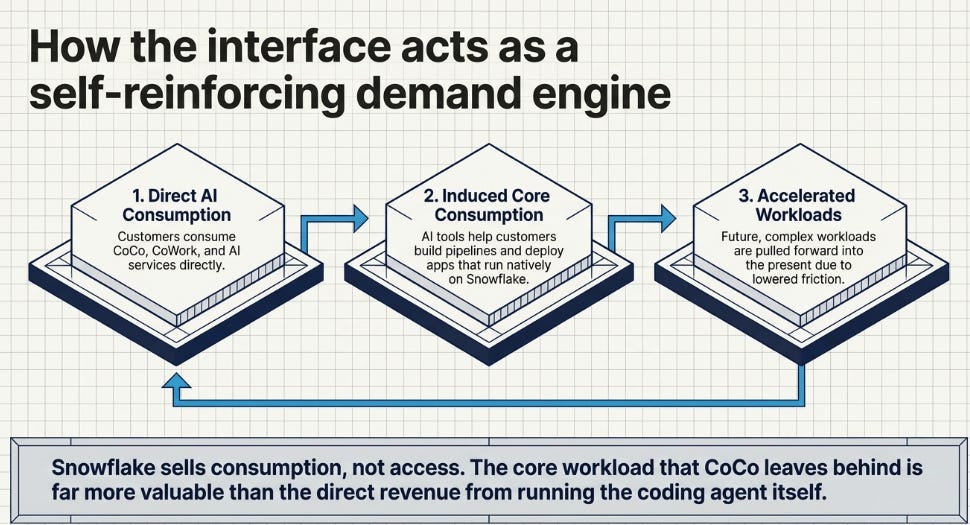
Last quarter, I wrote that CoCo was not the product; it was the interface (Snowflake 1Q27 Earnings: Second Interface Collapse). That description now looks incomplete. An interface helps a user operate a product. An engine changes what the product can produce. By reducing the time and expertise required to migrate data, build pipelines and deploy applications, CoCo is beginning to create demand for the underlying business.
This matters because Snowflake sells consumption, not access. Direct revenue from running CoCo is useful; the workload CoCo leaves behind may be far more valuable. The architecture has begun to appear in the income statement. We were right about the mechanism when the market was pricing the opposite. That does not mean Snowflake has already won the agentic enterprise.
The Big Fundamental Question
Can Snowflake turn its governed enterprise context into a self-reinforcing engine in which AI creates workloads faster, those workloads deepen core consumption, and the resulting usage strengthens Snowflake faster than commoditization and inference costs weaken it?
Powerful models have become broadly available, shifting the enterprise bottleneck from model capability to the ability to connect models safely to governed data and turn an idea into a working application. Snowflake becomes more valuable if CoCo and CoWork compress that process, because each new workload creates direct AI usage, recurring core consumption and deeper organizational dependence. The mechanism breaks if generic agents make workloads portable, retention fails to improve, or lower AI margins consume too much of the value being created.
The Interface Became a Demand Engine
Snowflake’s original achievement was a form of interface collapse. By separating storage from compute and automating much of the operational complexity of a traditional data warehouse, Snowflake reduced the expertise required to put data to work. Customers could begin with one workload and expand as consumption justified itself.
CoCo attempts a second collapse. A customer can use conversational language to write code, debug queries, build pipelines and migrate legacy systems. This is often described as productivity, but that word is too small. The strategically important effect is a reduction in the activation energy required to consume Snowflake.
There are three layers to the economics. First, customers consume CoCo, CoWork and other AI services directly. Second, those products induce core consumption by helping customers build things that run on Snowflake. Third, they accelerate consumption by pulling future workloads into the present.
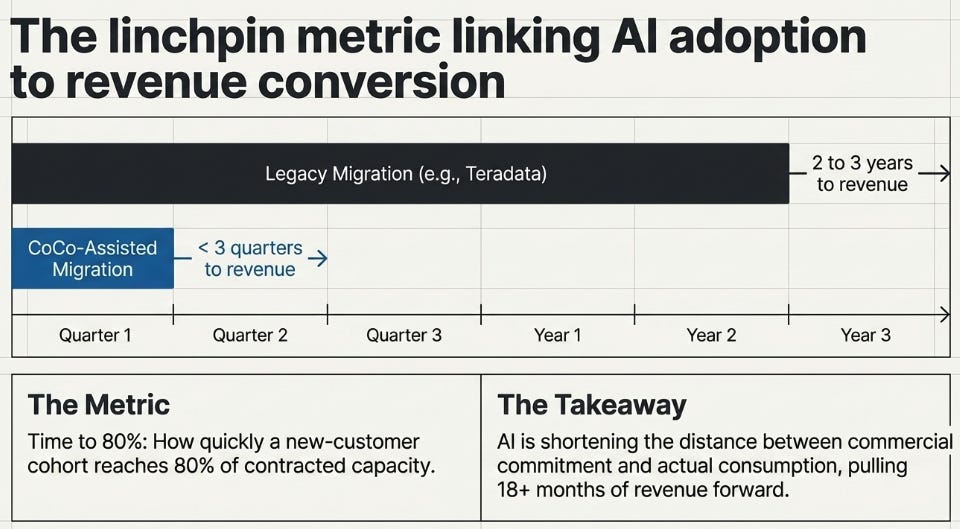
Management offered a useful example. A large network-equipment manufacturer is completing a Teradata migration in less than three quarters; Snowflake estimates that the same project would previously have required two to three years. The economic value is not confined to the cost of the coding agent. Snowflake begins earning from the migrated estate perhaps eighteen months earlier than it otherwise would have.
Ramaswamy disclosed another metric that may matter more than the AI account count: time to 80% of purchased consumption. Snowflake measures how quickly each new-customer cohort reaches 80% of its contracted capacity, and management says the newest cohorts have improved “very, very visibly.” This is the mechanism our earlier writing anticipated. AI is not merely adding a new workload category; it is shortening the distance between a commercial commitment and actual consumption.
Snowflake did not disclose the magnitude of that improvement. It should. If time to 80% continues falling, it would link AI adoption, implementation velocity and revenue conversion in one number. If it stalls, the interface may be popular without being economically transformative.
Seven Points, One Engine
The quarter itself was unusually strong. Product revenue reached $1.49 billion, up 37%, while total revenue increased 35% to $1.55 billion. Snowflake added 692 net new customers, up 32%, reaching 14,554. Deployed customer use cases rose 89%; use cases won per account executive increased 43%.
CoWork expanded to 5,800 accounts, up nearly 11% sequentially. CoCo surpassed 9,100 accounts after adding more than 2,000 during the quarter. Management raised FY27 product-revenue guidance by $230 million to $6.07 billion, or 36% growth, and guided Q3 to 37–38%. This was not simply a quarterly beat flowing through the annual number. Snowflake embedded a higher observed consumption curve into the second half.
The historical thesis ledger now looks different:
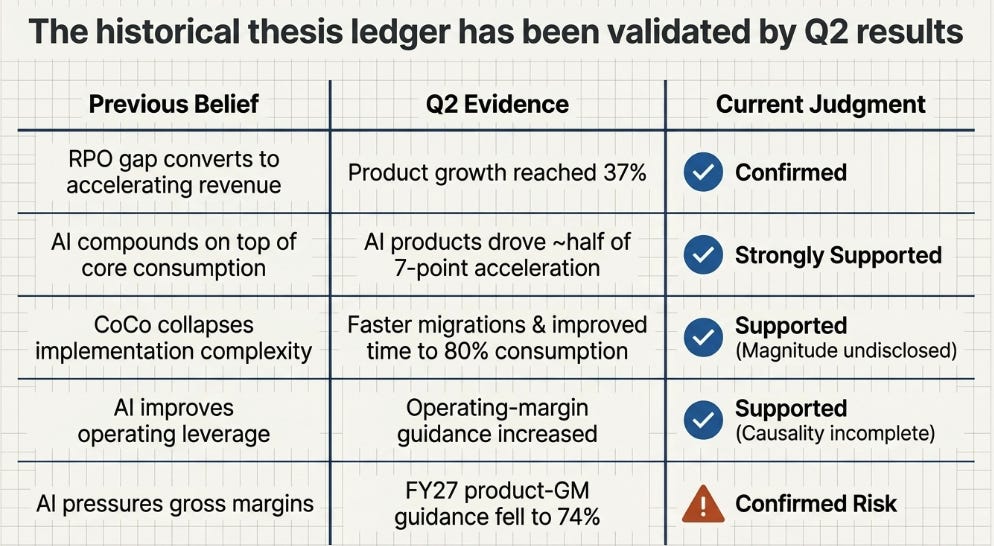
Source: Snowflake Q2 FY27 earnings release, supplemental materials and earnings call.
There are reasons to retain some restraint. Net revenue retention was 126%, healthy but unchanged from Q1 rather than breaking higher. Total RPO growth slowed to 30%, though the 54% expected to convert over the next twelve months implies roughly $4.86 billion of current RPO and a much stronger near-term conversion signal. Snowflake also refused to disclose the consumption uplift of AI adopters relative to comparable non-adopters.
Management said the effect was “pretty noticeable” across cohorts, then supported the claim with anecdotes about new use cases. Those anecdotes establish breadth. They do not establish lifetime value. Q2 proves acceleration; it does not yet establish its duration or terminal level.
Management Is Selling the Destination
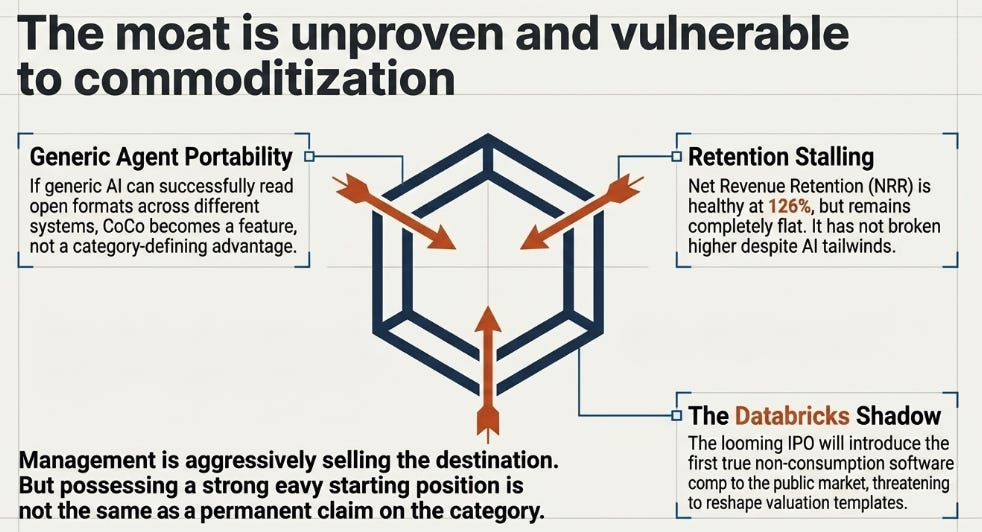
Management’s chosen sentence was unambiguous: “The agentic enterprise runs on Snowflake.” The company says AI brings new data and workloads onto Snowflake, its first-party products attract new users, and those users consume more across the core. Because Snofwflake already sits amid enterprise data, permissions, business definitions, models and workflows, management believes it can become the governed control plane connecting intelligence to action.
Our story now reconciles with management’s on the mechanism. We agree that direct AI revenue understates the opportunity. We agree that models become more useful when they operate against governed enterprise context. We agree that reducing the difficulty of migration and application development can accelerate the existing business.
The disagreement concerns how much of the destination has already been earned.
Our earlier articles sometimes moved too quickly from valuable to defensible. Data sharing creates ecosystem benefits, but it is not a telephone network in which every participant benefits from every new connection. Governance matters, but Databricks, Microsoft, Google and AWS can also build catalogs, semantic layers and governed model access. Snowflake possesses a strong starting position, not a permanent claim on the category.
The deeper potential advantage is the engine itself. Enterprise data and permissions already reside in Snowflake. CoCo understands the environment in which the work must run. Customers can create and deploy workloads faster. Those workloads generate consumption and new operating patterns, which Snowflake can use to make the next project easier.
If this engine produces faster time to value than competing approaches, Snowflake becomes progressively harder to displace. If generic agents can reproduce the same outcome across open formats and different systems, CoCo becomes an effective feature rather than a category-defining advantage.
Management has now supplied evidence for the mechanism we anticipated. It has not yet supplied evidence for the empire it is building around that mechanism.
One further observation is worth adding, because it will matter in the months ahead. Databricks was not named by management or by any of the nine sell-side analysts on the call — a silence that could reflect strategic positioning, analyst preference for the acceleration narrative, or simple absence. Whatever it reflects, the Databricks IPO, whenever it arrives, will produce the first public comparable that is not a consumption-software peer. That event will force sell-side reference classes to update in one direction or another. Until then, templates will default to the nearest available comp, which is Datadog.
The Wrong Reference Class?
There is a subordinate question worth naming, because it may determine how much of the destination Snowflake earns actually gets captured in the stock over the next four to six quarters.
At $118 in April, Snowflake was priced as an impaired data warehouse. At $376 today, it is increasingly priced as an AI-beneficiary consumption business — the sell-side reference class of Datadog, MongoDB and Confluent, adjusted for scale and growth. That reference class produces a fair-value ceiling in the low-to-mid $400s through FY28 on the raised revenue base, which is roughly where sell-side price targets will cluster over the next several weeks.
But if Snowflake genuinely becomes what management is claiming — a governed control plane for enterprise agent workloads — the correct reference class is not consumption software. It is a category that does not currently have a clean public comparable, and whose historical analogs (transaction networks, benchmark providers, certain regulated data services) have earned meaningfully higher multiples on the strength of amortization economics and structural switching costs. The gap between the two reference classes is roughly 400–500 basis points of terminal EV/revenue multiple, or approximately $100–175 per share on FY28 estimates.
This is not, on the current evidence, a case for a $700 stock. It is an observation that Snowflake’s valuation ceiling depends on which reference class the market eventually settles on, and that the market cannot settle on the higher class until measurable evidence forces the update — meaningful governance-related consumption disclosure, retention improvement among agent-heavy customers, or a public comparable that breaks the current templates.
Q2 strengthened the possibility of that reclassification. It did not complete it. A new reference class should be the consequence of measurable retention, governance economics and operating leverage — not a substitute for that evidence.
Faster Creation Has a Cost
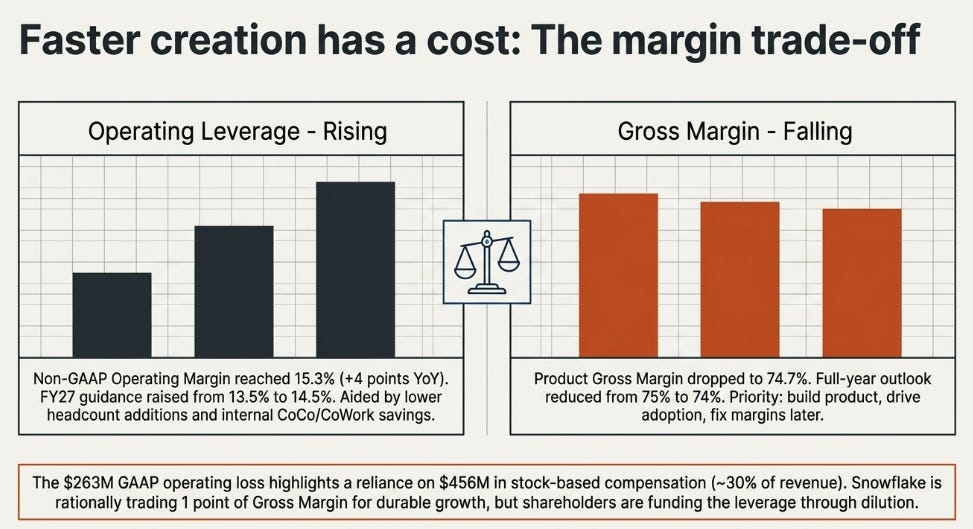
The second unresolved question is who captures the value.
Non-GAAP operating margin reached 15.3%, more than four points higher than a year ago, and Snowflake raised its FY27 operating-margin guidance from 13.5% to 14.5%. Year-to-date headcount additions fell sharply once the Observe acquisition is excluded. Management also described material internal savings from using CoCo and CoWork across marketing, finance and sales. There is real operating leverage here.
Product gross margin tells the other side of the story. It fell to 74.7%, and Snowflake reduced the full-year outlook from 75% to 74%. CFO Brian Robins explained the sequence plainly: build a great product, drive adoption and revenue, and then work on the margin implications. That is rational product management, but it also confirms that AI economics come after adoption in the current priority order.
The non-GAAP presentation deserves context. Snowflake still reported a $263 million GAAP operating loss, while stock compensation was approximately $456 million, nearly 30% of revenue. This does not invalidate improving operating leverage, but shareholders are funding part of it through dilution.
The relevant question is not whether gross margin declines by one percentage point. It is whether Snowflake is sacrificing one point of margin to create several additional points of durable growth, or replacing high-margin core growth with lower-margin AI activity. A lower percentage margin can create more value if incremental gross-profit dollars compound faster and customer dependence deepens. Management has shown the growth; it has not shown that complete economic bridge.
This is also where the current variant perception lies. The market now understands that Snowflake benefits from AI. What it may still misunderstand is that the decisive variable is neither AI account adoption nor a standalone AI revenue figure. It is the time required to turn enterprise intent into recurring consumption — and the gross profit Snowflake retains from doing so.
Three Prices, Three Snowflakes
At roughly $375–380 after the results, the stock no longer prices Snowflake as an AI victim. The three-year outcome depends on what kind of company this engine creates.
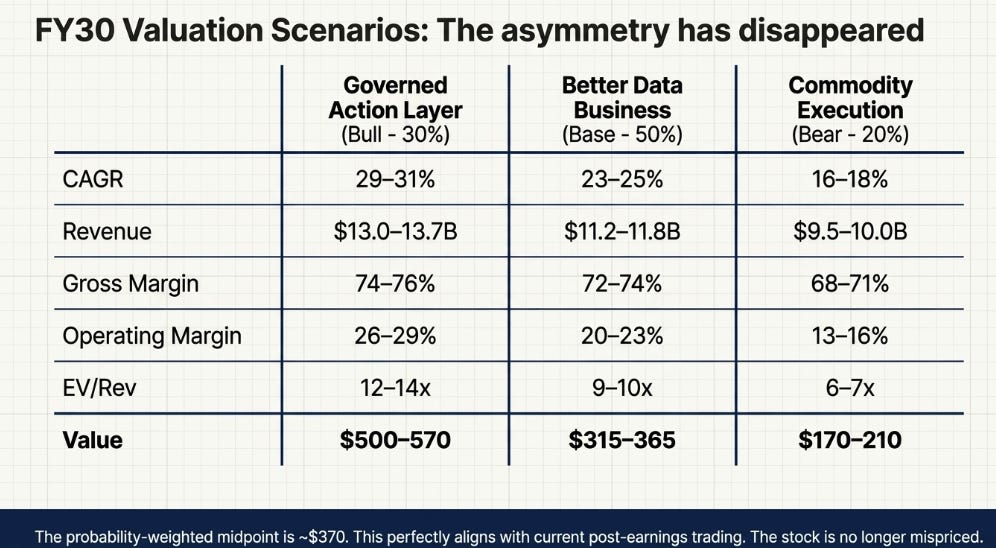
Scenario estimates are our assumptions, anchored to FY27 product-revenue guidance of $6.07 billion.
In the bull case, CoCo and CoWork become the preferred interfaces for enterprise data and agent development. Retention rises above 130%, revenue compounds near 30%, and operating margins reach the high 20s. Snowflake becomes the governed action layer management is selling.
In the base case, AI makes Snowflake a better data business without creating a new category. Growth settles in the low-to-mid 20s, retention remains around 125–128%, and gross margins remain below historical levels. This is an excellent company, but not a mispriced one.
In the bear case, open formats and generic agents reduce differentiation. AI expands with weaker economics, retention falls below 120%, and workloads move between competing systems with limited friction.
The probability-weighted midpoint is approximately $370, close to the post-earnings price. Conviction in the business has increased; the asymmetry in the stock has disappeared. I would hold rather than chase here, become interested around $325–335, and require higher retention and stable gross margins before underwriting prices above $420.
The Question After the Question
A year ago, the central question was whether AI would disintermediate Snowflake. Last quarter, it became whether AI could accelerate Snowflake. Q2 has substantially answered both: AI is making Snowflake more useful and driving the core business faster.
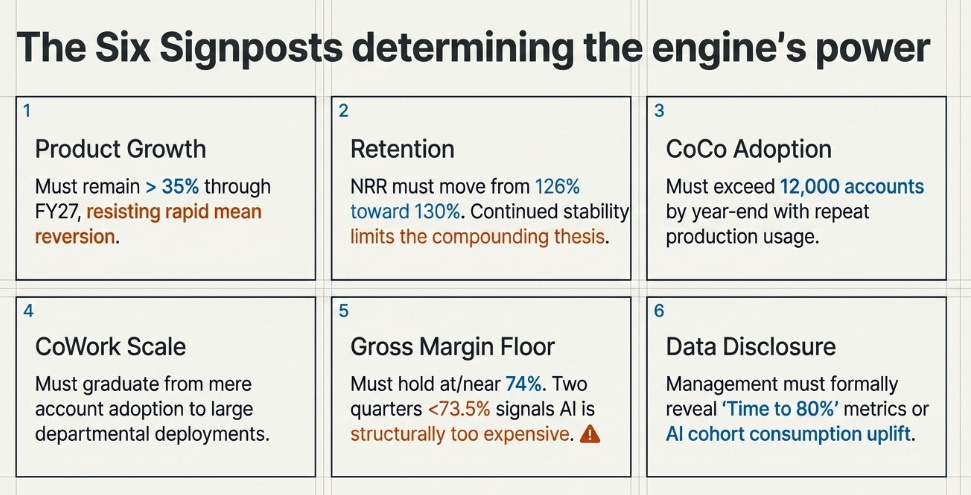
Six signposts will determine how powerful the engine becomes. Product growth should remain above 35% through FY27 rather than quickly reverting. Net revenue retention needs to move toward 128% and eventually 130%; continued stability at 125–126% would limit the compounding thesis. CoCo should exceed 12,000 accounts by year-end with evidence of repeat production usage, while CoWork must graduate from account adoption to large departmental deployments. Product gross margin should hold near 74%; two quarters below 73.5% would suggest that AI is becoming structurally more expensive. Most important, Snowflake should disclose either the improvement in time to 80% consumption or the consumption uplift of comparable AI-adopting cohorts.
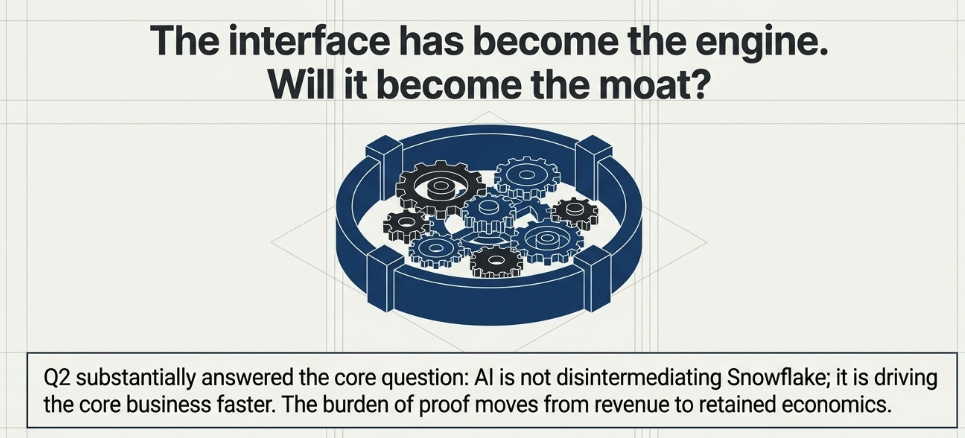
The thesis has advanced. Snowflake no longer needs investors to believe that AI might someday help its business; management has begun to quantify the contribution. What was mispriced at $118 was direction; what is now at issue at $376 is destination. The burden of proof has moved upward from adoption to durability, from acceleration to customer dependence, and from revenue to retained economics.
The interface has become the engine. The next two quarters will tell us whether it also becomes the moat.
Disclaimer:
The content does not constitute any kind of investment or financial advice. Kindly reach out to your advisor for any investment-related advice. Please refer to the tab “Legal | Disclaimer” to read the complete disclaimer.