


TL; DR
Q3 proved the first part of the thesis. SpaceX has become a real compute supplier: capacity rose from 0.6GW to 1.7GW, Super Intelligence turned profitable, and short-term pricing is holding above prior expectations. Pasted markdown
But the value of compute and the price of compute are not the same thing. Anthropic and Google capture most of the benefit when better models make each watt more productive; SpaceX captures it only while capacity is scarce or if it can deliver compute at structurally lower cost. Pasted markdown
The real upside requires owning demand. Starlink already shows the model: SpaceX owns the customer and keeps more of the productivity gain. Compute only reaches the same economics if Grok or Cursor can generate more value per watt than third-party renters are willing to pay without the debt-funded build overwhelming the equity.
The most important answer on SpaceX’s third-quarter call came when Goldman’s Eric Sheridan asked how the company decides between using its compute for its own models and renting it to others. Musk answered the question, and then explained the bet behind it:
Well, the relative allocation of compute to third parties versus internal is something that’s going to change from one month to the next. I guess as a rough approximation, our goal is to split it 50/50, more or less, where half of the compute is used internally and half of it is rented to others. That number could shift 60/40 one way or the other. It’s going to be dynamic. And obviously, our approach is to rent at effectively the spot market rate as opposed to sign these long-term deals. Our belief is that the value of compute per watt will increase over time, not decrease. The reason for that, I think it should be obvious to people really, is that as you improve the AI software, as the models get better and better, you get more useful intelligence per watt.
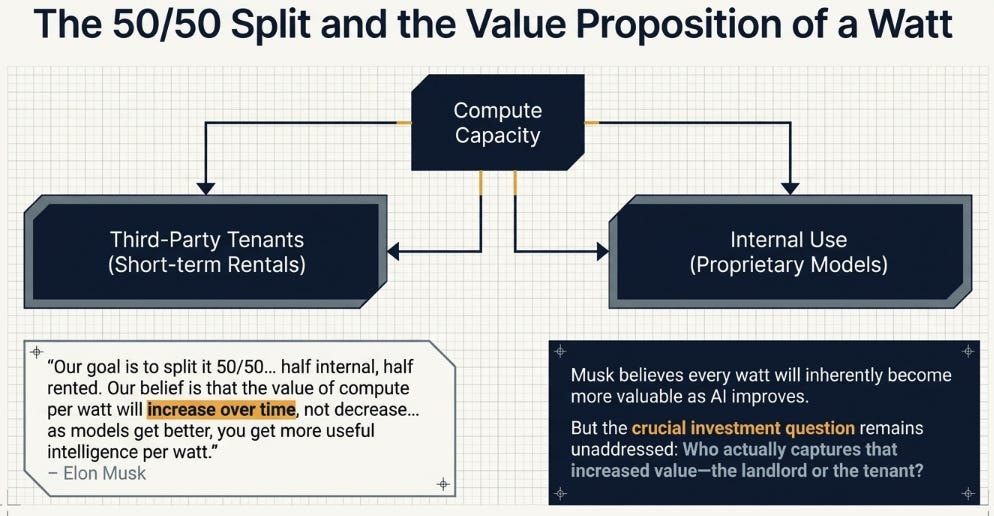
Musk is probably right that better models make each watt more useful. But the value of a watt and the price of a watt are different things. The value is what the watt can produce. The price is what the owner of the watt can charge for it. Competition decides how much of the first ends up in the second. That gap is the investment question for SpaceX’s compute business, and this quarter made it sharper.
What June Got Right, and One Thing It Got Wrong
In June we argued that SpaceX’s AI segment was misread. Its near-term value did not rest on Grok winning the model race, “but on SpaceX becoming the fastest route from demand to usable compute.” We said the first future that had to arrive was “proof that the Anthropic and Google deals are not merely temporary overflow demand, but early evidence of a repeatable business in selling scarce compute capacity.”
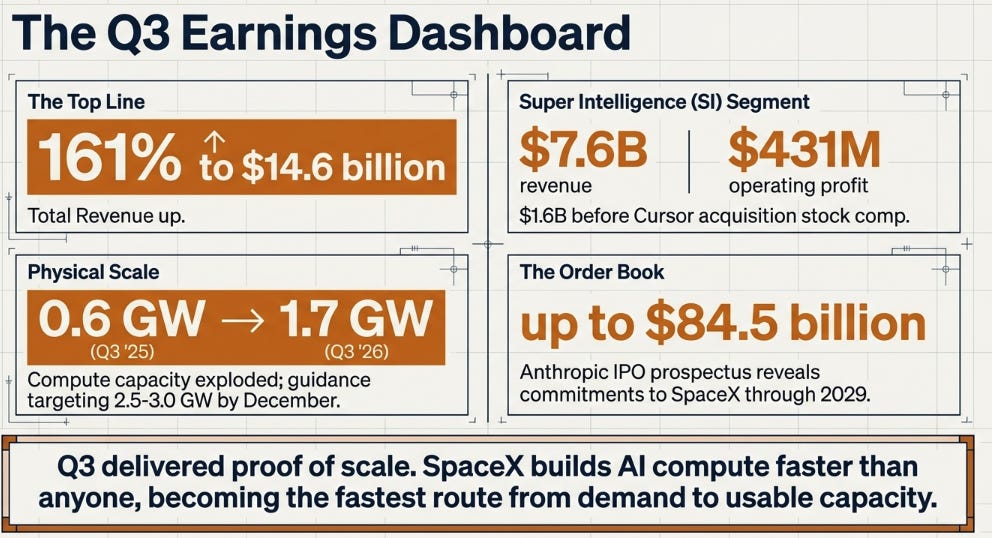
Q3 delivered that proof. Revenue rose 161% to $14.6 billion. The Super Intelligence segment, renamed from AI, earned an operating profit of $431 million on $7.6 billion of revenue, or $1.6 billion before stock compensation tied to the Cursor acquisition. Compute capacity went from 0.6 gigawatts a year ago to 1.7, and management expects 2.5 to 3 by December. SpaceX guided Q1 2027 revenue to $33 to $37 billion, against a FactSet consensus near $23 billion. Anthropic’s IPO prospectus reportedly shows up to $84.5 billion of commitments to SpaceX through 2029. Starship delivered on schedule: Flight 14 put 26 V3 satellites in orbit in September.
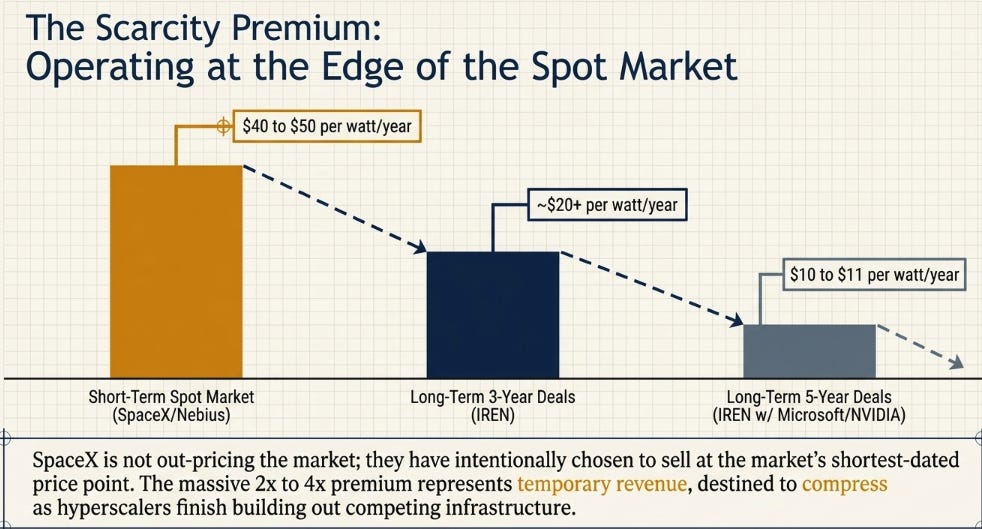
Pricing held too. CFO Bret Johnsen said pricing is “currently tracking slightly above the high end of the $30 to $50 per watt range we were discussing just last quarter,” and Musk said short contracts are “renewing at higher dollars per watt, not lower dollars per watt.” That is the going spot rate, not a premium. Nebius says short contracts clear at $40 to $50 million per megawatt a year, roughly twice what multi-year deals fetch, and CoreWeave raised prices about 25% in July. SpaceX is not out-pricing the market. It has chosen to sell at the market’s shortest-dated price, and the gap between that price and the long-term one is the part of its revenue the market itself treats as temporary.
We also own a claim that did not hold. June said the Anthropic deal “resolved the tension” between training Grok and renting GPUs, and that Grok’s weakness made renting to competitors “credible and likely durable.” Musk now wants half the fleet for internal use, and said “Grok Bot may end up being what uses most of our SI compute.” The tension was not resolved. It turns out to be the central question.
The Value of a Watt and the Price of a Watt
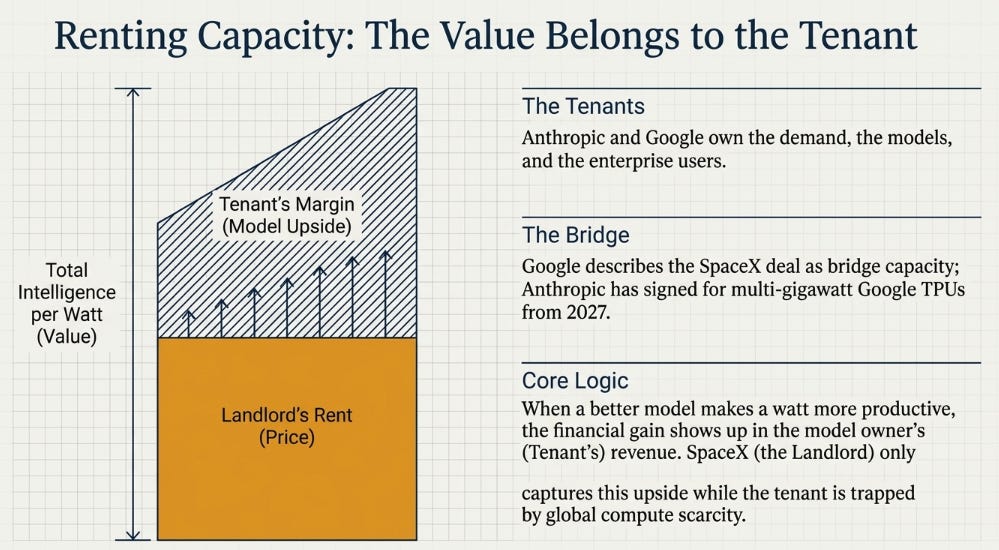
Start with who SpaceX sells to. Anthropic and Google own the demand: the models, the users and the enterprise contracts. They rent from SpaceX because they cannot build fast enough themselves, and both are building. Google has described its deal as bridge capacity. Anthropic has signed for multiple gigawatts of Google TPUs from 2027. When a better model makes a watt more productive, the gain shows up first in the model owner’s revenue, not in the landlord’s rent. The landlord captures it only while the tenant has nowhere else to go.
The market already puts a price on that. Short contracts at Nebius clear at $40 to $50 per watt a year. Longer ones clear at $20 to $25. IREN signed five-year deals with Microsoft and NVIDIA at roughly $10 to $11 per watt a year, and its three-year deals now run above $20. These are not like-for-like: the hardware, the buyer’s credit and what is bundled in all differ. But differences of that kind do not explain a gap of two to four times. Buyers are paying a large premium today to get capacity now and keep the right to leave. That premium does not tell us how fast it will fade. It does tell us which part of SpaceX’s economics we should be least willing to extrapolate, and SpaceX has put its whole rental business there.
SpaceX is also one of the companies that will end the scarcity. Musk said, “I would be surprised if we brought on less than 13 gigawatts of compute by the end of next year.” Google, Microsoft, Amazon, Oracle and the neoclouds are all building at the same time. Every one of those decisions is rational given today’s prices. Together they are what brings the price down. The faster SpaceX wins the race to build, the sooner the rent it earns from winning starts to shrink.
The strongest answer to this comes from management. Johnsen said, “At current pricing, new compute deployments are generating a payback of less than a year.” If that is true on a full-cost basis, the price could fall by half and the fleet would still earn back its cost well inside the life of the hardware. Short contracts would then be a cheap option on continued shortage rather than a risk. We take that seriously. We cannot check it. SpaceX discloses no cost per gigawatt, no utilisation and no useful life for its GPUs. CoreWeave, the nearest listed comparison, borrowed $2.6 billion in August on roughly five-year terms against contracts averaging about three, so it accepts one renewal gap. SpaceX accepts a renewal every quarter, on assets that depreciate over five or six years.
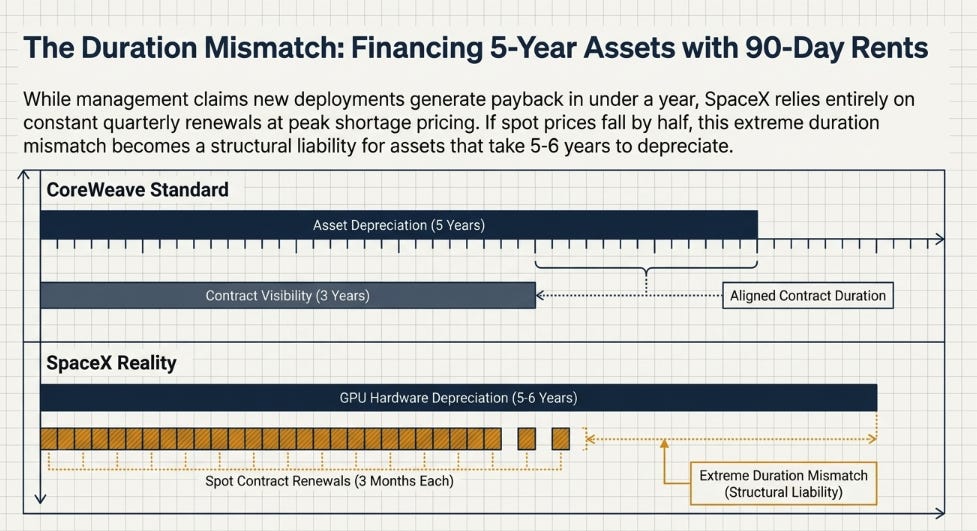
So, the question is how SpaceX keeps the value of a watt after the price falls. There are two ways.
The first is cost. If SpaceX can deliver a working watt more cheaply than anyone, it earns a return even at a low price. Musk’s answer to JPMorgan’s Doug Anmuth on power is the evidence for this route:
When we talk to the turbine suppliers, they tell us that the blades and vanes are 12 to 18 months behind the rest of the turbine, meaning they can deliver everything except the blades and vanes 12 to 18 months before they can deliver the blades and vanes. Casting is this really difficult bottleneck. If anything, it seems to be getting worse. That means that we can bring power online 12 to 18 months faster than anyone else.
That is a time advantage. A time advantage is worth the most when supply is short, and it is worth less each quarter as supply catches up. Whether it also becomes a cost advantage cannot be seen from outside.
The second is owning demand. If Grok and Cursor sell directly to users, then a better model raises SpaceX’s own revenue instead of a tenant’s. That is the only route that captures the increase Musk is describing. It also has a cost. Every gigawatt Grok uses is a gigawatt not rented at $50 a watt, so internal use only creates value if Grok earns more per watt than Anthropic would pay. Grok Bot reached 800,000 paid weekly users in October, doubling in a month. That is a start. It is nowhere near the scale needed to justify half of 13 gigawatts.
Starlink Keeps Its Watts
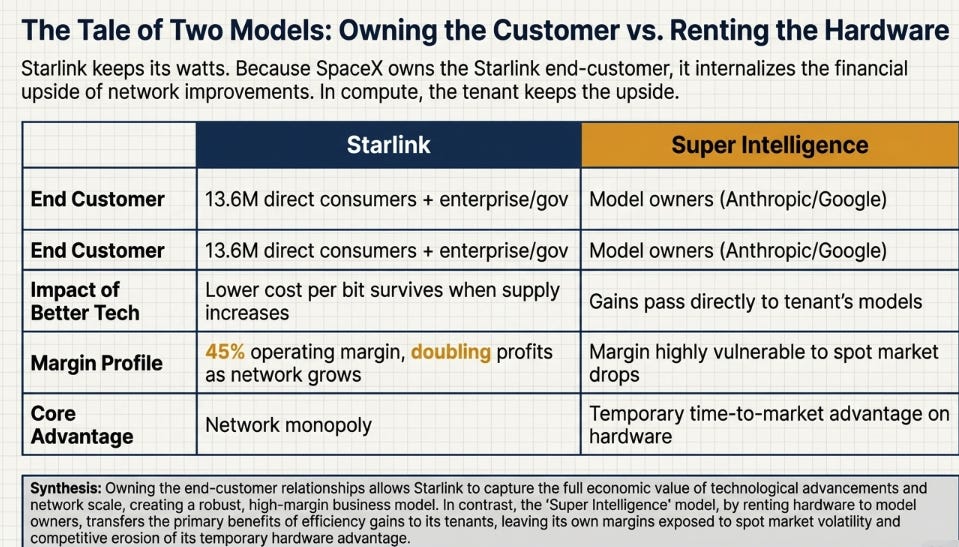
SpaceX already owns a business where it keeps the gain, and it is the one getting less attention.
Starlink sells to end customers: 13.6 million consumers, plus airlines, enterprises and governments. It holds spectrum and landing rights in about 174 markets. Because it owns the customer, it has a direct way to keep much of what it gains when the network gets better. Starship’s first operational flight put 26 V3 satellites in orbit, about ten Falcon 9 launches’ worth of downlink capacity. That lowers the cost of each delivered bit, and a lower cost survives when supply becomes plentiful in a way that a shortage price does not. Connectivity revenue rose 69% to $5.2 billion, operating income doubled to $2.4 billion, a 45% margin (about 42% without a one-time tariff refund), Starlink does not keep every gain. Consumer revenue per user rose from $66 to $69 on a better customer mix, but it was $83 a year ago. The margin is the better evidence: the network grew and profits doubled.
That is the contrast. In Starlink, SpaceX owns the customer, so it has a direct way to keep the gains from a better network. In compute, the model owners own the customer, so they keep most of the gains from better models, unless SpaceX owns the model people pay for.
Paying for It
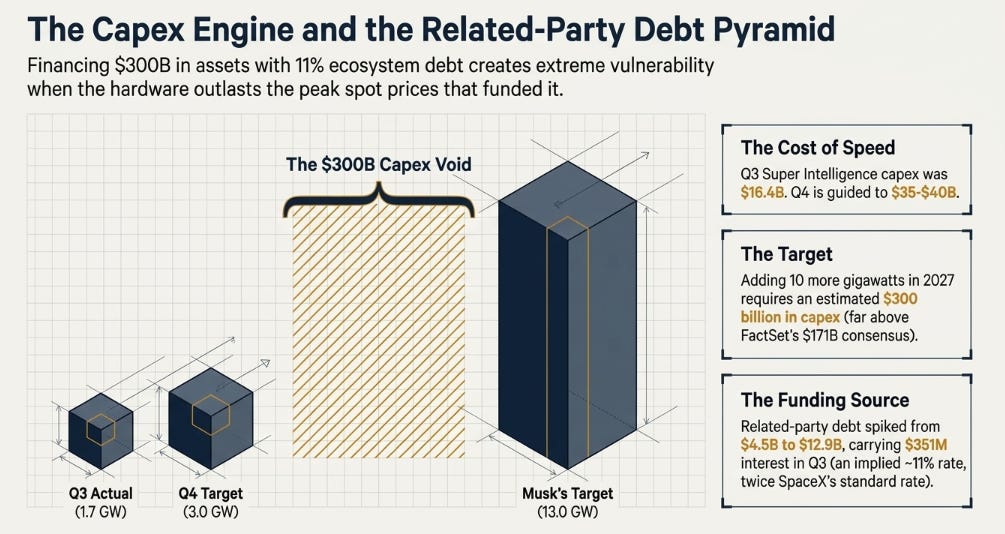
The second effect of building faster than anyone is that you pay for everything before you know what it will earn.
The IPO left SpaceX with about $51 billion of net cash at the end of Q3. But the build has outgrown the cash. Q3 capex was $19.6 billion, $16.4 billion of it for Super Intelligence. In August management pointed to capex similar to Q2’s $18.4 billion. Q4 is now guided at $35 to $40 billion. As a rough sensitivity, not a forecast: if each new gigawatt costs what our split of the Q4 guide implies, about $33 billion, ten more gigawatts in 2027 would need about $300 billion of capex, against a FactSet estimate of $171 billion. Asked how SpaceX would fund it, Johnsen said:
You have your operational cash flows, first and foremost. You have multiple pools of capital available in the debt market, especially because of our investment grade status and strong balance sheet. You also have the opportunity, from what we’ve seen, to partner with, I would say, the whole value chain related to on the vendor and customer side.
He also described the pace as “demand-led and prudent,” which is more cautious than the CEO’s 13 gigawatts.
One part of the funding needs a question rather than a conclusion. Debt owed to related parties rose from $4.5 billion in December to $12.9 billion and carried $351 million of interest in Q3. If the average balance was close to the period-end figure, that is about 11% a year, roughly twice SpaceX’s rate on other debt. We do not know the average balance, the fees or the lenders, and the 10-Q may explain it. June warned that “internal ecosystem demand is less informative than independent third-party demand.” Financing from inside the ecosystem deserves the same scrutiny. It matters more now that SpaceX and Tesla have both formed special committees of independent directors to study combining the companies. Musk said they “have not reached agreement on the terms of any transaction,” and a deal would need half of all Tesla shares to approve it. A merger would give the build a second balance sheet, and it would put more of the financing of SpaceX’s compute inside the Musk ecosystem.
Samuel Insull built Chicago’s power system faster than anyone in America, financed the expansion through a pyramid of debt-funded holding companies, and lost it in 1932. The power stations kept running. The shareholders did not. SpaceX’s balance sheet today is far stronger than Insull’s. The lesson is narrower: when the assets outlast the prices that paid for them, the financing decides who keeps the equity.
Three States, One Test
June’s variant has largely been absorbed. The Super Intelligence segment is profitable, and SpaceX now trades alongside the neoclouds rather than the aerospace names. Our variant, version two:
SpaceX’s compute business earns the price of a watt in a shortage. Its value depends on keeping the value of a watt after the shortage, through lower cost or through owning demand. Q3 proved the first and has not yet shown either of the second.
A rough check ties the price of a watt to the size of the business. At 13 gigawatts with half rented out, every $10 per watt a year is about $65 billion of rental revenue. The range from long-term to spot prices, $20 to $50, spans $130 to $325 billion a year before allowing for utilisation. Where SpaceX lands in that range is most of the difference between the states. We keep June’s three states of belief, now defined by who keeps the value of a watt:
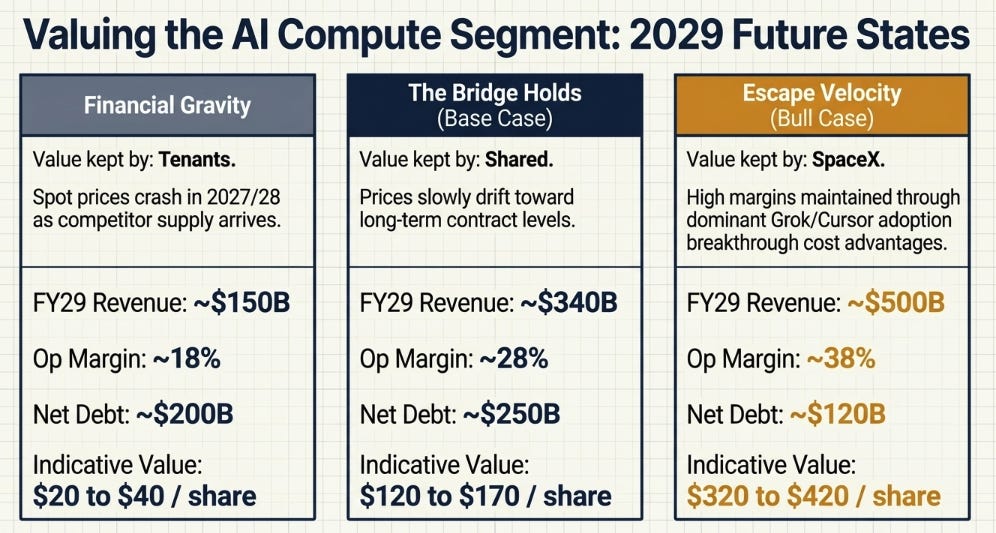
Each state is lower than June’s range. The reason is the financing. In June the bad state carried little debt. Now every state carries a debt-funded build, and the equity is what absorbs a lower price of a watt.
The cleanest tests would be realised price per watt, cost per gigawatt, utilisation and Grok revenue per watt. SpaceX discloses none of them, and asking for them is part of the test. Until it does, we use the closest reported number. Our hard threshold: Super Intelligence operating margin before acquisition-related stock compensation of at least 10% in Q4, as capacity nearly doubles. Q3 was 21.8%. The measure is imperfect. The segment mixes compute rental with Cursor, Grok and advertising, and its Q3 costs included $2.47 billion of depreciation and $821 million of ordinary stock compensation that cannot be split between them. Some decline is also expected as new capacity comes on before it bills, and the threshold allows for that. It cannot prove that depreciation is outrunning price. But below 10% we can no longer argue that the fleet earns its depreciation at the prices it gets, and we move toward Financial Gravity. There is no excuse clause for ramp timing.
SpaceX has shown it can build the scarcest thing in AI faster than anyone. That was the first future, and it arrived. The next one asks how much of the value of a watt SpaceX keeps once everyone else has finished building. Our range for the middle state at the end of 2029, about $120 to $170, brackets $147.79, the October 20 close before the results. A buyer at that price earns little over three years unless SpaceX keeps more of the value of a watt than a shared split would give it. That is what the stock assumes.
$SPCX
General Disclaimer: The information presented in this communication reflects the views of the author and does not necessarily represent the views of any other individual or organization. It is provided for informational purposes only and should not be construed as investment advice, a recommendation, an offer to sell, or a solicitation to buy any securities or financial products.
While the information is believed to be obtained from reliable sources, its accuracy, completeness, or timeliness cannot be guaranteed. No representation or warranty, express or implied, is made regarding the fairness or reliability of the information presented. Any opinions or estimates are subject to change without notice.
Past performance is not a reliable indicator of future performance. All investments carry risk, including the potential loss of principal. This communication does not consider the specific investment objectives, financial situation, or particular needs of any individual.
The author and any associated parties disclaim any liability for any direct or consequential loss arising from the use of this material and undertake no obligation to update or revise it.
Disclaimer:
The content does not constitute any kind of investment or financial advice. Kindly reach out to your advisor for any investment-related advice. Please refer to the tab “Legal | Disclaimer” to read the complete disclaimer.