


TL; DR:
The proof: Premium subscribers reached 300 million, ARPU rose 7.4% in constant currency, and gross margin hit a record 33.4%, challenging the view that royalty costs permanently cap Spotify’s economics.
The bet: Management is deliberately trading some low-quality user growth for higher conversion and monetisation, introducing more friction into the Free tier and prioritising revenue over raw MAU expansion.
The next layer: Audiobooks+ has surpassed $100 million in annual recurring revenue, offering an early glimpse of a metered model in which Spotify charges its most engaged users for additional hours, credits, and AI-powered experiences.
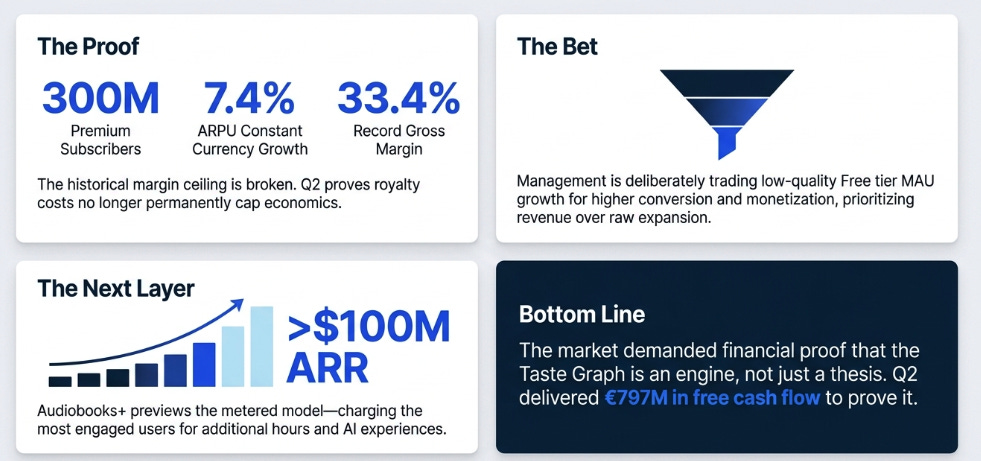
Three months ago, I argued that the market wanted financial proof the Taste Graph was an engine, not a thesis. Q2 supplied some of that proof: 300 million Premium subscribers, constant-currency ARPU growth of 7.4%, a record 33.4% consolidated gross margin, and €797 million in free cash flow. Yet the most important moment in the quarter was not a number. It was a decision, one that changes how I think about the next phase of Spotify’s business.
The Old Ceiling and How It Broke
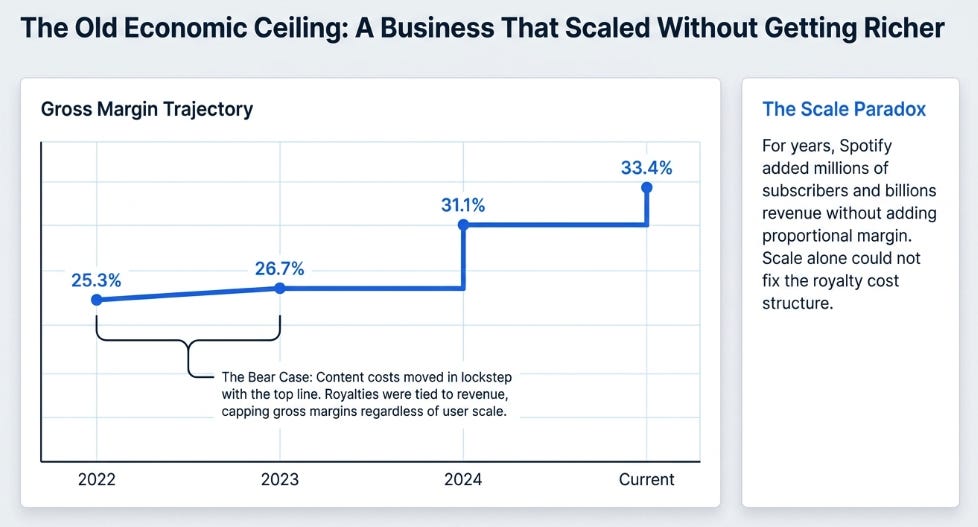
For most of its existence, Spotify had a problem that scale could not fix. Music royalties are generally calculated as the greater of a percentage of revenue and a per-user amount. As Spotify grew, content costs grew in rough proportion. Gross margin sat around 25-27% for years. The company could add subscribers and revenue, but it could not add margin, because the content cost structure moved in step with the top line. That was the bear case from the IPO through 2023: a business that could get bigger but never meaningfully richer.
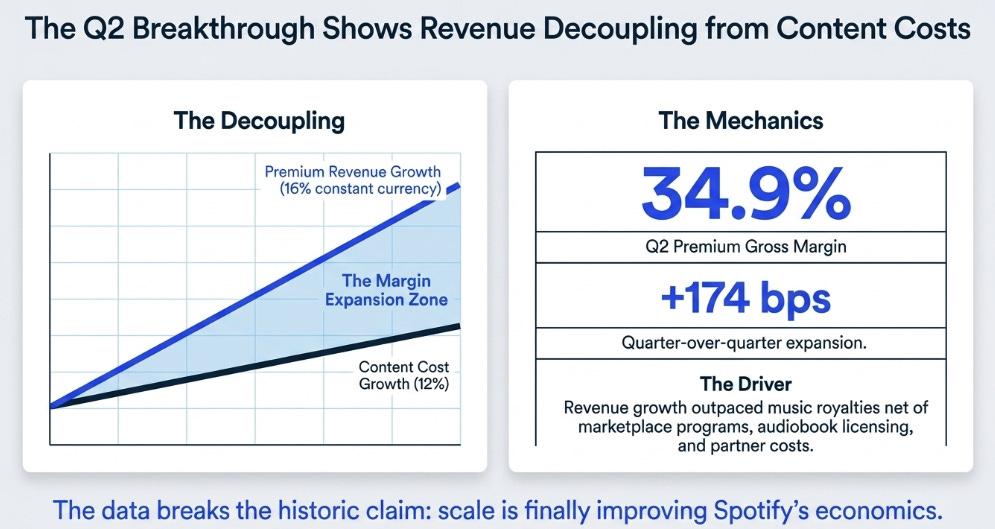
The margin trajectory tells you when something changed: 25.3% in 2022, 26.7% in 2023, 31.1% in 2024, and now 33.4%. Q2’s Premium segment was even sharper, gross margin of 34.9%, up 174 basis points, as Premium revenue grew 16% on a constant-currency basis while associated content costs grew only 12%. The filing attributes the improvement to revenue growth outpacing music royalty costs net of marketplace programmes, audiobook licensing costs, and Spotify Partner Program costs. That is all Spotify disclosed about the mechanics, and it is enough: the old claim that scale could never improve Spotify’s economics is broken in the data.
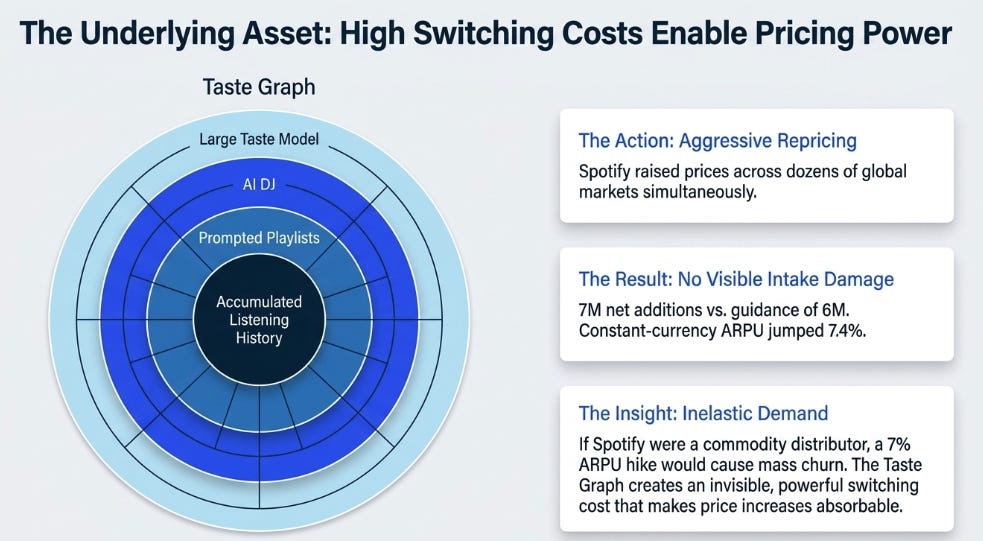
The Taste Graph matters here because it is the asset that makes price increases absorbable. Spotify raised prices across dozens of markets and subscriber growth remained healthy, 7 million net additions against guidance of 6 million, with management reporting no visible damage to intake. If Spotify were a commodity distributor, a 7% ARPU increase should have produced meaningful churn. It did not. The Large Taste Model, AI DJ at roughly 100 million subscribers, Prompted Playlist, years of accumulated listening history, these create a switching cost that is invisible in any single quarter and powerful across many. The subscription proved it can escape the old economic ceiling. The question is what Spotify builds on top of it.
The Decision
Alex Norström, on the Q2 earnings call:
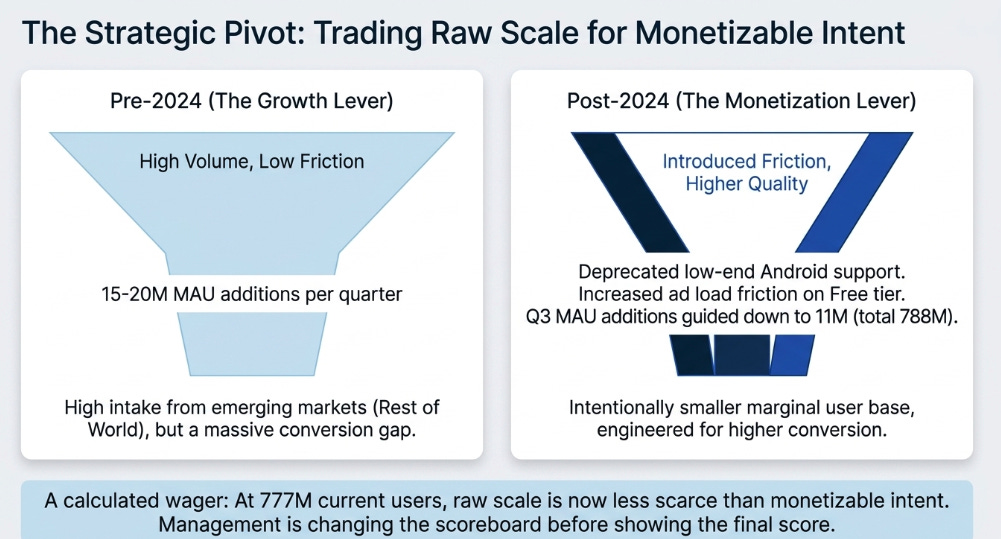
“We’ve been making changes like tweaking the sign-up to get a higher quality MAU throughput. We’ve deprecated a lower-end Android device support which builds the business and makes it more efficient for us. We’ve carefully introduced some friction in both ad load and some limitations in our Free tier. Gustav and I have this saying where we say sometimes we pull the growth lever, and sometimes we pull the monetization lever. Here we’re starting to pull the monetization lever.”
Spotify guided Q3 MAUs to 788 million, up 11 million from 777 million, a meaningful step down from the 16 million added in Q2 and the 15-20 million quarterly pace of recent years. The company is not shrinking. It is choosing fewer marginal users in selected emerging markets in the belief that the remaining funnel will generate more value. Norström pointed to Latin America as the precedent, where Spotify followed the same progression from high MAU growth and low conversion to a more monetisable base over several years.
I think this framing is credible. At 777 million users, raw scale is less scarce than monetisable intent, and the conversion gap in Rest of World, which represents a large share of MAUs but a much smaller share of subscribers, is precisely the kind of opportunity that rewards tighter funnels rather than wider ones.
But I also think it is important to name what this is. It is a wager, not a proof. The proof comes later: does conversion improve, does churn hold, does advertising revenue per Free user rise, does the emerging-market base generate more revenue despite slower intake? Management has changed the scoreboard before showing the new score. That does not make the decision wrong. It means the evidence that validates the decision has not yet arrived.
The Meter
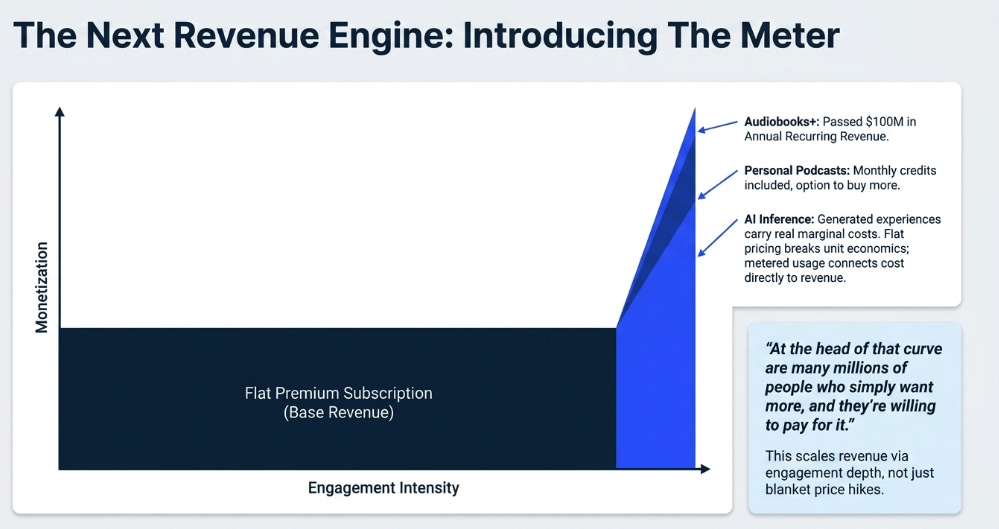
The smaller number in Q2 that I think matters more than most analysts will credit: Audiobooks+ passed $100 million in annual recurring revenue.
Norström described Spotify’s usage curve in a way that connected this directly to the Taste Graph:
“At the head of that curve are many millions of people who simply want more, and they’re willing to pay for it.”
Premium includes an audiobook allowance. Heavier listeners pay for more hours. Personal Podcasts follows the same logic, with monthly credits included in Premium and the option to buy more. Gustav Söderström made the connection to AI inference explicitly: generated experiences carry a real marginal cost, so unlimited use at a flat price would separate cost from revenue at the exact moment Spotify needs them connected.
This is the business model that may sit on top of the Taste Graph. The Taste Graph identifies what each user values. The usage-based layer, the meter, lets Spotify charge its most intensive users more, rather than raising the flat subscription price for everyone equally. That creates a different kind of revenue growth than conventional price increases: it is driven by engagement intensity rather than across-the-board repricing, and it scales with the depth of the personalisation engine rather than with management’s appetite for pricing risk.
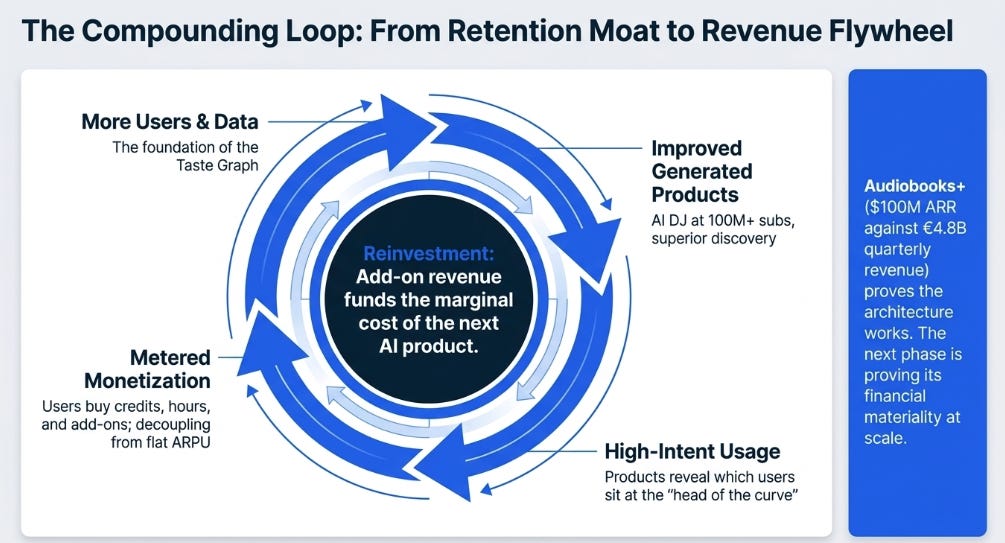
The loop this creates is stronger than better recommendations alone. More users generate more data. Better data improves discovery and generated products. Better products reveal which users sit at the head of the usage curve. Those users buy credits, hours, or add-ons, and the revenue funds the next product. At $100 million of ARR against nearly €4.8 billion of quarterly revenue, Audiobooks+ proves the architecture works. It does not yet prove materiality. The meter needs to become a business rather than an elegant explanation.
What Remains Unproved
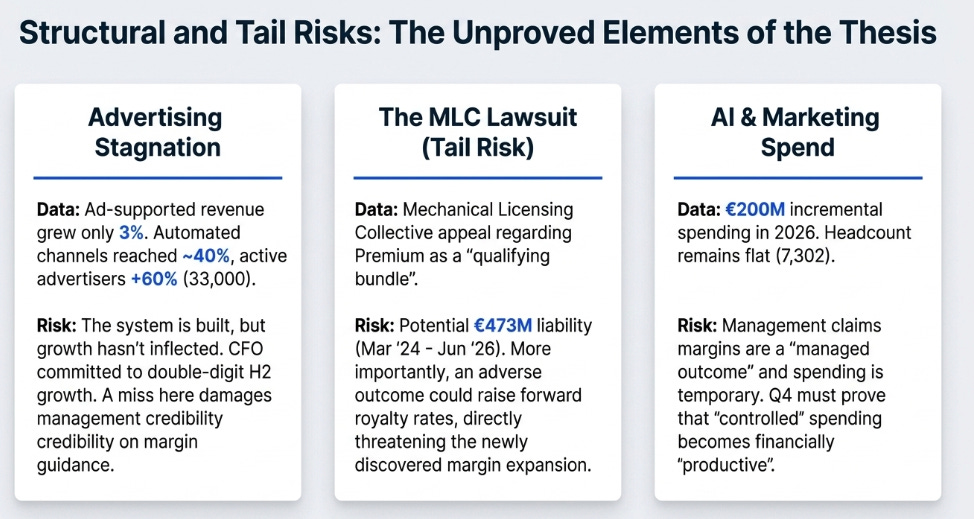
Advertising has stabilised but not inflected. Ad-supported revenue grew 3% in constant currency, reversing the decline from Q1. Automated channels reached nearly 40% of ad revenue, up from roughly 30% last quarter, and active advertisers grew 60% to 33,000. CFO Christian Luiga, whose guidance credibility on gross margin has been near-perfect for two years, committed to double-digit ad growth in the second half. The system is built. The excuse period should end. If double-digit growth arrives in Q3 or Q4, the market has to reprice a segment it had written off. If it does not, Luiga’s credibility on this specific promise takes a hit.
One risk I have not previously discussed sits on page 25 of the 6-K. The Mechanical Licensing Collective has filed an amended complaint and has sought permission for an interlocutory appeal of the January 2025 court ruling that classified Spotify’s Premium Service as a qualifying bundle for royalty purposes. If the MLC were to prevail in full, Spotify estimates a potential liability of approximately €473 million for March 2024 through June 2026, plus possible penalties. More important than the one-time charge, an adverse outcome could raise the forward royalty rate on the music component of Premium, which would directly threaten the improved content economics that Q2 demonstrated. Management did not discuss this on the call. I am not treating it as a base case, but it is the structural tail risk to the margin story and it deserves attention.
The €200 million of incremental marketing and AI spending in 2026 has not yet been tied to quantified returns. Management calls it temporary, expects Q4 moderation, and has kept headcount flat at 7,302. Söderström’s claim that “our margin is a managed outcome” is believable given the evidence. It is not a permanent pass. Q4 needs to show that “controlled” eventually becomes “productive.”
Three Years From Now
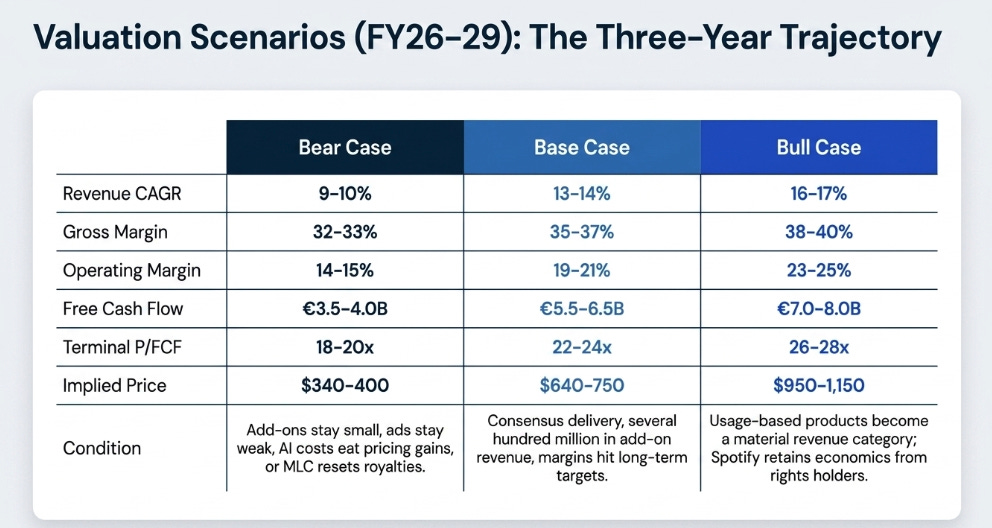
The bear case assumes add-on tiers remain small, advertising stays weak, and AI costs absorb pricing gains, or the MLC ruling resets royalty economics. The base case assumes consensus delivery, several hundred million euros of add-on revenue, and margins approaching management’s long-term targets. The bull case requires usage-based products to become a material revenue category while Spotify retains enough economics from rights holders to exceed a 20% operating margin.
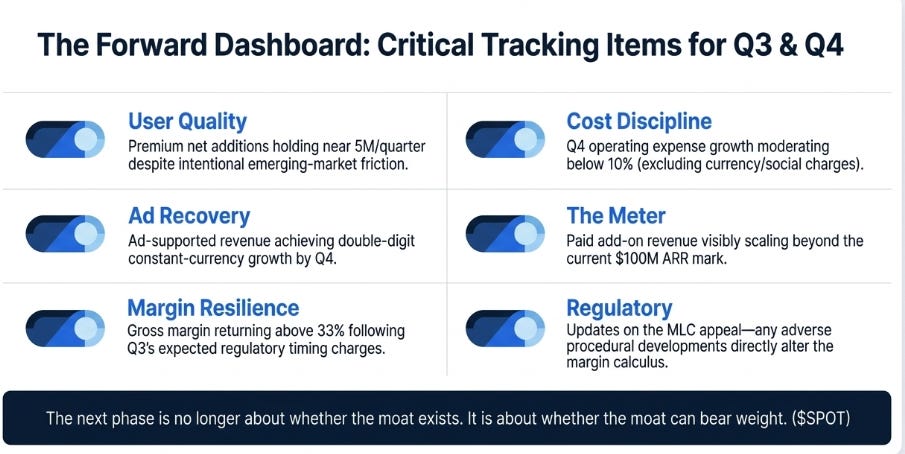
The tracking items: Premium net additions holding near 5 million per quarter despite emerging-market friction. Ad-supported revenue reaching double-digit constant-currency growth by Q4. Gross margin returning above 33% after Q3’s regulatory timing charge. Q4 operating expense growth moderating below 10% excluding currency and social charges. Paid add-on revenue moving well beyond today’s $100 million ARR. And the MLC appeal, any adverse procedural development would change the margin calculus directly.
Q2 proved that the core subscription has escaped its old economic ceiling. The monetisation decision and the meter are management’s wager that the same understanding of taste that improved retention can now support a richer, more layered revenue model. The next phase of this series is no longer about whether the moat exists. It is about whether the moat can bear weight.
Disclaimer:
The content does not constitute any kind of investment or financial advice. Kindly reach out to your advisor for any investment-related advice. Please refer to the tab “Legal | Disclaimer” to read the complete disclaimer.