


TL; DR
Spotify’s customer relationship looks increasingly durable: Premium subscribers beat expectations, personalization remains useful, and external agents may become another distribution layer rather than a substitute for Spotify itself.
But monetization is still the unresolved part of the thesis: Premium gross profit per subscriber-month is up meaningfully year over year, yet it was flat sequentially, while add-on products such as Audiobooks+ still lack enough disclosure to prove they materially lift retained economics.
That distinction matters at the current valuation: the stock rerated sharply while 2027 earnings expectations barely moved. The franchise may be stronger than before, but at roughly $584 the upside depends on proving Spotify can keep more of each incremental euro after royalties, investment and dilution.
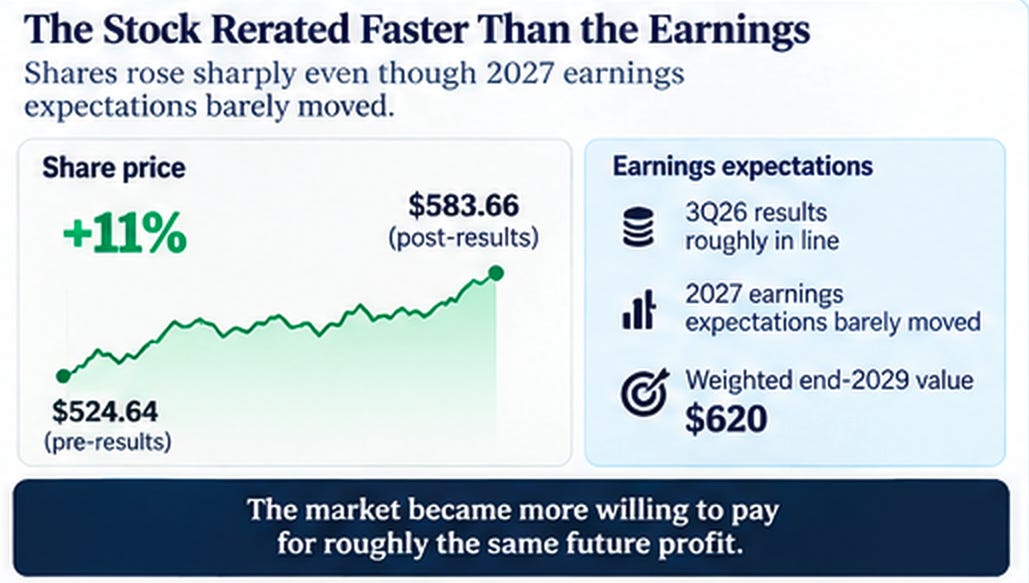
Spotify’s third quarter was close to expectations. Revenue of €4.97 billion was slightly below consensus, operating income of €672 million essentially matched it, and free cash flow declined year over year. Yet the shares rose 11% to $583.66. The market seemed relieved that a year of elevated investment was ending and reassured that AI agents might extend Spotify’s reach rather than replace it.
Both conclusions have merit. Neither settles the argument we made in August’s The Moat Learns to Monetise. Spotify has spent years learning what each listener wants, turning that knowledge into habit, and improving the economics of a subscription constrained by music royalties. The next step is to charge its most engaged customers for more than basic access: additional audiobook hours, differentiated experiences, and products whose price rises with use. We called that the Meter.
Q3 strengthened the case that Spotify can keep the listener. It offered little new proof that the Meter can materially increase what Spotify earns from that listener. And whatever new value it creates will still be shared with rights holders. The customer relationship looks increasingly durable. The incremental economics are still negotiated.
The Ceiling Was Broken, Not Abolished
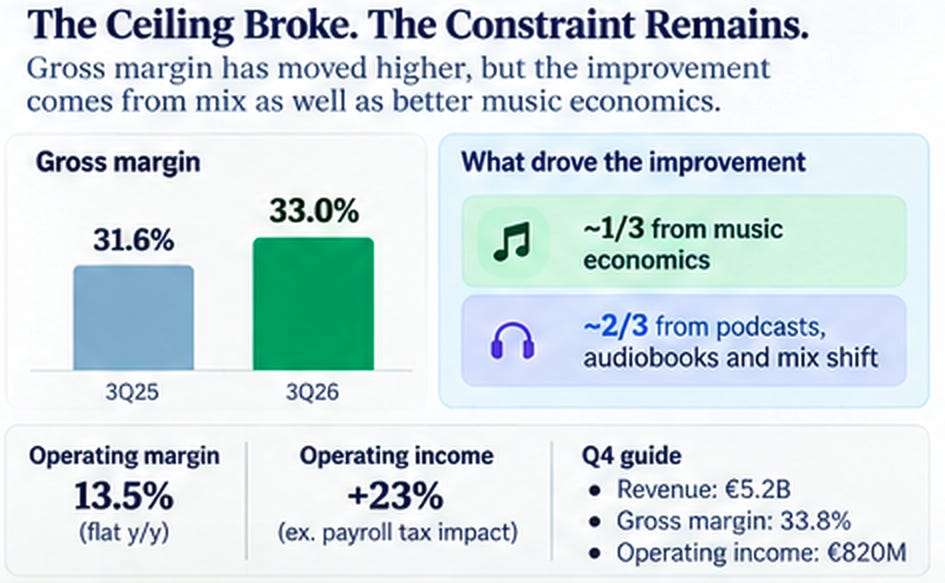
Spotify’s gross margin reached 33.0%, up from 31.6% a year earlier. For much of its history, the company was judged against an apparent mid-20s ceiling: as subscription revenue rose, music royalties rose with it. That ceiling has broken in the consolidated numbers. But at its May Investor Day, management said only about a third of margin expansion since 2022 came from music. Podcasts and audiobooks supplied most of the rest. The music business improved; Spotify also changed the mix of what it sells.
The core subscription remains healthy. Spotify added six million Premium subscribers, beating its target, while adding 11 million monthly active users. Fewer free-user additions alongside solid paid growth are consistent with August’s expectation that Spotify would prioritize more valuable users. They do not, on their own, prove better conversion: Spotify does not disclose the cohorts or churn required to establish that.
Operating margin was 13.5%, essentially flat with a year earlier, because marketing and investment in AI and cloud services absorbed the gross-margin improvement. Share-price-linked payroll taxes depressed the comparison: excluding a €22 million charge this quarter and a €16 million credit a year ago, operating income grew roughly 23%, rather than the reported 15%.
The Q4 guide is encouraging. Revenue of €5.2 billion, gross margin of 33.8% and operating income of €820 million imply operating expenses of roughly €938 million, down from €967 million in Q3. CFO Christian Luiga said expense growth was now “coming down meaningfully” and expected that moderation to continue into 2027. The year of accelerating investment may be ending, but that does not mean the elevated cost base disappears. Spotify must grow into it.
One accounting wrinkle matters when the next quarter arrives: the guide assumes a September share price of $487.38 for payroll-related charges, well below the post-results price. A sustained rally could push reported expense above the guide without changing the underlying business. We should judge expense moderation after adjusting for that mechanical effect, not on a headline miss alone.
The Agent Is a Door, Not the Destination
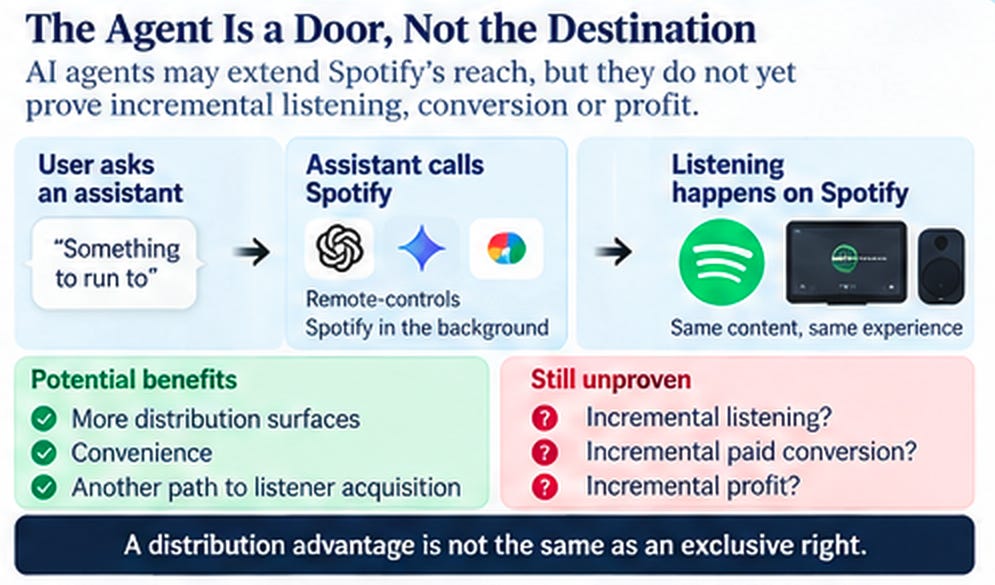
The strategic highlight came from co-CEO Gustav Söderström. As people move from opening an app to asking an assistant for “something to run to,” the assistant could become the interface that chooses the music service. That is an obvious threat to Spotify, particularly when Apple, Google and Amazon own both assistants and competing music subscriptions.
Söderström described something different:
“Listening is actually not shifting. All the listening is happening through Spotify ... [The agent] remote-controls Spotify in the background.”
That is Spotify Connect for the agent era. Connected speakers expanded Spotify’s reach without becoming its replacement; an external assistant can work the same way. Spotify was early to ChatGPT and, according to management, was Muse’s only music service at launch. Meta and OpenAI do not have competing music subscriptions, making an independent partner attractive.
This is a distribution advantage, not an exclusive right. The assistant may still decide which service to call; Apple Music or YouTube Music could become equally accessible. And while a general model knows which songs exist, Spotify knows years of individual listening choices, the reason Söderström has argued that “taste is not a fact.” Those preferences are a source of convenience and switching friction, though rival services have listening data too.
Nearly 40 million Premium users now listen to mixed playlists, with consumption rising 90% sequentially. That supports the usefulness of Spotify’s personalization. It does not tell us whether outside agents generate incremental listening, paid conversion or profit. Spotify disclosed none of those numbers. The agent may open a new door to customers, but we have not yet seen what is coming through it.
The Meter Has to Survive the Labels
A new door matters only if Spotify earns more from the people who enter. That is where the quarter was less reassuring. Constant-currency Premium revenue per user grew 7.5% in Q3, but management expects only 4.5%–5% in Q4. Part of the slowdown reflects lapping price increases across more than 150 markets, not necessarily weakening pricing power. Still, broad subscription increases arrive in rounds. Between rounds, Spotify needs more subscribers, richer plan mix or additional purchases to sustain growth.
That is the purpose of the Meter. Audiobooks+ had already passed $100 million of annual recurring revenue in August. Spotify now plans to expand audiobooks from 22 to more than 180 markets and has launched Creator Memberships. Usage-linked products could let heavy listeners pay for what they consume, while matching extra revenue to the added cost of delivering it. But Q3 provided no new Audiobooks+ revenue, attach rate or product-level margin. The ability to charge is growing faster than the evidence that customers are paying materially more.
Our most useful measure is therefore not the number of new features, but Premium gross profit per subscriber per month, average Premium revenue per user multiplied by Premium gross margin.
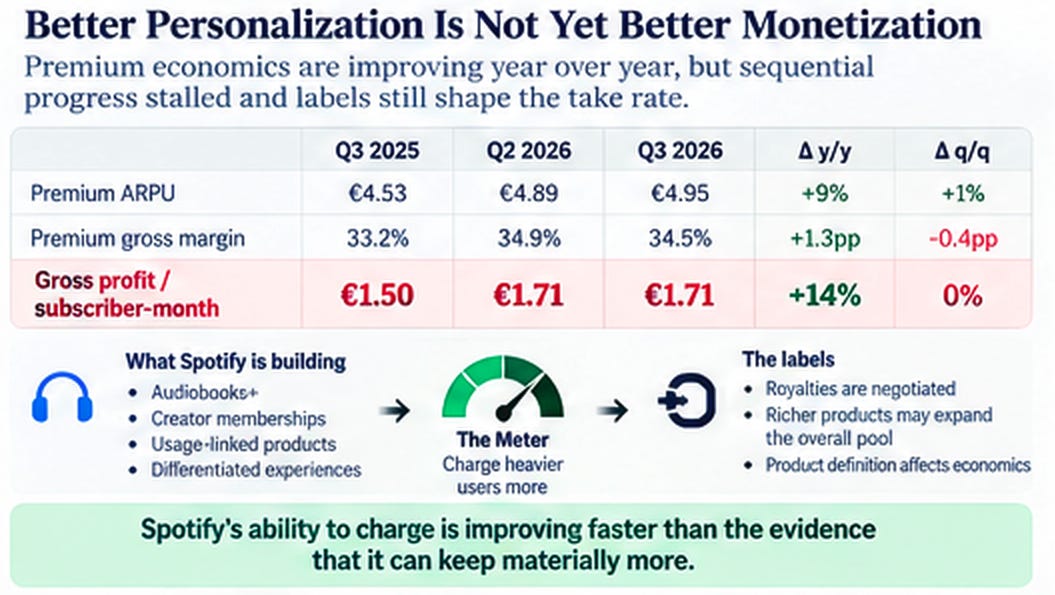
Spotify now keeps about 14% more gross profit per paid listener than it did a year ago. That is substantial progress. But the number did not improve sequentially: higher ARPU was offset by a lower Premium margin. This is the economic gap between better personalization and better monetization.
The labels determine part of what fills it. Universal, Sony, Warner and Merlin accounted for about 72% of label-delivered streams in 2025. Royalties are negotiated, often with revenue-sharing features, so not every extra euro reaches Spotify’s gross profit. Universal and Warner have also supported differentiated tiers and bundles in recent agreements; richer products could expand the pool for everyone rather than merely redistribute it. The continuing dispute over how audiobook bundles affect publishing royalties shows why the definition of a new product matters as much as its popularity.
By Q3 2027, we want to see gross profit per Premium subscriber approaching €1.80 a month with stable retention. A fall toward €1.65, particularly alongside adverse royalty terms, would be far more concerning than a disappointing feature-launch statistic. Advertising provides no offset yet: revenue per quarter-end free user was roughly €0.97, against €0.98 a year earlier, although that is an imperfect yield measure because free users are also a recruitment funnel.
A Stronger Franchise Is Not Necessarily a Better Stock
The share-price reaction highlights the difference. Analysts raised their targets after results while leaving 2027 earnings expectations almost unchanged. They became more willing to pay for essentially the same profit. Consensus also expects roughly 14.8% revenue growth in 2027, which is demanding against the near-term ARPU guide without another broad pricing round. We are closer to 13.5% unless those changes.
Our own August base-case range of $640–750 also needs revisiting: the company will carry a higher investment base than we assumed, and our earlier cash-flow approach treated stock compensation too generously.
Rather than compound that error, we value after-tax earnings, explicitly model diluted shares, and use free cash flow as a separate reality check. The figures below are end-2029 values, not present values. They assume €1 = $1.12, different tax rates and modest net finance income across the cases; cash is not added to the values a second time.
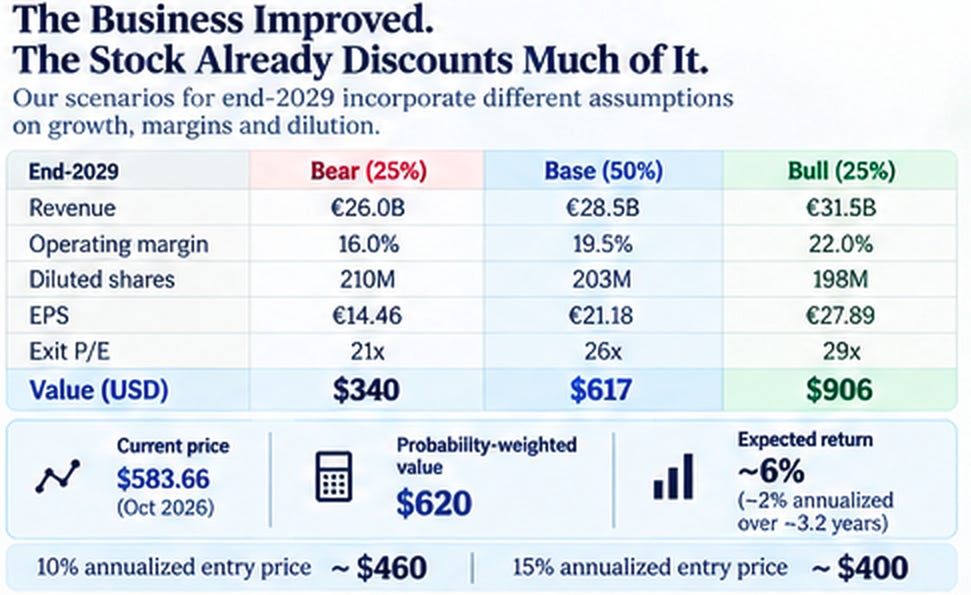
The base assumes continued subscriber growth of about 7%–8%, core revenue per user up roughly 4%–5%, and a few hundred million euros of additional annual metered revenue by 2029. It is not a heroic success case. Yet it offers only about 6% cumulative upside from $583.66. The bear implies a 42% loss; the bull, a 55% gain.
At these probabilities, the weighted end-2029 value is $620. That is around 6% total appreciation, or 2% a year across roughly 3.2 years. To earn 10% annually on the same assumptions, the entry price would need to be approximately $460; for 15%, about $400. These are mathematical thresholds, not promises that the scenarios or probabilities are right.
The base case also requires scrutiny beyond earnings. Its roughly €4.9 billion of indicative 2029 reported free cash flow assumes stronger cash conversion than after-tax operating profit; that is not automatically owner earnings, particularly with employee equity awards and buybacks. If the Meter remains small or royalty economics deteriorate, a 26-times exit multiple could prove generous.
We would hold rather than add near $584 and require either a meaningfully lower price or new evidence of higher retained profit before increasing exposure. A stock that rises faster than the underwriting improves is not made safer by a better quarter.
What Changes the Decision
February’s Q4 results should show whether expense growth really moderates, adjusting for stock-linked payroll taxes, and whether Premium revenue per user holds near the guided 4.5%–5% growth. During 2027, the decisive evidence will be gross profit per Premium subscriber, the size and margins of add-on products, and the outcome of label negotiations. An initial number for agent-originated listening and conversion would help distinguish a genuine new distribution channel from an attractive integration announcement.
Spotify has already answered the old question of whether music streaming can be a durable, profitable subscription business. Q3 made the answer more convincing. The open question is whether deeper knowledge of listeners and more places to reach them allow Spotify to keep substantially more money per customer.
The listener is loyal. The next leg of profit is still being negotiated.
Disclaimer:
The content does not constitute any kind of investment or financial advice. Kindly reach out to your advisor for any investment-related advice. Please refer to the tab “Legal | Disclaimer” to read the complete disclaimer.