


TL; DR
The core is still funding the experiment: operating profit excluding new AI products grew 19%, while the drag from new AI products increased to RMB10.5 billion. The established businesses remain strong enough to finance the build, but that does not make every yuan of AI spend value-creating.
Weixin’s moat may be execution, not frontier intelligence: management explicitly said Xiaowei does not require Hunyuan to be state of the art. Identity, permissions, Mini Programs and payments may matter more than owning the best model.
The investment case now turns on incremental economics: WorkBuddy is beginning to generate real receipts, but Tencent still needs to show that agents create new profitable activity rather than simply rerouting existing transactions while adding compute cost.
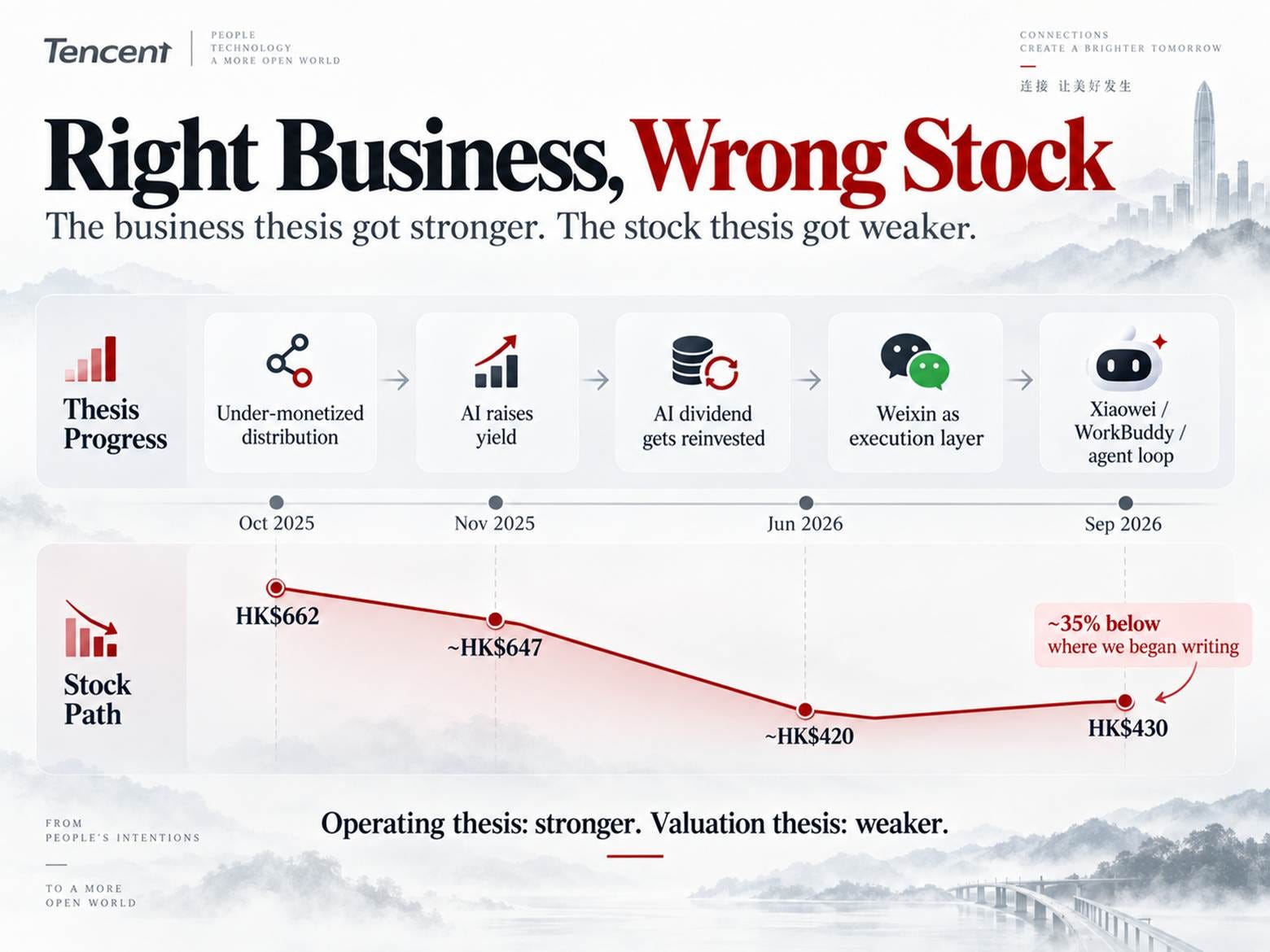
We started writing about Tencent around HK$662. By our June article, the reference price was roughly HK$420; Tencent’s September 21 close was HK$430, according to FactSet. A decline of approximately 35% from our first reference price, before dividends, deserves more than another explanation of why the business is interesting.
Our operating thesis has held up better than our investment conclusion. Tencent continues to monetise its existing distribution, while games and advertising remain strong. But we underestimated capital intensity and overstated the protection provided by apparently inexpensive earnings. The original three-year scenarios have not matured; the suggestion that downside was tightly bounded has nevertheless proved inadequate for the journey.
In June, we wrote:
“The market is not stupid. It is refusing to capitalize the tollbooth until the tolls are visible.”
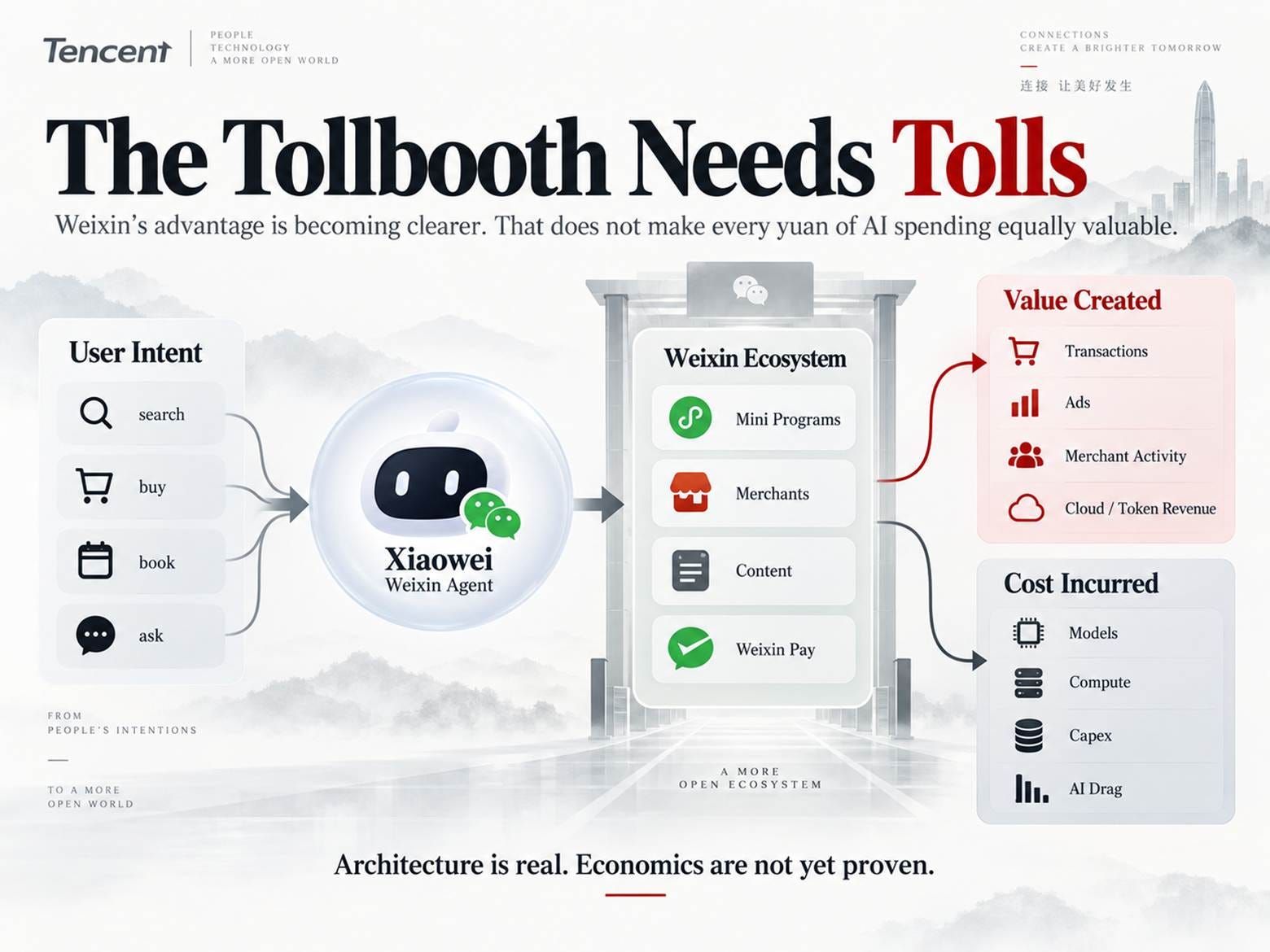
That remains the right starting point. Q2 strengthens the case that Tencent can create an agent economy inside Weixin. It also reveals why believing in that opportunity does not require accepting every investment made in its name. The question is now whether Tencent can turn more delegated tasks into enough incremental profit to justify the capital committed.
The Core Is Paying the Bill
Tencent reported RMB204.8 billion of revenue, up 11%, and RMB75.6 billion of non-IFRS operating profit, up 9%. Excluding new AI products, operating profit reached RMB86.1 billion, up 19%. This was not a newly invented Q2 disclosure: our June article already used the same separation to describe two companies inside one filing.
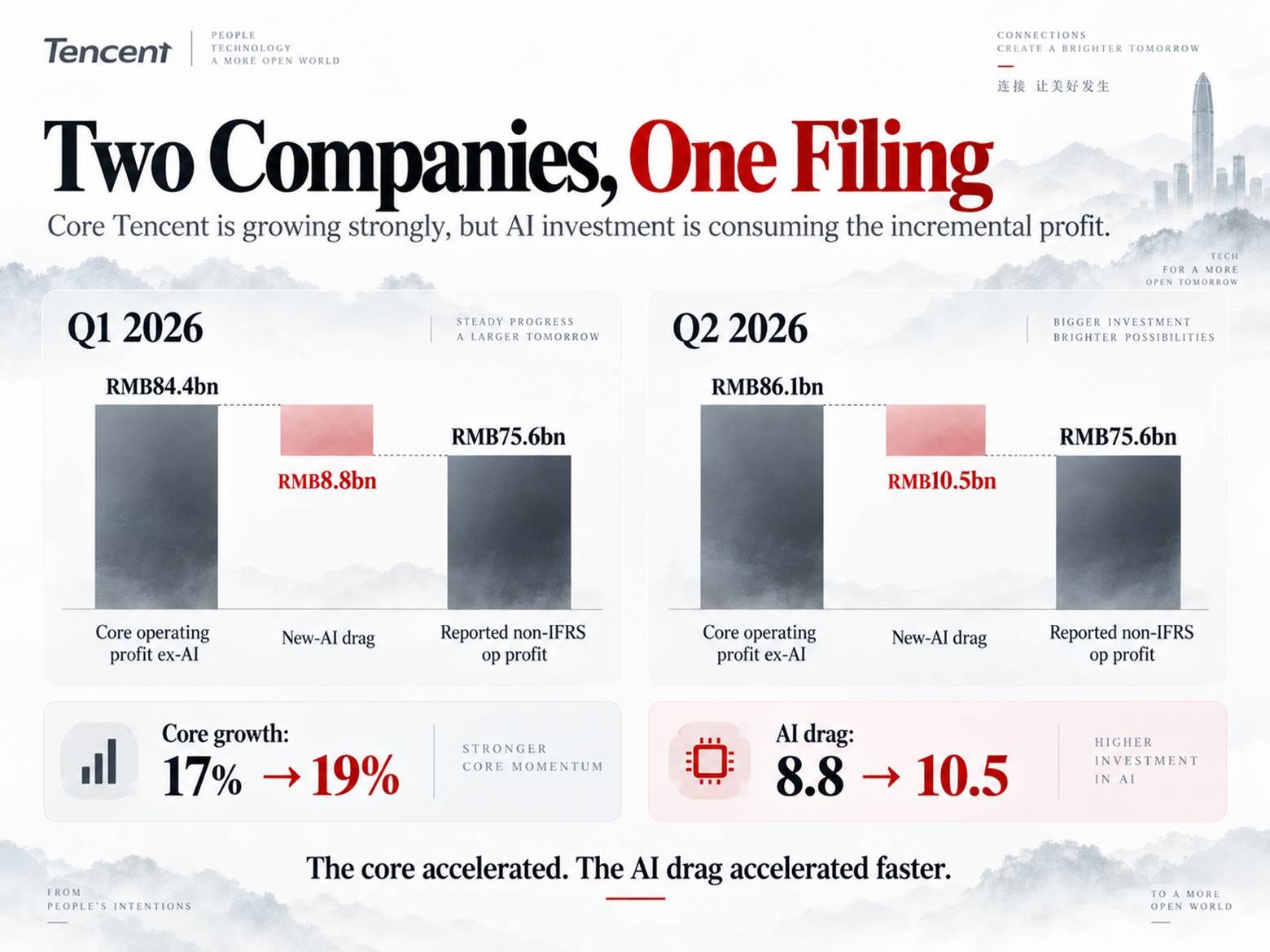
Almost the entire RMB1.7 billion sequential improvement in profit excluding new AI products was absorbed by the increase in AI losses. The distinction is useful, but it is not absolution. Adding losses back demonstrates the strength of the funding business; it does not establish that those losses are discretionary or that financing them creates value.
The established businesses remain encouraging. Domestic games grew 17%, Marketing Services 22%, and VAS gross margin reached 64%, versus 60% a year earlier. But the old AI-dividend argument needs precision: gross-profit growth exceeded revenue growth by about two percentage points, not the seven we previously highlighted. Management also said advertising-funded games contributed approximately two percentage points to Marketing Services growth. Strong advertising does not mean every point of growth came from better AI targeting.
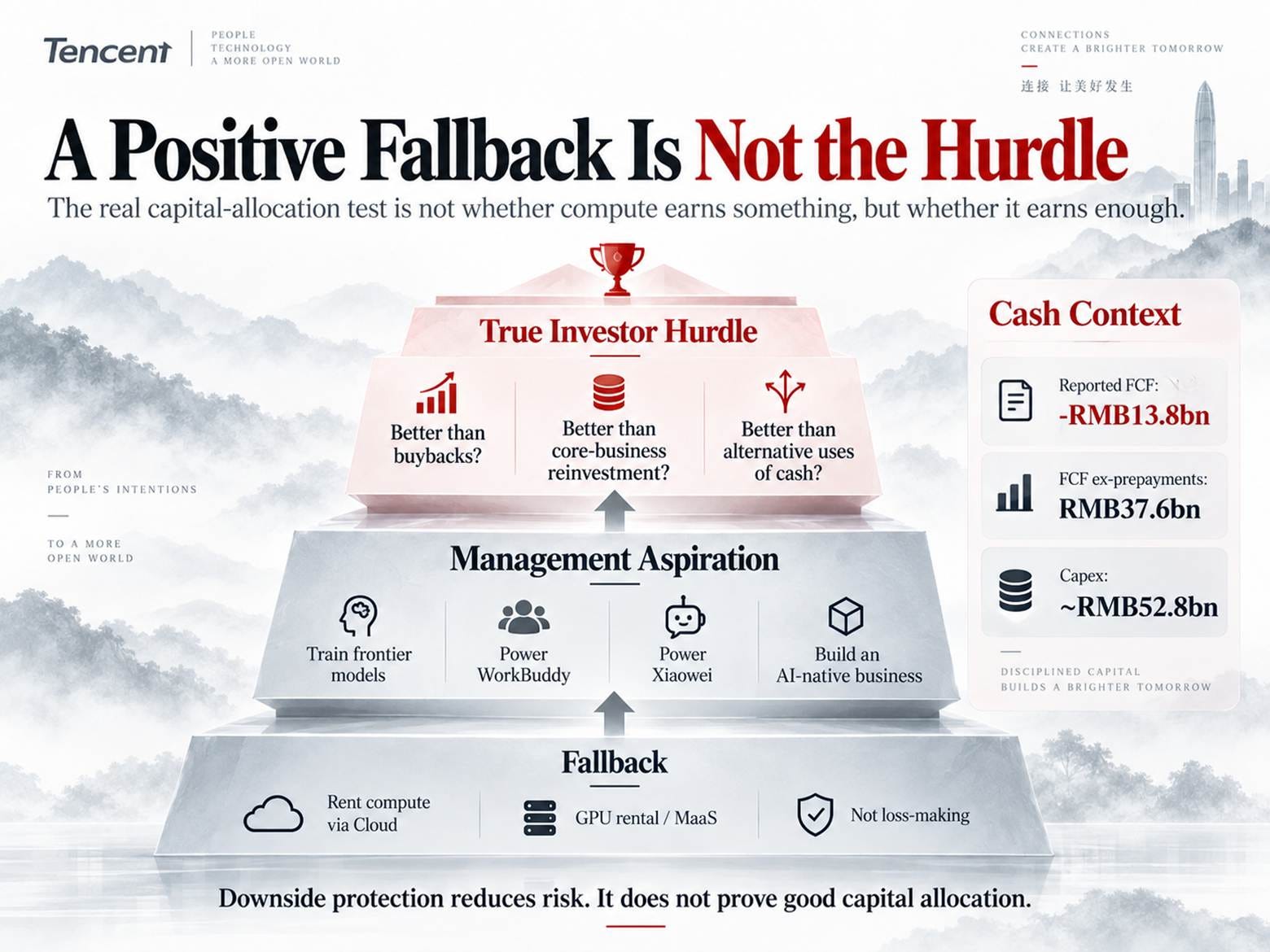
The cash picture requires equal care. Total capex reached approximately RMB52.8 billion, while reported free cash flow was negative RMB13.8 billion. Excluding compute-procurement prepayments, however, management said FCF would have been positive RMB37.6 billion. The RMB88.7 billion sequential decline in net cash also included RMB41.6 billion of dividend payments; it was not simply an AI operating loss.
FCF figures matter. The adjusted number demonstrates substantial cash generation before those procurement prepayments. The reported number records cash shareholders have committed. Removing the prepayments helps explain the quarter, but it does not make the investment free or establish that similar commitments will not recur.
The Model Is Not the Tollbooth
Our earlier articles established why agents might make Weixin more valuable. A model supplies intelligence; a useful agent also needs identity, permissions, service access and settlement. Mini Programs potentially supply the services, Weixin the trusted relationship, and Weixin Pay the transaction capability. Q2 adds Xiaowei, a Weixin-native prototype designed to connect these pieces, with user confirmations still required.
The most consequential clarification came when JPMorgan asked why Tencent needed to spend toward frontier-model capability. Martin Lau answered:
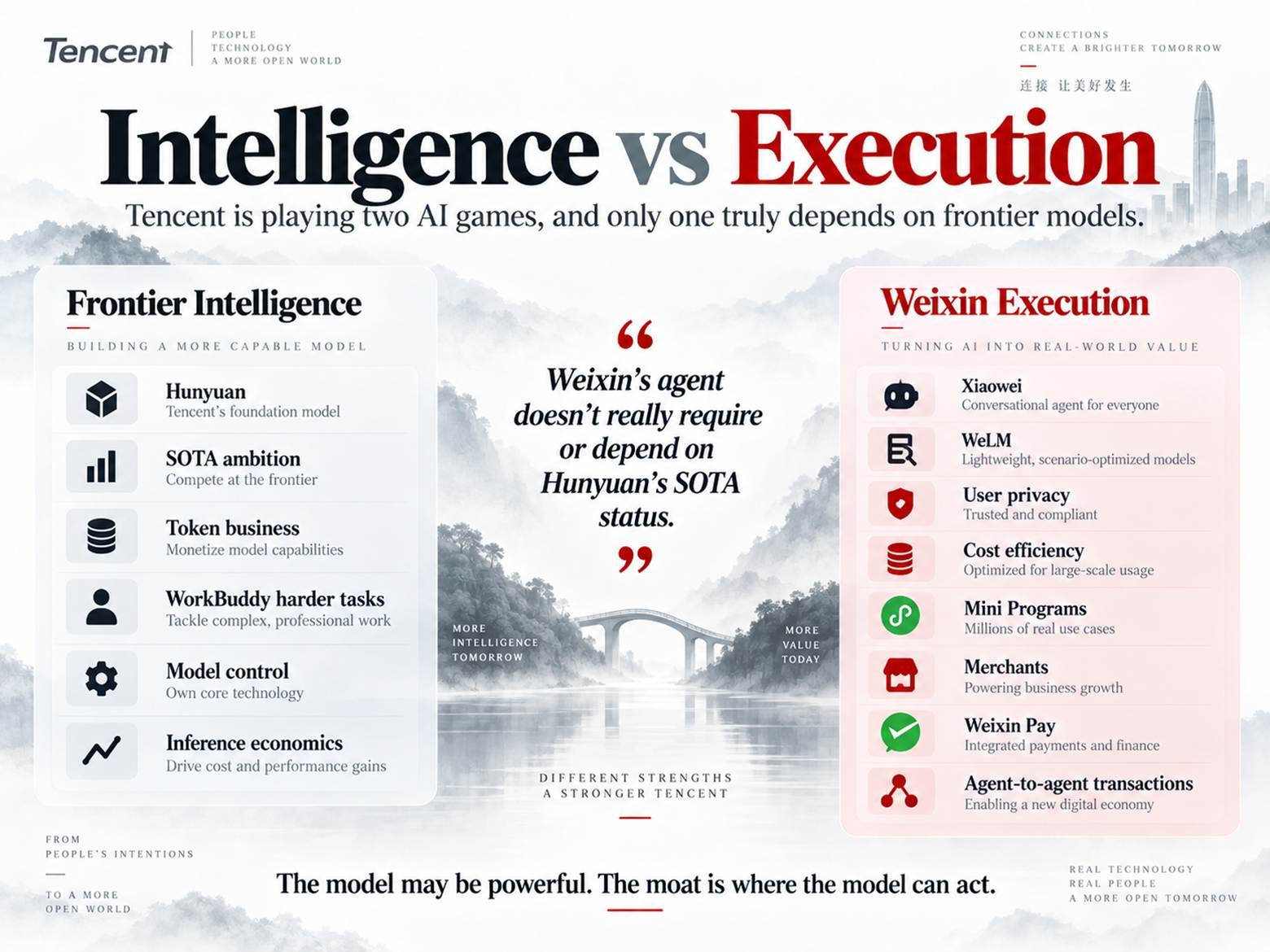
“Weixin’s agent doesn’t really require or depend on Hunyuan’s … SOTA status. Weixin’s design, as we have said a few times, is actually centered around user privacy and focusing on solving all the necessary interactions an agent needs within the Weixin environment and also for cost efficiency.”
State-of-the-art intelligence and Weixin execution are therefore distinct propositions. Hunyuan’s frontier ambitions support more demanding WorkBuddy tasks and a broader token business. Xiaowei is designed around the intelligence necessary to operate effectively within a particular environment. Better models can help both, but winning the frontier race is not management’s stated prerequisite for Weixin’s agent to work.
This changes the capital-allocation argument. Xiaowei could extend a scarce asset Tencent already controls; frontier Hunyuan also competes for a new profit pool. The first opportunity cannot automatically justify the second budget. Weixin’s agent thesis could succeed while the next increment of frontier-model spending still earns an inadequate return.
The potential compounding mechanism remains attractive. Successful delegation encourages users to entrust more tasks to Xiaowei. That activity gives merchants an incentive to make their services agent-accessible. More accessible services make the agent more useful, attracting further delegation. Tencent need not charge a new fee on every task: additional advertising, payments and merchant activity could monetise the expansion through existing businesses. That is the economic possibility behind management’s proposed agent-to-agent transactions.
But the relevant word is “additional.” UBS asked whether agents might merely reroute existing transactions, adding compute costs while removing advertising impressions. Lau answered with a vision of a more useful Weixin, not a quantified economic bridge. A better customer experience can expand a market, but it can also eliminate profitable friction. The quarter establishes neither outcome.
Where the First Receipts May Appear
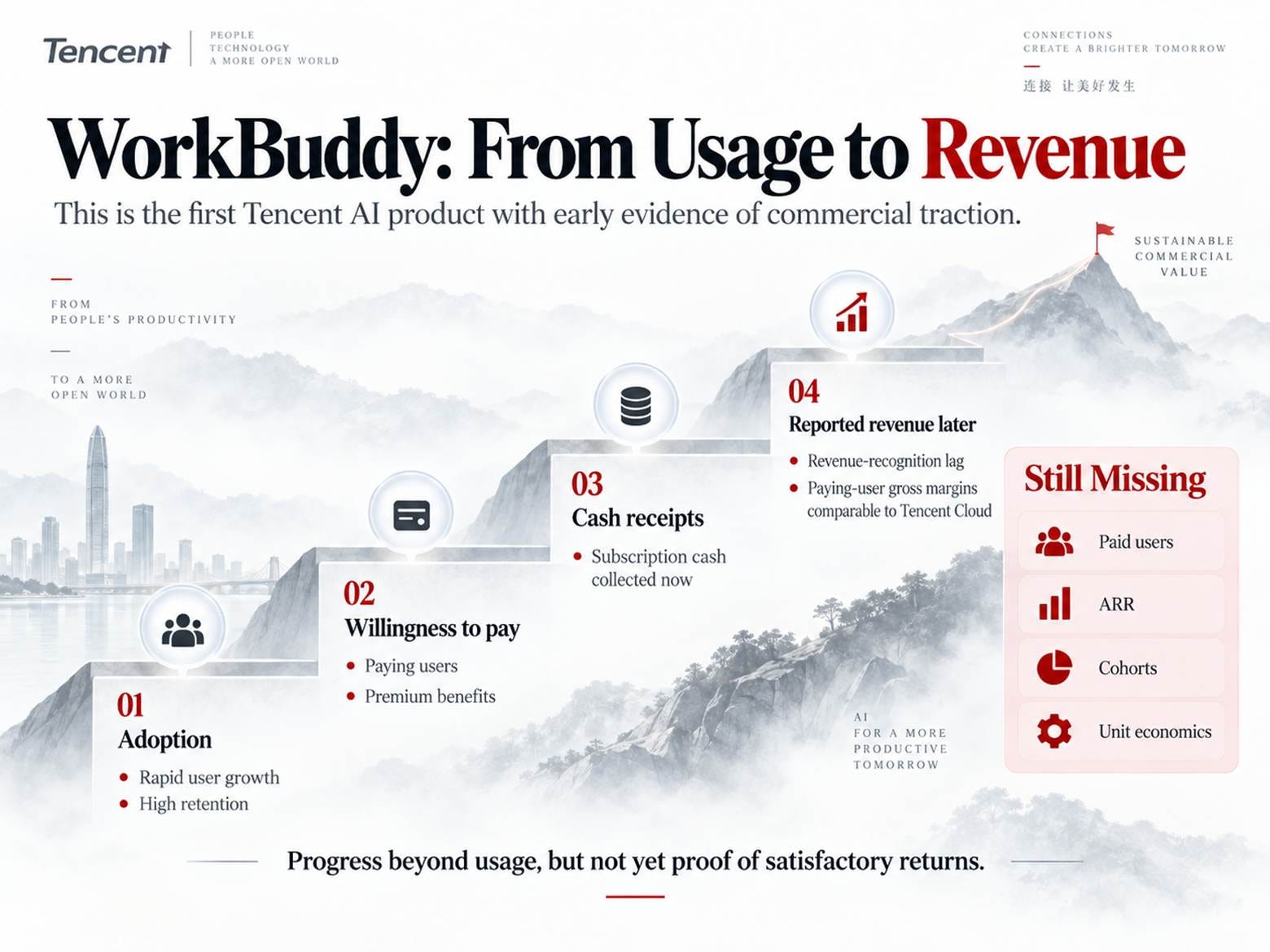
WorkBuddy offers a different kind of evidence. Management says paying users already generate gross margins comparable with Tencent Cloud, although subsidising free users lowers the product’s overall margin. Tencent also redirected spending toward WorkBuddy after identifying stronger traction, rather than increasing every AI project’s budget indiscriminately.
James Mitchell supplied the most useful commercial disclosure:
“And so similar to games and some of our other businesses, there’s a lengthy time lag between the cash receipts coming to us from the users and those cash receipts translating into reported revenue. But we are seeing a substantial ramp in the cash receipts today, and that will translate into reported revenue growth for Tencent Cloud as we move through the year.”
This is progress beyond retention claims. Customers are paying, and management describes a revenue-recognition lag. But it disclosed neither the magnitude of receipts nor paid cohorts, while paying-user gross margins do not establish profitability after acquiring users and developing models. WorkBuddy has evidence of monetisation, not yet evidence of satisfactory returns on all the capital supporting it.
It also qualifies something our Q4 article overstated. Difficulty selling general-purpose consumer chatbot subscriptions does not mean subscriptions are unavailable throughout Chinese AI. WorkBuddy’s productivity use cases apparently support payment. Tencent’s opportunity is broader than collecting transaction fees, but its different businesses need different tests.
That is why I would not collapse the investment case into “Tencent is China’s Meta.” The useful distinction is between raising yield on existing activity and creating genuinely new paid activity. Nor should WorkBuddy’s SkillHub be presented as proof that Weixin’s Mini Programs have become agent-callable at scale. They are related ambitions, not interchangeable evidence.
The Price of Owning the Future
The analysts on the call were asking economic questions. Bernstein wanted depreciation and payback explained; UBS challenged incremental demand; Bank of America asked whether compute would displace repurchases. This does not establish what every investor believes, but it hardly supports the claim that the market failed to notice Tencent’s 19% ex-new-AI profit growth.
Management’s defence is that compute has alternative uses. Tencent could rent capacity through Cloud rather than devote it to models and proprietary applications. Lau also said some recent orders and prepayments could then have been resold at more than a 30% profit. That is evidence of current scarcity, not a realised gain across the compute estate or a permanent valuation floor.
A profitable fallback reduces the risk of stranded capacity; it does not clear the capital-allocation hurdle. The comparison is not a positive return versus zero. It is risk-adjusted returns from AI versus repurchases and other uses of capital. Management acknowledged the trade-off by saying superior compute opportunities could mean less cash for buybacks. Calling the initial build a lump sum does not identify its peak or eliminate future replacement spending.
Our variant perception is therefore narrower, and stronger, than “the market does not understand.” Weixin’s execution advantage may require less dependence on frontier-model leadership than a generic AI narrative implies. But that makes it more important to evaluate Tencent’s expensive model ambitions separately. The scarce asset may be the environment in which intelligence acts, without every attempt to manufacture more intelligence becoming equally valuable.
Three Futures, Not a Promised Recovery
I retain June’s FY29 scenarios rather than raise the targets because the prototype is more tangible. Product evidence improved; the capital burden increased. These are conditional investment assumptions, not company guidance or consensus forecasts.
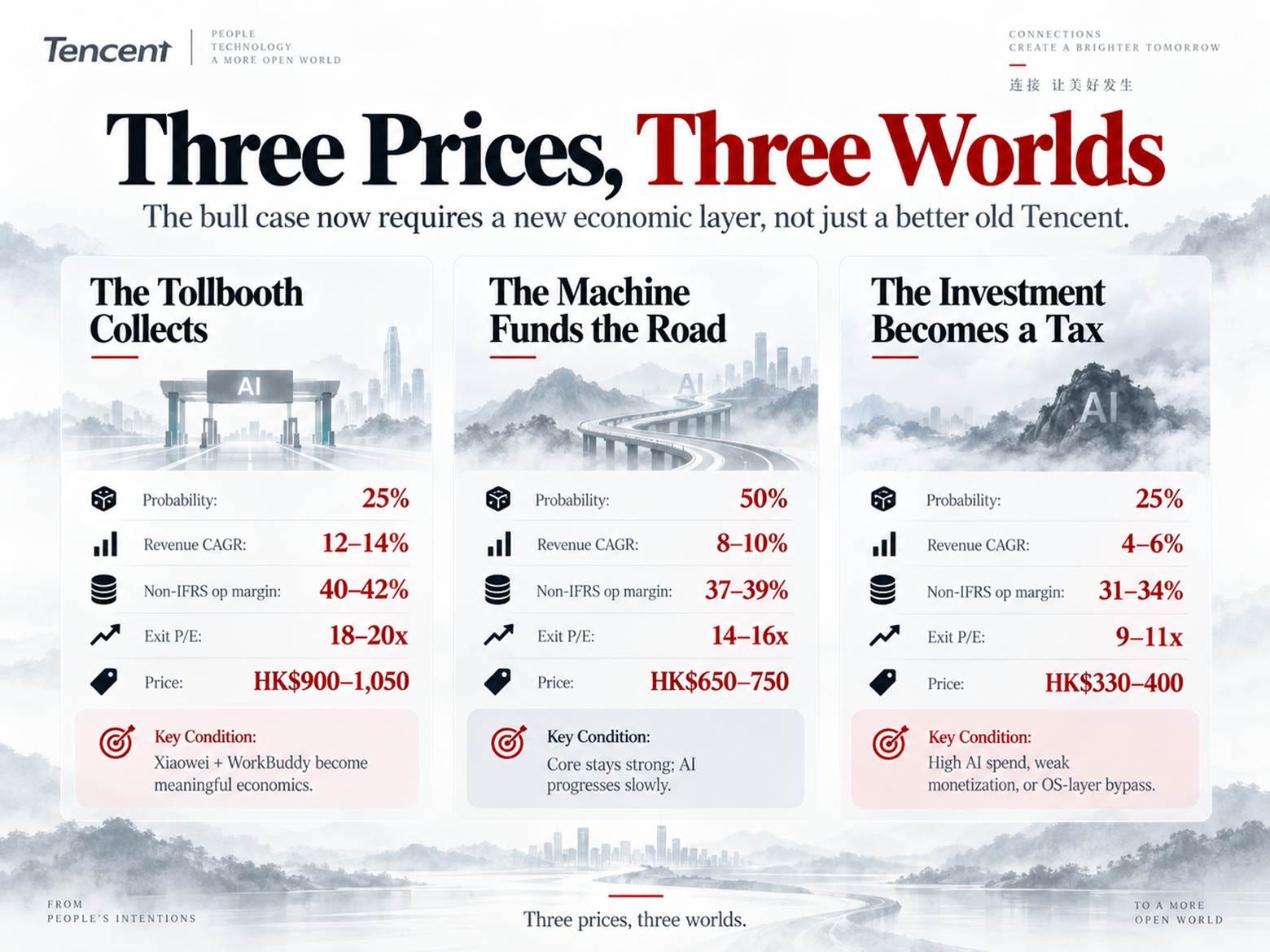
Source: June’s FY29 scenario framework, retained rather than newly recalculated. Operating margins include new-AI investment; multiples apply to FY29 earnings. Probabilities are subjective and dividends are excluded.
The bull case requires WorkBuddy to become a meaningful profit pool and Xiaowei to expand economic activity, with capital intensity easing as revenue catches up. The base case allows strong games and advertising to finance slower AI progress, followed by cash-flow recovery. The bear case combines persistent investment with weak monetisation or an outside agent taking control of user intent. Its price range is not a guaranteed floor.
These outcomes require earnings as well as multiples. At midpoint multiples, the midpoint prices imply approximately HK$51, HK$47 and HK$37 of FY29 EPS equivalent, respectively. Strong core growth alone does not deliver those outcomes if depreciation, dilution or continuing AI losses absorb the gains.
Our dashboard must not become easier as the spending rises. June’s ex-new-AI operating-profit growth test remains above 15%, with below 10% signalling deterioration. The 25–30% second-half growth ambition applied to Business Services; low-20s Cloud growth in Q2 is encouraging but is neither the same measure nor the same period. June’s reported quarterly FCF bar remains RMB50 billion, with repeated quarters below RMB40 billion a warning. Ex-prepayment FCF is a separate diagnostic, not a substitute pass.
For the new business, I would treat Q3 AI drag reaching RMB14 billion without quantified commercial progress as an escalation trigger, not proof that an undisclosed management budget has been breached. WorkBuddy needs paid-user, revenue or cohort disclosure; Xiaowei needs successful tasks, repeat delegation and incremental transactions. Those observations would test whether usage is becoming durable economics.
We were right to identify valuable distribution and its potential transformation. We were wrong to treat that insight as sufficient protection against capital-allocation and valuation risk. Q2 strengthens the strategic case, but the appropriate response is not another declaration that vindication is inevitable.
Tencent may own an unusually valuable place for agents to act. The next question is how much shareholders should pay to make those agents intelligent, attract their users and complete their tasks. The tollbooth thesis will earn its valuation when the resulting cash exceeds that cost, not merely when the architecture becomes impossible to ignore.
Disclaimer:
The content does not constitute any kind of investment or financial advice. Kindly reach out to your advisor for any investment-related advice. Please refer to the tab “Legal | Disclaimer” to read the complete disclaimer.