


TL;DR
WorkBuddy is the first serious evidence that China may finally support a large enterprise-software market: it crossed 10 million daily users, more than 100 trillion tokens of daily usage and a US$500 million annualized gross-revenue run rate. The opportunity is potentially much larger than conventional software because customers can pay for completed work rather than another seat.
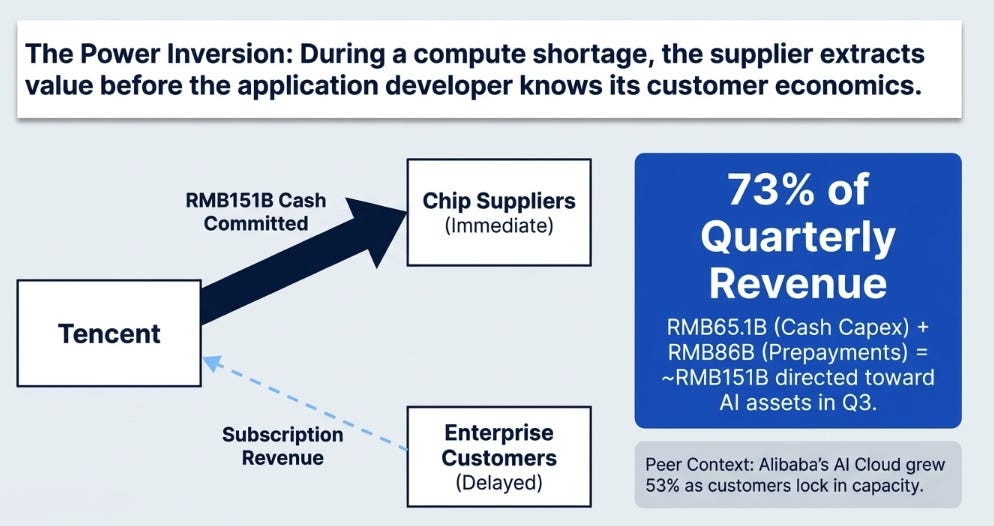
But the economics arrive in the wrong order: Tencent committed roughly RMB151 billion to capex and advance compute commitments in Q3 before WorkBuddy and other AI products had demonstrated mature profits. During a compute shortage, the supplier can extract value before the application developer knows what its customer economics will be.
The investment works when bargaining power eventually shifts back toward workflows: WorkBuddy must become embedded enough in documents, permissions and enterprise processes to retain value after compute becomes cheaper, while Xiaowei can potentially monetize Weixin’s existing relationships using less expensive intelligence. The real test is whether application value rises faster than the cost of producing it.
In September’s The Tollbooth Needs Tolls, I argued that Tencent’s ownership of customer relationships could give it an advantage in an AI economy built around agents. I also warned against treating a profitable alternative use for computing capacity as proof that buying more capacity was a good investment. The correct comparison was with the cash Tencent could return to shareholders, not with leaving servers idle.
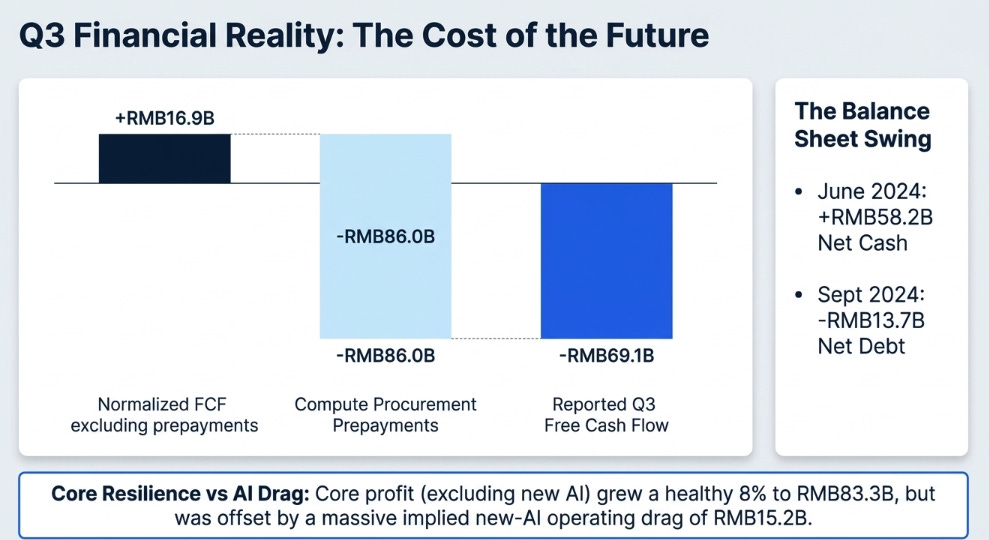
The third quarter made that distinction painfully concrete. Revenue increased 8% to RMB207.3 billion, below expectations, and non-IFRS operating profit fell 6% to RMB68.1 billion. Free cash flow was negative RMB69.1 billion. Tencent went from RMB58.2 billion of net cash in June to RMB13.7 billion of net debt in September. Yet WorkBuddy, its enterprise AI agent, crossed 10 million daily users and a seven-day annualized gross revenue run rate of US$500 million. The market Tencent has long hoped would pay for productivity software may finally be appearing, at almost precisely the moment the cost of serving it has become exceptionally high.
That is the quarter’s fundamental question: can Tencent turn its relationships with consumers and businesses into durable AI profits before the suppliers of scarce computing claim too much of the surplus?
The Market Shows Up
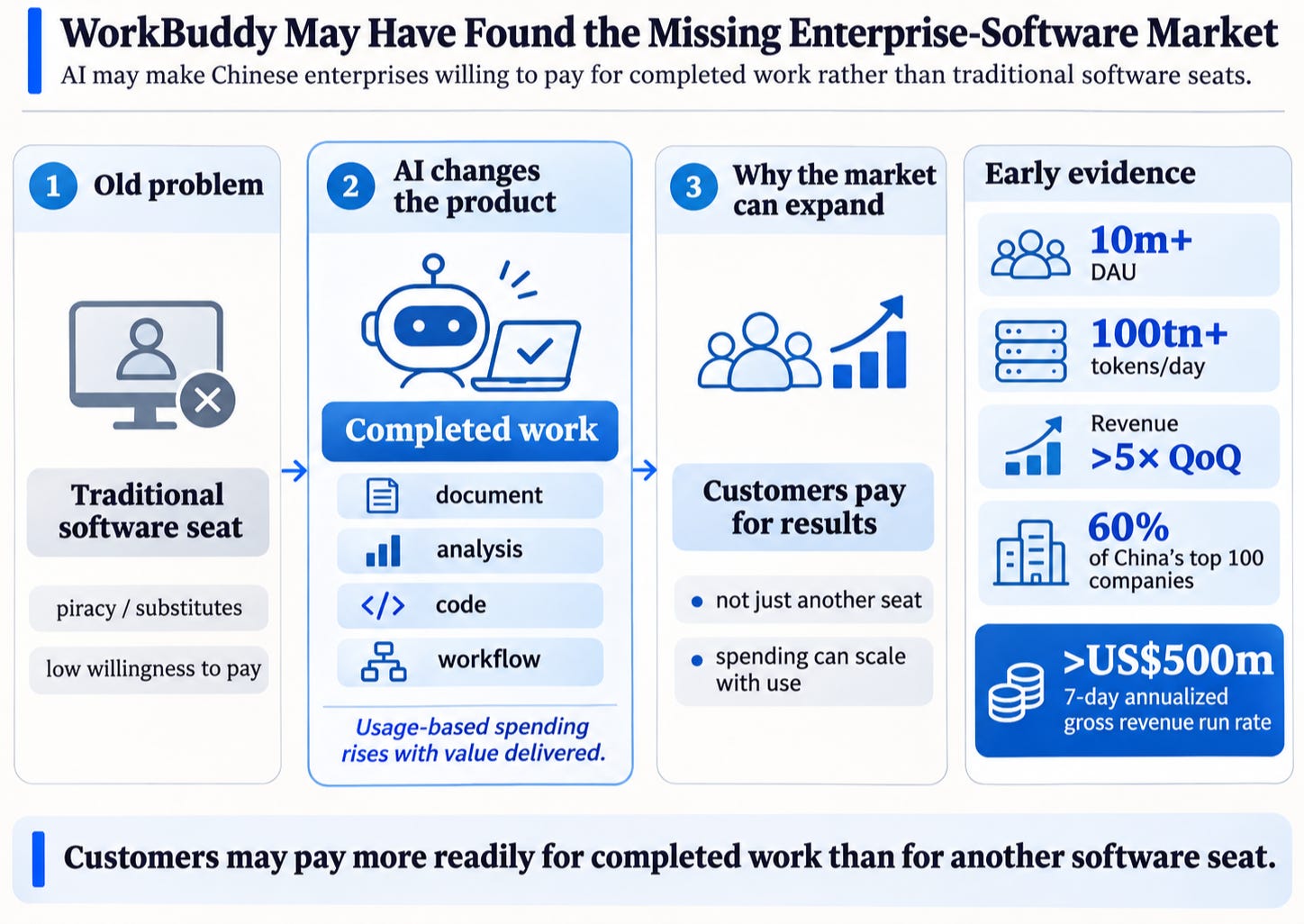
China created enormous consumer-internet businesses without creating an enterprise-software market of comparable value. Companies were reluctant to pay Western-style subscription prices for productivity tools, and piracy or inexpensive substitutes reduced the returns available to vendors. Martin Lau believes AI changes the value proposition, and he explained why by reaching back to Tencent’s experience in games:
Firstly, AI services avoid software piracy problem. Secondly, WorkBuddy covers a large number of valuable use cases within enterprises, such as document preparation, data analysis, project management, research, and software development, which makes the whole package worth paying for. The subscription plus token usage-based monetization model means that customers can unlock a paid experience at a low flat entry price, but then spend more as they derive more value. WorkBuddy’s annualized gross revenue over the last seven days has exceeded $500 million, which is more than 2x of Tencent Meeting, which was launched seven years ago. In some ways, these dynamics mirror those of China’s online game industry evolution, where cloud connectivity also curbed piracy, and an item-based monetization model unlocked a much larger revenue pool when spending can scale up along the demand curve.
The games analogy is more than a metaphor. Server-side games were harder to pirate, and virtual items allowed committed players to spend far more than casual ones. An agent could create a similar spending curve in office work. A company unwilling to buy another software seat may pay willingly for a complicated analysis, a working piece of code or a process completed without days of employee effort. Charging for completed work, or the intelligence required to do it, potentially enlarges the market rather than merely redistributing existing software budgets.
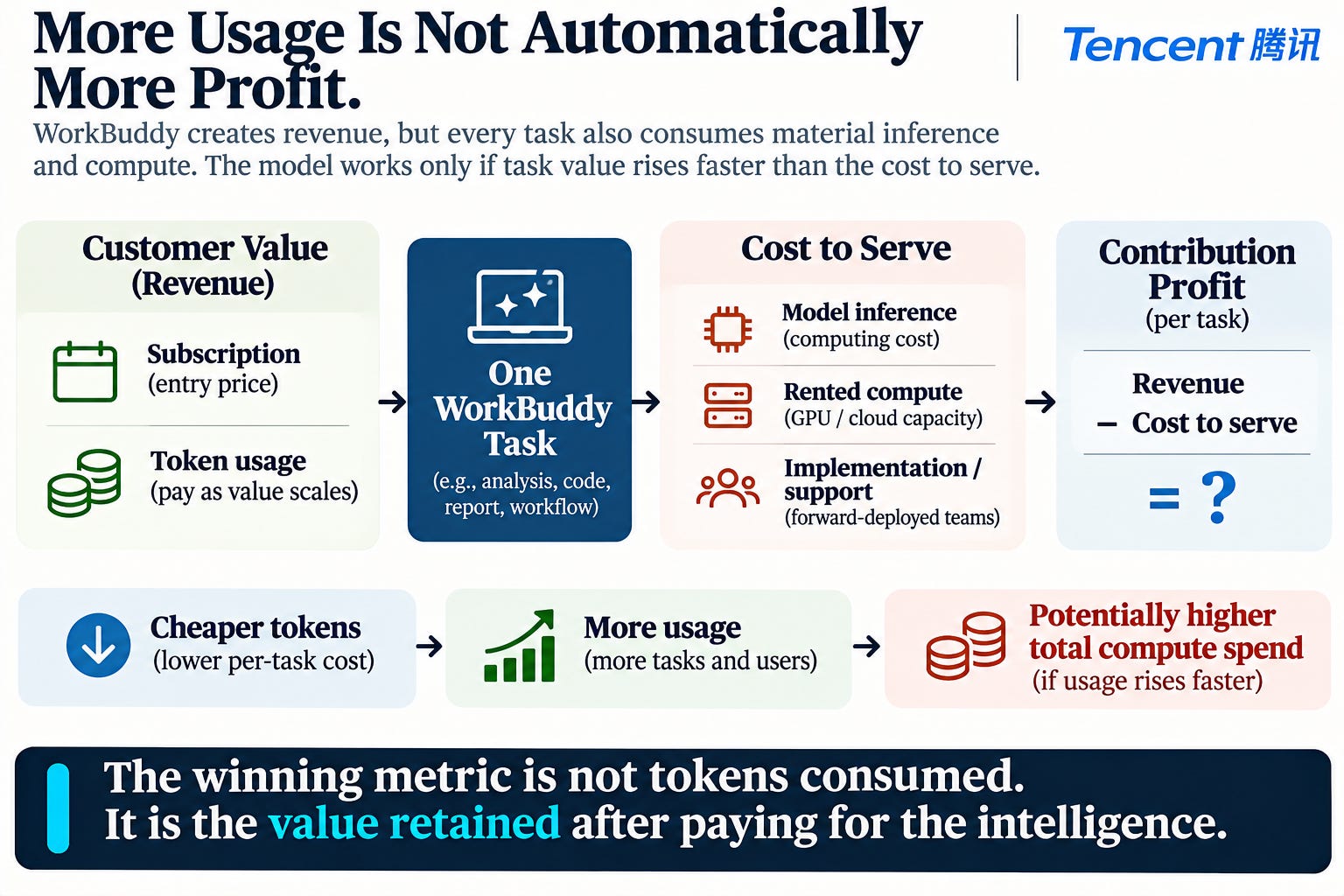
WorkBuddy’s early evidence is substantial: more than 100 trillion tokens consumed daily, revenue up more than fivefold in the quarter and customers from 60% of China’s top 100 companies, according to Tencent. The revenue run rate is nevertheless gross, extrapolated from seven days during rapid growth. It is neither audited annual revenue nor profit. WorkBuddy also consumes outside models and computing capacity. Unlike conventional software, every additional complex task incurs material inference expense. Cheaper models can encourage so much additional usage that total compute costs increase rather than fall. Tencent must retain enough of the task’s value after paying for the intelligence that performs it.
The enduring competitive advantage is therefore unlikely to be the lowest token price. It is the ability to become embedded in enterprise documents, permissions and workflows, so that customers keep returning for the results. Forward-deployed engineers can demonstrate those results, but their labor is also a cost; true scale arrives when usage expands without a proportional increase in hands-on implementation.
The Supplier Gets Paid First
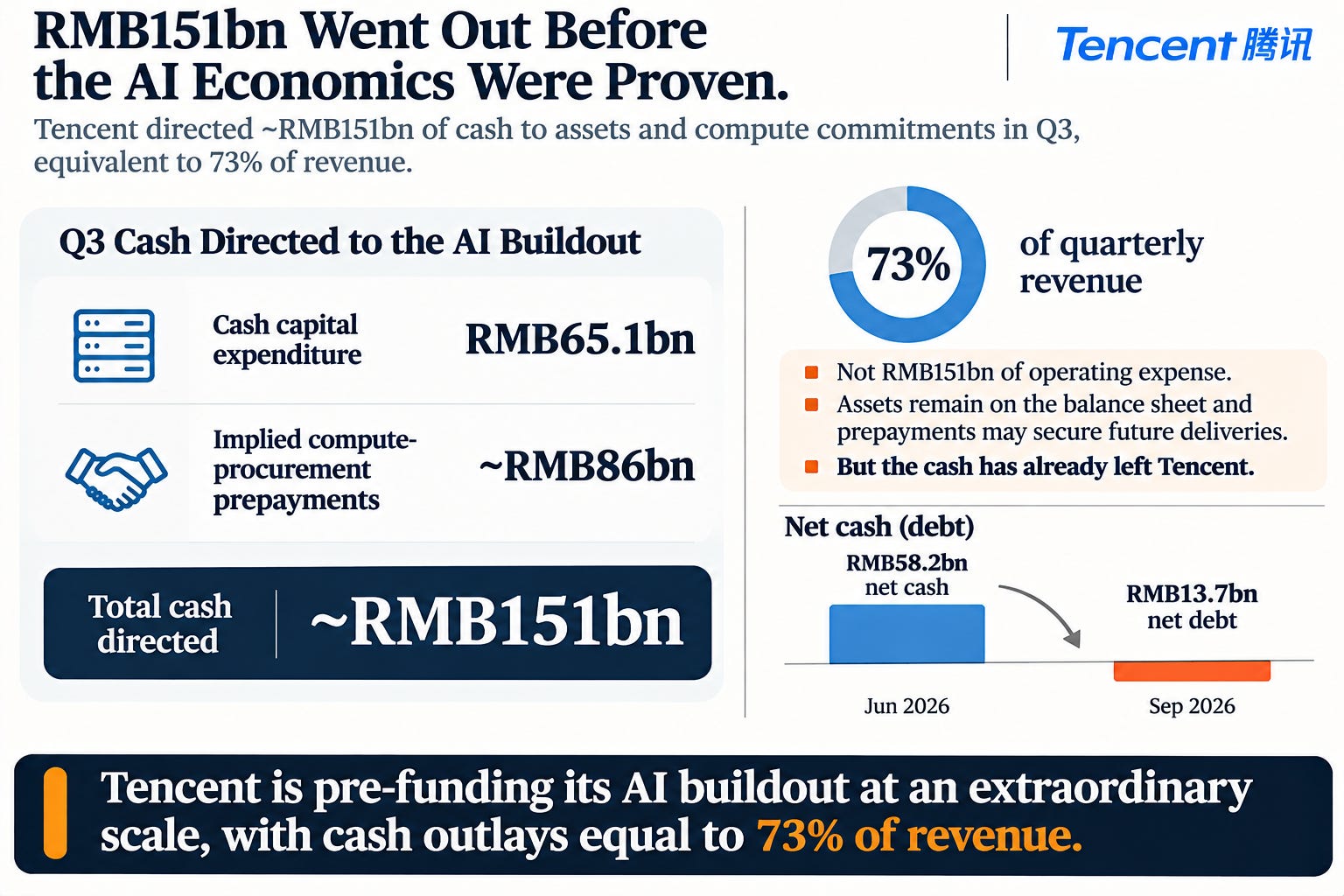
Tencent spent RMB65.1 billion on cash capital expenditure during Q3. Its reported free cash flow was negative RMB69.1 billion; without prepayments for computing procurement, management says it would have been positive RMB16.9 billion. The RMB86 billion difference, added to capex, implies roughly RMB151 billion of cash directed toward assets and advance commitments in one quarter, equivalent to 73% of revenue. These are not RMB151 billion of operating expenses. Assets remain on the balance sheet and prepayments may secure future deliveries. But the cash leaves Tencent before new AI products have established mature profits.
James Mitchell told investors that this extraordinary outlay should not be extrapolated indefinitely:
Regarding prepayments, the second and third quarter were abnormally high levels, and we have now entered into the long-term contracts that we wanted to enter into, so our prepayment outflows will decline. In fact, there may be some quarters where prepayments reverse due to the cancellation of contracts that we previously prepaid, but we’re now exiting as a result of recent changes.
Compare the direction of the money with Tencent’s peers. Baidu says customers are increasingly prepaying to secure its GPU cloud capacity and signing longer contracts. Alibaba’s AI Cloud and Compute revenue grew 53%, including 64% growth from external customers. Both have made sustained investments in proprietary accelerators. Tencent has domestic chip initiatives and substantial infrastructure of its own, but its procurement commitments show that its available capacity cannot yet satisfy its ambition on favorable cash terms.
This is the inversion of our earlier thesis. We expected AI’s ultimate economic value to accrue to the companies controlling users and workflows, not those providing raw intelligence. That may still happen. During a shortage, however, the company that can promise the next unit of compute has unusual negotiating power. The application developer commits cash today and learns its customer economics later.
The distinction is about bargaining power and timing, not proof that every chip supplier enjoys extraordinary returns. Prepayments are not profits, and Alibaba and Baidu themselves consume considerable capital. Nor has Tencent identified the contracts affected by recent regulatory changes; connecting specific cancellations to export restrictions would be speculation. The investment issue is whether today’s scarcity premium will diminish as capacity expands and models become more efficient, leaving Tencent’s workflows valuable after the supplier’s leverage has faded.
Two Clocks, One Investment
September established two warnings: growth in profit excluding new AI products below 10%, and an AI operating drag above RMB14 billion without commercial evidence. Q3 triggered the first. Profit excluding new AI products grew only 8%, to RMB83.3 billion, while the implied new-AI drag reached RMB15.2 billion. WorkBuddy’s monetization provides the commercial evidence that makes the second warning more nuanced, not irrelevant.
The core is still resilient. Domestic games grew 11%; advertising rose 19% despite weak consumption. But Marketing Services gross margin declined as AI-related costs and Mini Dramas investment expanded, technical infrastructure expenses excluding depreciation rose sharply, and R&D grew 42%. Tencent is not merely subsidizing a launch. Its cost structure is changing.
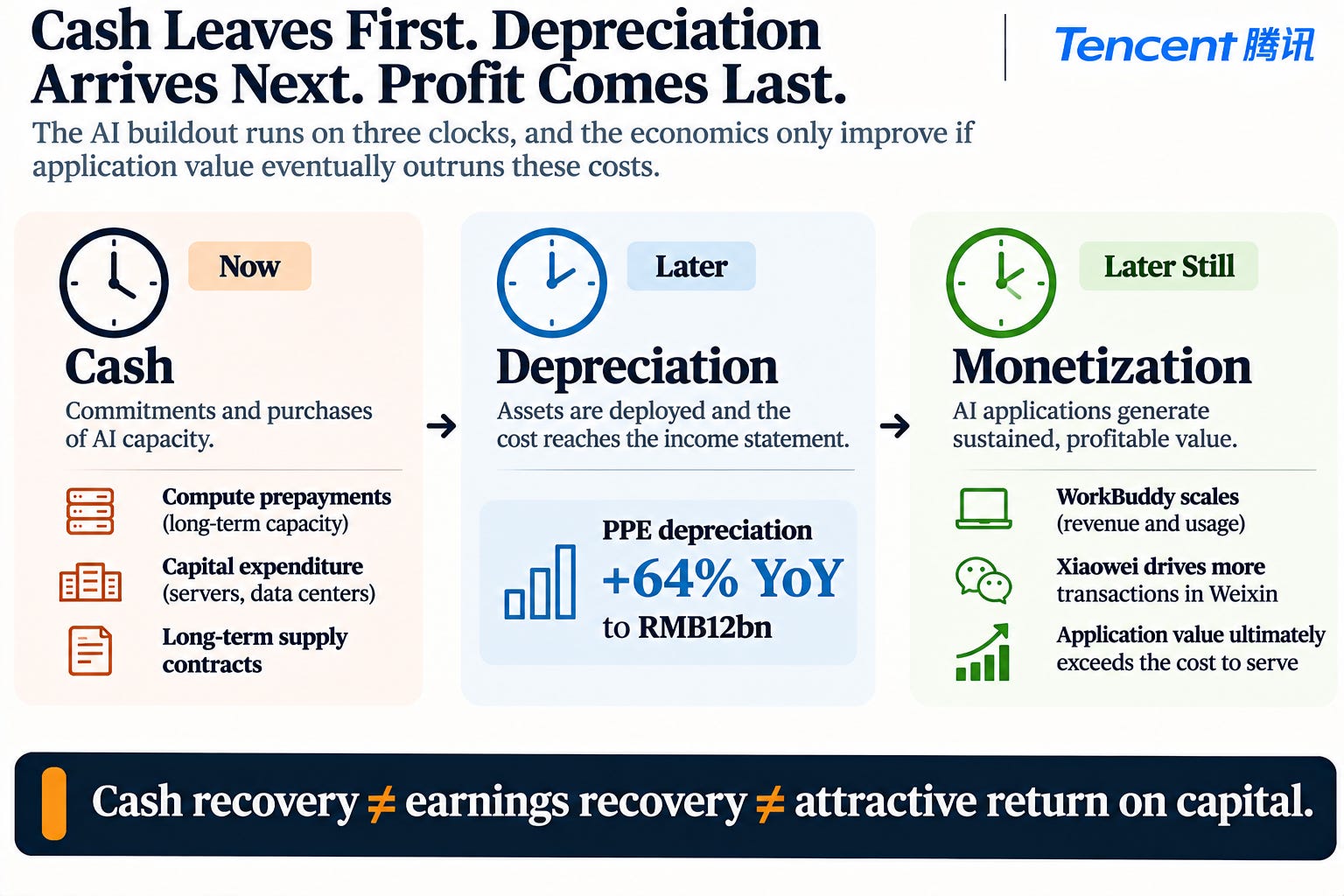
There are three clocks. Cash is committed before servers and capacity are delivered. Depreciation follows when assets are available for use. Monetization from applications and enterprise workflows may mature later still. Mitchell expects cash capex to fluctuate around current peaks through 2027 before easing, and prepayments could normalize sooner. Cash flow might therefore recover before reported earnings show the full benefits; continuing replacement spending or weak utilization could prevent either recovery.
It would be a mistake to forecast depreciation by treating every yuan of recent procurement as a server with the same useful life. Tencent’s equipment, facilities and contractual rights have different accounting and replacement profiles. What we can observe is that property-and-equipment depreciation has already risen 64% to RMB12 billion in Q3. The capital Tencent spends to develop an AI market will remain an economic obligation long after the initial payment is forgotten.
What Tencent Gets to Keep
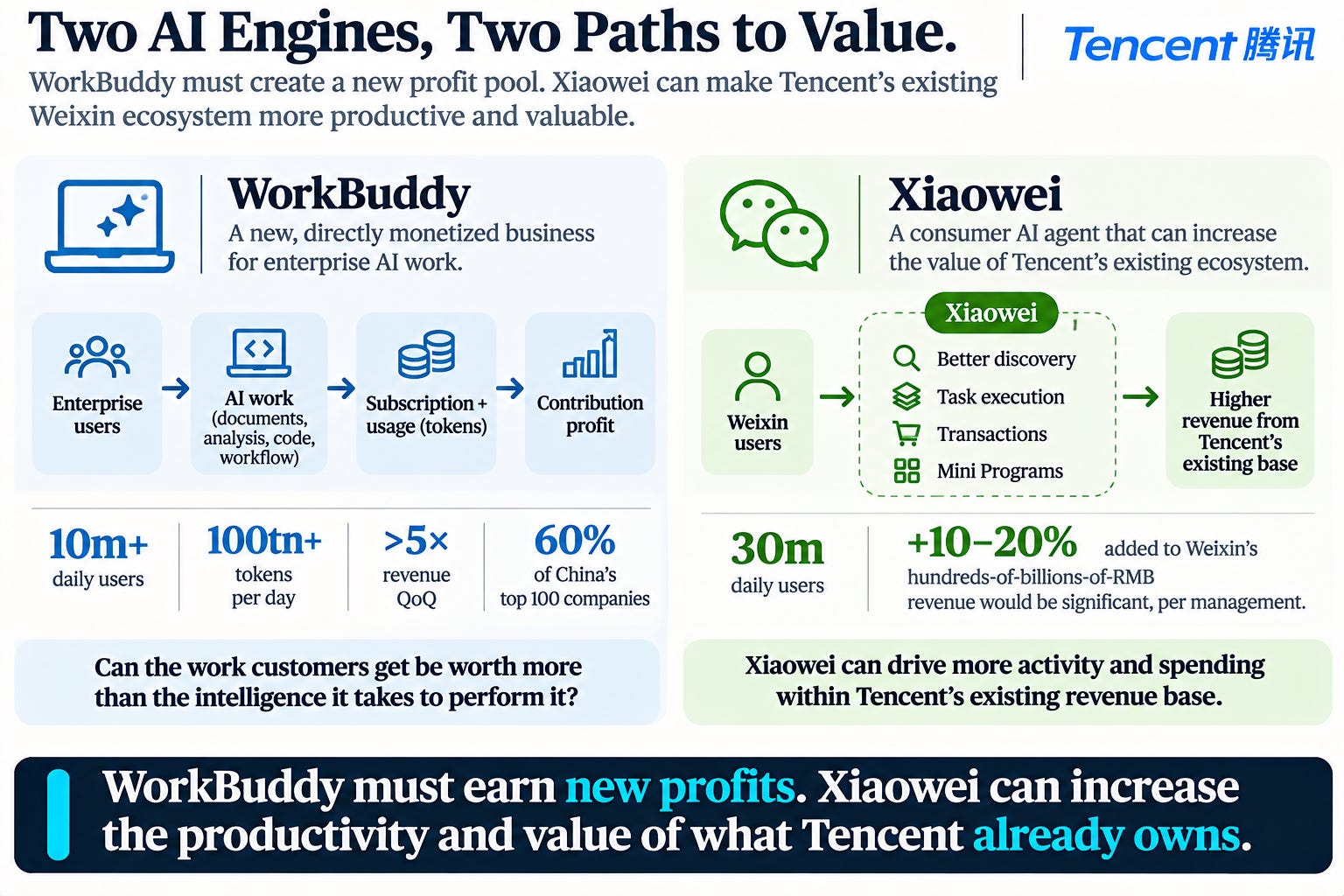
WorkBuddy has to be paid for directly: subscriptions and usage must eventually produce attractive contribution profits. Xiaowei, the assistant inside Weixin, has a different job. It can make existing relationships with users, merchants, Mini Programs and payments more productive without demanding a separate subscription. Lau described the potential:
And we believe, if you look at the current revenue stream of Weixin, which is, if you combine everything, in the hundreds of billions of RMB a year, right? Then adding 10% or 20% to that would be a very significant number, which will make Xiaowei hugely profitable for us. So, I think that’s the overall equation. And we feel that we will see that in the next 6 to 12 months very clearly.
That is an ambition, not an attributable earnings disclosure. Xiaowei’s 30 million daily users could generate additional transactions, or merely reroute activity already occurring in Weixin. The important detail is that Xiaowei need not use the most expensive frontier intelligence for every task. Access to identity, contacts, merchants and payment execution may matter more than maximum model sophistication. If a cheaper model can accomplish the action, Tencent’s best consumer AI economics might require much less compute than its frontier-model program. The latter must justify its own investment rather than borrowing the former’s strategic promise.
At HK$348.40 on November 19, the stock has declined sharply since our September article. But cheaper is not automatically attractive when the earnings and cash requirements have changed. I would revise the August–September three-year framework as follows:
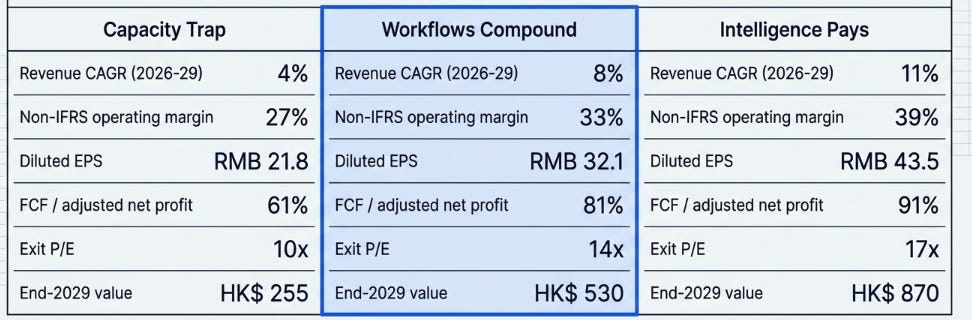
These are underwriting estimates, not management guidance. They assume that depreciation absorbs part of the benefit of AI growth; the stronger outcomes require WorkBuddy to mature commercially and the cash-intensity peak to pass. The probability-weighted value is approximately HK$515, about 48% above the reference price. Yet the central case depends mainly on a recovery in valuation from roughly ten to fourteen times modeled earnings, not exceptional EPS growth. Share holders are being asked to anticipate a cash recovery that is not visible yet.
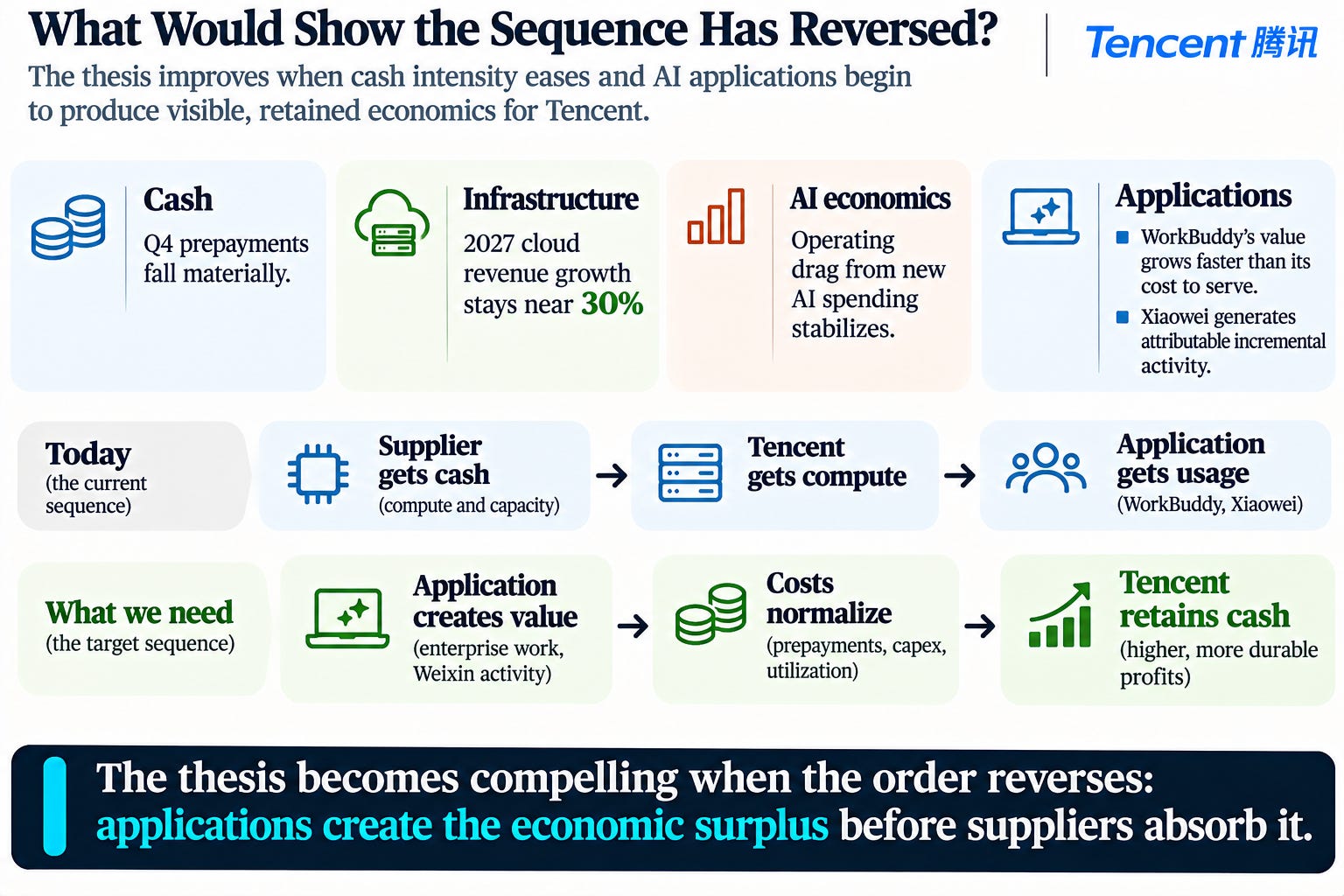
I would hold rather than add on the price decline alone. The first evidence should be prepayments falling materially in Q4. During 2027 I want cloud growth sustained near 30%, the operating drag of new AI products stabilizing, and actual incremental commercial activity attributable to Xiaowei. Above all, WorkBuddy must show that growing usage creates more value for Tencent than it costs to serve.
Our original claim was that AI should make Tencent’s customer relationships more valuable. WorkBuddy suggests the opportunity may be larger than we anticipated. What we underestimated was how much Tencent would need to pay for the intelligence before it could prove that proposition. During a compute shortage, suppliers collect first. Tencent’s investment case becomes compelling when the sequence reverses when the work enabled by its applications grows more valuable, the cost of producing it falls, and the cash retained by shareholders begins to reflect the difference.
Disclaimer:
The content does not constitute any kind of investment or financial advice. Kindly reach out to your advisor for any investment-related advice. Please refer to the tab “Legal | Disclaimer” to read the complete disclaimer.