


TL; DR
The semiconductor sell-off was not a verdict on AI demand. It reflected a breakdown in the assumptions that scarcity, cheap capital, independent customer demand, and supplier pricing power would persist indefinitely.
The central question is whether AI can become self-funding before it becomes overbuilt. Capacity is being constructed faster than enterprises can redesign workflows, establish trust, and convert technical capability into dependable revenue.
The next AI trade will reward conversion, not construction. The winners will own durable bottlenecks, sell to customers with independently generated cash flow, and demonstrate rising economic returns as infrastructure scales.
On Tuesday, the S&P 500 closed slightly higher. Beneath that calm surface, fundamental long-short funds, systematic strategies and multi-strategy equity books all lost more than 1% on the same day, something Goldman had not recorded since March 2020. Technology portfolios were being de-grossed, memory stocks suffered exceptional long selling, and leveraged Korean products were forcing trades into a market whose liquidity was disappearing by the hour. The index was green. The AI trade underneath it was in liquidation.
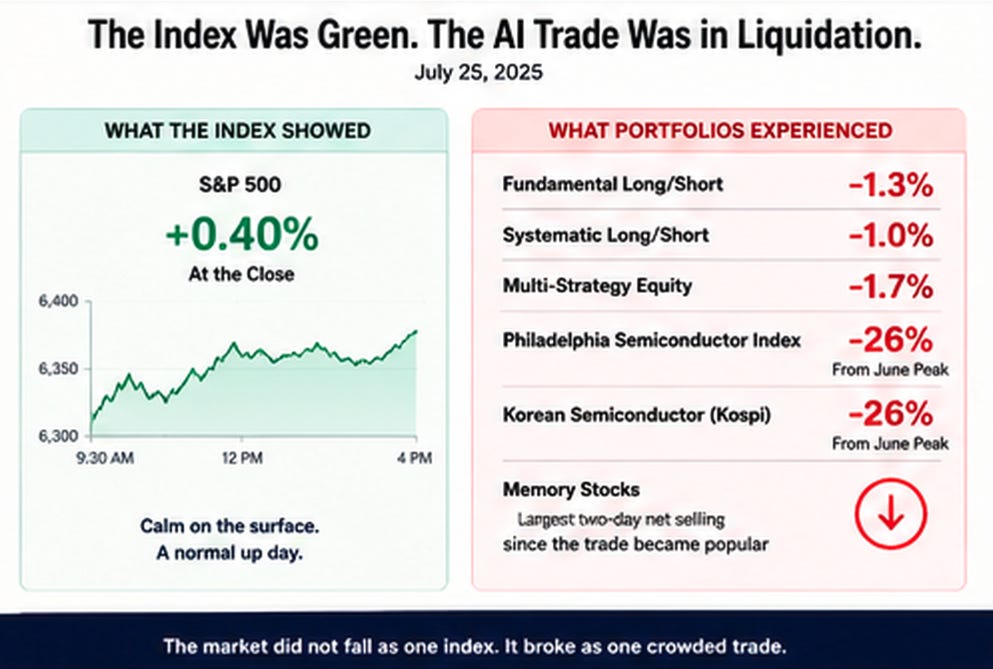
The semiconductor index had fallen roughly 26% from its June high, while Samsung and SK Hynix suffered double-digit daily declines. Yet there had been no obvious collapse in AI usage. Access to leading models remained constrained, infrastructure plans continued to rise, and SK Hynix had just reported record quarterly revenue and operating profit. The industry was still describing demand it struggled to serve.
I began with the simplest explanation: a crowded trade had finally broken. That was true, but insufficient. Positioning explained why the decline became so violent. It did not explain why investors had suddenly become willing to sell every version of the same long-term AI story.
The deeper change was interpretive.
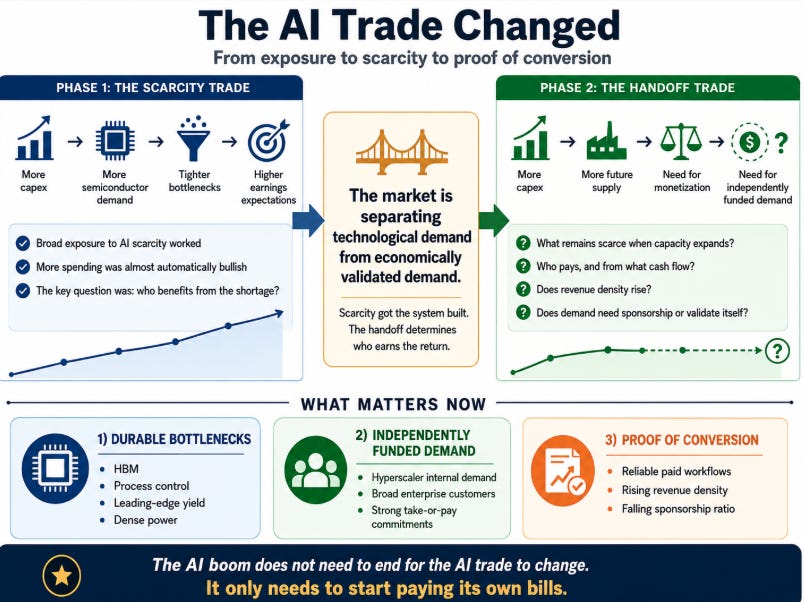
For the first phase of the boom, the market had a simple model. More capital expenditure meant more accelerators; more accelerators meant more high-bandwidth memory, advanced packaging, networking, power and semiconductor equipment; more demand against constrained supply meant stronger pricing and higher earnings.
Scarcity was the signal.
Over the past month, scarcity stopped being enough.
Thirty Days That Broke the Scarcity Trade
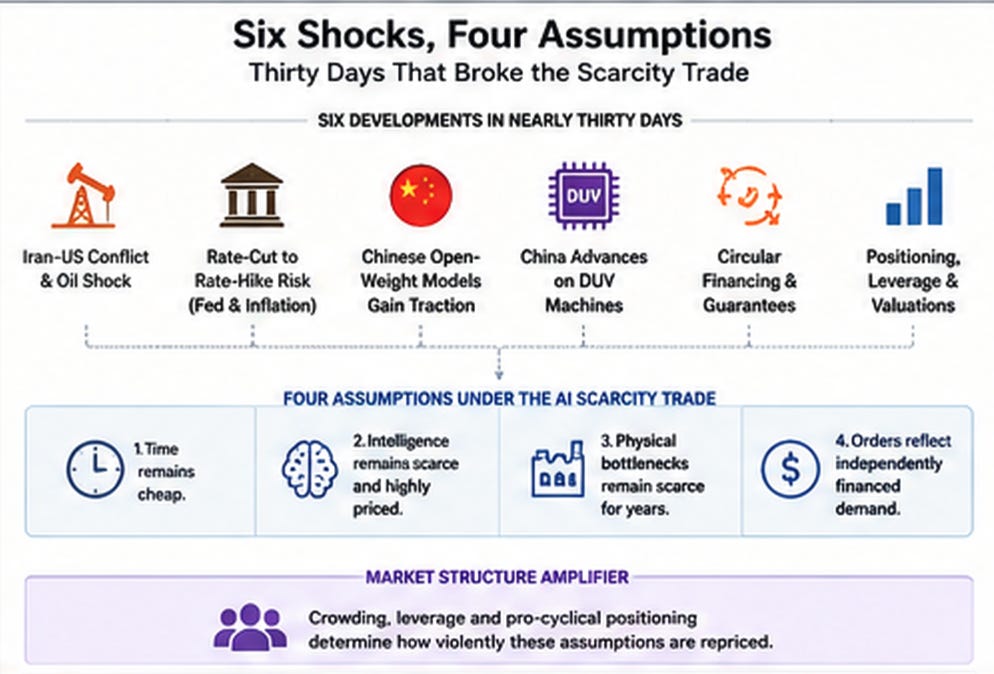
The AI trade rested on four assumptions: demand would outgrow supply; physical bottlenecks would remain scarce long enough to preserve pricing power; customers would eventually generate the cash required to pay for capacity; and capital markets would give monetisation time to arrive. Each came under pressure in a different way.
First, the cost of time changed. Renewed conflict between Iran and the United States pushed oil and inflation risk back into the market just as a new Federal Reserve chair was signalling less tolerance for persistent inflation. Within weeks, the debate moved from when rates might be cut to whether the Fed could raise them almost immediately.
Higher rates do not eliminate demand for intelligence. They shorten the period during which an unprofitable project can wait for demand to become revenue. Land, power and equipment must be secured before applications generate cash. A cash-rich hyperscaler can tolerate that gap; a specialist provider dependent on refinancing cannot. Macro determines how long the system has to answer the AI question.
Then intelligence itself appeared less scarce. Chinese open-weight models such as Kimi and Qwen suggested that useful capability could spread more quickly and cheaply than investors had assumed. The immediate interpretation was that cheaper Chinese models meant fewer Western chips. That skips a step.
Open models attack the pricing power of frontier laboratories more directly than physical consumption. Lower prices can attract more users, make lower-value tasks viable and enable several agents to work in parallel. If the price of a useful outcome halves and consumption more than doubles, physical demand expands; if consumption rises only modestly, users capture the benefit while capacity providers face weaker economics. Adoption can therefore remain strong while value migrates away from the laboratories supporting much of the buildout.
The third challenge was to the duration of hardware scarcity. Domestic Chinese immersion DUV production does not make those tools equivalent to ASML systems on throughput, uptime, overlay, yield or cost per good wafer. What changed was not current supply but the market’s estimate of how long Western scarcity rents might persist.
The fourth concern attacked the quality of demand. Bloomberg reported potential Nvidia-related arrangements worth more than $750 billion. The SK Group agreement includes reciprocal procurement, but the possible OpenAI arrangements are different: Nvidia was reported to be considering up to $250 billion of lease guarantees and financing roughly $350 billion of chip purchases. Google has reportedly backstopped Anthropic-related leases, while SoftBank has financed a large OpenAI commitment. The talks may change or fail, but their scale is difficult to dismiss.
None of this proves that demand is fictitious. Young industries often require coordination. A model laboratory needs compute before it can create the capability and revenue that make the compute affordable. A data-centre developer needs a committed tenant before lenders will fund construction. A supplier with superior information and a strong balance sheet may rationally bridge that gap.
Yet financing changes what an order tells us. A conventional purchase says the customer has cash, or can borrow against its own credit, and has chosen to spend it on the supplier’s product. A vendor-supported purchase says the supplier believes strongly enough in the customer’s future to help create the purchasing power. The second may be an excellent investment. It is not independent validation.
The market may not believe AI demand is fabricated. It may believe the timing of that demand is being financially engineered.
Then the trade broke. Crowded momentum exposure, high valuations, Korean leveraged ETFs, dealer hedging and systematic thresholds transformed a month of changing assumptions into indiscriminate liquidation. Fundamental concerns supplied the reason to sell. Market structure supplied the scale of the selling.
The Question Beneath the Sell-Off
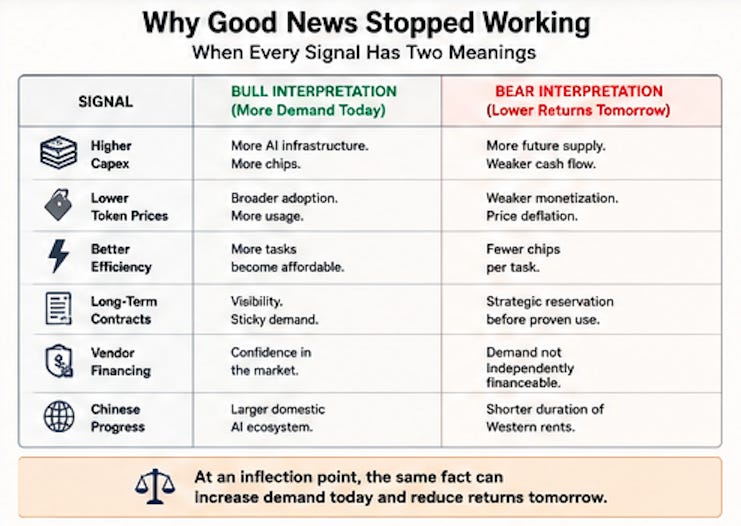
At an inflection point, information does not disappear; its meaning becomes unstable.
Higher capex means more current demand and more future supply. Lower model prices mean weaker laboratory monetisation and broader adoption. Better efficiency means fewer chips per task and more affordable tasks. Vendor financing signals confidence and incomplete customer funding.
This is why capex up, down or flat can all be read negatively. The market has lost a stable framework for interpreting the data. The numbers had not merely changed. Their meaning had.
The question underneath the confusion is:
Can the AI boom become self-funding before it becomes overbuilt?
The fuller version is more precise:
Can falling costs and improving capability create enough broad, independently financed end-user demand before the physical capacity and financial obligations built in anticipation of that demand outrun the resulting cash flows?
The AI buildout moves through four stages:
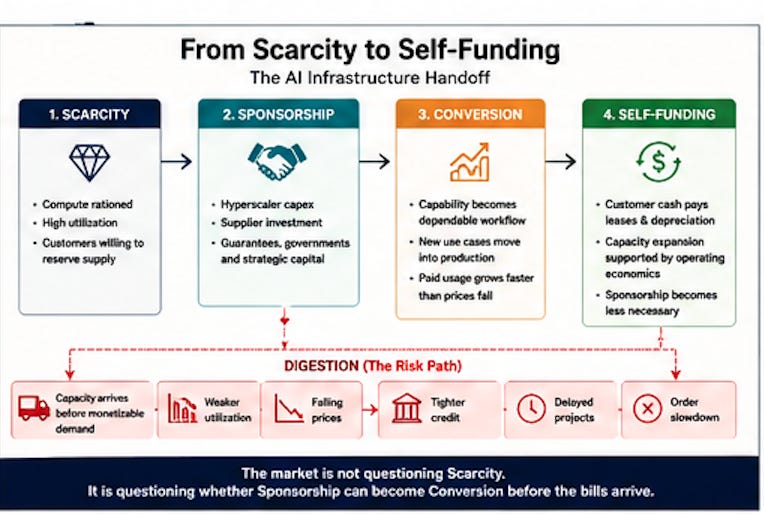
The failure state is not necessarily a collapse. It is digestion: Sponsorship creates capacity faster than Conversion creates monetisable demand. Utilisation or pricing disappoints, financing tightens and new projects slow while underlying usage continues growing into what has already been built.
That is the mental model: Scarcity → Sponsorship → Conversion → Self-funding.
The market is not seriously questioning the first stage. It is asking whether the industry can complete the final two before the obligations created in the second come due.
Intelligence Has a Meter
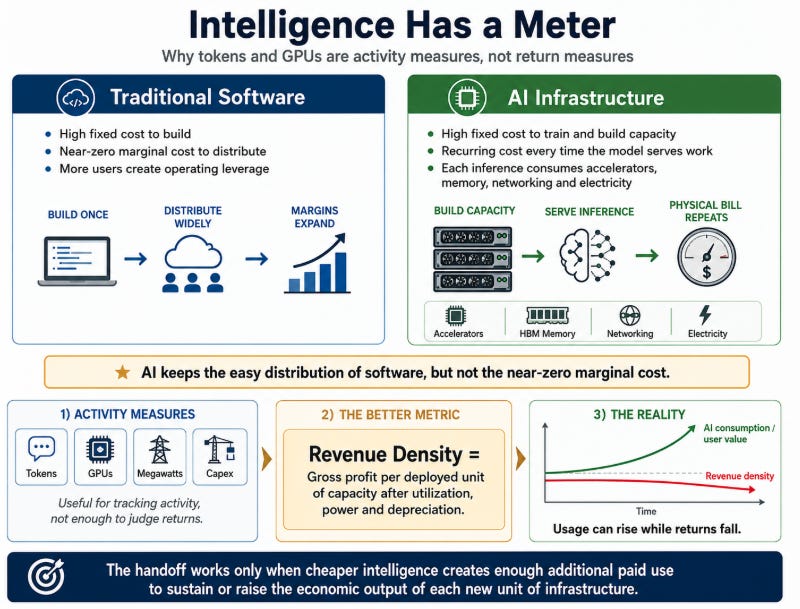
Traditional software combines high fixed costs with almost free distribution. AI keeps the easy distribution but not the near-zero marginal cost. Every inference consumes accelerators, memory, networking and electricity; every improvement in capability must eventually support a recurring physical bill.
That means tokens, GPUs and announced megawatts are activity measures, not return measures. The better measure is revenue density: gross profit per deployed unit of capacity after utilisation, power and depreciation. AI consumption can rise rapidly while revenue density falls, leaving users with enormous value and the owners of capacity with inadequate returns. The handoff works only when cheaper intelligence creates enough additional paid use to raise, or at least sustain, the economic output of each new unit of infrastructure.
Two Clocks
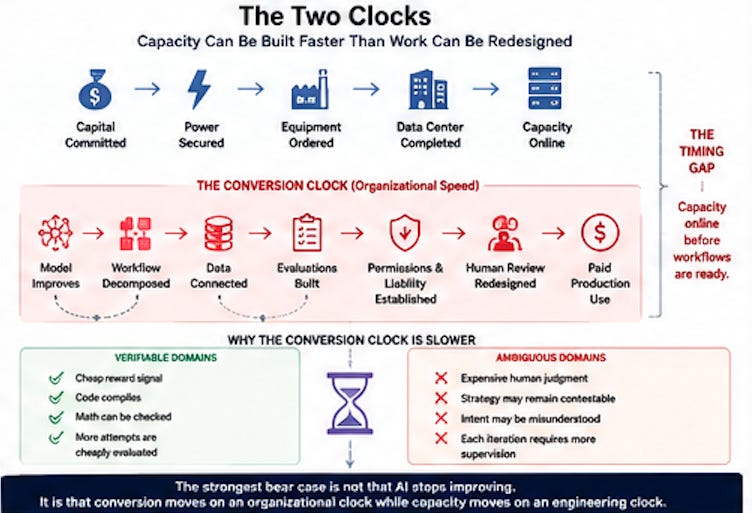
The strongest bear argument does not require AI to fail. It only requires the construction clock to move faster than the conversion clock.
The construction clock is governed by capital, land, power, permits and equipment. Once a project is approved, the process is difficult but legible. The conversion clock is governed by organisations. An enterprise must connect models to proprietary data, establish permissions, build evaluations, redesign processes and assign responsibility. Technical capability can improve overnight; institutional trust moves at the speed of budgets and behaviour.
This difference is clearest in the divide between verifiable and non-verifiable work.
Code offers a cheap reward signal. A program can be compiled and tested against a specification. Mathematics can often be checked mechanically. A game or simulation has an objective score. The model can generate many attempts and identify the better result without placing an expensive human expert inside every iteration.
Most knowledge work is less accommodating. A legal argument can be persuasive while misunderstanding the client’s objective; a medical recommendation can be plausible while missing the decisive fact. The reward signal is expensive because improvement requires scarce human judgment and often a delayed real-world outcome.
That can create a fundamentally different cost curve. In a machine-checkable domain, another block of compute can generate many attempts that are cheaply evaluated. In an ambiguous domain, each equal improvement may require disproportionately more compute, context and expert feedback. Capability still rises, but the cost of each step can rise faster.
Amdahl’s law adds another constraint. Making one component of a workflow ten times faster does not make the entire workflow ten times faster if the remaining stages are unchanged. AI may generate code instantly, but integration, testing, security review and deployment can still determine the pace of the complete job. A model can become superhuman at one stage while end-to-end productivity remains limited by the slowest human or organisational stage.
This is the most credible capital-cycle bear case. AI can continue improving, enterprise adoption can keep expanding, and capacity can still arrive before enough workflows are ready to use it productively.
The bull case is stronger because verifiability is partly a property of how work is organised. Tasks can be decomposed, tools can check facts, simulations can test consequences, multiple agents can critique one another and humans can review exceptions.
Coding became an attractive AI market not only because models improved. Software development already had compilers, tests, repositories, permissions, version control and monitoring. The surrounding system made the model’s work legible. Insurance, law, medicine and operations can build their own equivalents, even if the process is slower and less complete.
The addressable market is also larger than the existing wage pool. Cheaper intelligence can create work that humans never performed because human cognition was too expensive: continuous monitoring instead of quarterly review, thousands of simulated experiments before a physical one, or several agents exploring alternative plans in parallel.
I think this broadening will happen. I do not think it will happen on the same clock as power contracts, chip orders and data-centre construction.
That mismatch is enough to create a cycle.
When the Seller Becomes the Lender
The financing structure tells us whether the industry is bridging the clock mismatch or hiding it.
Nvidia can use the profits from present scarcity to accelerate its market, secure memory supply and encourage Nvidia-based system designs. That may deepen its advantage, but it also changes its economic exposure.
A conventional semiconductor supplier ships a product, receives cash and leaves the customer responsible for earning a return. A supplier that provides equity, purchase financing or guarantees retains exposure to customer solvency, utilisation and refinancing conditions after delivery.
The useful distinction is not circular versus non-circular. It is acceleration versus validation.
Would the same capacity be built, at the same price and on the same schedule, without guarantees, strategic equity and financing from companies that sell to or benefit from the project?
If the answer is yes, supplier capital is accelerating an independently viable market. If the answer is no, future demand is being pulled into the present and the resulting order cannot be treated as independent evidence that the economics already work.
The healthy loop is straightforward: strategic capital builds capacity; capacity enables better models; better models create useful applications; applications generate customer cash; customer cash finances the next wave.
The fragile loop begins almost identically: suppliers support customers; customers commit to supplier-based capacity; those commitments support revenue, valuations and new borrowing; new capital finances more purchases.
The two loops look identical while facilities are being built. They separate when the bills arrive.
A useful measure would be a sponsorship ratio: the share of incremental capacity supported by vendor guarantees, strategic equity, cloud credits, government assistance or related-party financing rather than arm’s-length customer cash and credit. Its level will be hard to estimate and means little in isolation; early industrial systems often require support. Its direction matters.
If the first $100 of capacity needs $30 of strategic support and the next $100 needs only $15 because utilisation and customer cash flow have improved, the handoff is working. If the next $100 needs $45, the system is becoming less self-sustaining as it grows.
Financing is therefore both evidence of Nvidia’s extraordinary strength and a symptom of incomplete downstream capital formation. A weak company could not act as the balance sheet of an industry. A fully self-funded industry would not need it to.
One Income Statement, Two Memory Cycles
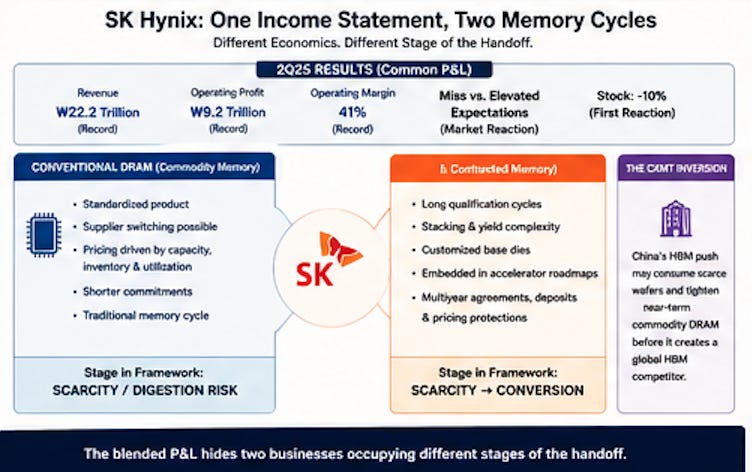
SK Hynix’s quarter shows why the framework matters at the company level.
The company reported record revenue of KRW79.3 trillion and operating profit of KRW60.5 trillion, yet both fell below elevated expectations. The market initially treated the miss as one signal about “AI memory.” The underlying disclosures pointed to two businesses moving on different economic paths.
Conventional DRAM remains exposed to familiar memory economics: common standards, switchable suppliers and pricing governed by capacity and inventories. HBM is different. Multiple dies must be stacked and connected, the logic base die is becoming more customised, qualification is lengthy and the customer’s roadmap becomes tied to the supplier’s process and packaging performance.
SK Hynix began mass shipments of HBM4 and disclosed long-term agreements with around ten customers. The arrangements include pricing structures designed to address volatility and financial mechanisms such as deposits intended to support fulfilment and improve demand visibility.
That is evidence of movement from Scarcity toward Conversion. Demand is shifting from opportunistic spot purchasing toward commitments embedded in multiyear roadmaps. It is not yet proof of Self-funding: a long contract can reflect strong downstream economics or strategic fear of being unable to secure capacity.
Still, treating HBM and commodity DRAM as one homogeneous cycle is a category error. One part of SK Hynix remains governed by traditional memory economics. The other is becoming a process-differentiated franchise embedded inside that cycle.
China adds another inversion. CXMT’s policy obligation to develop domestic HBM could force it to allocate more wafers to a product that initially yields fewer useful bits per wafer than commodity DRAM. The near-term result may be less conventional DRAM supply, even as the market reacts to Chinese equipment progress as though a flood were imminent. The long-term supply threat is real; the immediate allocation effect may run in the opposite direction.
The same distinction applies across semiconductors. ASML is valuable not because no one else can generate light, but because customers care about throughput, overlay, uptime and cost per good wafer at enormous scale. TSMC is not paid merely for owning factories, but for leading-edge yield and dependable integration. KLA benefits not simply from more wafers but from the rising economic cost of detecting defects late as HBM and advanced packaging become more complex.
The next semiconductor market will distinguish these structural capabilities from generic exposure to more capacity.
The Handoff Scorecard
The framework becomes useful only if it can be updated.
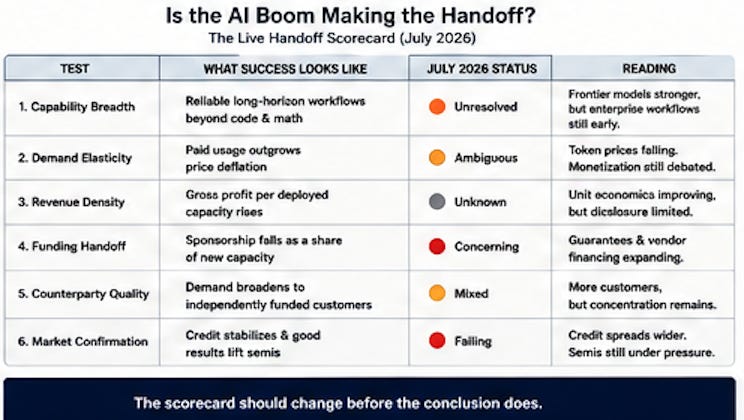
This scorecard matters more than whether one quarter’s Azure guide is two percentage points above consensus. A cloud beat can produce a squeeze. It cannot resolve the debate unless it reveals utilisation, demand breadth, revenue conversion and customer quality.
The next frontier-model release matters for the same reason. The market does not need another system that scores marginally better on familiar tests. It needs evidence that capability gains are opening new categories of paid work faster than capacity is arriving.
Credit should be watched alongside the models. Wider spreads, larger guarantees, shorter maturities or weaker lease protections may show that the handoff is failing before chip orders slow.
The Next AI Trade
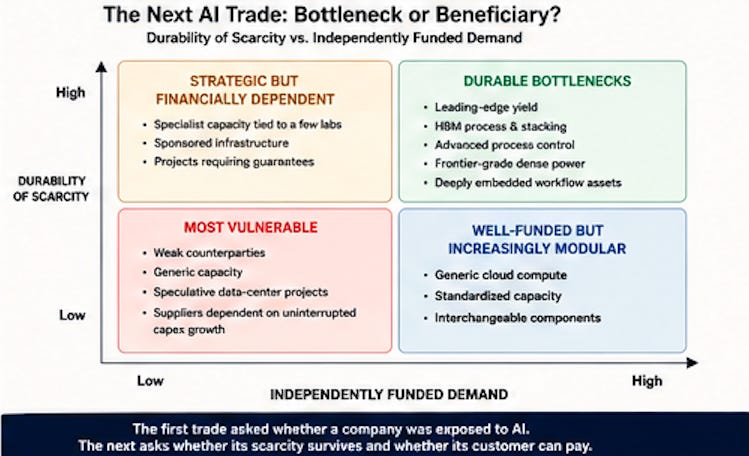
The first AI trade rewarded exposure to scarcity. The next will reward proof of conversion.
For every company in the chain, investors should ask three questions.
What remains scarce when headline capacity becomes abundant? The answer may be leading-edge yield, HBM packaging, process control, dense power, proprietary workflow data or customer distribution. A temporary shortage is not a durable advantage.
Who pays the company, and from what independently generated cash flow? A hyperscaler monetising AI inside an existing cloud, advertising or enterprise business is different from a specialist provider dependent on one frontier laboratory. The same dollar of backlog can represent very different economic demand.
Does scale improve the economics, or require more sponsorship? A healthy system becomes easier to finance as it grows because utilisation, customer diversity and revenue density improve. A fragile one becomes larger while remaining dependent on favourable capital markets, rising asset values and new guarantees.
The sell-off became more violent than the change in end demand justified, and forced deleveraging can push durable companies below reasonable value. Yet buying the same broad basket at lower prices assumes the basis of the trade has not changed. That basis has changed.
The strongest bear case is not that AI fails. It is that AI succeeds too slowly relative to the physical and financial obligations made on its behalf. I think that case will be partly right.
My base case is a rolling digestion, not a broad collapse. The growth rate of capital expenditure peaks before useful AI consumption does. Some projects are delayed or restructured, generic capacity sees weaker pricing, and poorly financed operators struggle. Frontier-grade systems, leading HBM and the hardest manufacturing bottlenecks can remain scarce throughout the adjustment.
This view becomes more bullish if models begin completing long-horizon professional work reliably; if paid usage grows faster than price deflation; if revenue density rises as capacity opens; and if the sponsorship ratio falls. It becomes more bearish if each wave requires larger guarantees, credit weakens despite strong usage and strategic capital becomes more important rather than less.
The fibre buildout offers the useful historical warning. Investors were right that bandwidth demand would explode, but many were wrong about the sequence: capacity arrived, financial obligations followed, and sufficient cash flows came too late. The internet won; many of the companies financing its arrival did not. Technological inevitability is not the same thing as an attractive return for every owner of capacity.
The historic importance of this drawdown is not that the market has conclusively answered the question. It is that the old question no longer works.
The market has stopped asking whether AI will require more compute. It has begun asking whether the value created by that compute will reach the companies financing it soon enough.
Scarcity got the system built. The handoff will determine who earns the return.
The AI boom does not need to end for the AI trade to change. It only needs to start paying its own bills.
Disclaimer:
The content does not constitute any kind of investment or financial advice. Kindly reach out to your advisor for any investment-related advice. Please refer to the tab “Legal | Disclaimer” to read the complete disclaimer.