


TL; DR
Technology removed rented friction: search, reviews, marketplaces, logistics and returns made alternatives easier to discover and try, weakening advantages that came mainly from distribution, familiarity and inertia.
The real consumer asset is permission: when alternatives are visible, strong companies still win because customers actively choose their proposition or begin the decision with them.
For investors, direction matters more than heritage: the opportunity is strengthening permission flow before the market recognizes it; the danger is paying for accumulated brand strength while current permission is deteriorating.
Warby Parker
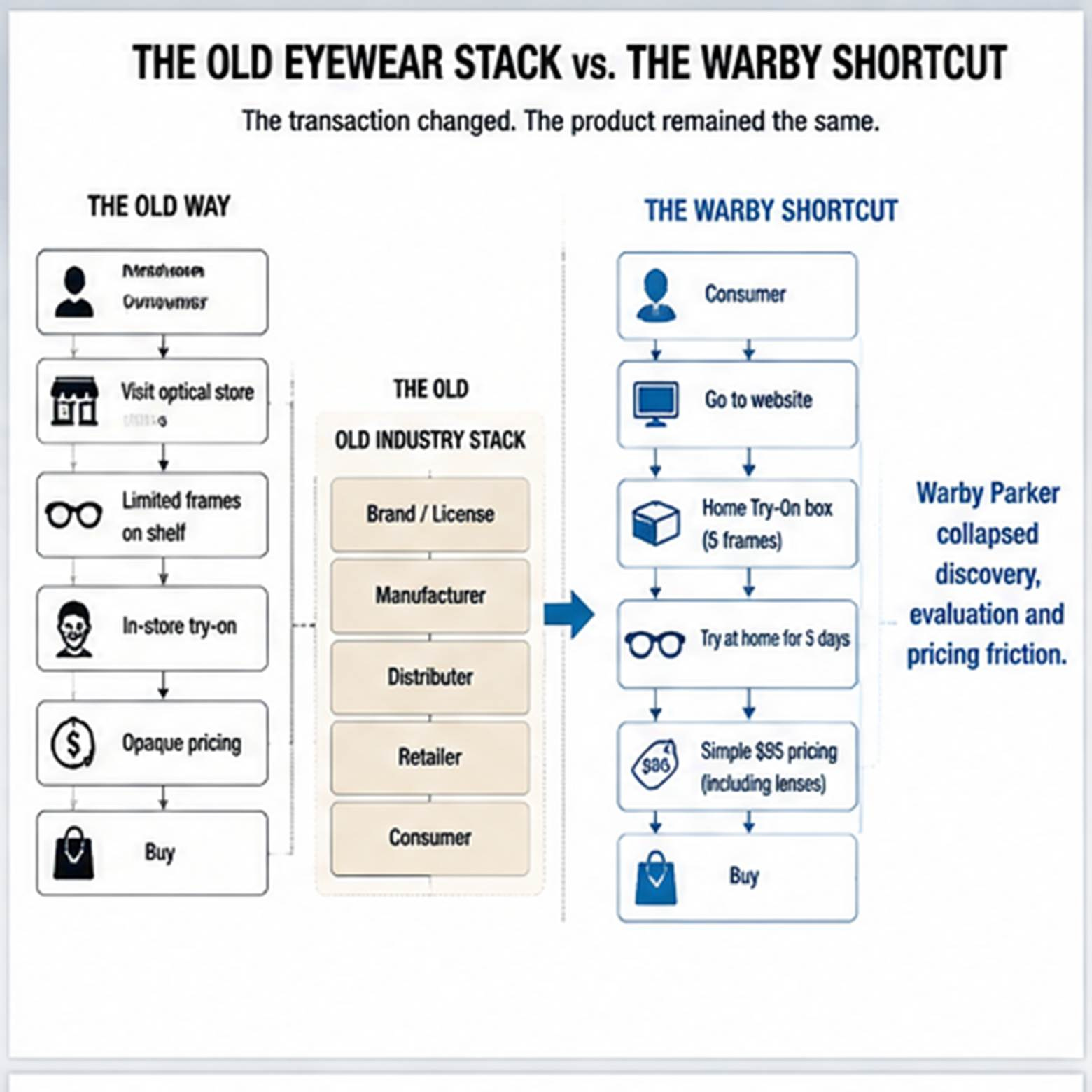
In February 2010, four Wharton students launched a company selling prescription glasses for $95, including lenses. The price was striking, but the more important idea arrived in a cardboard box. A customer unsure about buying glasses online could choose five frames, have them shipped home, try them on for five days, and send them back. At the time, less than 2.5% of glasses were sold online, which made sense: eyewear seemed like the sort of category the internet could not easily disrupt because evaluation required putting the product on your face.
Warby Parker turned that constraint into the product. The company later recalled in its prospectus:
“We reached our first-year sales targets in three weeks, sold out of our top 15 styles in four weeks.”
The demand was not evidence that consumers had suddenly stopped caring about brands. It was evidence that a set of costs embedded in the old buying process had been mistaken for an intrinsic part of the product.
The incumbent system was formidable. Luxottica owned Ray-Ban and Oakley, licensed eyewear from names including Prada, Chanel and Tiffany, and operated thousands of retail locations through chains including LensCrafters, Pearle Vision and Sunglass Hut. Its advantage combined brands, manufacturing, wholesale relationships and retail distribution. Warby Parker did not reproduce that machine. It made parts of the machine less necessary.
Discovery moved online. Evaluation moved into the customer’s home. Returns reduced the risk of experimentation. A simple price made the transaction easier to understand. Warby Parker did not abolish the value of brands or physical stores; it removed enough friction that the incumbent’s distribution no longer settled the decision.
That distinction reaches far beyond glasses.
Rented Friction
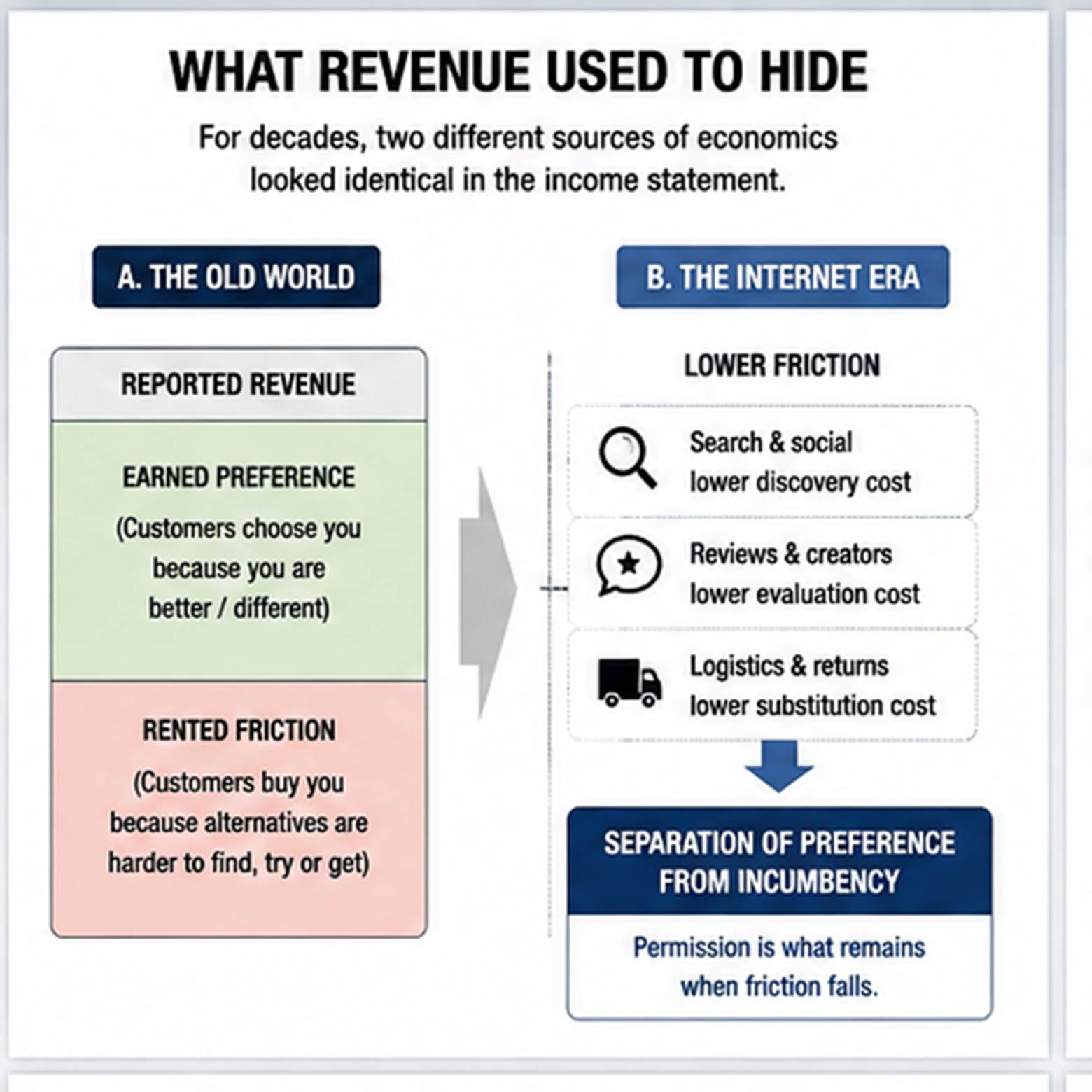
For most of the twentieth century, consumer companies benefited from two different kinds of transactions that looked identical in the income statement. Some customers bought because they genuinely preferred the product, trusted the company, identified with the brand or valued the experience. Others bought because considering something else was difficult enough that they did not bother.
The second source of economics might be called rented friction.
Discovery once depended heavily on what retailers stocked and advertisers could put in front of consumers. Evaluation was difficult because independent information was scarce. Substitution involved finding the alternative, risking money on it and accepting the possibility that it would disappoint. Distribution, advertising and heritage reduced those costs for incumbents, which meant a familiar product did not always need to be much better; the alternative needed to be sufficiently better to justify discovering and trying it.
This created the great consumer loop of the last century. Scale financed advertising, advertising built awareness, awareness helped secure distribution, distribution generated transactions, and those transactions financed more scale. The loop rewarded genuinely great brands, but it could also protect ordinary propositions fortunate enough to occupy it. Revenue did not disclose which was which.
The internet changed that by lowering the cost of reconsideration. Search and social media made alternatives discoverable. Marketplaces expanded availability. Reviews, creators and specialist communities made claims easier to verify. Logistics and returns reduced the cost of experimentation. Friction did not disappear, nor did easier comparison make every category a commodity. Where products are interchangeable, it pushes surplus toward the consumer. Where products genuinely differ, it makes those differences easier to see.
Permission itself is much older than the internet. Titan demonstrated that decades earlier in India, overcoming a far more entrenched watch incumbent through product, design, retail experience and service. The important point is that technology did not invent permission; it reduced the shelter available to companies that lacked it. Titan’s Watches & Wearables business is still moving in the same direction today: net sales grew 16% in FY2025, while the company said the “premium wave continued unabated.”
Removing friction gets a company considered. It does not get it chosen.
That requires permission: the customer’s willingness to give a company the next transaction when realistic alternatives are easy enough to discover, evaluate and buy.
There are two useful forms. Proposition permission answers why the customer wants this product or experience: better economics, superior function, cultural meaning, status or scarcity. Decision permission answers why the customer begins the decision with this company at all: membership, loyalty, ecosystem, community or trusted discovery. Costco can possess both; a hotel loyalty system may lean more heavily on the second, while a technical footwear brand may lean more heavily on the first.
The taxonomy matters less than the underlying question: when alternatives are visible, why does the customer still choose you?
The Inflation Test
That question helps explain why today’s consumer economy looks so contradictory.
The dominant macro description is the K-shaped consumer: affluent households remain relatively healthy while lower-income households are more exposed to accumulated inflation, housing costs and credit. That distinction matters, winners and losers coexist inside restaurants, apparel, footwear and beauty, while value and premium businesses can strengthen simultaneously. Company-specific demand systems often explain the dispersion better than income labels.
The K-shape explains spending capacity. Permission explains spending choice.
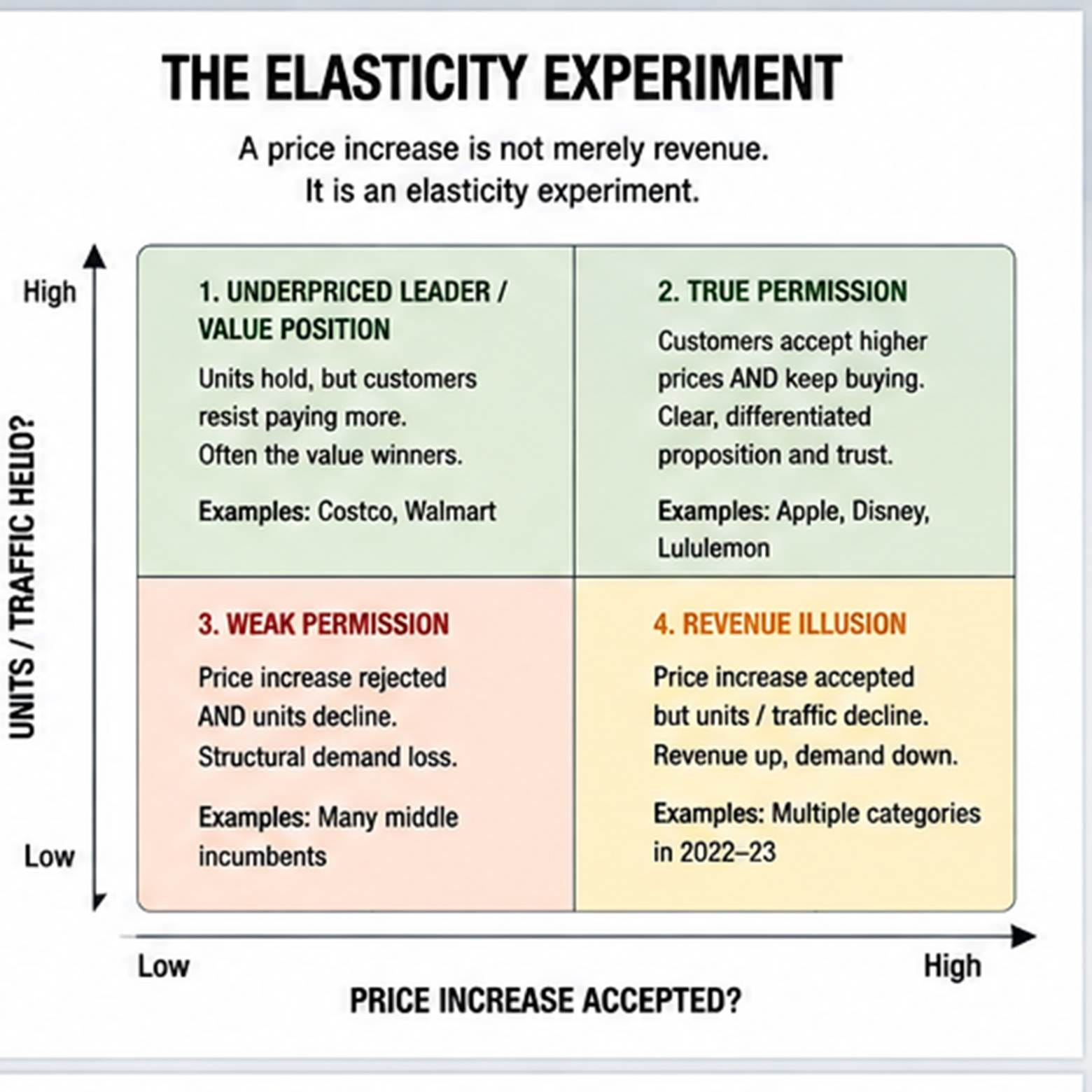
The inflation shock of 2021 through 2023 made that distinction unusually visible because consumer companies across categories simultaneously raised prices. For several quarters, nominal revenue made the outcome look reassuring: an 8% price increase could offset a 4% unit decline and still produce reported growth. This was often described as pricing power.
But a price increase is not merely revenue. It is an elasticity experiment.
Warby Parker tested the old system by making an alternative cheaper and easier to evaluate. Inflation ran the test in reverse: incumbents asked customers for substantially more money and discovered how much genuine preference existed underneath the inherited transaction. Companies that held units, transactions and full-price demand proved something different from companies that held revenue only because price concealed falling volume.
This also gives us a better definition of the consumer “middle.” It is not a price point, and it is not an income group.
The middle is high awareness, high availability and low permission.
The customer knows the company, can easily find the product, and struggles to articulate a compelling reason to choose it.
That is why value and premium can win together. Costco or Walmart can make the economic exchange unusually clear. A strong footwear or apparel brand can make functional or cultural value unusually clear. The vulnerable incumbent offers familiarity and distribution as though those were reasons in themselves.
Distribution still matters enormously; its role has changed. It increasingly amplifies an underlying proposition rather than substitutes for one. Distribution multiplies permission for strong companies. For weak companies, it multiplies inventory.
Permission Stock and Permission Flow
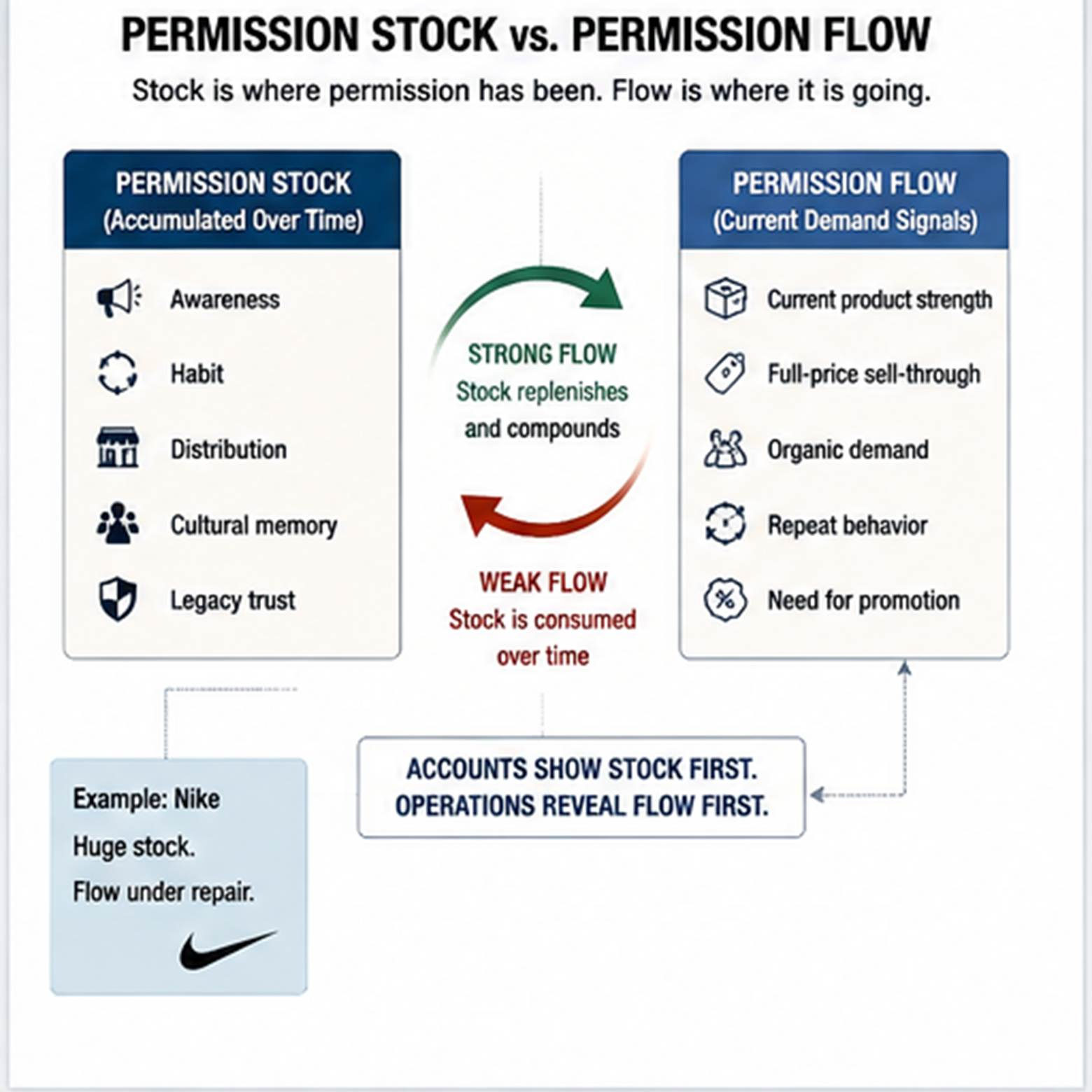
The danger for incumbents is that brand strength is usually discussed as a stock. A famous company possesses awareness, customer memories, retail relationships, cultural associations and habits accumulated over decades. Those assets are real, but they describe where permission has been, not necessarily where it is going.
The more useful distinction is permission stock versus permission flow. Permission stock is the accumulated consequence of yesterday’s successful products and relationships. Permission flow is whether today’s products and experiences are adding to or subtracting from the customer’s reason to choose.
Nike shows why the distinction matters. It remains one of the world’s most recognizable consumer brands, yet its latest results show a business still repairing current demand. In fiscal 2026’s fourth quarter, wholesale revenue grew 1% currency-neutral while Nike Direct fell 9%; CFO Matthew Friend said:
“sell-through remains challenged.”
Nike’s accumulated permission has not disappeared. What management is working to rebuild is the flow.
Financial statements can hide that transition because they report the installed base of an advantage. Revenue comes from customers acquired over decades. Distribution reflects relationships accumulated over decades. Permission deterioration therefore tends to appear first at the margins: more promotion, weaker full-price selling, slower inventory, more spending to acquire or retain demand, and poorer conversion of gross profit into operating profit.
That is why the sequence of repeat or units → clean margin → free cash matters. Units reveal whether demand exists; clean margin reveals how much inducement was required to secure it; free cash reveals whether the mechanism remains economically self-sustaining.
The investment implication follows directly. The best company is not automatically the best stock. What matters is permission trajectory relative to expectations. The attractive setup is strengthening permission flow that the market still prices as the old state. The dangerous inverse is enormous historical permission, weakening flow and a valuation that continues to capitalize the historical franchise as permanent.
The Asian Inversion
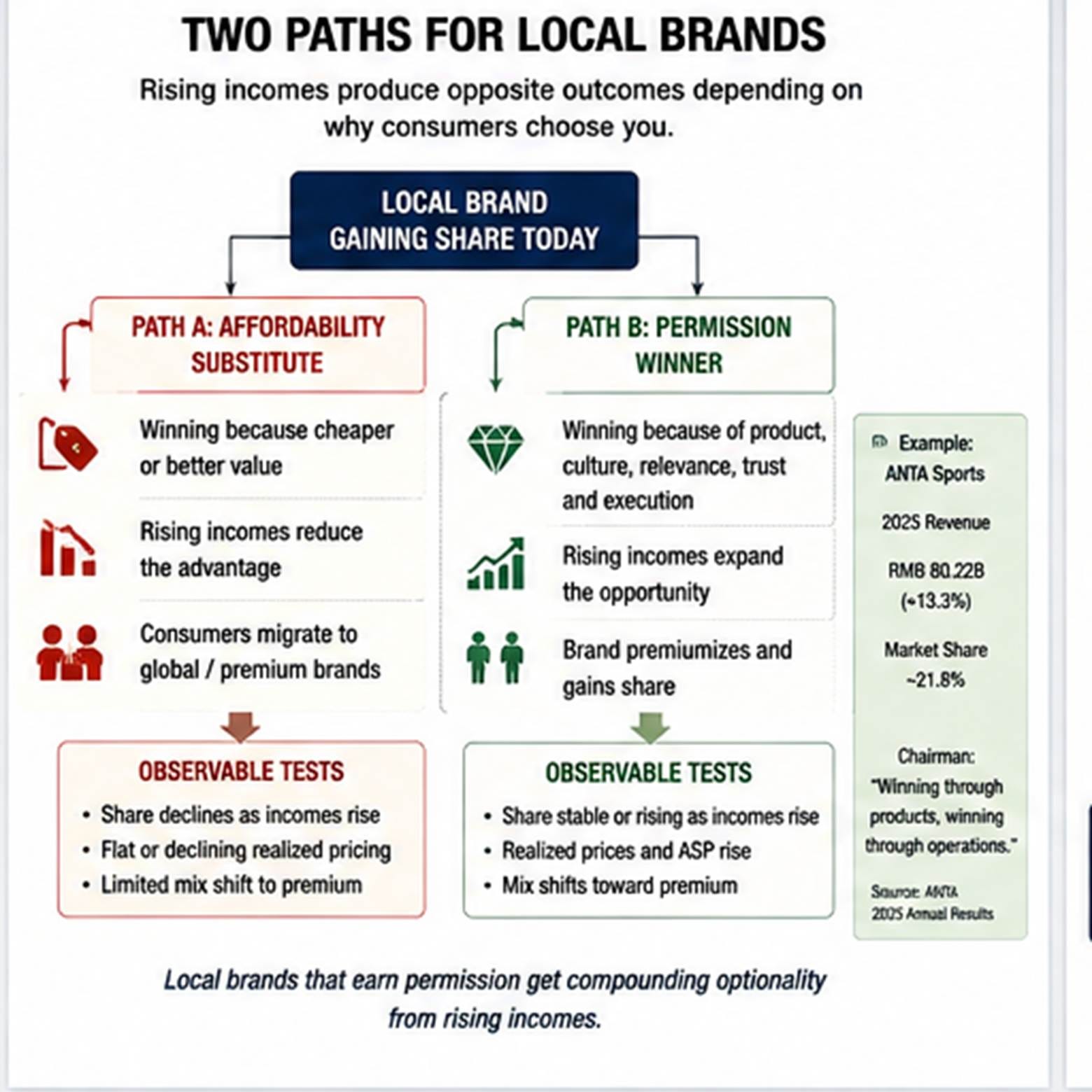
The framework becomes more consequential in Asia because it challenges one of the oldest assumptions in emerging-market consumer investing: that rising incomes eventually pull consumers toward global brands.
That thesis made sense when multinational advantage came bundled with capital, manufacturing expertise, national advertising, distribution and trust. Technology has made parts of that bundle easier to assemble. Local companies can achieve discovery before developing national physical distribution, source manufacturing, iterate quickly from customer feedback and build relevance through local creators and communities. Meanwhile, cultural fluency, local price architecture, product cadence and regional aesthetics remain difficult to centralize.
This creates two completely different explanations for local-brand success. If consumers choose a local brand because it is cheaper, rising incomes should eventually work against it. If they choose it because it has earned stronger permission, rising incomes give the company room to improve the product, raise realized prices and premiumize without surrendering the relationship.
ANTA Sports is useful because that process is already visible at scale. In 2025 revenue rose 13.3% to RMB80.22 billion and its share of China’s sportswear market increased to approximately 21.8%. Its chairman describes the strategy as:
“Winning through products, winning through operations.”
That is not the language or the financial profile of a company whose advantage depends simply on consumers being unable to afford the foreign alternative.
The conventional emerging-market equation is rising income → global-brand trade-up. The alternative is considerably more interesting: rising income → local brand premiumization.
The distinction is testable. Local challengers that maintain or gain share while moving consumers up their own price architecture were not merely affordability substitutes; they earned permission. Those that lose share as purchasing power rises were renting demand from price.
What Gets Paid For
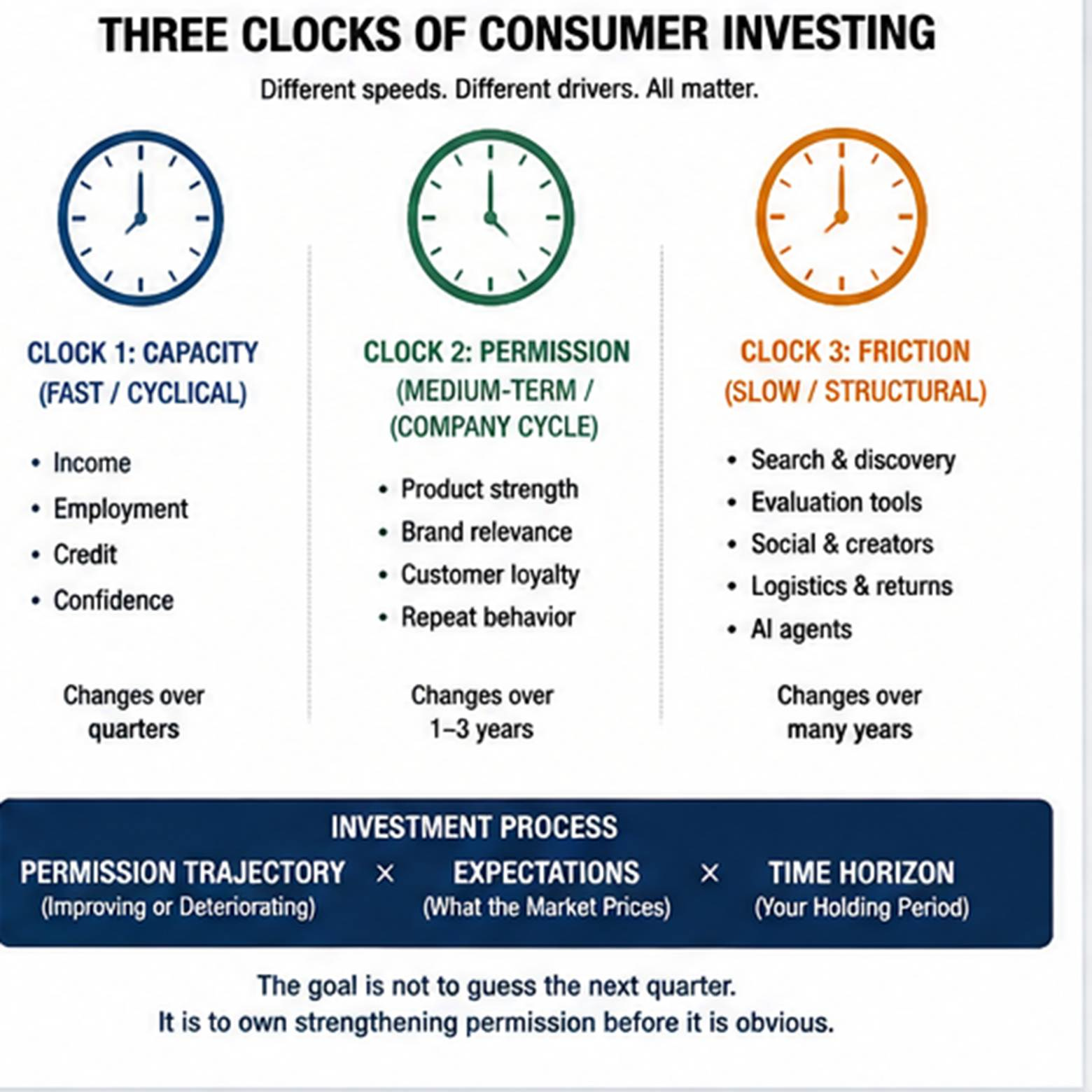
These forces operate on different clocks. Consumer capacity moves with employment, income and credit over quarters. Permission usually strengthens or deteriorates over a multi-year company cycle. Friction changes structurally over decades as technology changes discovery, evaluation and substitution. Confusing the clocks makes good theses look wrong and temporary macro moves look structural.
For portfolio construction, the question is therefore not simply which company has the strongest brand. It is which company’s permission is changing, whether the market recognizes that change, and how long the mechanism should reasonably take to show up in the accounts.
Test that proposition rather than merely admire it. Classify companies today as strengthening, stable or weakening permission and observe the next four to six quarters. Strengthening permission should produce better relative units or transactions, healthier inventory, less reliance on promotion and cleaner operating conversion. If it does not, permission is simply sophisticated vocabulary attached to winners after the fact.
Agentic purchasing may eventually provide another test by reducing decision friction still further, particularly for businesses whose permission depends more on habit or default than on demonstrable product superiority. That is a question for the next stage of the internet’s effect on consumer choice. The current stage is already visible.
Warby Parker’s five-frame box makes the change tangible. The company did not prove that brands were obsolete. It proved that once discovery and evaluation became easier, the incumbent’s distribution could no longer answer the customer’s question for her. Warby still had to provide a reason to choose.
That is increasingly the condition facing every consumer company. The K-shape tells us something important about whether the customer can spend. Technology tells us how easily she can consider alternatives. Permission determines who receives the transaction.
The internet did not commoditize brands. It revealed which brands had ever been real.
And the investment question is the same one Warby Parker put in front of a customer opening a box of five frames at home:
Given a genuine choice, would she still buy this?
Disclaimer:
The content does not constitute any kind of investment or financial advice. Kindly reach out to your advisor for any investment-related advice. Please refer to the tab “Legal | Disclaimer” to read the complete disclaimer.