


TL; DR:
The core continues to compound: Toast added a record 9,500 net locations, recurring gross profit reached $595 million, and monetisation rose to 98 basis points without relying on higher pricing.
AI now has revenue attached: Toast IQ Grow is on track to become the company’s fastest product to $10 million in ARR, using transaction-level data to identify opportunities, launch campaigns, and measure the orders they generate.
The economics remain unproved: Early demand and customer outcomes are encouraging, but Toast has not disclosed paid accounts, retention, service intensity, or gross margins, the evidence needed to show that Grow can scale like software rather than a managed service.
One Idea, Several Names
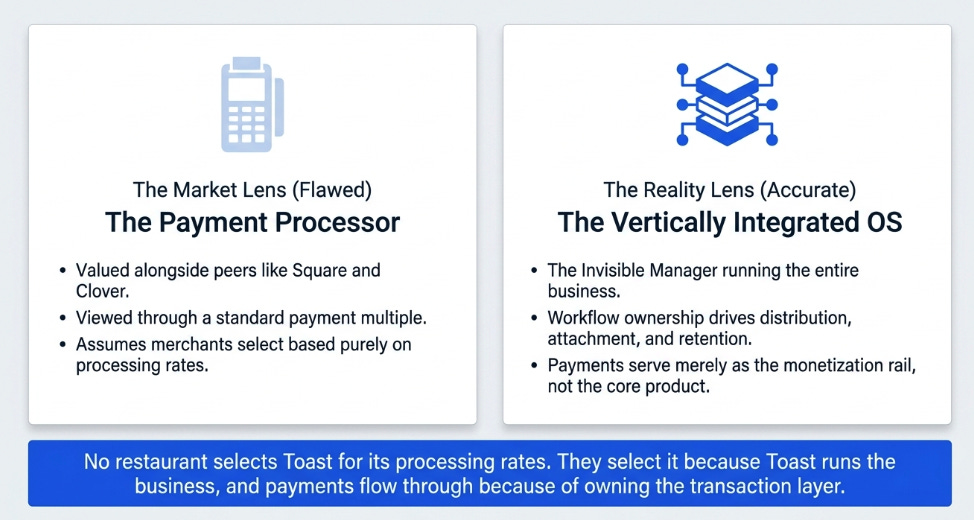
For eighteen months our argument has been the same. Financial technology accounts for most of reported revenue, so the market files Toast alongside Square and Clover and applies a payment multiple. That is the wrong lens, because no restaurant selects Toast for its processing rates. They select it because Toast runs the business, and payments flow through because of owning the transaction layer. Toast is a vertically integrated restaurant operating system with payments as the monetization rail.
We gave that one idea three names across four articles, the integration layer, the profit sanctuary, the invisible manager, which was a writing habit rather than a change of mind. Two things in the record deserve correcting.
The first is timing. For six quarters we pointed at Toast IQ adoption figures and treated usage as evidence the AI layer was arriving. Usage is not revenue, and a market that declines to underwrite what it cannot measure was behaving sensibly. We were describing a mechanism and asking to be paid for optionality.
The second matters more. We consistently defended Toast’s decision to reinvest rather than harvest, distinguishing chosen lower margins from structurally lower margins. That distinction holds. But we treated the act of reinvestment as though it were evidence of value creation, and it is not. Investment is not the conclusion. Return on investment is. Toast still discloses no acquisition cost, payback period, or contribution margin for any business it is funding.
Q2 does not require a new identity for Toast. It gives better evidence about the company we have been studying since the start.
The System Still Compounds
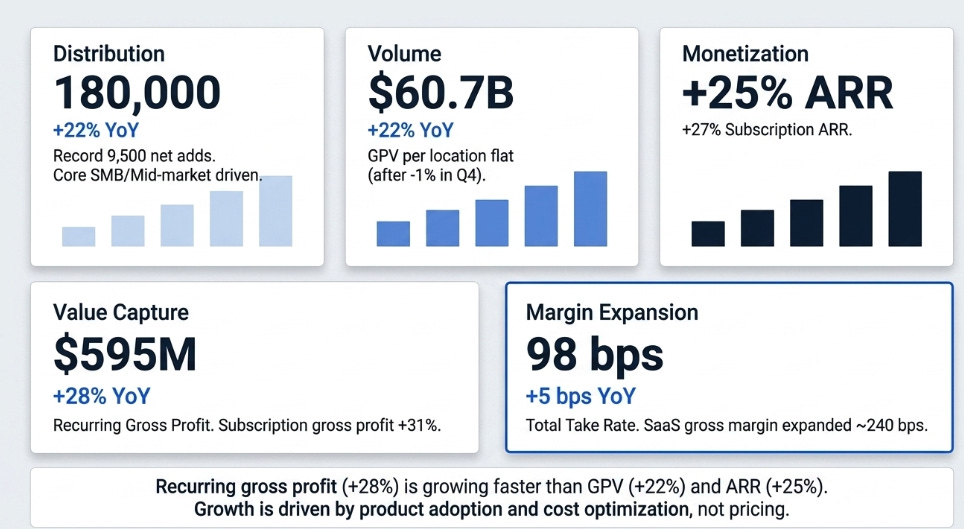
Toast added a record 9,500 net locations, taking the base to roughly 180,000, with the majority from core SMB and mid-market rather than a few large enterprise deployments. GPV reached $60.7 billion and recurring gross profit $595 million.
Location count measures distribution, ARR measures monetization, and recurring gross profit measures how much Toast actually captures from that distribution. All three rose, and gross profit rose fastest. GPV per location was flat after falling 1% in the fourth quarter, SaaS gross margin expanded roughly 240 basis points, and total take rate, recurring gross profit over GPV, reached 98 basis points, up five year over year. Elena Gomez attributed the take rate gain to product adoption and cost optimization rather than pricing, which makes it durable. Toast did not sustain growth by adding visibly weaker customers.
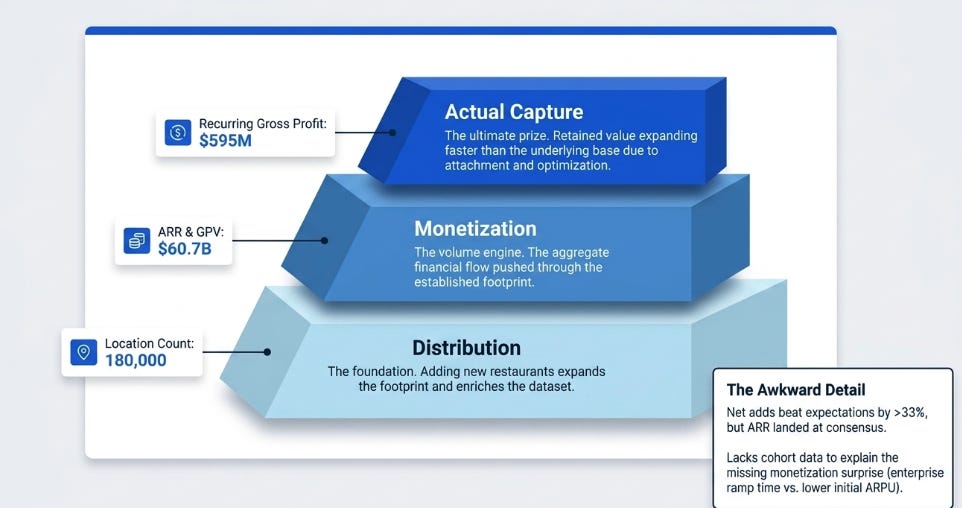
One detail sits awkwardly. Net adds beat expectations by more than a third while ARR landed at consensus, which raises the question of why such a large location surprise produced no monetization surprise. New locations ramp over time, many may have gone live late in the quarter, and enterprise or international deployments may carry lower initial ARPU, but Toast disclosed no cohort data to settle it. Worth tracking rather than a thesis break.
The Closed Loop, and What It Hasn’t Proven
Toast IQ Grow is a marketing product built on restaurant data. Management said it is on track to be the fastest product in company history to $10 million in ARR, that it already runs at positive gross margins, and that one restaurant cut agency spending 70% while generating over $100,000 in marketing-attributed sales in under two months.
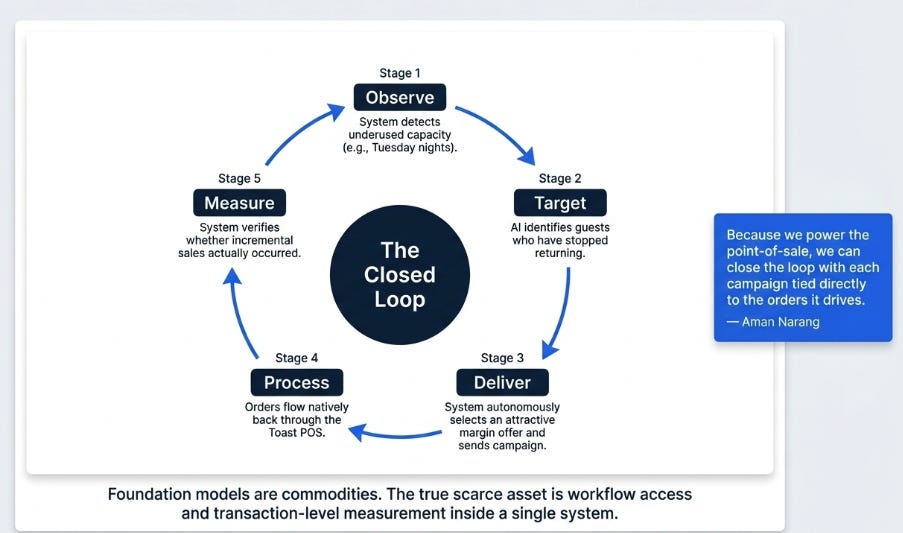
What matters is not that Toast built an AI marketing tool. What matters is that it can close the loop. A standalone vendor can produce a competent email. Toast can observe that Tuesday nights are underused, identify guests who stopped returning, select an offer with attractive margin, deliver the campaign, process the resulting orders, and verify whether incremental sales occurred. Narang put it directly:
“Because we power the point-of-sale, we can close the loop with each campaign tied directly to the orders it drives.”
The model is not the scarce asset, since foundation models are available to everyone. The harder combination is context, distribution, workflow access, and transaction-level measurement inside one system. This is why AI most likely increases the value of Toast’s existing position rather than creating a different company.
The prize is adjacent spending. Restaurants outsource marketing, payroll, bookkeeping, tax, and scheduling, and as Narang noted, they are often “spending a multiple of what they spend on software” on those functions. Toast’s total ARR works out to roughly $13,400 per location. It does not need to capture all of the surrounding budget for the economics to change; a modest share would materially raise revenue per location. How much is technologically addressable and economically capturable, this quarter did not answer.
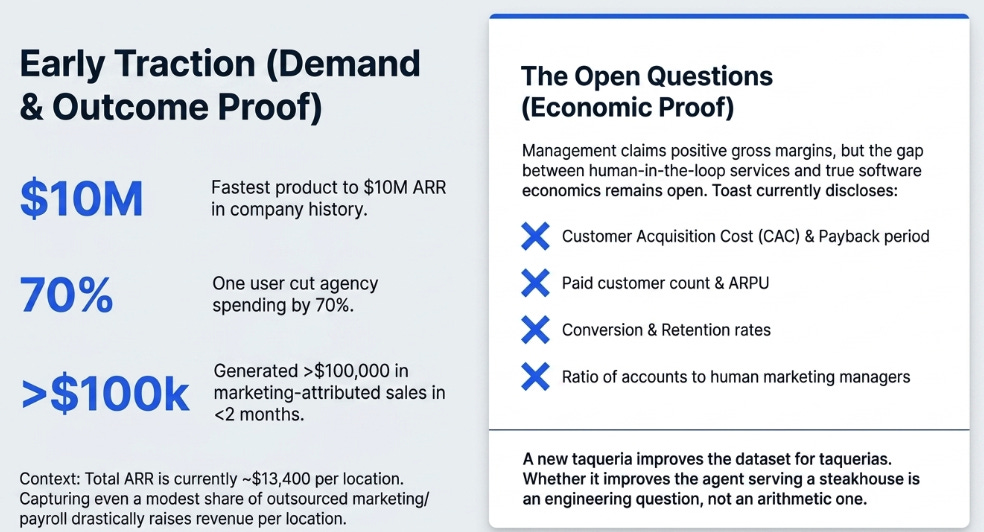
Which is the discipline required here. Three standards of proof apply. Demand proof asks whether restaurants will buy, and Grow’s trajectory suggests some will. Outcome proof asks whether the product creates measurable value, and the early figures suggest it can. Economic proof asks whether Toast can deliver at scalable margins, and that remains entirely open.
Bernstein’s Harshita Rawat pressed on exactly this, given the marketing success managers who review AI-generated work. Narang answered:
“As we’ve gotten some early scale, we’ve already seen the gross margins improve. Frankly, I have no concerns long term about what the gross margins of that business could be.”
Confident, possibly right, not a disclosed unit-economic model. Toast provided no paid customer count, no conversion rate, no ARPU, no retention, no current gross margin, and no ratio of accounts to marketing managers. A human-in-the-loop service can show improving margins at small scale and still settle far below software economics, and that gap is most of the upside case.
One further qualification to something we have argued before: more locations do not automatically make the agents smarter. They expand distribution and may enrich the benchmark set, but only if Toast can standardize patterns across restaurants that differ enormously in cuisine, format, and check size. A new taqueria improves the dataset for taquerias. Whether it improves the agent serving a steakhouse is an engineering question, not an arithmetic one.
The Same Disagreement, Third Quarter Running
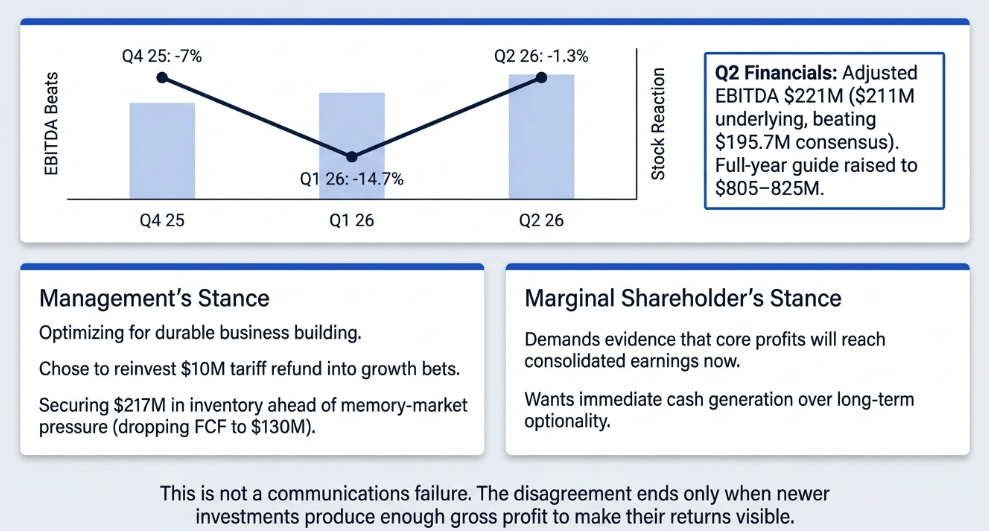
Toast beat on revenue, recurring gross profit, EBITDA, GPV, and location adds, and the stock fell 1.3%. Adjusted EBITDA of $221 million included roughly $10 million from a tariff refund, leaving underlying EBITDA near $211 million against consensus of $195.7 million. Full-year EBITDA guidance rose to $805–825 million, a $15 million midpoint raise against a $25 million beat. Gomez explained the gap without hedging:
“We strategically chose to reinvest the tariff refund into key growth initiatives and to seed long-term bets. As a result, we’re increasing our full-year adjusted EBITDA guidance by less than the Q2 beat.”
Close to close, Q4 2025 took the stock down about 7%, Q1 2026 down 14.7%, and this quarter down 1.3%. Three consecutive quarters of strong results, guidance withheld, negative reaction. This is not a communications failure that better investor relations can repair. Management is optimizing for the number of durable businesses it can build; the marginal shareholder wants evidence core profits will reach consolidated earnings. The disagreement ends only when the newer investments produce enough gross profit to make their returns visible.
Q2 moved that forward without settling it. New market ARR is near $200 million and doubling, retail SaaS ARPU is approaching core levels within two years of launch, and Grow has revenue attached rather than usage statistics. Against that, free cash flow fell to $130 million from $208 million as inventories rose to $217 million from $114 million at year-end, with Toast securing components ahead of memory-market pressure. That may be the right trade, but the cash has left the building and the explanation now carries a deadline.
A note on something we over-weighted. Last quarter Toast Local had its own section as the answer to DoorDash’s point-of-sale ambitions. This quarter it appeared once, briefly, at the end of the final answer. The demand-side thesis is not dead, but the evidence is much weaker than on the merchant side and we should weight it accordingly. DoorDash remains the real counterpoint: Toast knows the restaurant better, aggregators own more consumer intent. Toast needs enough connection to the guest to avoid becoming a back-office utility while someone else controls demand.
Three Outcomes for the Same Company
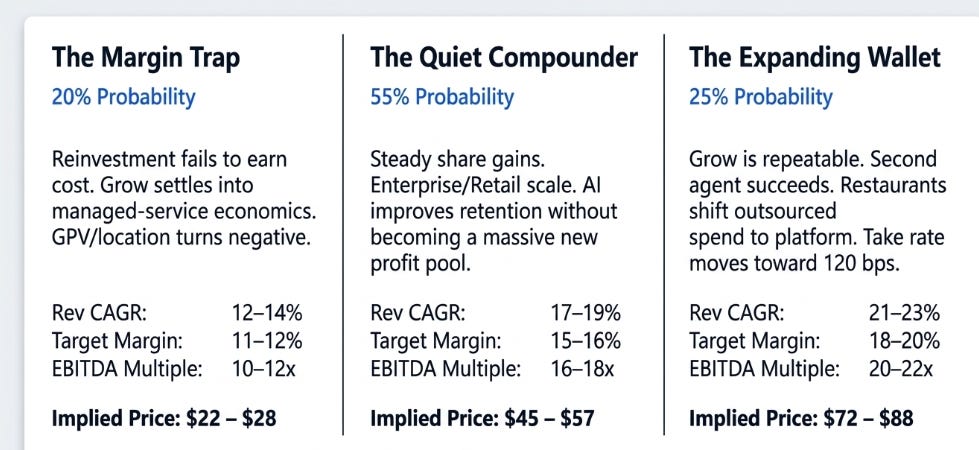
None of these requires Toast to become a different business. In each it remains a restaurant operating system, and the only question is how deeply it monetizes that position. From roughly $32, with about 580 million diluted shares and $1.7 billion of net cash, looking to FY2028.
The margin trap (20%). Restaurant activity weakens, GPV per location turns negative, Toast Capital losses rise, and Grow finds adoption but settles into managed-service economics. The core stays valuable while reinvestment fails to earn its cost. Revenue compounds at 12–14%, margins near 11–12%, and at 10–12 times EBITDA that supports roughly $22–28.
The quiet compounder (55%). Toast keeps taking share, attachment rises, enterprise and international scale steadily, retail becomes a credible adjacency, and AI improves support costs and retention without becoming a separate profit pool. Revenue compounds at 17–19%, margins reach 15–16%, and at 16–18 times EBITDA that supports roughly $45–57.
The expanding wallet (25%). Grow proves repeatable, a second agent succeeds, human review per account falls, and restaurants shift part of their outsourced spending onto the platform. Total monetization moves from 98 basis points toward 120. Revenue compounds at 21–23%, margins reach 18–20%, and at 20–22 times EBITDA that supports roughly $72–88.
The base case has sat in the $45–57 range across three articles while the stock traded $37, then $26, then $24, and now $32. The destination has not moved. What changed is that the upside now has a mechanism attached rather than an aspiration.
What Would Change Our Mind
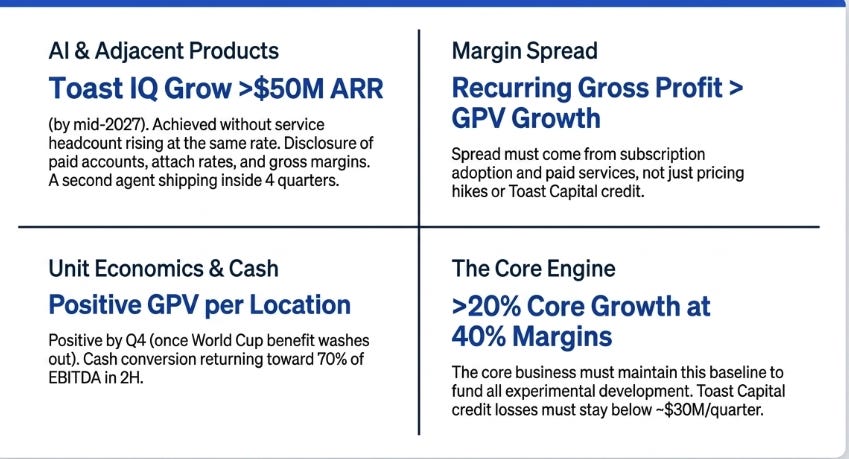
Grow above roughly $50 million in ARR by mid-2027, without service headcount rising at the same rate. A second agent shipping inside four quarters. Disclosure of paid accounts, attach rate, or gross margin, usage anecdotes have stopped being sufficient.
Recurring gross profit growth staying several points above GPV growth, with the spread coming from subscription adoption and paid services rather than pricing or credit.
GPV per location positive by the fourth quarter, once the World Cup benefit washes out. Cash conversion back toward 70% of EBITDA in the second half. Toast Capital credit losses below roughly $30 million a quarter.
And the core holding above 20% growth at 40% margins, because that is what funds everything else.
Our view has not changed. Toast is a vertically integrated restaurant operating system with payments as the monetization rail, and workflow ownership is what drives distribution, attachment, retention, and data context. Enterprise, international, retail, Toast Local, and agentic products are extensions of that architecture, not quarterly reinventions of the company. Q2 strengthened the core thesis and produced the first measurable evidence that the same position can be used to perform work restaurants currently outsource, which is not a new definition of Toast, but a larger answer to the question we have been asking from the start: how much can be built on top of a workflow Toast already owns?
The register was the wedge, and the operating system is the moat. The opportunity now is making that operating system worth more to every restaurant that joins it.
Disclaimer:
The content does not constitute any kind of investment or financial advice. Kindly reach out to your advisor for any investment-related advice. Please refer to the tab “Legal | Disclaimer” to read the complete disclaimer.