


TL; DR
The first proven AI economics are internal: subscription gross margin expanded 320 basis points, with management explicitly citing AI-driven support automation as a contributor. The invisible manager is already working; its first customer is Toast itself.
The bigger opportunity is customer profit, not another software module: Toast wants agents to coordinate marketing, staffing, inventory and margin management around a restaurant’s contribution profit. If that works, the payoff should show up in retention, payment volume, product adoption and possibly lower restaurant failure not just standalone AI subscription revenue.
But value capture must be earned, not imposed: the FTC case puts contractual switching friction under scrutiny just as Toast asks investors to tolerate slower margin expansion and more reinvestment. The next phase only deserves a premium if restaurants stay because Toast makes them better businesses, not because leaving is difficult.
Toast and Block reported on the same evening and offered investors different futures. Block projected roughly 30% adjusted operating-income growth in 2027. Toast’s incoming CFO, Michael Senno, promised only “very modest margin progression.” Block shares climbed about 15% the following day; Toast rose 5.5%. The businesses and earnings measures are not comparable, but the contrast is instructive: one proposed harvesting more profit, the other reserving the right to spend it.
Toast earned that choice. Third-quarter recurring gross profit rose 27% to $642 million, above management’s $615–625 million guidance, while adjusted EBITDA reached $240 million, beating expectations near $220 million. Full-year EBITDA guidance increased to $840–850 million. In August, we argued that restaurants were starting to pay for the operating system rather than merely the payment terminal. Q3 reveals a more interesting distinction. The invisible manager is already producing results, but its first customer was Toast itself.
The Extraordinary Becomes Ordinary
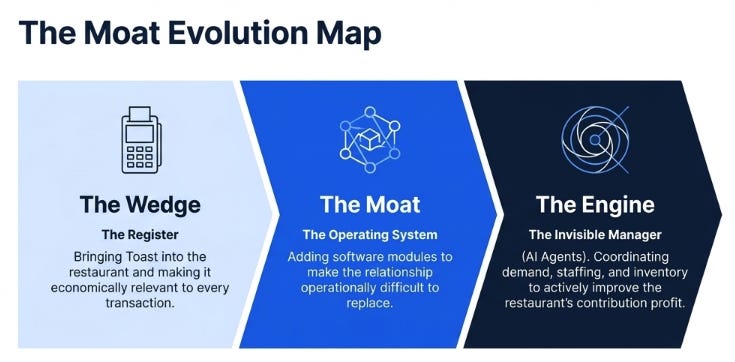
The underlying thesis has not changed. The register brings Toast into the restaurant, payments make it economically relevant to every transaction, and software makes the relationship more difficult to replace. What has changed is the pace at which those mechanisms create incremental profit.
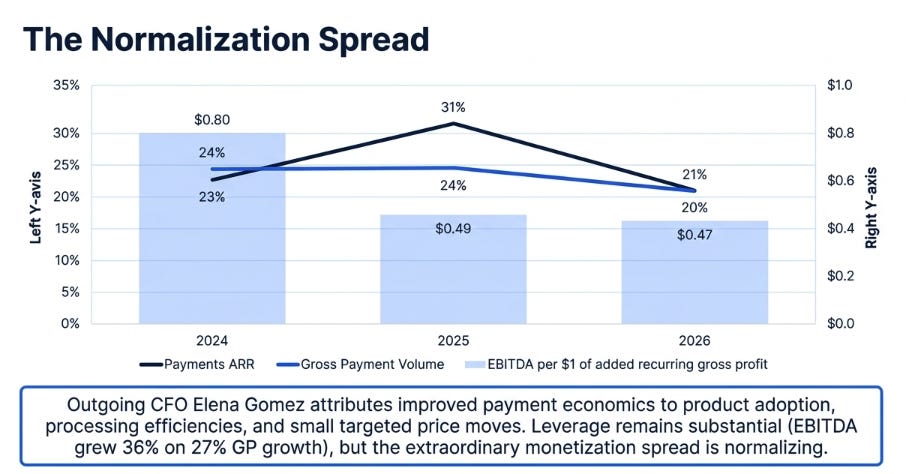
Payments ARR outgrew payment volume by seven percentage points in 2025, but only one point this year. Departing CFO Elena Gomez attributed improved payment economics to product adoption, processing efficiencies and “small targeted price moves,” qualifying our August claim that the benefit required no higher pricing. The extraordinary monetization spread is normalizing. So is the 80 cents of incremental EBITDA per dollar of gross profit produced during the earlier restructuring period. At 47 cents, leverage remains substantial: EBITDA grew 36% while recurring gross profit grew 27%.
We also need to correct two August judgments. We described three consecutive earnings beats followed by falling shares, but only the first-quarter 2026 report fits that description. And we characterized 2026 as a margin-sacrifice year; adjusted EBITDA will instead reach roughly 35.5% of recurring gross profit, about two points above 2025. Toast has been investing and expanding margins simultaneously. The question is whether its next investment cycle can deliver returns comparable to the gains already captured.
The Invisible Manager’s First Job
Gomez gave the clearest evidence of what AI has accomplished:
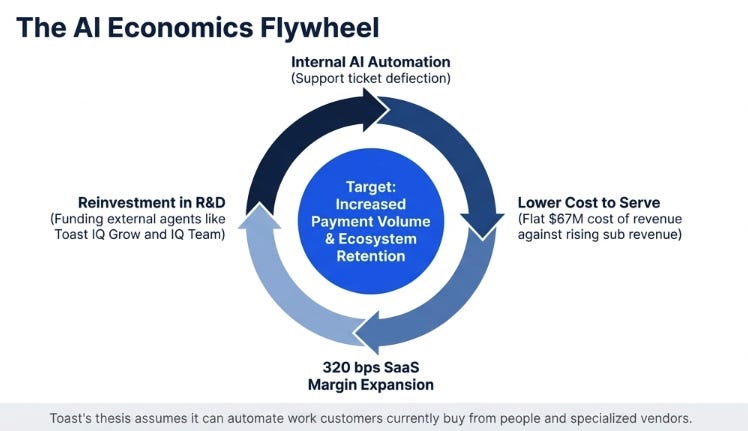
Subscription gross profit grew 36% and SaaS gross margin increased 320 basis points from a year ago. AI tools are handling a growing portion of support tickets, providing a better customer experience and are an important contributor to that margin expansion.
Subscription revenue climbed from $244 million to $317 million, while its reported cost of revenue stayed at $67 million. Not all the improvement belongs to AI, but management explicitly identifies automation as a contributor. The first visible agent economics are therefore not additional fees paid by restaurants; they are lower costs incurred by Toast to serve them. That matters because Toast’s thesis increasingly assumes it can automate work that customers currently buy from people and specialized software vendors.
CEO Aman Narang described the ambition:
We’re building towards a team of agents that drive results for our customers, crafting marketing campaigns, forecasting demand with staffing to match, flagging low inventory before an out of stock, and protecting margin from swings in costs... Restaurants already pay for marketing, scheduling and payroll, and bookkeeping services, often several times what they spend on software.
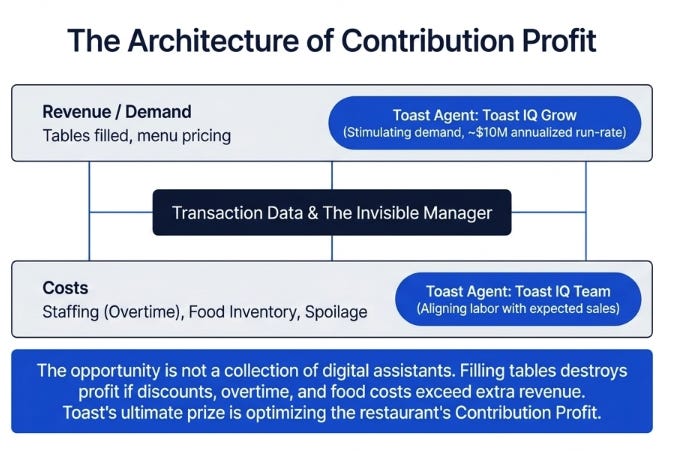
The opportunity is not a collection of digital assistants. A marketing campaign can fill tables while destroying profit if discounts, overtime and food costs exceed the extra revenue. Cutting labor can improve today’s margin while worsening service and future demand. Restaurants need to optimize contribution profit, not individual tasks. Toast IQ Grow can stimulate demand; IQ Team, launched this quarter, can align staffing with expected sales; and Toast’s transaction data can reveal what actually happened. Inventory and supplier information could eventually close the loop between demand and cost.
That is an attractive architecture, not yet a demonstrated profit engine. Grow is on course for roughly $10 million of annualized revenue, less than half a percent of Toast’s $2.5 billion ARR. Even $50 million at a hypothetical 40% margin and 16 times EBITDA would be worth only $320 million to a company valued near $19 billion. The prize lies in better retention, higher payment volume, additional product adoption and perhaps fewer restaurant failures. Narang says Toast customers process more volume and are less likely to close than average restaurants, but stronger operators may simply be more likely to adopt Toast.
The evidence needs similar care elsewhere. Management’s 41% reduction in overtime hours concerns users of established Scheduling Pro, not a controlled incremental benefit of IQ Team. The nearly 50 million Online Ordering accounts are not 50 million active Toast Local users. None of this invalidates the opportunity; it establishes how much of the customer-outcome thesis remains to be proved.
When the Moat Is Put on Trial
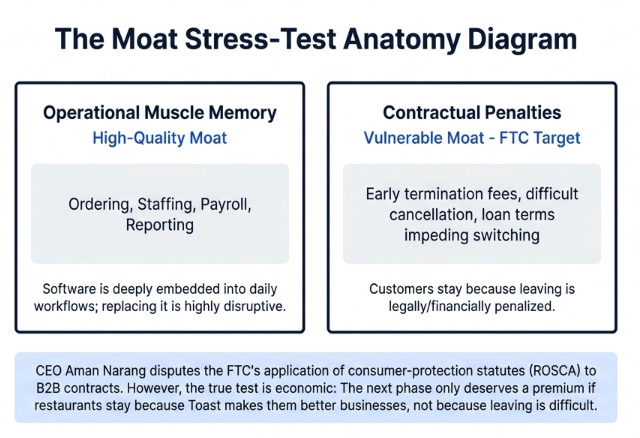
The October 29 lawsuit from the FTC and state and local authorities introduces an uncomfortable test. The complaint alleges hidden or unauthorized fees, unwanted add-ons, weak support, difficult cancellation, early termination penalties and loan terms that may impede switching. Toast disputes the allegations. Narang told investors:
We’ve been engaged with them and cooperating with them really over the past year, and fundamentally, believe their application of ROSCA is unprecedented for custom contracts in B2B, which is what we negotiate for every single customer.
His defense raises a legitimate question about applying a consumer-protection statute to negotiated business contracts, but the suit matters beyond potential penalties. We have argued that Toast’s moat lies less in hardware than in operational muscle memory: once ordering, staffing, payroll and reporting depend on the platform, replacing it is disruptive. Contractual penalties are another kind of switching cost. If some apparent retention reflects cancellation friction rather than operational value, the quality of that moat is lower than we assumed. A remedy could also change the economics of selling new agents into the installed base.
The support allegation must not be treated as proof that AI-driven efficiencies compromised service; no such causal link has been established. Nonetheless, it creates a test of whether the 320-basis-point SaaS margin improvement is compatible with the customer experience Toast promises. The stronger Toast’s product-driven retention, the less its economics should depend on disputed contractual restrictions.
The Right to Reinvest
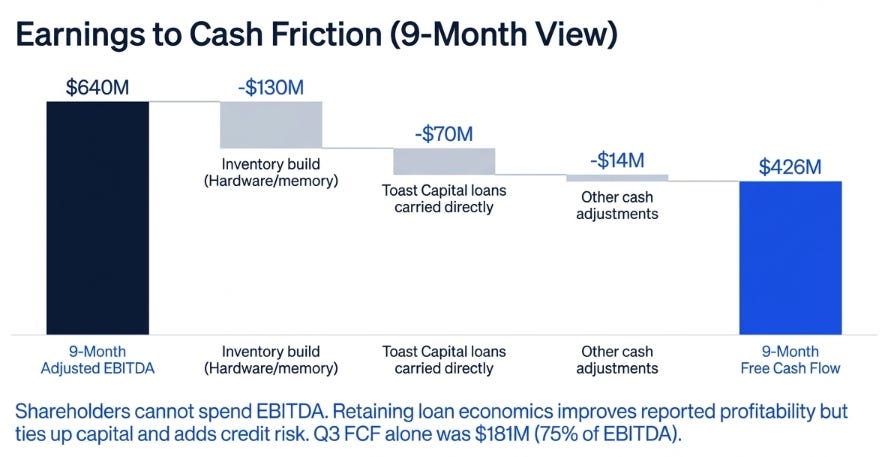
The larger financial tension is between earnings and cash. Third-quarter free cash flow was $181 million, 75% of EBITDA, but through September it was $426 million versus $430 million a year earlier, even as nine-month EBITDA climbed from $470 million to $640 million. Inventory built ahead of hardware and memory costs is a material reason: it reached $244 million, up from $114 million at year-end. That cash may return when stocking normalizes, but shareholders cannot spend EBITDA.
Toast Capital creates a second distinction. Credit-related costs reached $35 million, above our earlier $30 million comfort line, while Toast now carries approximately $70 million of loans directly. Retaining loan economics can improve reported profitability while tying up capital and adding credit risk. Horizon 2, enterprise, international and retail, offers more encouraging evidence of reuse: management expects about $200 million of ARR with 25% less direct R&D than the core required at that scale. That proves some engineering leverage, not lower total selling, onboarding or servicing costs.
Senno framed the coming trade-off explicitly:
And the pace of margin expansion over the past couple of years has actually been faster than we had anticipated. We’re sitting on what we believe is a generational opportunity... And as a result, we expect very modest margin progression next year.
This is a defensible choice if Toast can translate its existing transaction, staffing and customer data into outcomes independent point solutions cannot reproduce. Core margins already exceed 40%; management is choosing to direct incremental capacity toward new markets and agents. But August’s warning remains appropriate: “Investment is not the conclusion. Return on investment is.” The departure of Gomez and the planned retirement of the chief revenue officer add execution risk just as the company asks investors to tolerate slower near-term margin expansion.
Better Business, Fuller Price
The valuation should not capitalize pass-through payment revenue or treat adjusted EBITDA as cash available to shareholders. I would retain August’s three economic outcomes but value FY2030 owner earnings, free cash flow after cash taxes, less stock compensation, at end-2029. Starting from roughly $2.38 billion in FY2026 recurring gross profit, the model allows tax losses to run down, loan funding to consume cash, and buybacks principally to offset dilution.
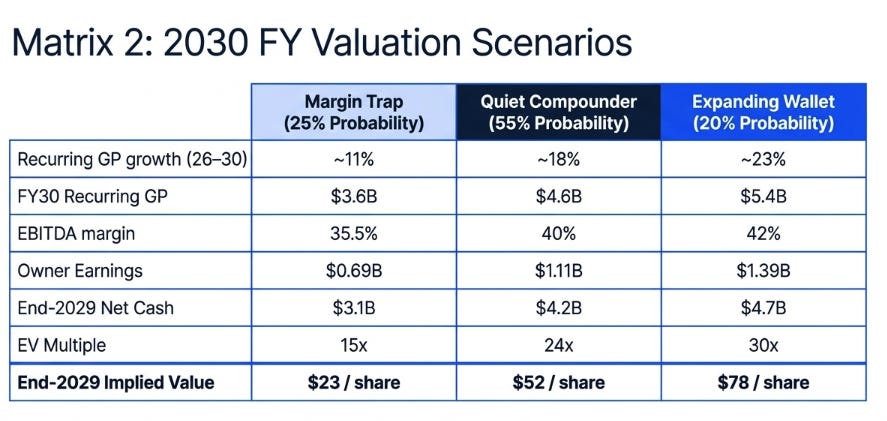
These are our scenarios, not management guidance. With approximately 590–595 million diluted shares and net cash added only once, the probabilities imply about $50 per share, roughly 41% above the November 4 price of $35.37, or around 12% annualized to end-2029. That is less compelling than August’s $53 weighted value from a $32 stock price. The company has strengthened, but the stock is fuller.
The margin trap assumes slowing location additions, weaker monetization and regulatory or credit friction. The quiet compounder depends on roughly 34,000–37,000 annual net additions, improving profit per location and disciplined reinvestment. The expanding-wallet case requires agents to improve merchant economics sufficiently to increase retention and share of wallet, not merely sell another subscription. The base valuation also assumes that Toast can sustain a premium for future owner earnings; attractive growth alone does not justify any multiple.
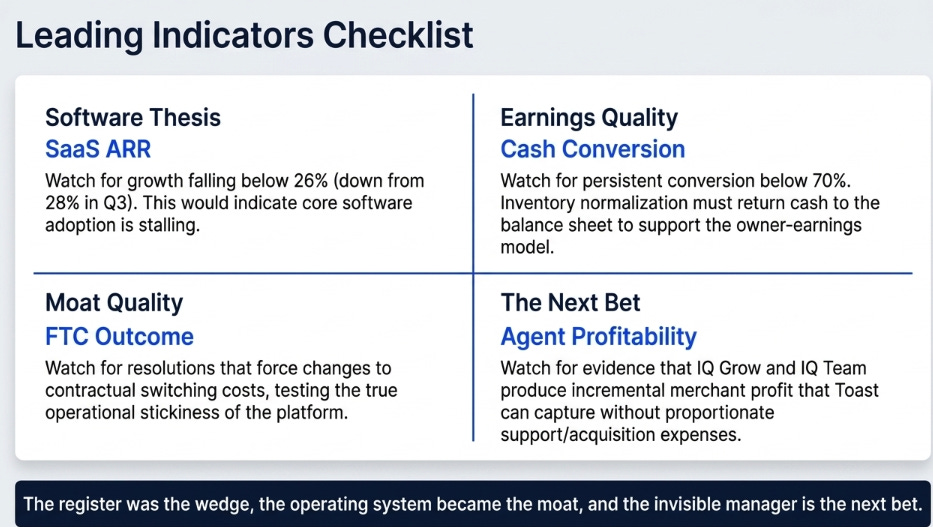
The next evidence should be concrete. SaaS ARR growth below 26%, after 28% in Q3, would weaken the software thesis. Cash conversion should recover as inventory normalizes; persistent conversion below 70% would force a lower owner-earnings estimate. The FTC outcome will test contractual versus operational switching costs. Most important, management needs to show whether Grow and Team produce incremental merchant profit and whether Toast can capture part of it without proportionate support and acquisition expense.
The register was the wedge, the operating system became the moat, and the invisible manager is the next bet. Q3 demonstrated that AI already helps Toast run itself more efficiently. The next and far larger opportunity is to make restaurants better businesses because they run on Toast, and to retain a meaningful share of that improvement on terms restaurants freely choose.
Disclaimer:
The content does not constitute any kind of investment or financial advice. Kindly reach out to your advisor for any investment-related advice. Please refer to the tab “Legal | Disclaimer” to read the complete disclaimer.