


TL; DR
TSMC is becoming more valuable per unit of physical output. Equivalent 12-inch wafer shipments rose 9.6% year over year, while dollar revenue rose 41.2%. The gap reflects newer nodes, richer mix and growing value around the wafer through advanced packaging and integration. Pasted markdown
The moat may be shifting from owning every component to owning the handoffs. TSMC is willing to buy interposers from GlobalFoundries while retaining customer responsibility, qualification and system integration. The scarce asset is increasingly the accumulated knowledge required to make complex AI packages yield reliably at scale. Pasted markdown
The market already understands the next two years; our variant view is duration. Consensus expects very strong 2027–28 growth. The harder question is whether TSMC’s integration advantage keeps margins and cash returns elevated after today’s shortages ease and the current fab buildout arrives.
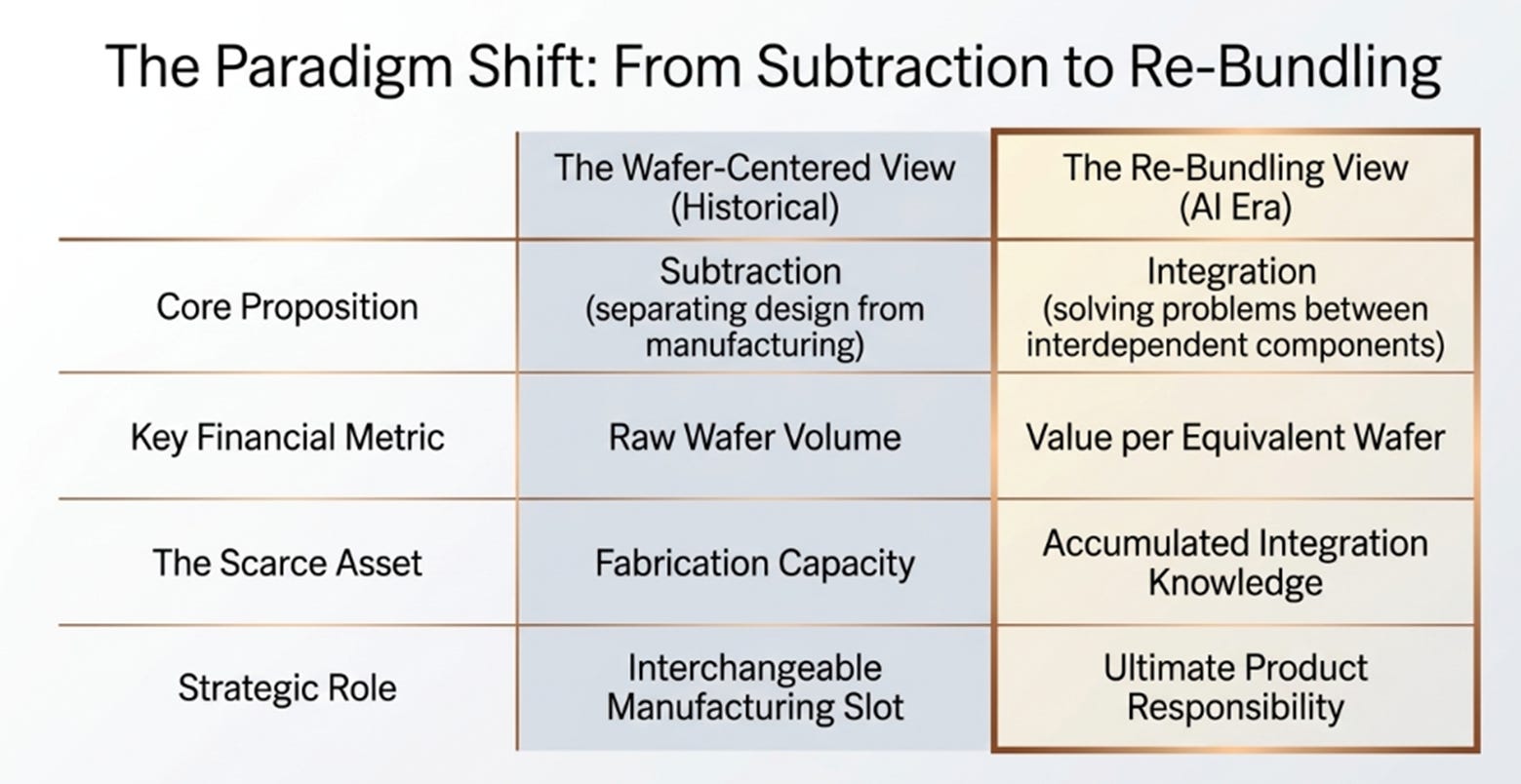
For most of its history, TSMC’s proposition was subtraction. A semiconductor company did not need to own a fabrication plant; it could concentrate on designing chips and let TSMC manufacture them. That separation created the foundry industry and, eventually, the most important manufacturer in the world.
AI is now pushing in the other direction. The processor, memory, interposer, substrate, power delivery and cooling system have become too interdependent to optimise as separate products. Our July article, The Re-Bundling of Silicon, argued that the package was becoming the product and that the advantage would accrue to the companies capable of solving the problems between components.
That is why the most revealing exchange on TSMC’s third-quarter call concerned a purchase from another foundry. GlobalFoundries will supply silicon interposers for TSMC’s advanced packages because TSMC does not have enough back-end capacity. The world’s leading foundry is outsourcing part of the work required to ship its customers’ most valuable products.
Under a wafer-centred view of TSMC, this looks like a small concession to a competitor. Under the re-bundling view, it reveals something larger: TSMC can distribute physical production while retaining responsibility for making the complete product work. The Big Fundamental Question is whether that responsibility produces knowledge and earnings that compound faster than the capital required to sustain them.
I think this quarter moves the answer in TSMC’s favour. Revenue is separating from physical wafer volume, customers are bringing more of their systems into TSMC’s manufacturing process, and TSMC is willing to recruit another foundry to keep those systems moving. The enduring advantage will depend on where the learning accumulates after the shortage ends.
The Value Beyond the Wafer
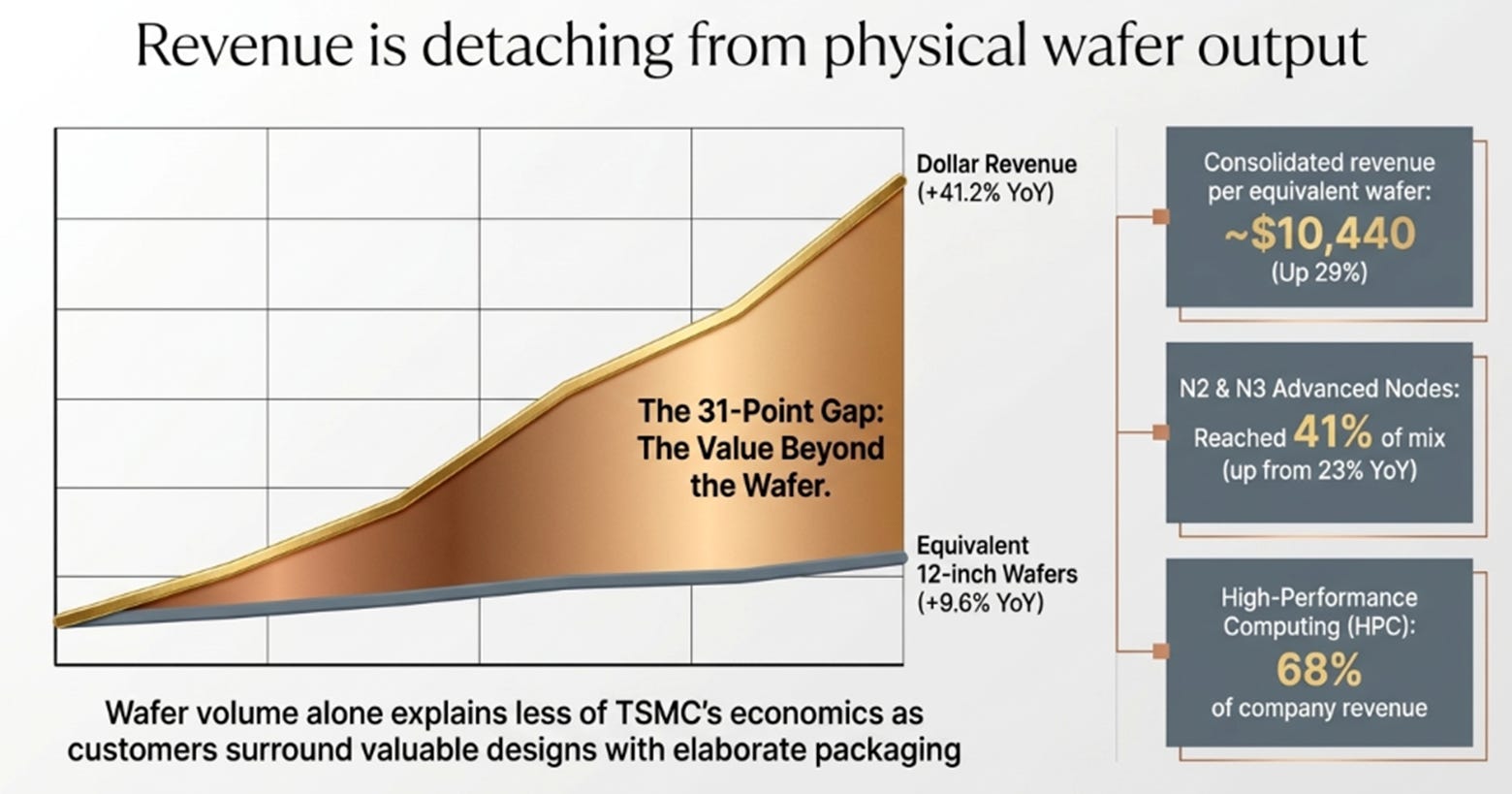
TSMC shipped 9.6% more equivalent 12-inch wafers than it did a year ago and generated 41.2% more-dollar revenue. Dividing one by the other suggests consolidated revenue of roughly US$10,440 per equivalent wafer, an increase of 29%. The 31-point gap between volume growth and revenue growth is the most important financial fact in the quarter.
This ratio is not an average wafer price. TSMC’s revenue includes packaging and other work that the wafer count does not, while process mix, pricing and foreign exchange also affect the comparison. That imperfection is part of the insight: wafer volume alone explains less of TSMC’s economics as more value gathers around the wafer.
The reported mix points in the same direction. N2 rose from 3% of wafer revenue in the second quarter to 8% in the third, while N2 and N3 together reached 41%, compared with 23% a year earlier. High-performance computing accounted for 68% of company revenue. More customers are moving more valuable designs onto TSMC’s newest processes, then surrounding those designs with increasingly elaborate packages.
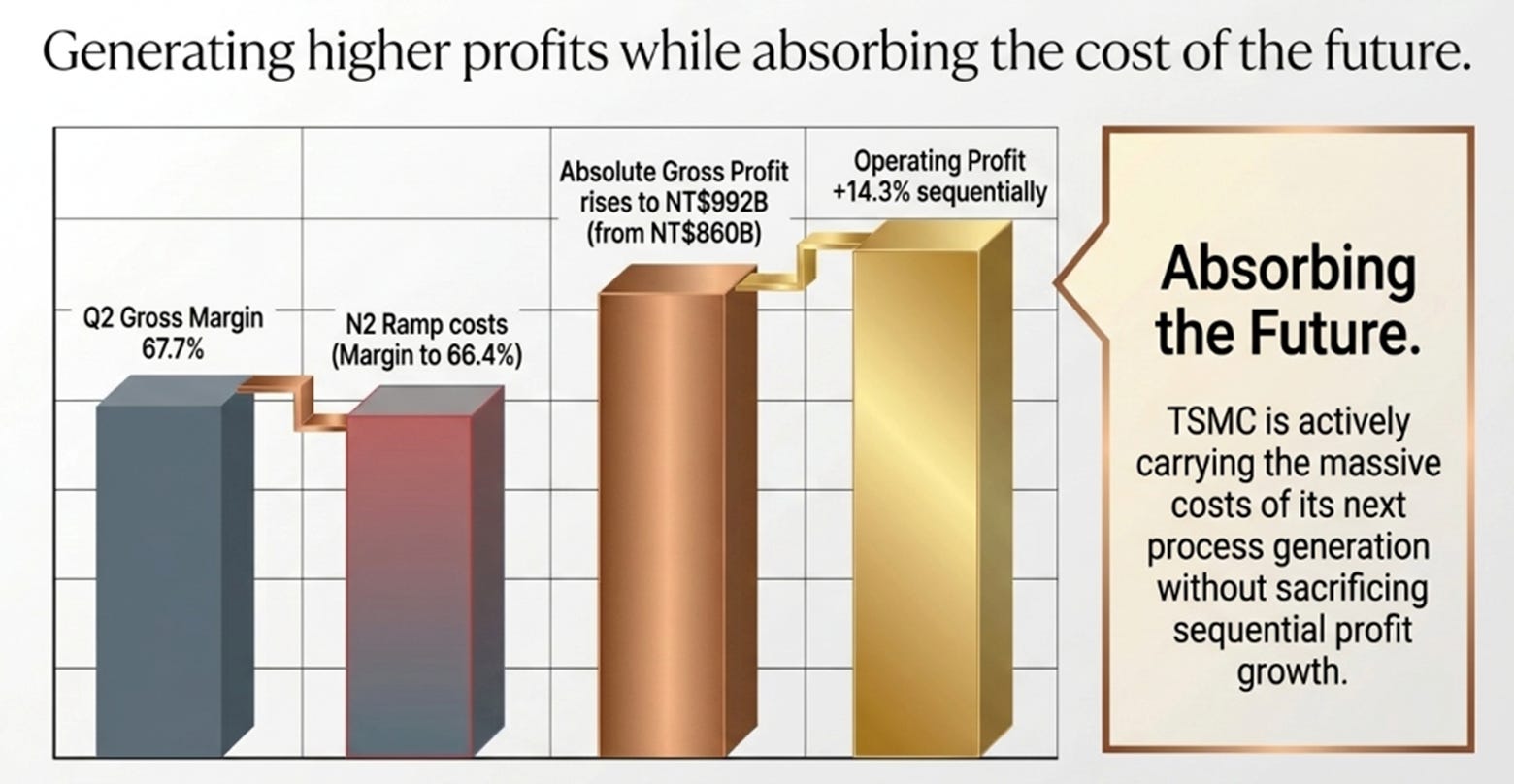
The income statement shows the effect without requiring another quarter of margin expansion. Gross margin declined from 67.7% to 66.4% as N2 ramped, yet gross profit rose from NT$860 billion to NT$992 billion and operating profit increased 14.3% sequentially. The business produced more profit while absorbing the cost of its next process generation. Fourth-quarter guidance implies another 14% sequential revenue increase at the midpoint, after third-quarter revenue exceeded the previous guidance midpoint by 3.4%.
This is the financial continuation of our July view. The Cost of Building the AI Age argued that TSMC no longer faced a self-imposed scarcity problem; it faced a construction schedule. It also described the mechanism that could make the expansion durable:
Customers retain attractive economics, so they concentrate their best designs and capacity commitments at TSMC. Those commitments finance the next node and fab. Scale and manufacturing learning sustain the technology lead, which reinforces the next round of customer commitment.
The quarter adds an important refinement. Scale is increasing the value attached to each unit of output, while manufacturing learning is extending beyond the transistor and into the connections among chips. TSMC’s opportunity after scarcity rests on keeping that wider responsibility when the new capacity arrives.
Owning the Handoffs
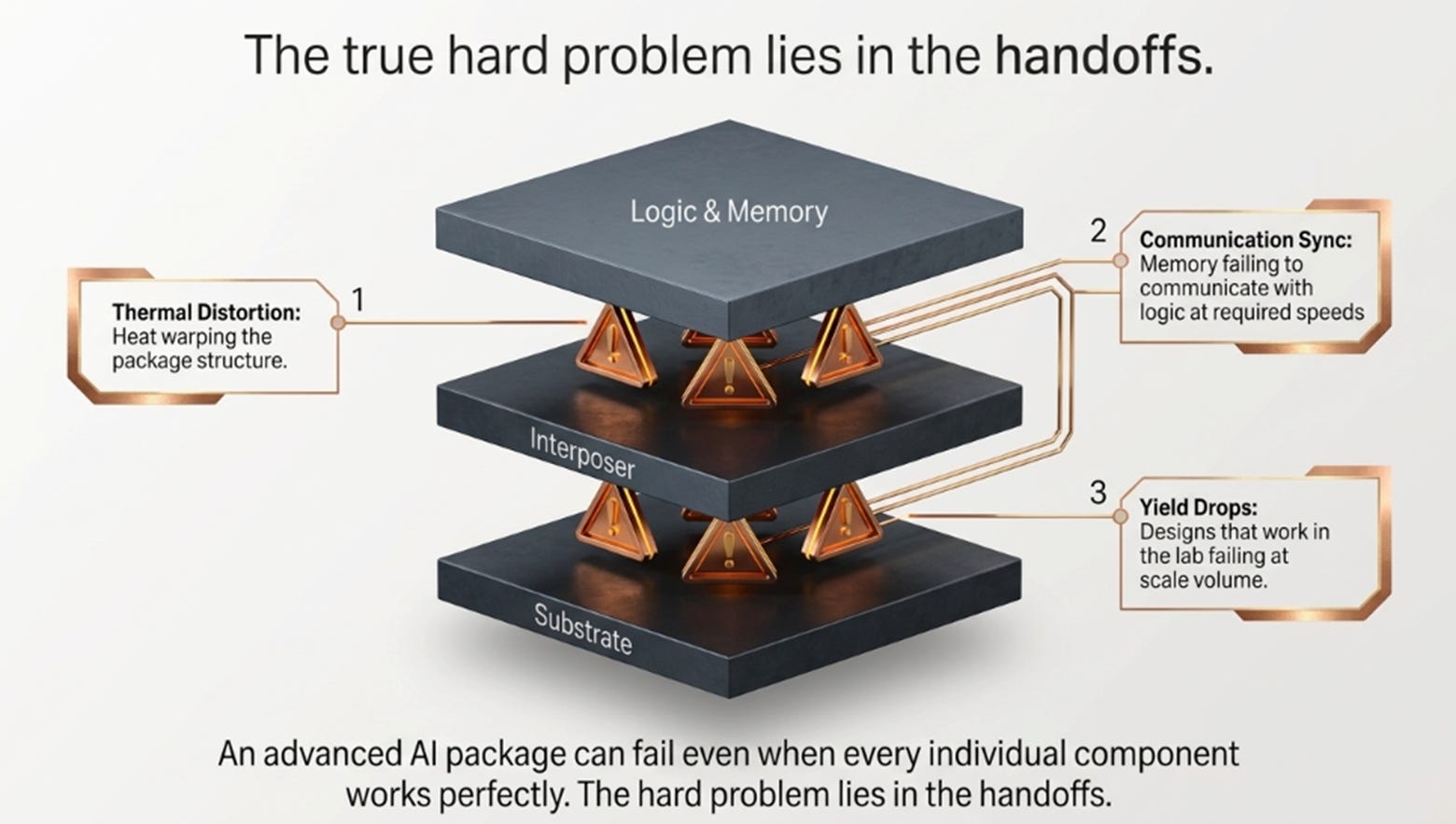
An advanced AI package can fail even when every individual component works. Heat can distort the package, connections can become unreliable, memory may not communicate with logic at the required speed, and a design that works in a laboratory may yield too poorly in volume. The hard problem lies in the handoffs, because the behaviour of each part changes the requirements of the others.
TSMC encounters those failures across more leading-edge products than any other manufacturer. Its packaging work combines modelling, test structures, fabrication experience and coordination with memory, substrate and materials suppliers. Its 3Dblox approach gives design teams a shared way to describe physical and electrical connections and analyse power, timing and thermal constraints. A common description helps the participants coordinate; it does not reproduce the experience required to manufacture the result reliably.
This is how scale can strengthen the advantage. Each difficult product produces knowledge about materials, yield, thermal behaviour, mechanical stress and production methods. Some of that knowledge remains useful when the next customer brings a different accelerator or memory configuration. A larger set of harder problems creates more learning, the learning lowers the risk and time required for the next launch, and that reliability attracts the next set of designs.
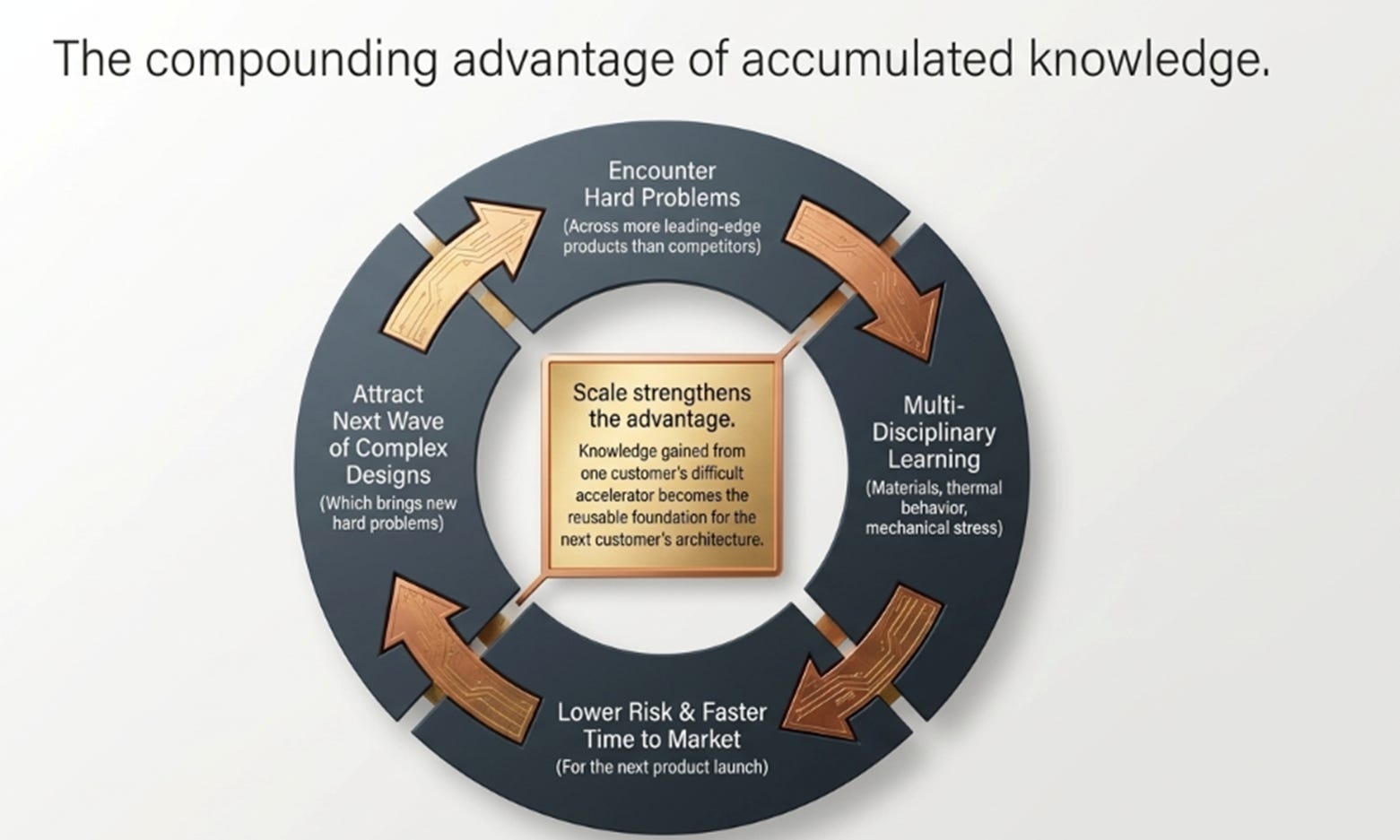
The loop does not require TSMC to own every component. GlobalFoundries can fabricate an interposer while TSMC retains the customer relationship, qualifies the package and coordinates front-end and back-end supply. C.C. Wei explained the priority on the call:
“Our number one priority is to help our customers to be successful in their market.”
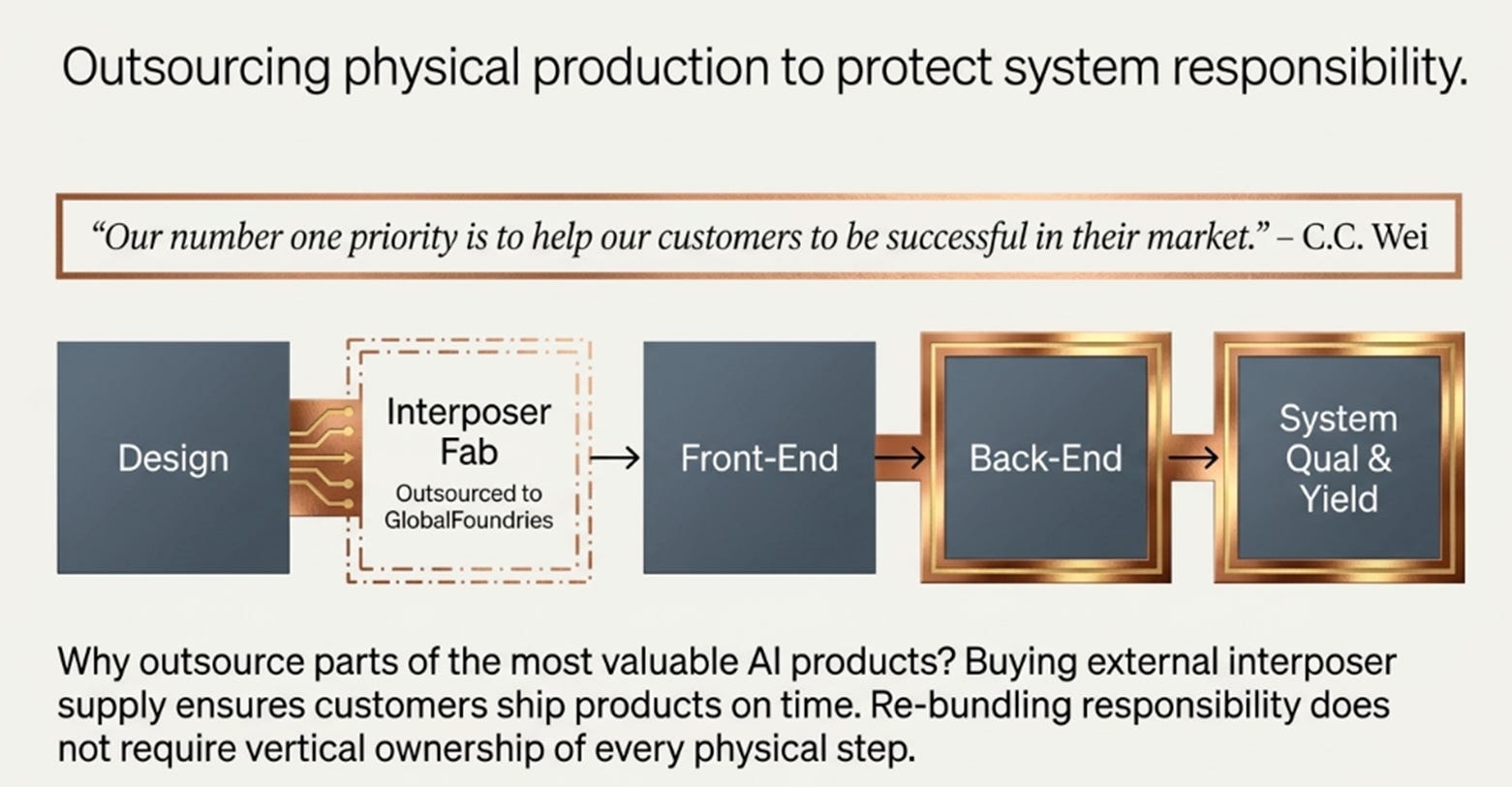
That sentence can sound like the usual language of partnership. Here it describes an operating choice. An unavailable interposer can prevent an expensive accelerator from becoming a saleable product, so buying external supply makes TSMC’s process and packaging capabilities more useful. The GlobalFoundries agreement advances the July thesis because re-bundling responsibility does not require vertical ownership.
A separate question about a secondary market for wafers revealed the same posture. TSMC does not allow customers to sublet or auction scarce capacity, although it permits limited collaboration through mask-licensing agreements. TSMC is preserving control over how production is allocated while allowing specific forms of cooperation that help products reach the market. Its role is becoming broader than selling an interchangeable manufacturing slot.
There is a clear limit to this interpretation. Nvidia can control the system architecture, and Intel, Samsung or an outsourced packaging company could become the trusted route from design to qualified production. Standards may eventually make today’s difficult handoffs routine. The thesis weakens if customers can move advanced integration work without sacrificing yield, time or reliability, because the reusable knowledge would then accumulate somewhere else.
That risk also clarifies what we are claiming. Our July prediction that TSMC may acquire or form a deep partnership with an interconnect-IP company remains unfulfilled; buying interposers is a supply agreement. The evidence this quarter is narrower and more concrete: TSMC will let another manufacturer into the physical chain when doing so reinforces its responsibility for the customer outcome.
The Price of Responsibility
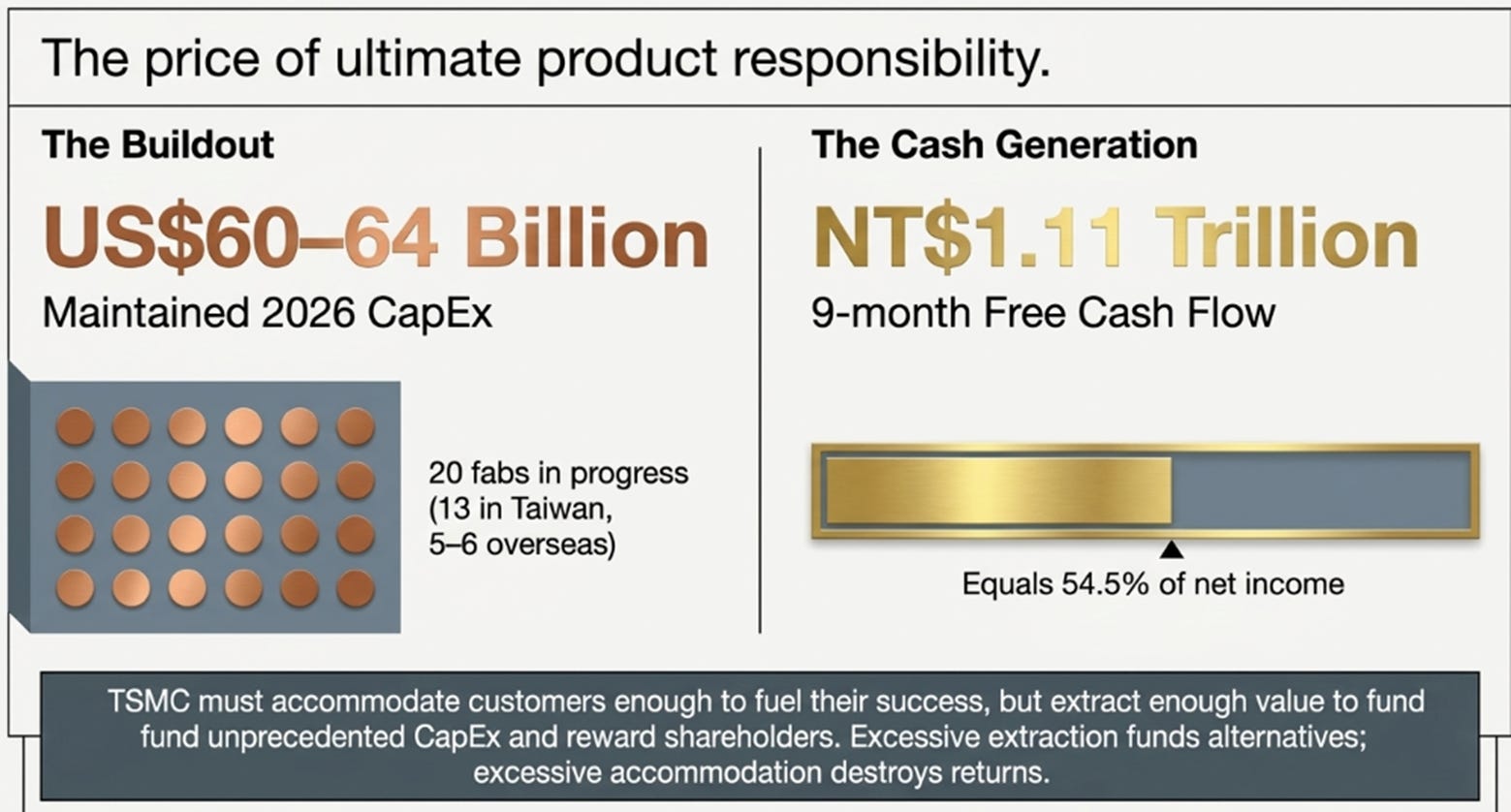
Management is selling confidence that customer road maps justify an unprecedented buildout. TSMC maintained 2026 capital expenditure of US$60–64 billion and said investment from 2026 through 2028 would be significantly higher than during the previous three years. It has nearly 20 fabs in progress, including 13 leading-edge or advanced-packaging fabs in Taiwan and another five to six overseas. The promise to shareholders is straightforward:
“The increase in revenue will outpace the increase in CapEx.”
Analysts largely accepted the demand story and tested the return story. Citi asked how TSMC accounts for power and supply-chain bottlenecks when deciding how much capacity to build. UBS pressed for 2027 and 2028 capital intensity and the effect of tool-price inflation. Stifel asked whether reported price increases applied to existing commitments or only incremental capacity, then asked why TSMC was procuring interposers from GlobalFoundries. The debate has moved from whether AI demand exists to how much of its value TSMC keeps and what it must spend to keep it.
Cash explains the scepticism. Nine-month free cash flow was approximately NT$1.11 trillion, equal to 54.5% of net income, even though third-quarter conversion improved sharply. TSMC also reported NT$198.7 billion of other investing inflows, mainly related to US investment tax credits. Those credits reduce the cost of overseas expansion, while the recurring returns still depend on utilisation, pricing and the earnings of the completed fabs.
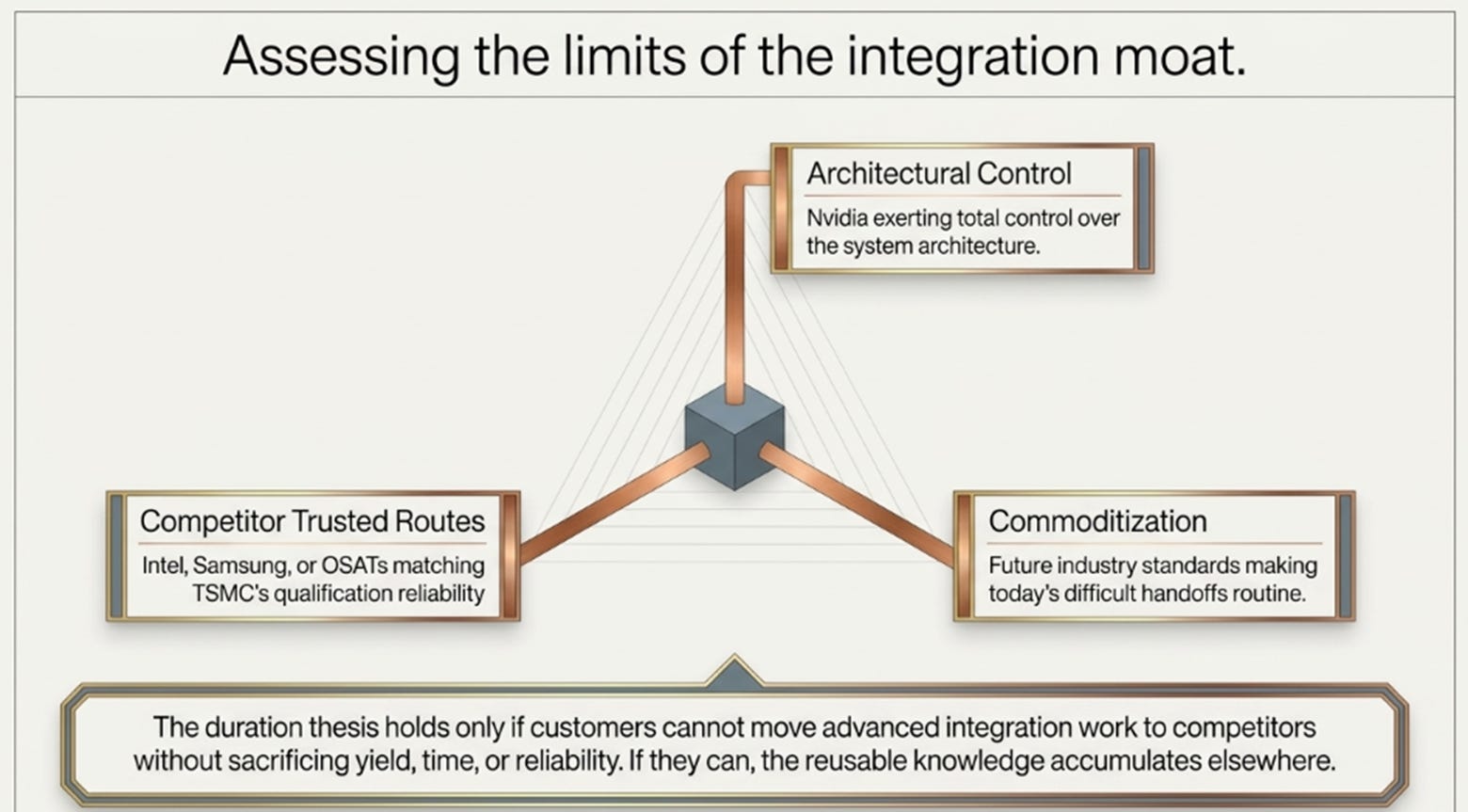
The partner doctrine matters here as much as the technical lead. TSMC wants customers to earn enough on their products to keep assigning it their next designs, while shareholders need TSMC to earn enough to finance the next generation and distribute more cash. Excessive extraction would encourage customers and governments to fund alternatives; excessive accommodation would leave TSMC carrying the cost of everyone else’s success. The strength of the business and the attractiveness of the shares meet at that boundary.
What the Market Has Already Found
The market has already discovered the next two years. FactSet’s October 16 consensus implies revenue growth of approximately 37% in 2027 and 27% in 2028, both above our base-case assumptions. We should retire July’s suggestion that investors simply underestimate the expanding earnings base. Our variant perception concerns duration: AI may have increased the value of what TSMC does after today’s shortages ease because customers are buying a reliable manufacturing outcome, rather than capacity alone.
The price leaves room for that interpretation to matter. FactSet’s median FY2027 EPS estimate rose from NT$137.13 on July 17 to NT$146.92 on October 16. Against the ordinary-share reference prices used in our two updates, NT$2,470 and NT$2,440, the multiple declined from 18.0 to 16.6 times. Investors accepted higher near-term earnings without paying more for their duration.
Our scenarios run to October 2029 and value the shares on FY2030 earnings. They begin with estimated 2026 revenue of NT$5.594 trillion, combining reported sales with the midpoint of fourth-quarter guidance at management’s NT$30.6 exchange-rate assumption. All three hold the share count at 25.932 billion and assume net non-operating income equal to 1% of revenue.
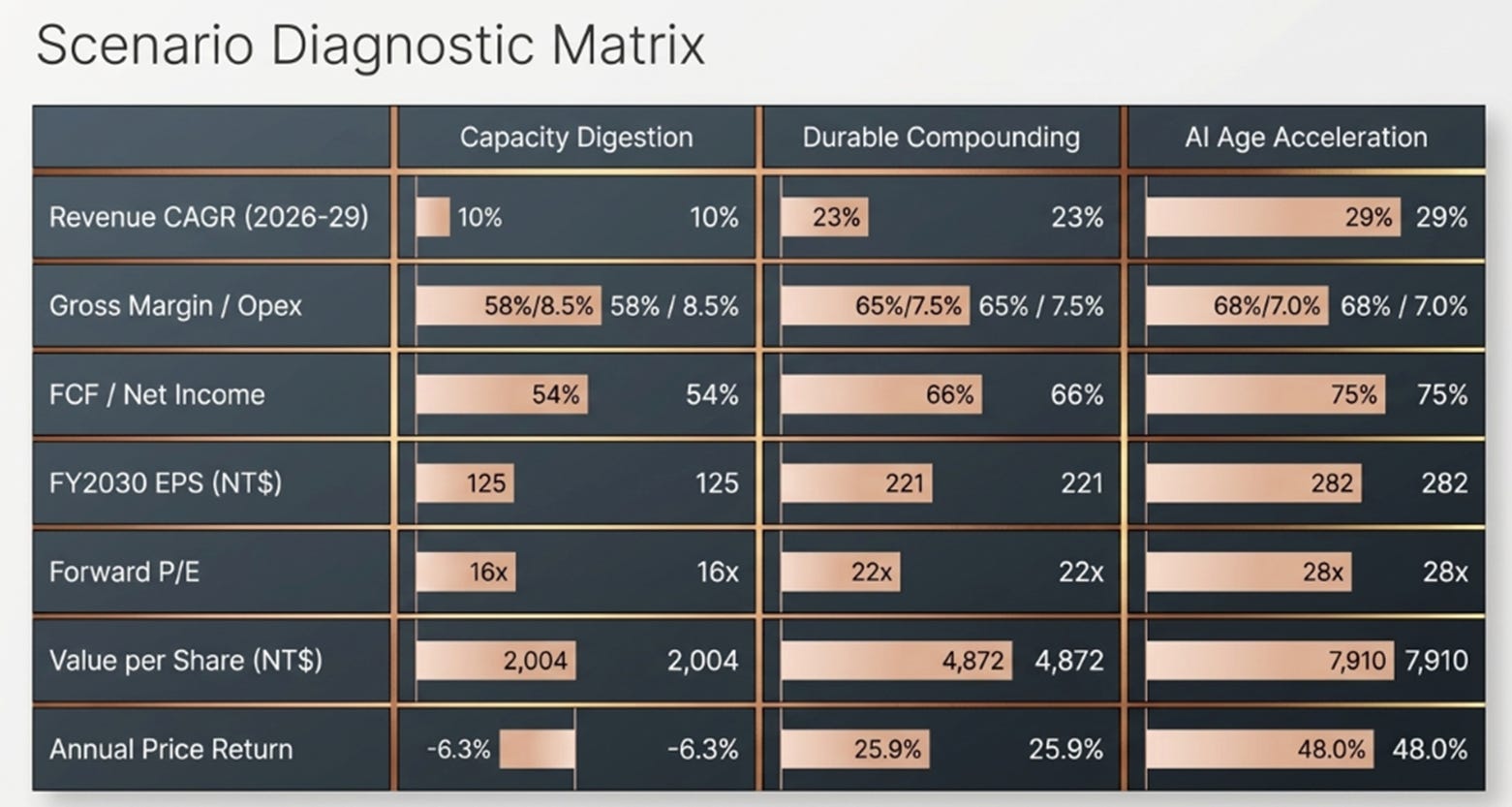
Our estimates; price returns exclude dividends. Cash conversion is the FY2030 run rate and assumes depreciation of 15% of revenue, working-capital investment of 1.5% and no other cash adjustments. ADR returns also depend on exchange rates and the ADR premium.
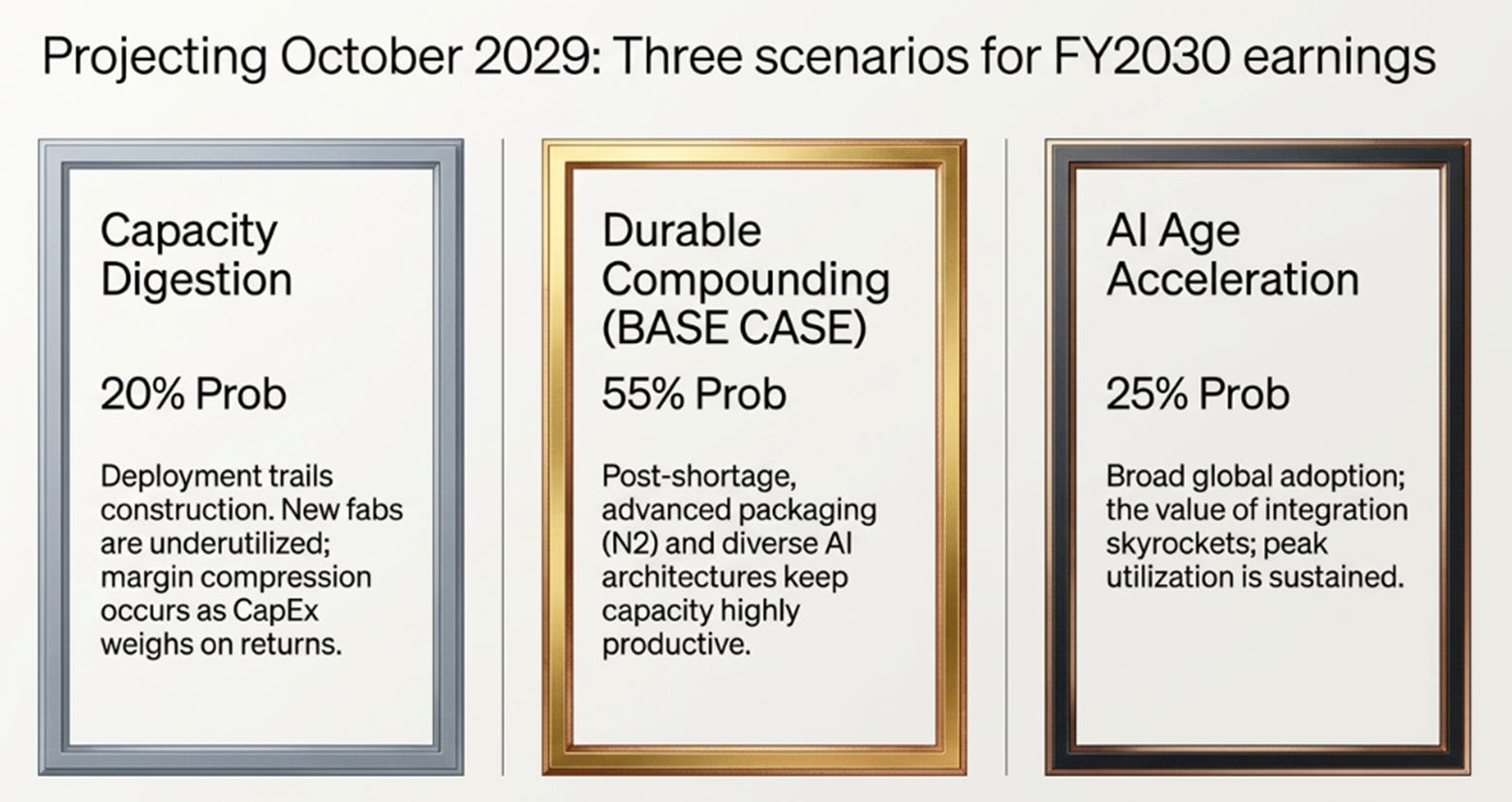
Capacity Digestion assumes deployment falls behind construction, leaving new fabs underused before capital spending moderates to 32% of revenue. Durable Compounding assumes N2, advanced packaging and a wider set of AI architectures keep capacity productive as the shortage fades. AI Age Acceleration requires broader adoption, strong utilisation and continued growth in the value of integration. We retain July’s 20%/55%/25% weights because this quarter improves the evidence on execution while leaving post-buildout cash returns unresolved.
July’s bear and base valuations survive this reconstruction; its bull case does not. At the original end-2028 horizon, using FY2029 earnings, the revised values are approximately NT$1,856, NT$4,236 and NT$6,592. At the 29% growth midpoint, using today’s revenue base and share count, the earlier bull EPS range of NT$255–295 required a 55–64% net margin. That was not credible. The new bull case uses a net margin near 51%, leaving us with a stronger operating thesis and a more disciplined valuation.
The base case also separates the earnings outcome from the re-rating. If our FY2030 earnings are valued at today’s market forward multiple of 16.6 times, the shares reach roughly NT$3,680, an annualised return near 15%. The move from there to NT$4,872 comes from a re-rating to 22 times. I find the ordinary shares attractive around the NT$2,440 reference price on the first outcome; the re-rating requires evidence that the learning advantage survives the buildout and produces cash.
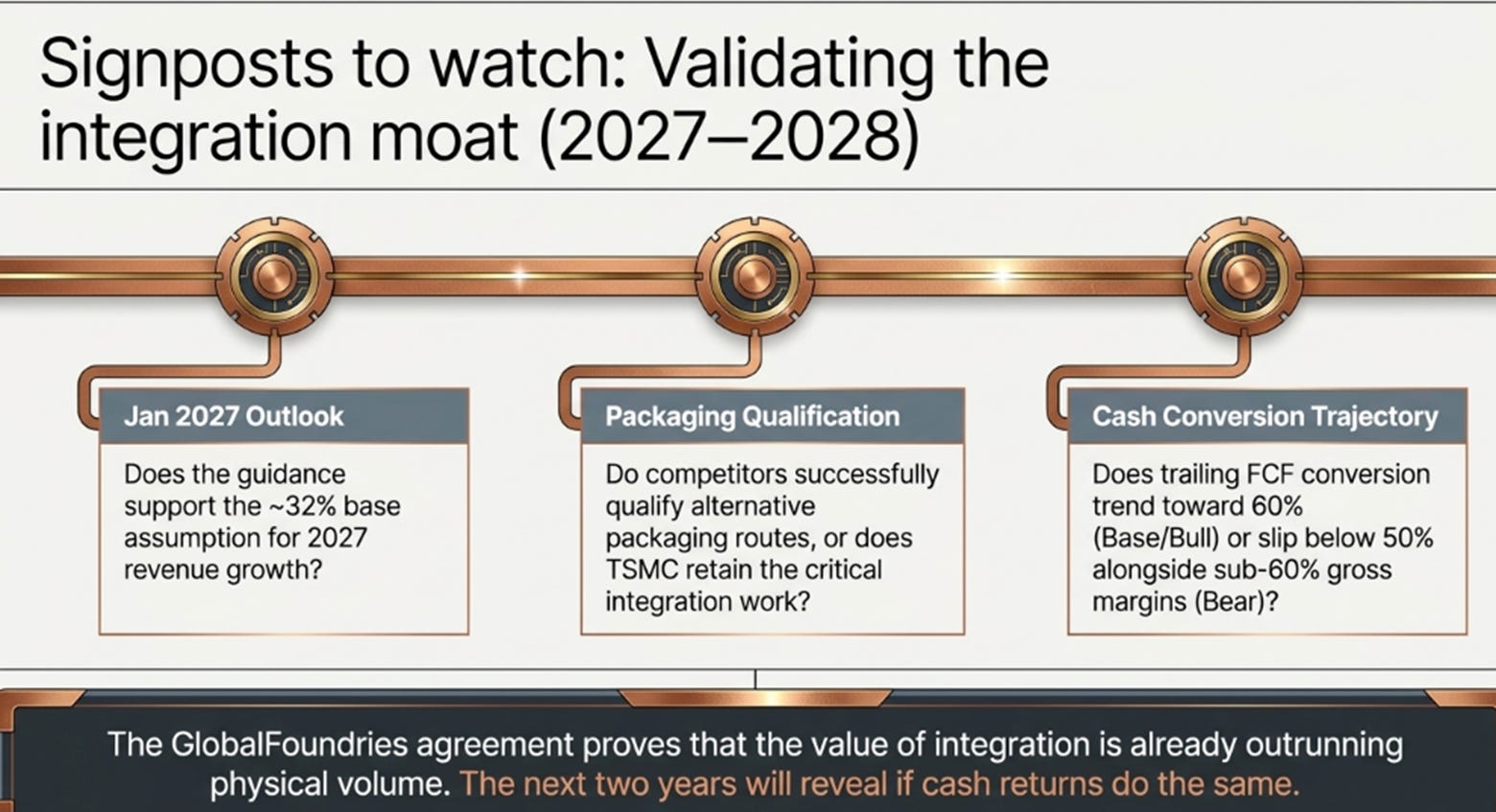
That evidence will arrive in stages. January’s outlook should support 2027 growth reasonably close to our 32% base assumption. Through 2027 and 2028, packaging-capacity commentary, customer and competitor qualification announcements, and utilisation will show whether TSMC retains the valuable integration work as alternatives emerge. Trailing cash conversion moving toward 60% while gross margin holds around 64–66% would strengthen the case; conversion below 50% alongside slowing growth, or gross margin below 60% because new capacity is underused, would move us toward Capacity Digestion.
The GlobalFoundries agreement is small relative to TSMC’s results, but it explains the larger transition. TSMC can let another foundry manufacture a part when TSMC remains the company responsible for making the complete package work. This quarter suggests that the value of that role has begun to outrun physical volume. The next two years will show whether cash does the same.
Disclaimer:
The content does not constitute any kind of investment or financial advice. Kindly reach out to your advisor for any investment-related advice. Please refer to the tab “Legal | Disclaimer” to read the complete disclaimer.