


TL; DR
The operating thesis strengthened: bookings grew 22% in constant currency, profit grew faster, AV utilization is improving, and Uber’s market position remains resilient in mature autonomous-vehicle cities.
The valuation thesis weakened: Uber still withheld AV take rates and comparable Uber One metrics, while committing more than $10 billion to help build the autonomous supplier ecosystem.
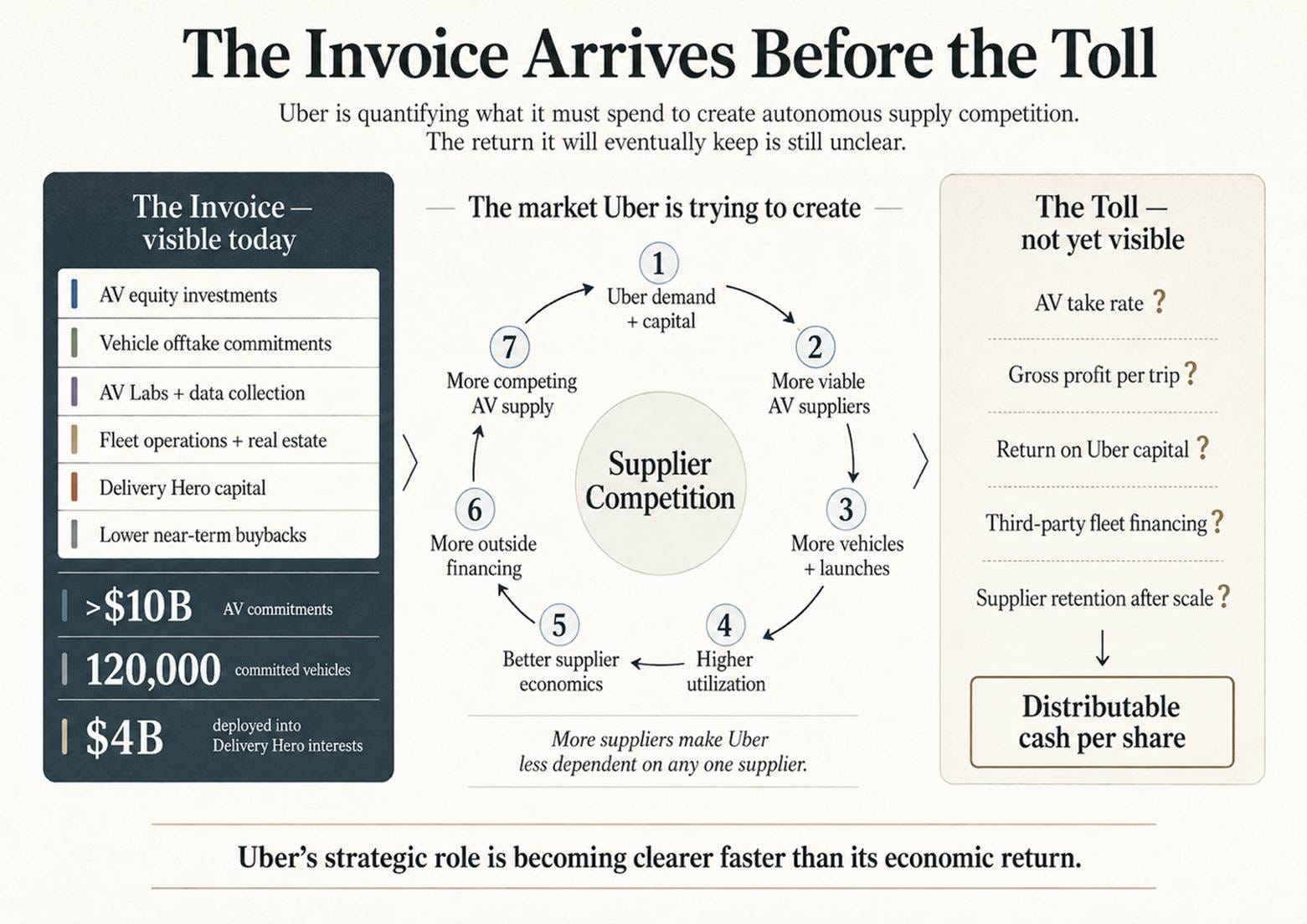
The key question has shifted: it is no longer whether Uber matters in an autonomous world, but how much capital it must contribute and how much cash ultimately remains for shareholders.
In May I wrote that Uber had moved from being priced as an autonomous-vehicle casualty in the high $60s to being priced as a business with a plausible coordination thesis at $80. I thought the remaining distance to my $120–$130 base case depended on Uber One becoming more deeply embedded, Delivery margins reaching 4%, and insurance savings accelerating U.S. Mobility.
Three months later, Uber delivered the strongest evidence for that thesis yet, and the stock returned to roughly $68. The repricing did not merely stall; it reversed.
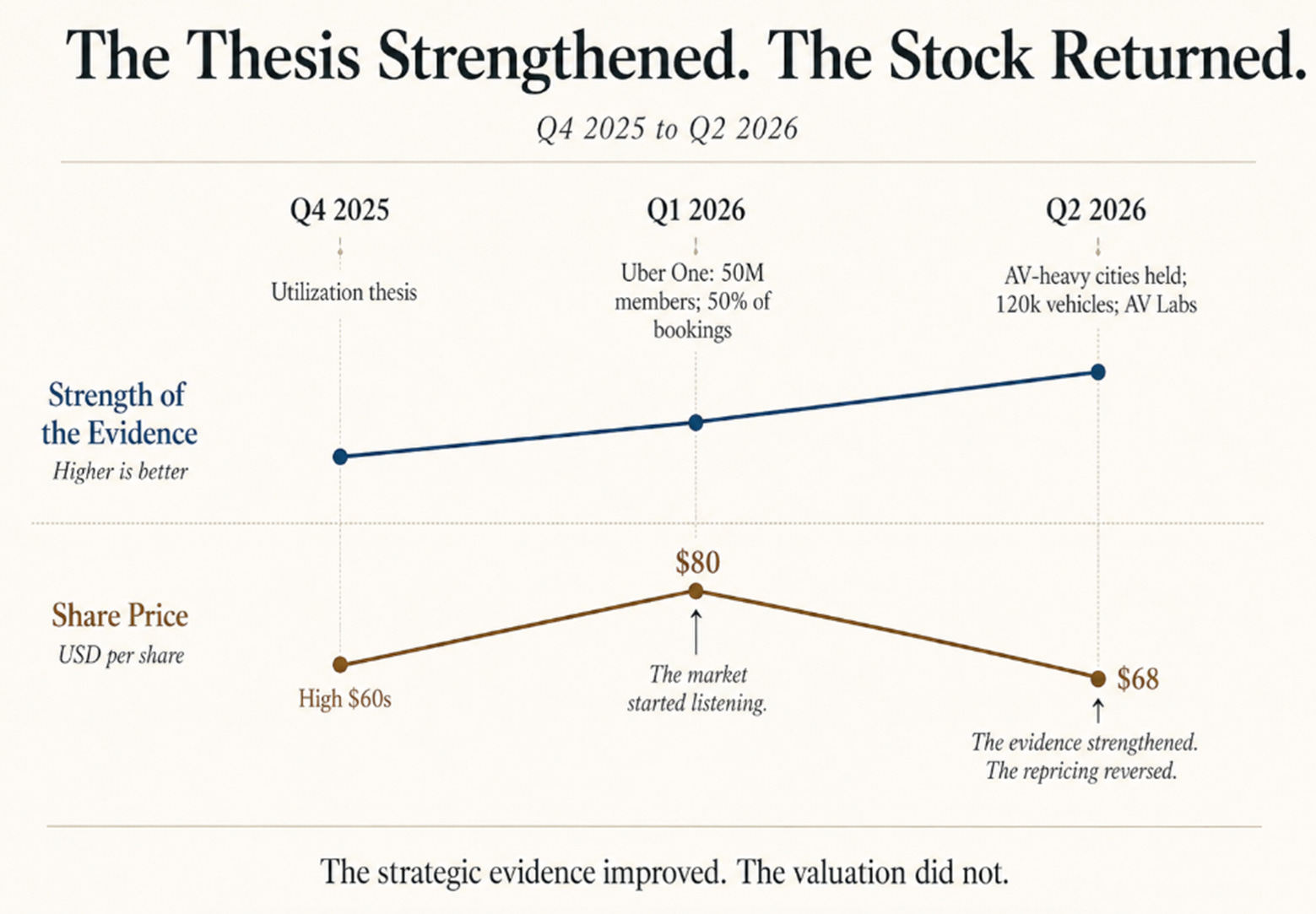
That does not mean the original thesis was wrong. It means my explanation for what would move the stock was incomplete.
I had assumed Uber would rerate as management proved that autonomous fleets need its demand. Q2 suggests that proof is no longer sufficient. Uber is now providing increasingly precise evidence of what preserving that position will cost, while still withholding the numbers that show what it will earn.
The Scorecard
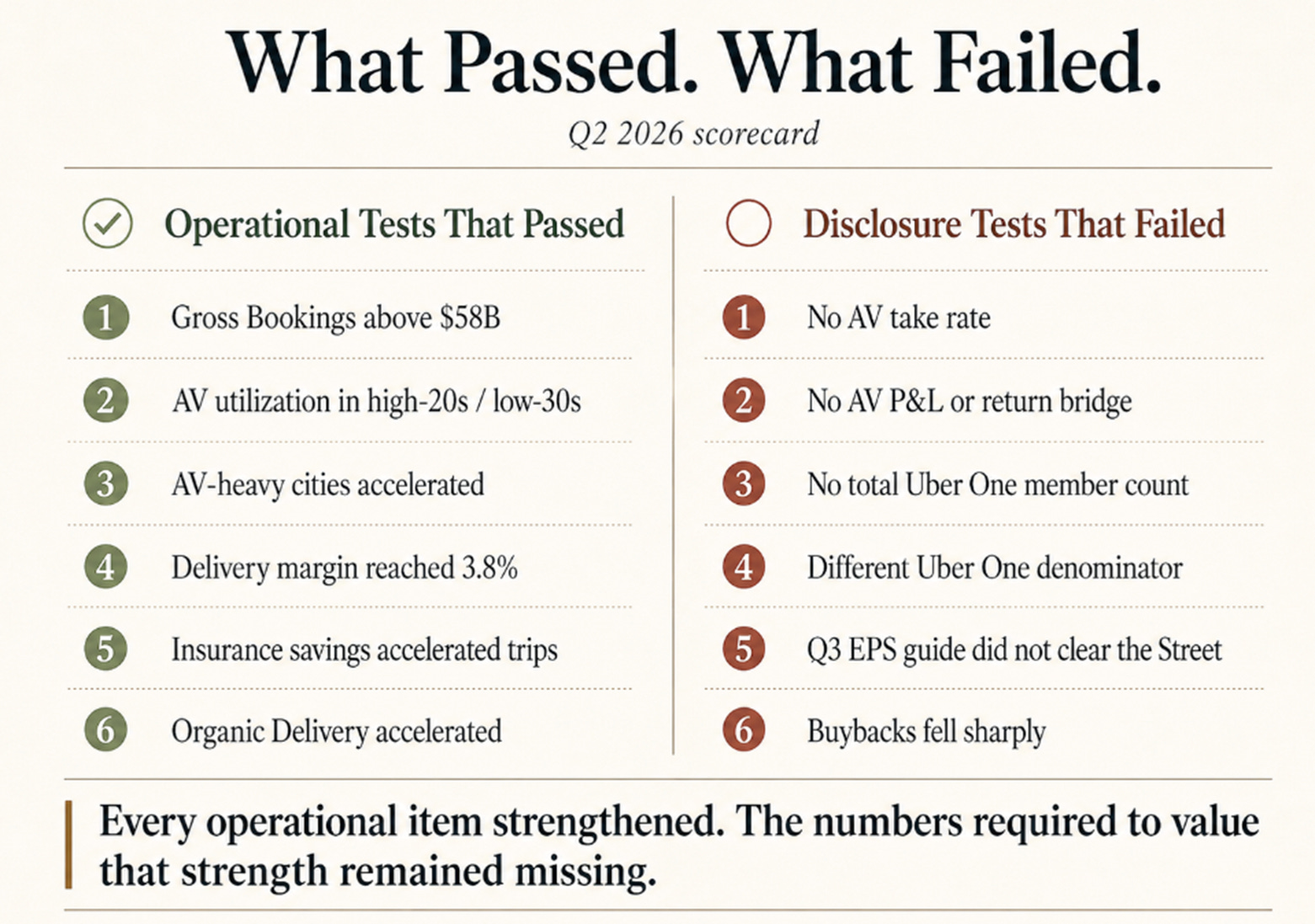
The honest place to begin is with the tests I set before the quarter.
After Q1, I wrote:
“If Uber reports Q2 without disclosing AV take rates, I will interpret that as a signal the economics are not yet where management wants them.”
Uber did not disclose the take rate. When Bank of America’s Justin Post asked how the more-than-$10-billion autonomous commitment would affect earnings and margins, Balaji Krishnamurthy said Uber would provide more visibility as deployment approached scale.
I do not think that answer means the economics are necessarily poor. The commercial arrangements are early, likely vary by partner, and may change as vehicle volumes grow. But I committed in advance to what continued silence would mean. I do not get to rewrite the test after seeing encouraging evidence elsewhere.
Uber One created a second disclosure problem. Q1’s defining number was fifty million members generating half of total Gross Bookings across Mobility and Delivery. In Q2, management said membership reached another record and that members generated more than 70% of Delivery Gross Bookings, but it did not update the member count or the share of total bookings.
The new statistic may be useful. It is not an update to the old one. It changes both the metric and the denominator. One quarter may be harmless; a second omission would look deliberate.
The operational evidence was almost the mirror image. Gross Bookings reached $58.0 billion and grew 22% in constant currency. Adjusted EBITDA increased 33%, non-GAAP operating income rose 40%, Delivery bookings grew 25%, and Delivery operating income grew 38%.
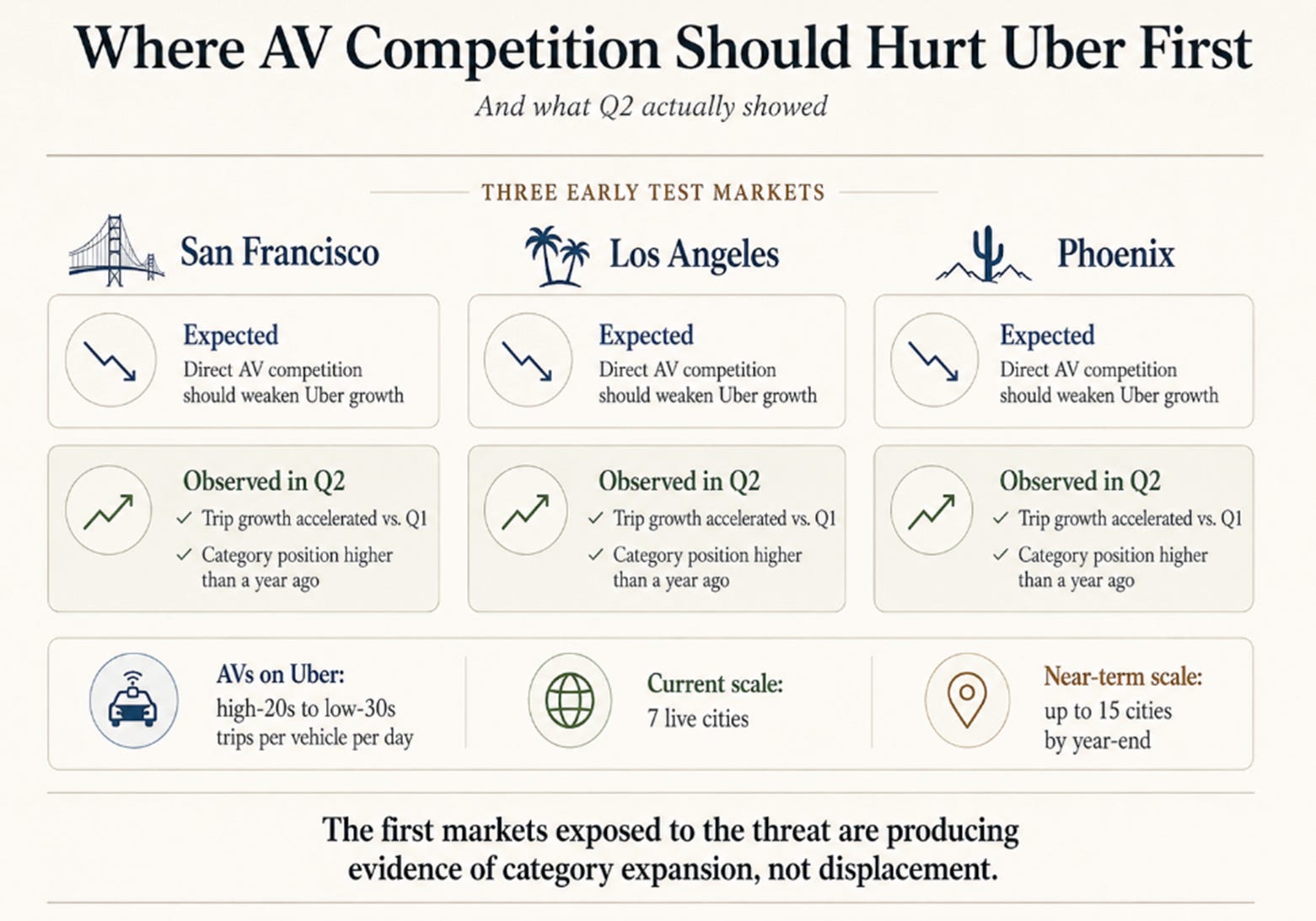
Insurance savings passed through lower prices produced faster trip growth in Los Angeles and San Francisco. Autonomous partners were completing trips in the high twenties to low thirties per vehicle per day. Uber’s category position in Los Angeles, San Francisco, and Phoenix; the mature U.S. AV markets, was higher than a year earlier.
The pattern is hard to dismiss: the operating tests strengthened, while the two disclosures needed to value that strength failed.
The Proof
The original Uber thesis began with utilization.
Human drivers provide their own vehicles and decide when to work. When demand falls, they turn off the app. An autonomous vehicle is a fixed asset that depreciates whether it is carrying a passenger or sitting idle. Its owner must cover charging, cleaning, maintenance, insurance, remote assistance, and financing before earning a return.
That makes dense demand more valuable after autonomy arrives, not less.
Q2 supplied the best evidence yet that Uber can provide it. AVs are now live on Uber in seven cities, with as many as fifteen planned by year-end. Partners have committed approximately 120,000 vehicles over the coming years, and management says Uber’s position has strengthened rather than weakened in the cities where autonomous competition is most advanced.
AV Labs adds another layer. Uber is operating sensor-equipped vehicles that collect rideshare-specific driving data for its partners. Combined with demand, dispatch, fleet operations, insurance, financing, charging, and local regulatory work, Uber is becoming an input into autonomous commercialization rather than merely another app through which a completed product can be booked.
The strategic argument is much stronger than it was eighteen months ago. Uber will almost certainly matter in an autonomous world.
And yet relevance is not ownership.
The Invoice
In 2005 Apple prepaid $1.25 billion to five memory suppliers to secure NAND flash for the iPod. Apple was not trying to manufacture semiconductors; it was using the strength of a customer relationship it already controlled to make sure scarce supply expanded around it.
Uber is attempting something similar, with one dangerous difference. Apple’s memory suppliers did not aspire to own the iPod customer. Uber’s autonomous partners may eventually want the rider, the app, and the entire trip economics.
Dara Khosrowshahi’s desired market structure is clear: several AV developers compete across technologies, vehicles, and regions; each benefits from Uber’s demand and local operating capabilities; and no single provider gains enough power to dictate commercial terms.
I had treated that fragmentation as the likely outcome of the industry. Q2 suggests Uber may have to help finance it into existence.
Uber expects to commit more than $10 billion across equity investments, infrastructure, and vehicle offtake arrangements. It is helping software partners raise capital, anchoring vehicle demand, collecting shared data, and building the capabilities needed to launch fleets city by city. Management intends to bring in outside financiers as deployments scale.
The intended loop is compelling. Uber’s recurring demand raises vehicle utilization; better utilization attracts suppliers and outside capital; more suppliers reduce Uber’s dependence on Waymo or any other developer; better coverage and price produce more demand.
But the loop begins with Uber’s balance sheet.
That creates two risks. The first is that Uber supports weaker suppliers that never become competitive with the leading autonomous systems. Lucid can have PIF backing, Nuro software, and a large Uber order without proving that it can manufacture the right vehicle at the right cost.
The second is that successful suppliers use Uber’s capital, data, and demand to reach scale before seeking better economics or distributing directly. Uber may help create the competition it needs and still fail to own the value that competition produces.
The non-obvious insight from Q2 is that Uber is using cash from its capital-light business to create the supplier market its capital-light future requires.
Where the Cost Appears
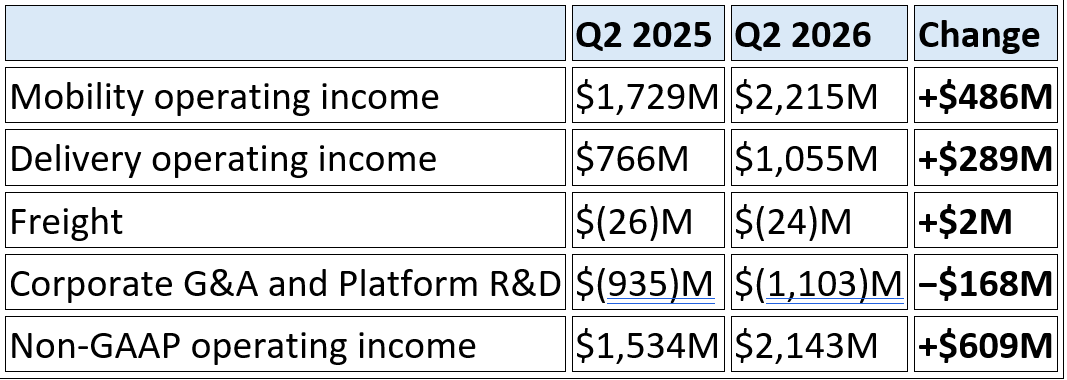
Uber does not disclose a clean bridge from AV investment to current operating expenses, so it would be wrong to treat every increase in corporate costs as autonomous spending. The consolidated results still show where the broader ambition first meets the income statement.
Source: Uber Q2 2026 earnings release.
Mobility and Delivery generated $775 million of incremental operating income, while corporate costs absorbed $168 million. That line contains shared finance, legal, technology, mapping, payments, and other functions, so it cannot be assigned solely to AV Labs, partnerships, or M&A. It is still the visible line through which some of the expanding corporate agenda reaches shareholders.
The Q3 guide made the tension more immediate. Uber guided to non-GAAP EPS of $0.84–$0.88, versus an analyst expectation of approximately $0.89, while its bookings midpoint was broadly in line with the Street. The quarter proved the strategic case but did not create near-term estimate upside.
Capital allocation told the same story. Uber generated $10.1 billion of trailing free cash flow, but deployed approximately $4 billion to establish a 37% economic interest in Delivery Hero and repurchased only $510 million of its own stock.
Reported free cash flow measures what the operating business generates. It does not measure what remains available to owners after acquisitions, strategic equity investments, and AV commitments.
Management is winning the strategic argument and losing the multiple because the costs can be placed into a model today, while the returns remain a distant assumption.
What the Next Year Can and Cannot Tell Us
The next few quarters cannot determine whether Uber’s AV strategy creates value. The vehicles, financing structures, supplier relationships, and commercial agreements will take years to mature. Uber itself has said meaningful commercialization will take much longer than the underlying technical progress.
Corporate costs moderating in Q3 would not prove that the $10 billion earns an attractive return. A restored buyback would not prove that outside financiers will eventually absorb the vehicle risk. Even a disclosed take rate would tell us little without knowing what Uber spent or guaranteed to obtain it.
What the next year can show is whether Uber can carry the build without weakening the business that funds it.
Through early 2027, the test is whether Mobility and Delivery continue producing bookings growth near 20%, profit grows faster than bookings, central costs become more controlled, leverage remains bounded, and buybacks recover. That would show that management can incubate a long-duration project without sacrificing current per-share compounding.
During 2027, the test shifts toward risk transfer. Uber needs to demonstrate scaled third-party vehicle financing, clarify which of the 120,000 commitments are firm or conditional, and show how much capital or guarantee exposure remains with Uber.
Only from 2028 onward can the final economic question begin to resolve: AV gross profit, take rate after all support, return on Uber capital, utilization across several suppliers, and whether those suppliers remain on Uber after reaching scale.
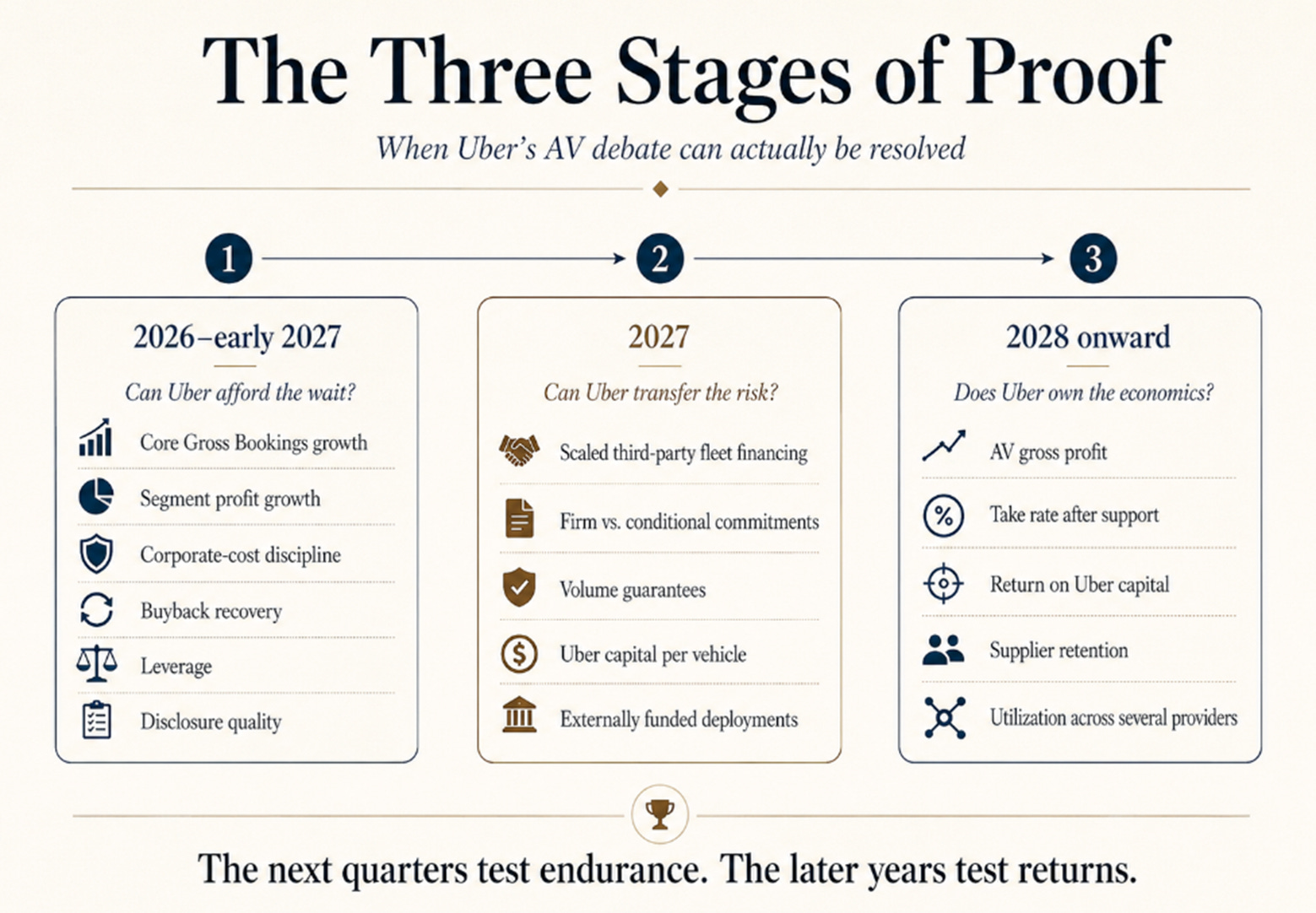
The next few quarters do not resolve the long-term thesis. They determine whether Uber earns the right to keep pursuing it.
Three Futures
These scenarios use my assumptions from the FY2026 earnings base:
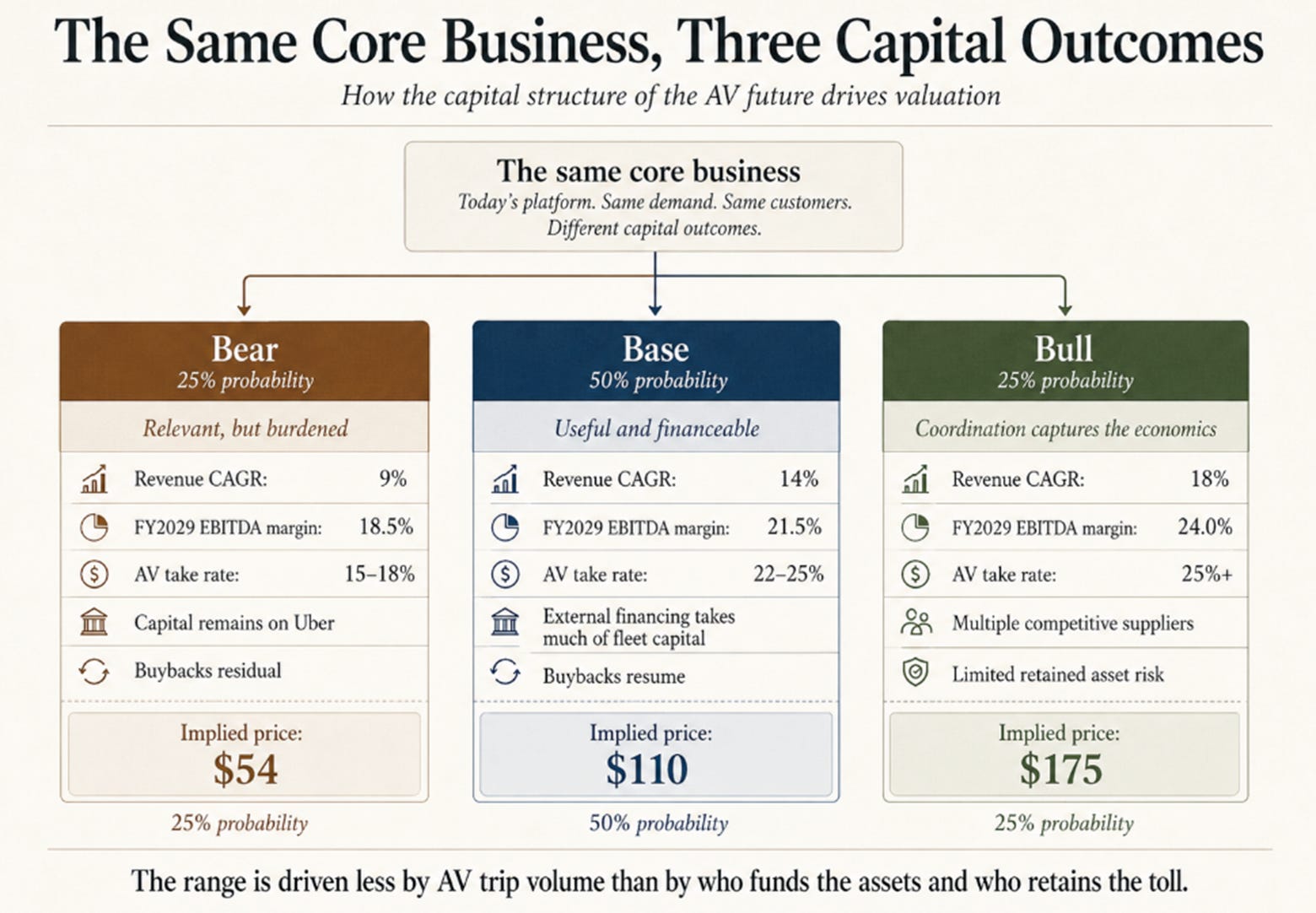
The bear case is not Uber disappearing. The company remains relevant, but central costs stay elevated, Delivery Hero consumes capital through its integration, suppliers gain bargaining power, and buybacks become residual. Earnings rise, but the multiple remains compressed because strategic importance never becomes distributable cash.
The base case assumes that Mobility and Delivery continue compounding, Uber contains the incubation cost, and third-party financing gradually takes over much of the vehicle funding. AVs remain too small to drive the consolidated model, but they no longer justify a large displacement discount.
The bull case requires several competitive AV suppliers, visible economics above a 20% take rate, limited retained fleet risk, and a core business strong enough to fund investment while reducing the share count.
The probability-weighted value is approximately $112. The wide range does not mainly reflect uncertainty about how many robotaxi trips Uber completes. It reflects uncertainty over how much capital Uber must leave behind and how much cash per share remains for owners.
I still believe the coordination thesis. Q2 made it stronger. What changed is my understanding of why the stock has not responded.
I expected Uber to rerate when it proved that autonomous vehicles would need its demand. Instead, each new piece of proof arrived with a more visible invoice and no disclosed toll.
Uber is building a long-duration asset whose value will not be known for at least another year or two. The next few quarters will not tell us whether that asset works. They will tell us whether Uber can afford to wait.
Uber has proved that it can make autonomous vehicles busy. It has not yet proved that it can stop paying once they are.
Disclaimer:
The content does not constitute any kind of investment or financial advice. Kindly reach out to your advisor for any investment-related advice. Please refer to the tab “Legal | Disclaimer” to read the complete disclaimer.