


TL; DR
The marketplace is getting better at utilization: Uber is shifting incentives toward scarce supply, expanding products like Wait & Save and premium rides, and says autonomous partners complete about 30% more trips per vehicle per day than first-party fleets. The operating machine is improving.
But supplier choice is becoming more important than matching efficiency: Waymo wants customers to request Waymo specifically, while Amazon can put Uber Eats fulfillment behind its own front door. Uber can be the marketplace, or merely the infrastructure behind someone else’s customer relationship.
Uber One may be the bridge: membership and supplier-funded benefits can give a customer or an AI agent a reason to select Uber even when the interface sits elsewhere. But those benefits only matter if they improve the all-in offer and do not simply transfer margin away from Uber or fleet owners
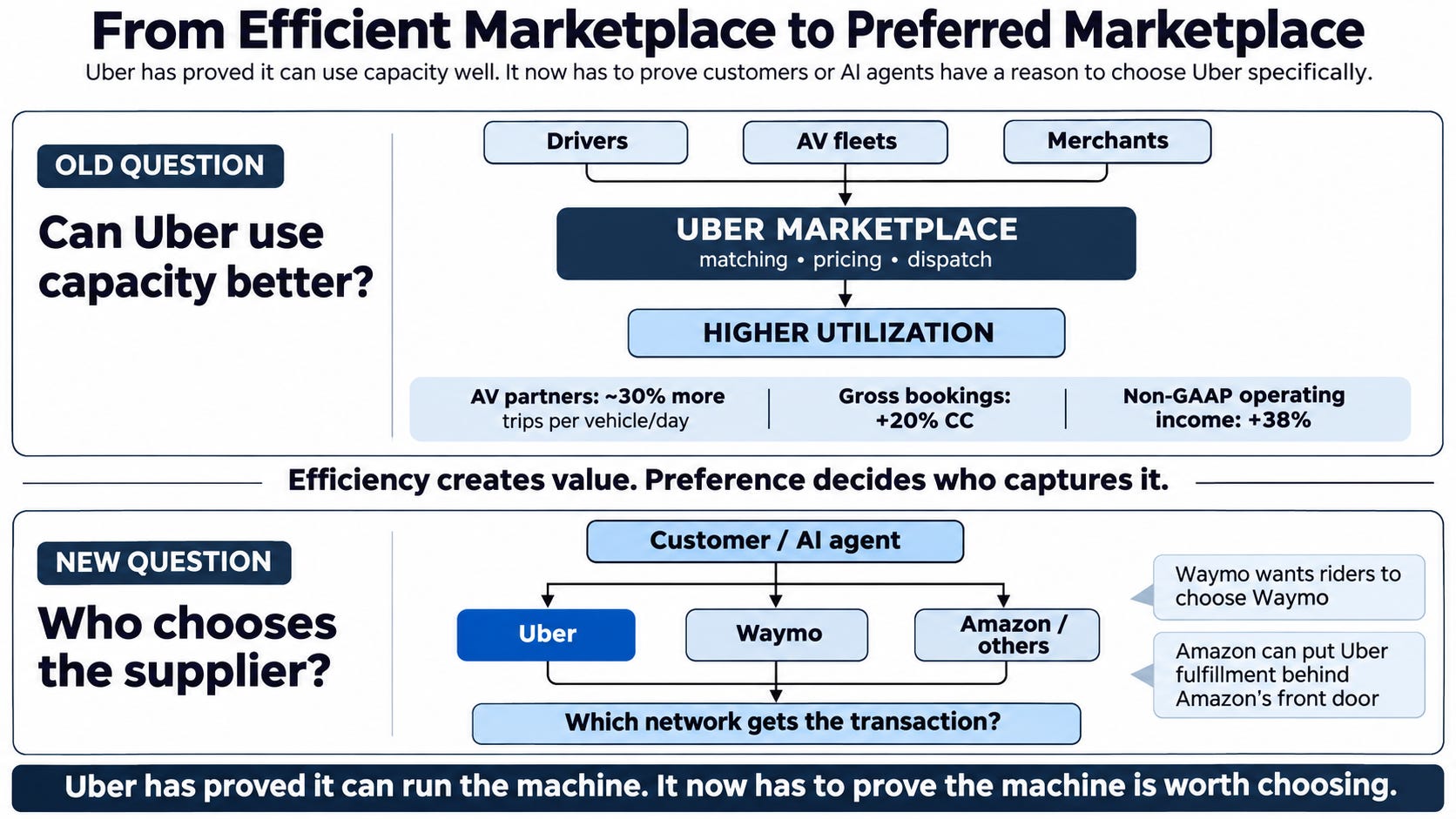
In 1927, Henry Ford halted Model T production to retool. His assembly line still worked; what had changed was the customer. Alfred Sloan’s General Motors offered cars for different budgets, regular model updates and financing through GMAC. Ford had perfected the economics of making a car. GM had built a relationship that could accommodate the customer’s next purchase. By the time Ford responded, Chevrolet had passed him.
In February 2025’s Beyond the Ride, I argued that autonomous vehicles would not eliminate Uber’s value: removing the driver does not remove the challenge of keeping expensive transportation capacity productive. August’s Proved the AV Thesis. Now Comes the Bill asked who would finance that capacity. Q3 strengthens the operating argument. Uber says its US autonomous partners complete roughly 30% more trips per vehicle per day than first-party fleets; gross bookings grew 20% in constant currency and non-GAAP operating income 38%. Yet at $68.78 on November 5, the stock was almost unchanged from its price when the February article appeared.
The week’s developments suggest why the next question is different. Waymo wants riders to ask for Waymo, not just a driverless car. Amazon now sells restaurant delivery fulfilled by Uber without requiring an Uber account. AI agents may eventually compare both offers on a customer’s behalf. Uber has proved that its network can make transactions more efficient; it has not established how much of the value it will retain when others influence which transaction gets made.
The Marginal Dollar
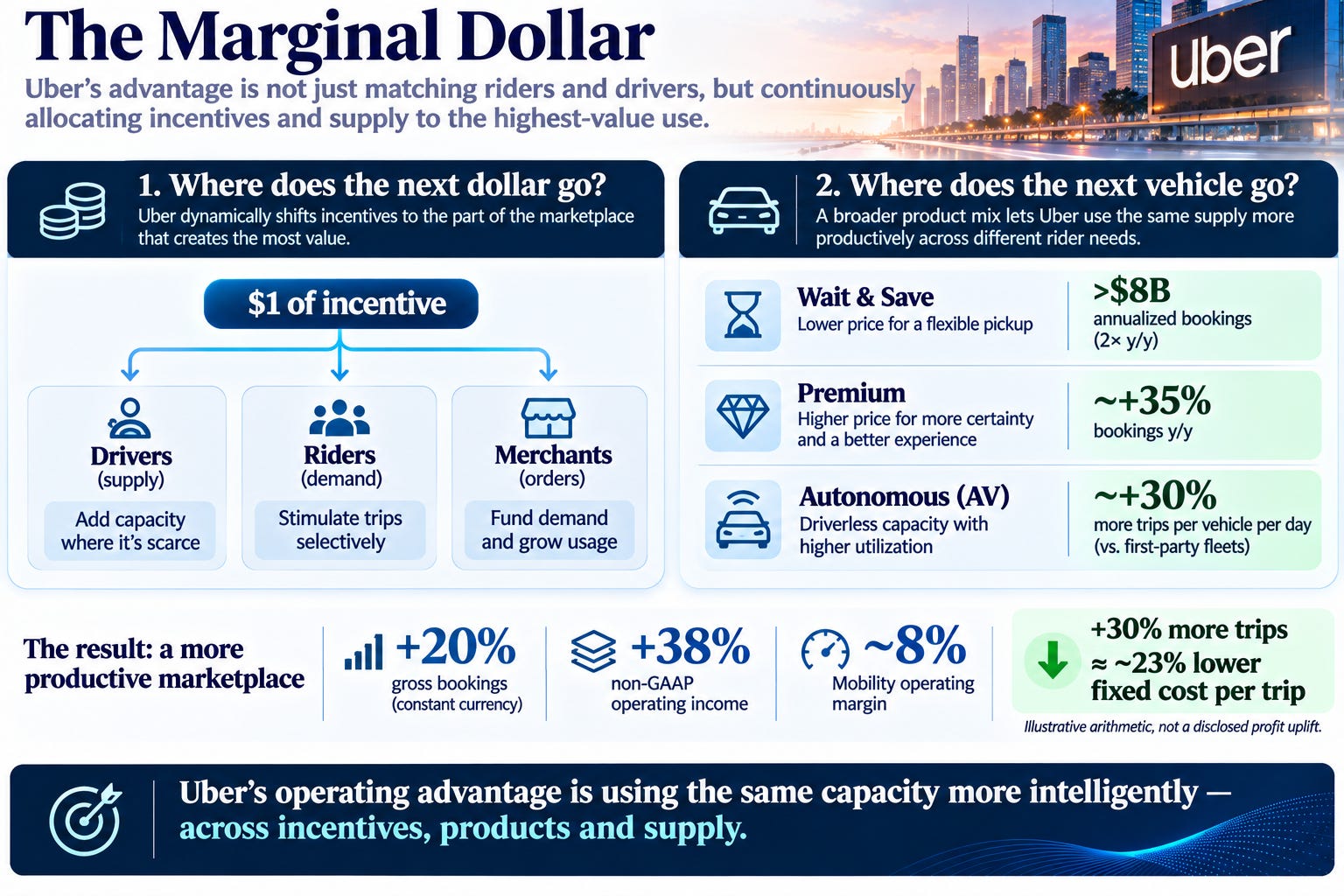
Mobility bookings grew 17% in constant currency, a little below management’s plan, while trip growth slowed from 18% to 16%. International driver availability and fuel costs constrained supply; the anniversary of the Trendyol Go acquisition also affected consolidated trip comparisons. Dara Khosrowshahi explained Uber’s response:
Then we have incentives... These are more flexible dollars that we target... whereas last year, more of the incentives went to riders to reduce price, now this year, we’re taking down rider incentives, and we’re using those dollars to fund driver incentives. Now that does mean sometimes higher prices for riders, which is something that we watch out for.
Uber shifted money toward the scarce side of the marketplace, tolerating some higher rider prices while Mobility operating margin reached about 8% of bookings. The result was not simply better matching. Uber continuously decides whether another dollar should attract a driver, persuade a rider or create an order a merchant is willing to subsidize. The company can also change the product to make supply easier to use.
Wait & Save exceeded an $8 billion annualized bookings run rate, doubling over the year, while premium products grew roughly 35%. Uber has largely deprioritized UberX Share. The prepared remarks describe the broader design:
The same rider may choose Wait & Save for an everyday trip and a premium product for a business journey. Our advantage is the ability to serve those different needs on one platform, rather than offer the same experience for every occasion... A broader mix of trips improves driver utilization and marketplace efficiency, creating more room to reinvest in affordability and reliability.
Both cheaper products ask riders to accept something in return for a discount but Wait & Save purchases flexibility in pickup time rather than tolerance for a shared journey. My inference is that the first concession is easier to turn into efficient dispatch than the second; Uber has not published a controlled comparison. Together with premium services, the choice reveals a network that can offer different combinations of time, price and certainty to the same person on different occasions.
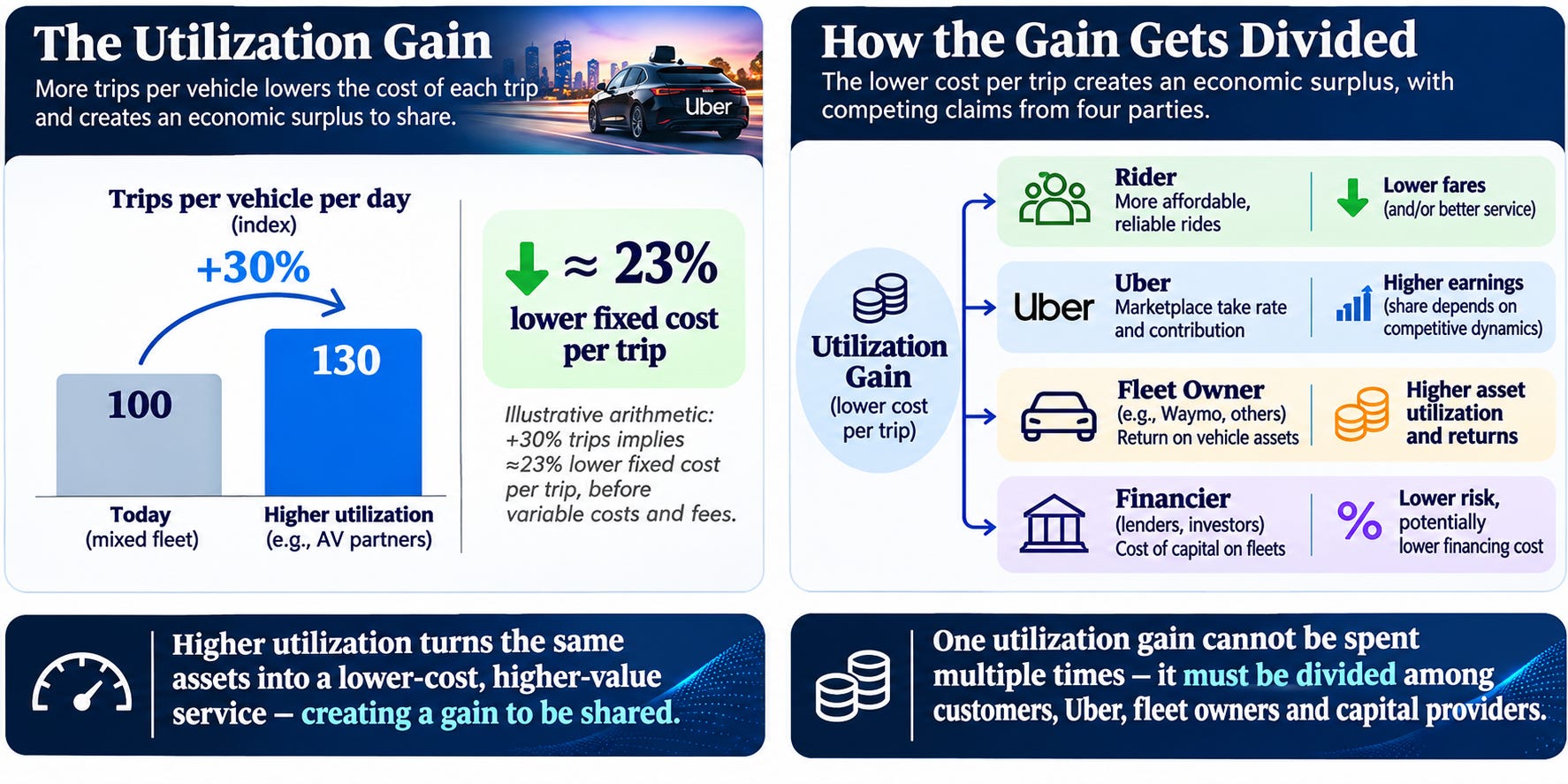
That is also the economic logic behind autonomous utilization. If a fleet completes 30% more trips with unchanged fixed costs, fixed cost per trip falls about 23%, before variable costs and marketplace fees. Uber’s reported advantage is not a controlled comparison of identical fleets, so it should not be mistaken for a measured profit uplift. But within each service tier, efficient dispatch depends on treating qualified vehicles as substitutes. A rider requests an UberX or an autonomous option; the network wants freedom to assign the best available car. A supplier with its own brand may want exactly the opposite.
The Refusal and the Login
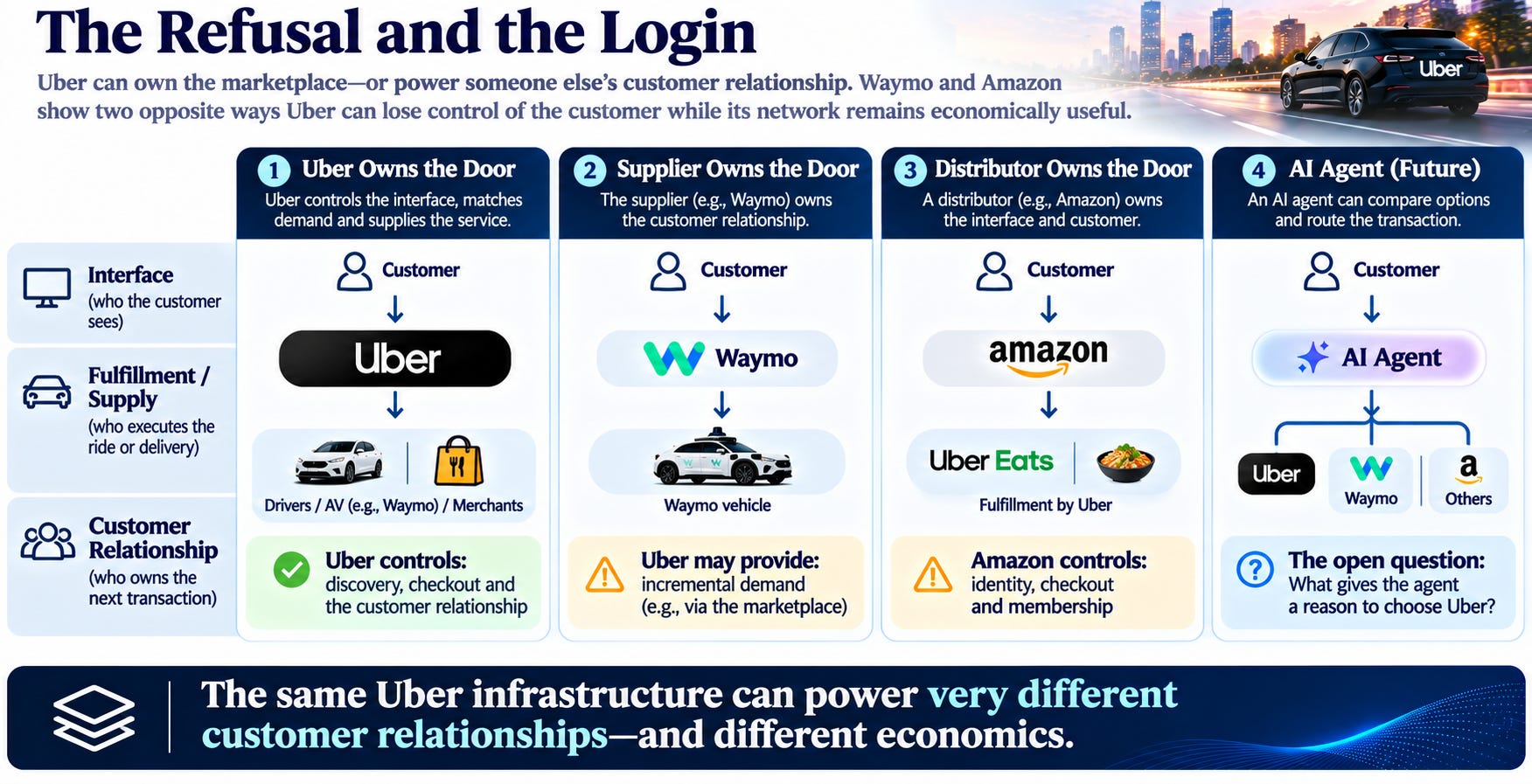
On November 4, Waymo co-CEO Tekedra Mawakana described requesting a Waymo through Uber as something of a “crapshoot”: customers wanting a robotaxi might get a human driver. Waymo plans its own app in Austin and Atlanta from January 2028, while continuing its existing Uber distribution arrangements. The plan was reported in July, but November brought the customer-relationship argument into sharper focus. Uber says it offered a dedicated robotaxi option that Waymo declined; Waymo has not corroborated the account or its motivation.
The tension exists regardless of that disputed detail. Uber’s utilization advantage comes from allocating interchangeable capacity. Waymo’s direct app and $29.99 Premier membership encourage customers to choose a particular supplier. That does not make Uber dispensable: Waymo can value incremental marketplace demand and still cultivate direct riders. But it corrects our February assumption that AV developers would generally need Uber more than Uber needed them. The leader, with its own capital and consumer recognition, has a different bargaining position from smaller fleets.
Amazon presents the mirror image. On November 5 it introduced Uber Eats restaurant ordering inside Amazon’s website and app. Prime members get delivery-fee waivers on qualifying orders, pay with Amazon credentials and need no Uber account. Uber fulfills the transaction, but Prime supplies the conspicuous membership proposition. Compare Uber’s April Expedia partnership: Uber is the customer-facing destination, Expedia supplies hotel inventory, and Uber One provides benefits. Uber can be the front door to someone else’s supply, or the supply behind someone else’s front door.
Neither arrangement is inherently bad. An externally originated order can be profitable without becoming a direct customer; owning the front door may require substantial subsidies. Amazon’s restaurant integration also excludes Uber’s fast-growing grocery business, which Amazon has reason to serve itself. The partnership validates the delivery network without establishing that Uber will capture the wider purchasing relationship.
What matters is the bargaining position created by discovery, benefits and the ability to influence a future purchase. As Khosrowshahi said when asked about AI agents:
I used to work in the travel business where we were dependent on the Googles of the world. I don’t want to go back there... That said, we will have discussions with third-party AI agents... every single AI system company is talking to us, and we’re really now negotiating the terms of trade. And the good news here is, in most markets, you have two mobility, big mobility providers, two big delivery providers. I think I’ve counted now there are eight different assistants, and I think there’ll be more than 10 assistants.
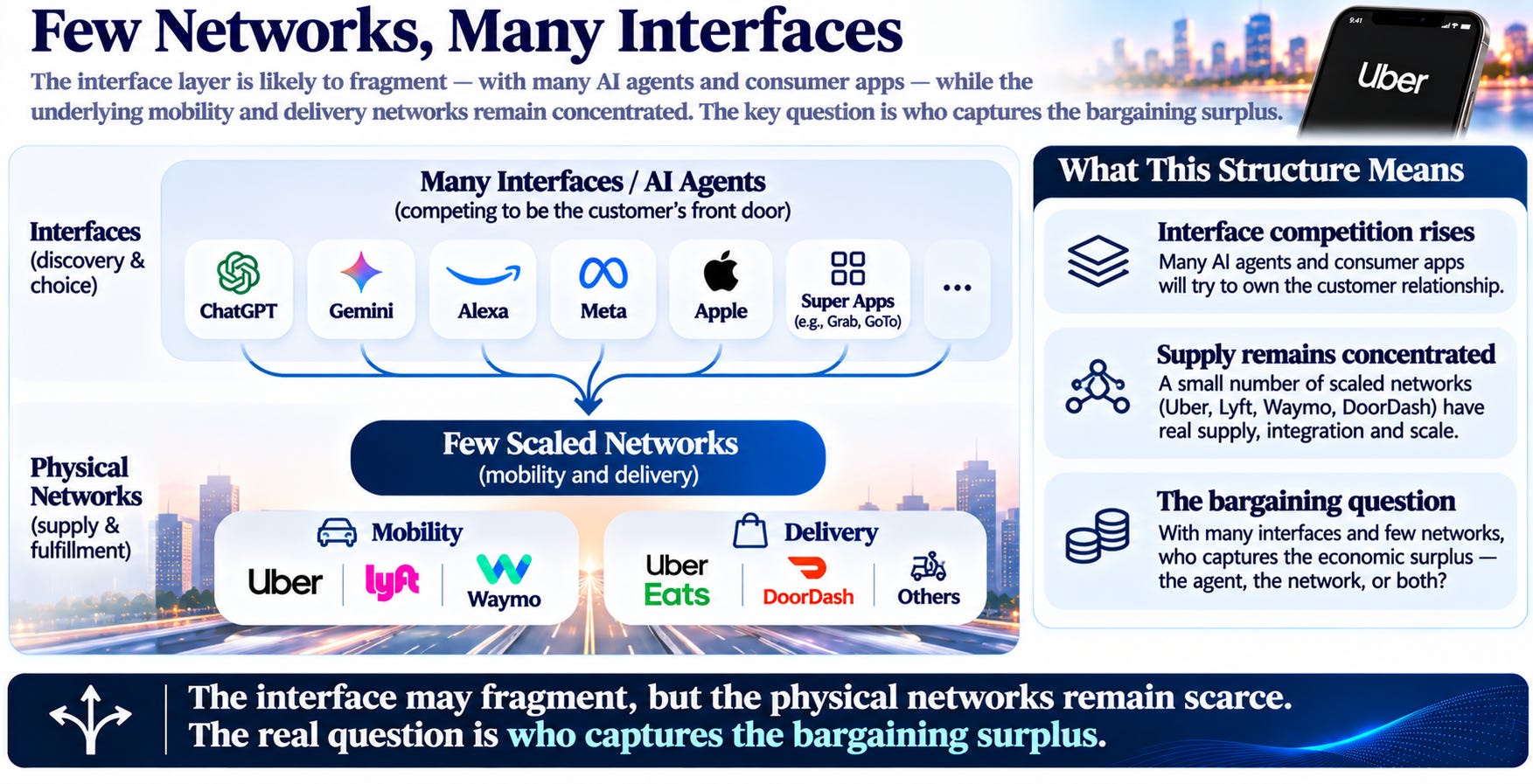
The negotiating case is credible: there are few scaled physical-service networks and many potential AI interfaces. Yet scarcity does not settle how much each party gets. Agent-originated activity remains negligible, Uber cited roughly 500 Eats orders and four rides in a Halloween week encompassing hundreds of millions of transactions. The risk is prospective: comparison becomes easier, a differentiated supplier can favor its own channel, and a powerful distributor can ask for more of the surplus. Uber needs to be selected for reasons beyond having inventory available.
Uber One’s Next Job
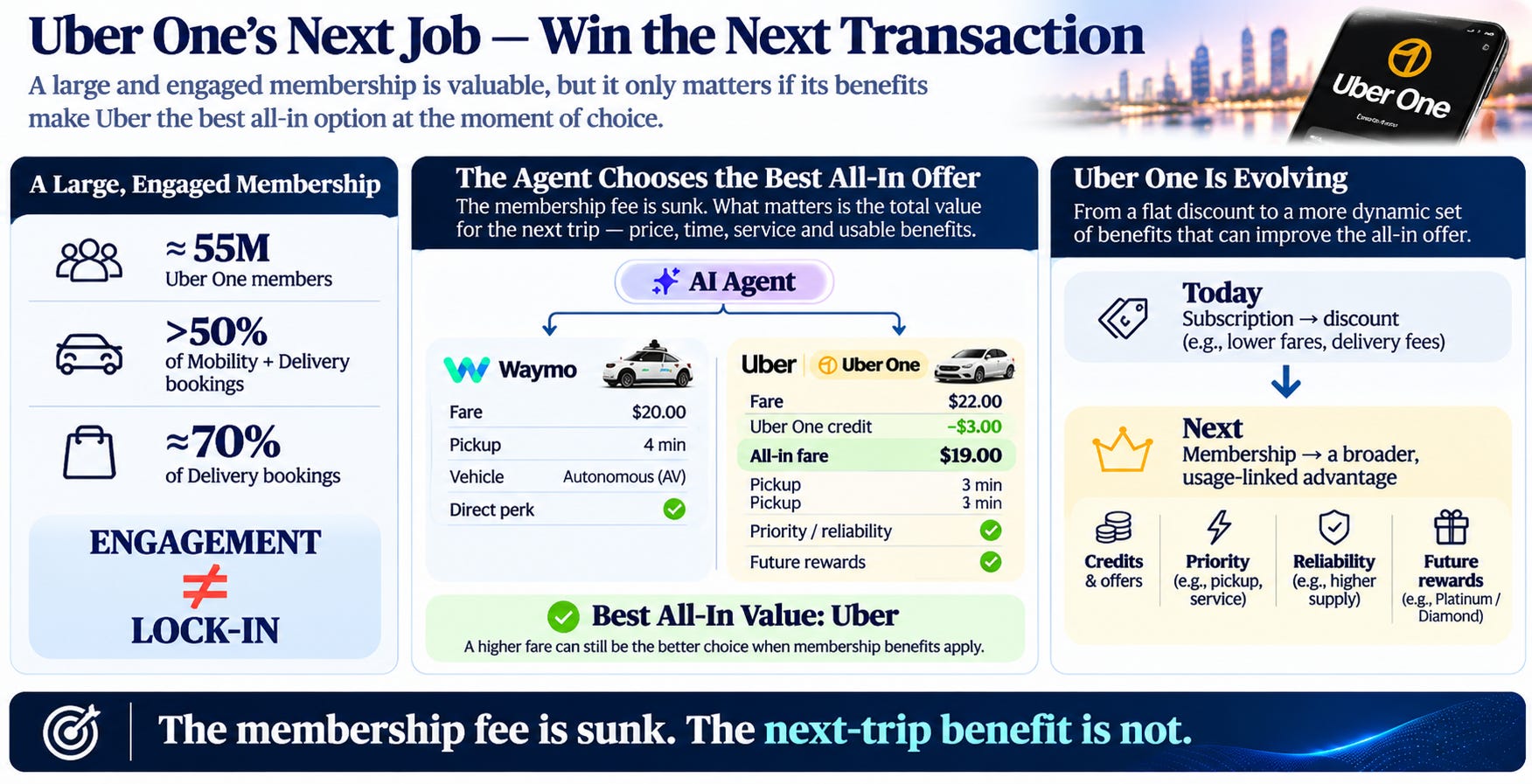
Uber One has approximately 55 million members, accounting for more than half of combined Mobility and Delivery bookings and around 70% of Delivery bookings. That restores the comparable membership disclosure we criticized in August. It establishes considerable engagement, not how much spending the subscription caused. We also overstated its defensive power in May: a member can take a Waymo ride without canceling Uber One. Membership creates a reason to return, not an obligation.
Agents make this distinction explicit. The fee a customer has already paid is sunk; the benefit available on the next ride is not. A useful assistant should recognize applicable credits, pickup priority, service quality and future rewards alongside the fare. A program becomes durable when those advantages improve the offer being compared, rather than relying on customers failing to compare at all.
Uber is testing elements of that shift. A limited-time Platinum and Diamond tier pilot rewards qualifying rides and orders over a rolling three-month period, while management has discussed richer benefits linked to frequency. This is not proof of increased incremental retention. It is a move from a flat prepaid discount toward rewards whose value can vary with usage. The more interesting question is who funds them.
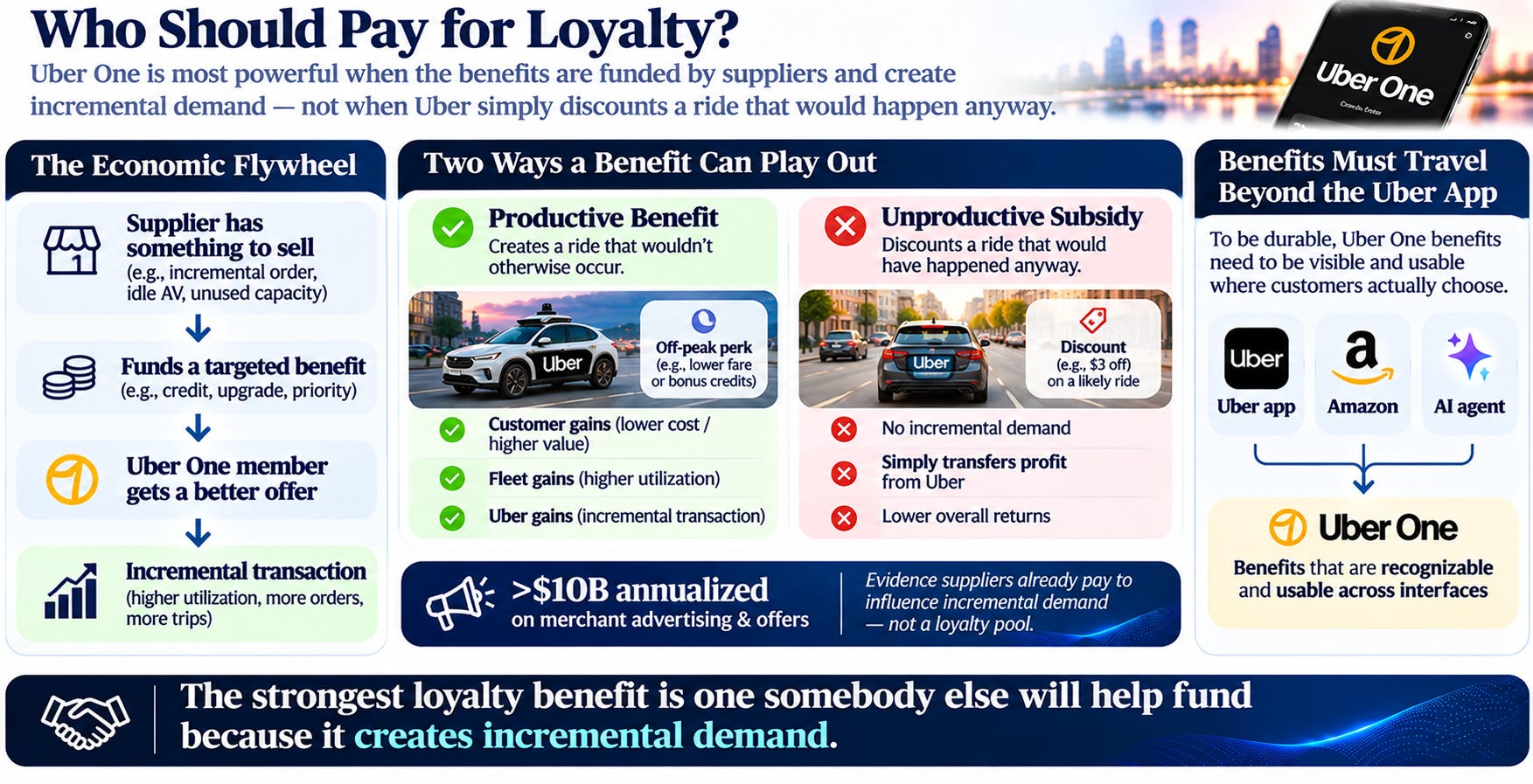
Booking’s Genius program suggests an answer. A hotel with an empty premium room may fund an upgrade that is worth far more to a traveler than it costs to provide. Uber already has a related mechanism: merchants spend more than $10 billion annualized on advertising and offers across its platform. That figure is not advertising revenue or a loyalty pool. It does show that suppliers are willing to pay to influence incremental demand. If Uber can connect that willingness to benefits members actually value, the program might improve both customer preference and supplier returns.
Autonomous fleets make the logic more consequential. Human drivers can log off when demand disappears; a fleet’s capital cost persists while its vehicles sit idle. An off-peak perk could create a ride that would not otherwise happen and leave its owner better off, although energy, maintenance, insurance and repositioning still cost money. A discount on a ride that would have occurred anyway simply transfers profit. Uber’s advantage is its ability to distinguish those occasions through pricing, dispatch and demand data, not an ability to make every subsidy productive.
Finally, benefits must be recognizable beyond Uber’s own interface. Costco’s membership integration on Uber Eats shows that two relationships can coexist inside a transaction; Amazon shows that the external relationship can instead dominate the visible offer. An assistant might eventually compare an Uber One benefit with a supplier’s direct perk, but Uber has not demonstrated universal portability into outside agents. Nor can an impeccable loyalty offer promise a driverless ride unless Waymo makes that product bookable. The agent needs a credible all-in proposition, price, pickup window, service type, usable rewards and reliability, not a discount on something Uber cannot deliver. The opportunity is to give the next chooser a real economic reason to select Uber, with the supplier helping fund that reason.
Who Keeps the Gain?
August’s capital question remains unresolved. Khosrowshahi offered a possible mechanism when discussing financing for autonomous fleets:
If there’s a fleet that for some reason fails in terms of their operations, we can take that AV vehicle and put it under separate ownership, and it will still earn on the Uber network, so to speak. So we think that the financing on the Uber network can have a real advantage in terms of cost of capital versus alternatives.
If a vehicle can continue earning after its operator fails, lenders may be financing access to a durable demand network rather than betting entirely on one fleet company. That could reduce the cost of capital and Uber’s need to own vehicles. But the conditional words matter: software licenses, permits, maintenance arrangements and residual-value risk may constrain transferability. External financing transfers value and risk only according to its actual terms; it cannot make a fleet owner’s required return disappear.
The core operation can support the transition, though not without limits. Q3 free cash flow reached $2.54 billion, up about 14%, below non-GAAP operating-income growth. Buybacks increased to $750 million, and management is limiting additional M&A while it integrates acquisitions. Some early autonomous vehicles and related obligations will nonetheless remain on Uber’s balance sheet. The same utilization gain cannot entirely fund cheaper rides, superior member benefits, Uber’s marketplace fee and the capital owner’s return. This is why financing terms and the AV take rate belong in the same investment discussion: each determines how the improvement is shared, and which risks shareholders retain.
At $68.78, Uber traded near 15.6 times FactSet FY2027 non-GAAP EPS consensus of approximately $4.40. I would retain August’s three outcomes rather than assign a premium to loyalty features or financing arrangements that have not yet demonstrated their returns.
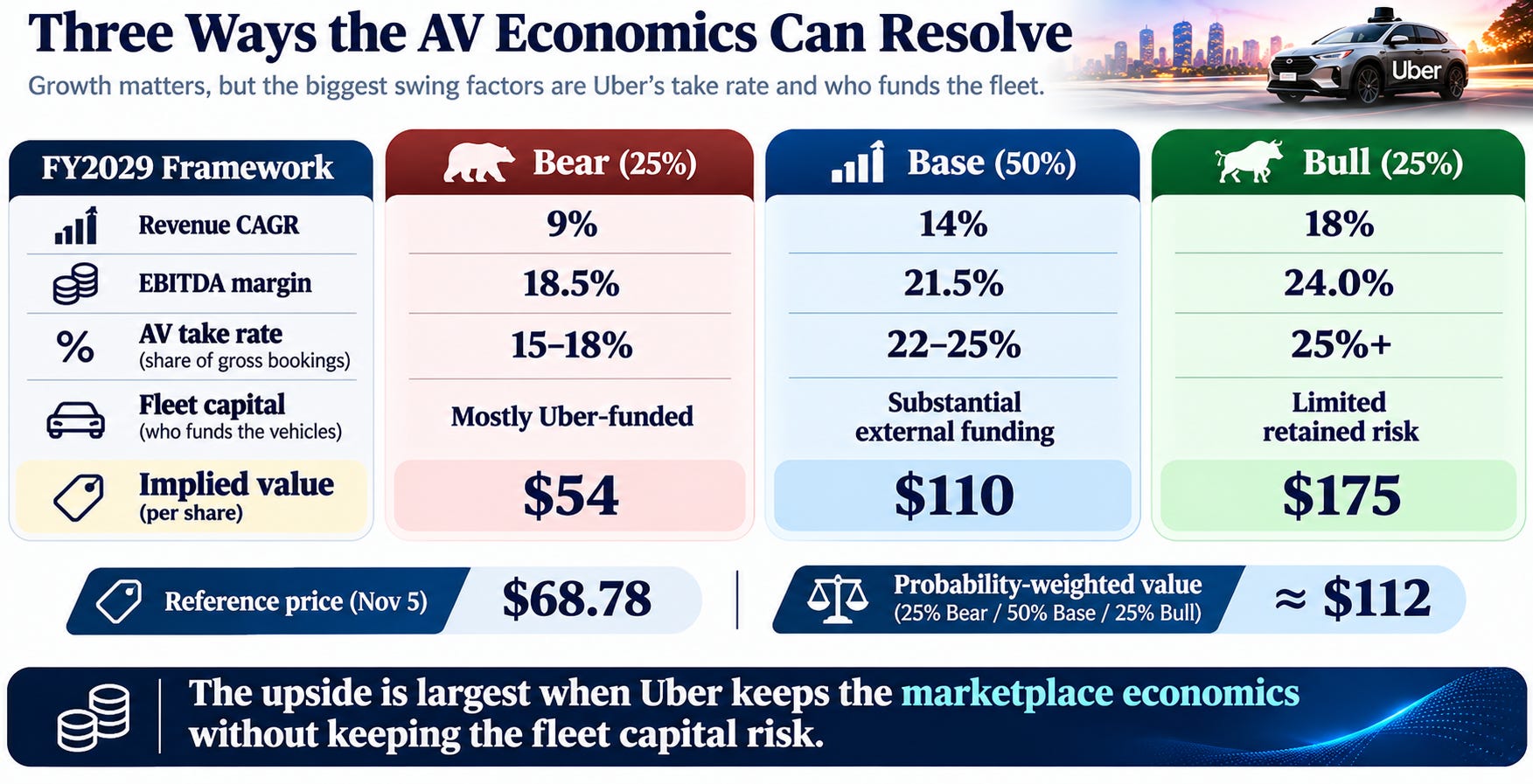
Their probability-weighted value remains approximately $112, 63% above the November 5 close. These are our previously published outcomes, not freshly recalculated forecasts. The next evidence that could justify greater conviction is a disclosed AV take rate, financing that genuinely transfers retained obligations, and Uber One benefits that increase incremental contribution rather than merely reward existing heavy users. Without those proofs, the share price’s discount cannot simply be called a mistake.
Ford’s factories had not stopped working when General Motors overtook him. The source of advantage had moved from producing efficiently to offering customers something they preferred. Uber’s utilization machine is getting stronger, but Waymo and Amazon reveal how that same machine can operate for someone else’s customer relationship. Its next task is not preventing choice. It is creating an offer worth choosing and retaining enough of the benefit to reward the suppliers and shareholders who make it possible.
Disclaimer:
The content does not constitute any kind of investment or financial advice. Kindly reach out to your advisor for any investment-related advice. Please refer to the tab “Legal | Disclaimer” to read the complete disclaimer.