


TL; DR
The repair is real. Adjusted EPS rose 61%, the earnings floor increased to $20.50 and cash conversion was strong even as revenue was essentially flat. UnitedHealth is earning more from the risks it chooses to retain. Pasted markdown Pasted markdown
But pruning cannot compound forever. The real test is the economics of the next patient: can UnitedHealth return to membership growth while keeping medical costs, care margins and earnings intact? Competitor evidence suggests new members can be more expensive than retained ones. Pasted markdown Pasted markdown
At ~$378, recovery is already partly priced in. Our base case reaches about $462 by end-2029, but the bigger upside requires evidence that better care economics can persist through renewed growth—not simply another year of restructuring and reserve improvement. Pasted markdown
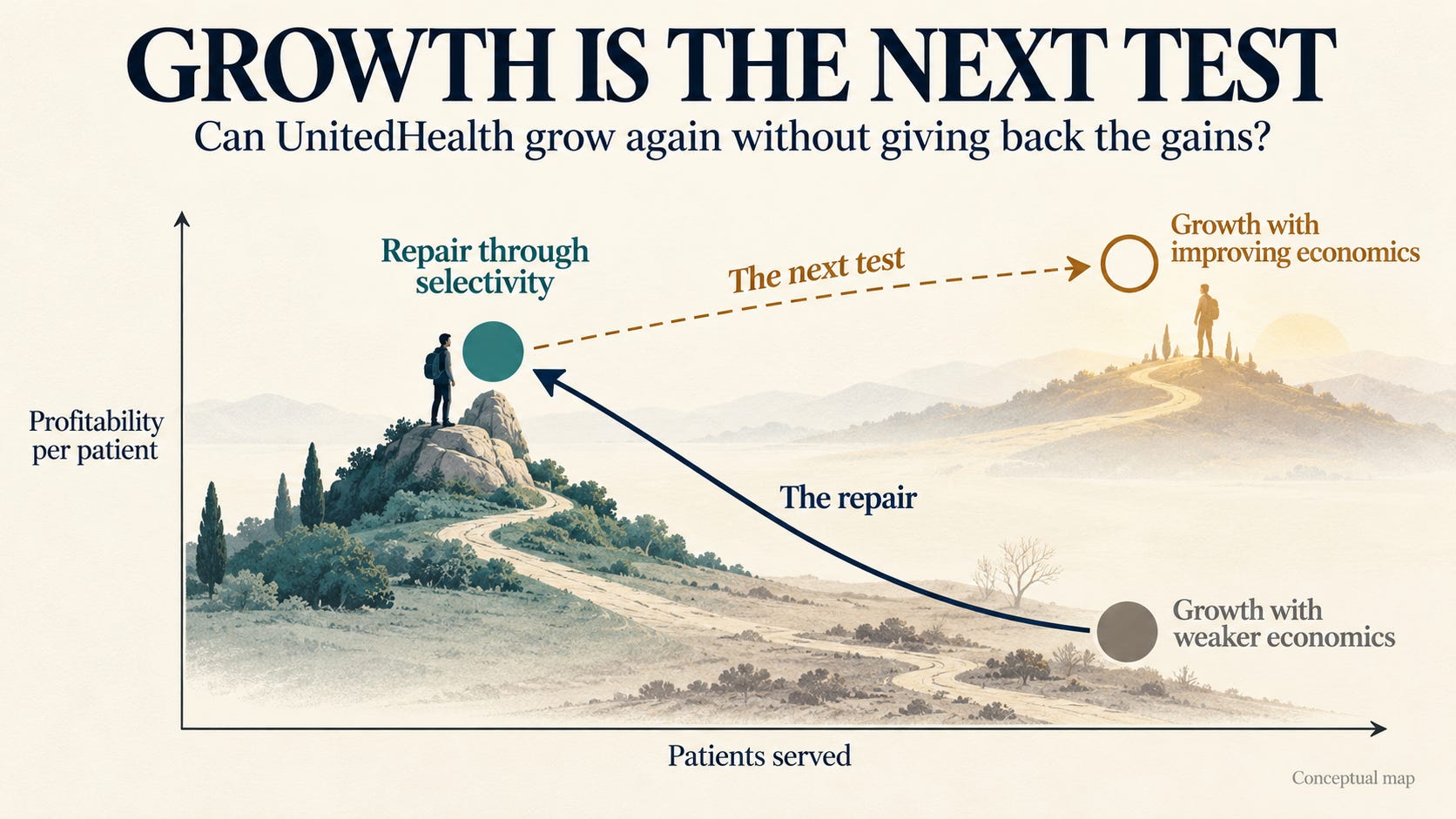
UnitedHealth’s third-quarter release reported “Adjusted Earnings of $4.69 Per Share.” That beat the October 12 FactSet consensus of $4.14 and increased 61% from a year earlier. Revenue fell 0.4% to $112.7 billion. Management raised its annual earnings floor to $20.50 from July’s $19.50–$20.00 range.
I think these were good results. Their most revealing feature is that profits are recovering while revenue is barely moving. UnitedHealth is demonstrating what happens when it becomes more selective. The harder test will come when it becomes bigger again.
In July, The Layer Beneath argued that we had underestimated the operating capabilities left behind after UnitedHealth’s reimbursement advantage weakened. Q3 strengthens that conclusion, while leaving the fundamental question intact:
Does UnitedHealth become better at delivering care at lower total cost as it serves more patients, and can it retain enough of those savings to compound earnings?
The Recovery We Underestimated
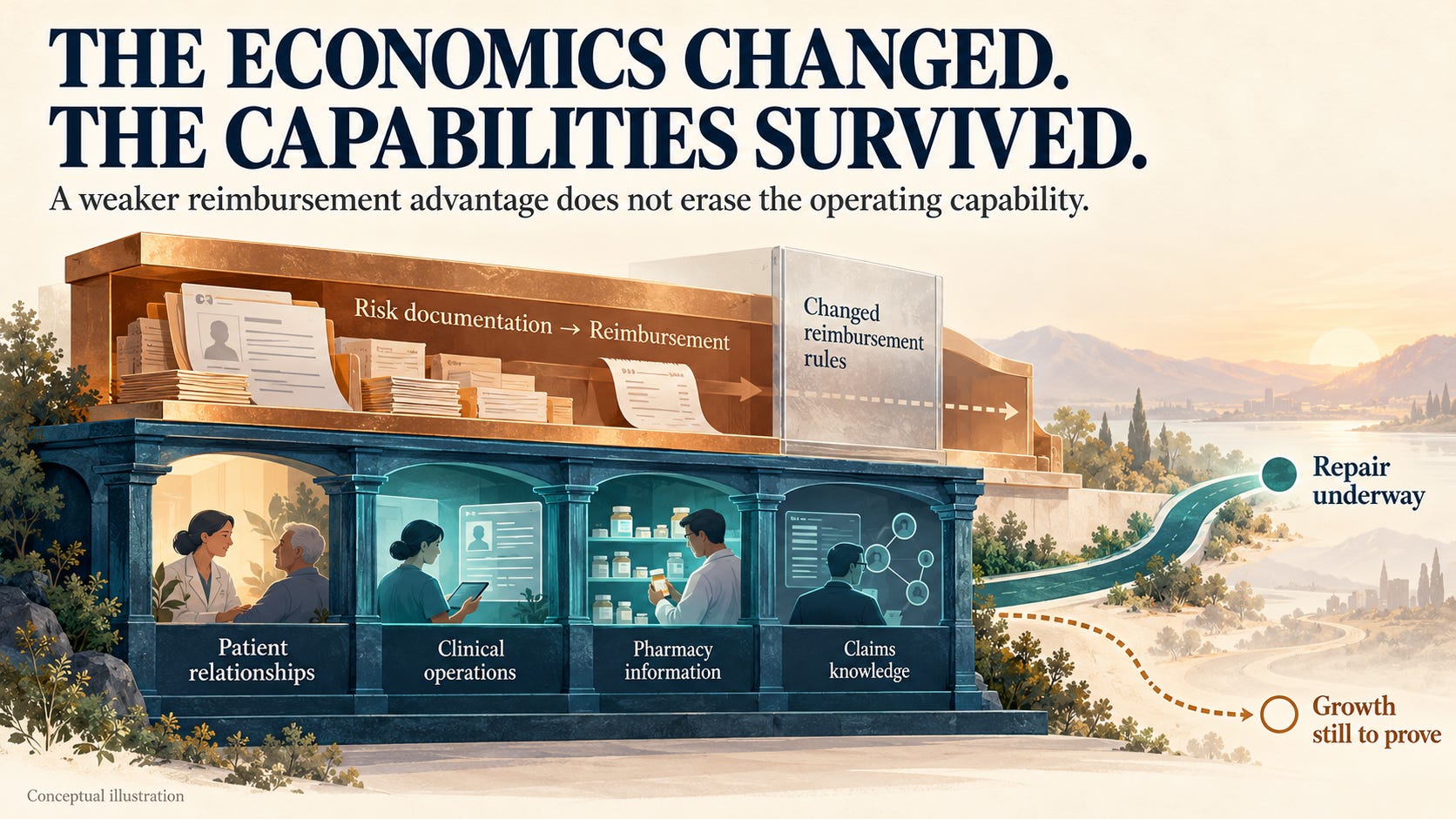
Our earlier interpretation leaned too heavily on one explanation. UnitedHealth combined insurance, care delivery and diagnostic information to document patients’ conditions and receive risk-adjusted reimbursement. When Medicare’s V28 changes weakened parts of that opportunity and profitability collapsed, we treated reimbursement optimization as an almost complete explanation of the business.
That was too categorical. Reimbursement rules, inadequate pricing, patient mix, utilization and execution affected the same financial result. January was too bearish about the business that could survive them.
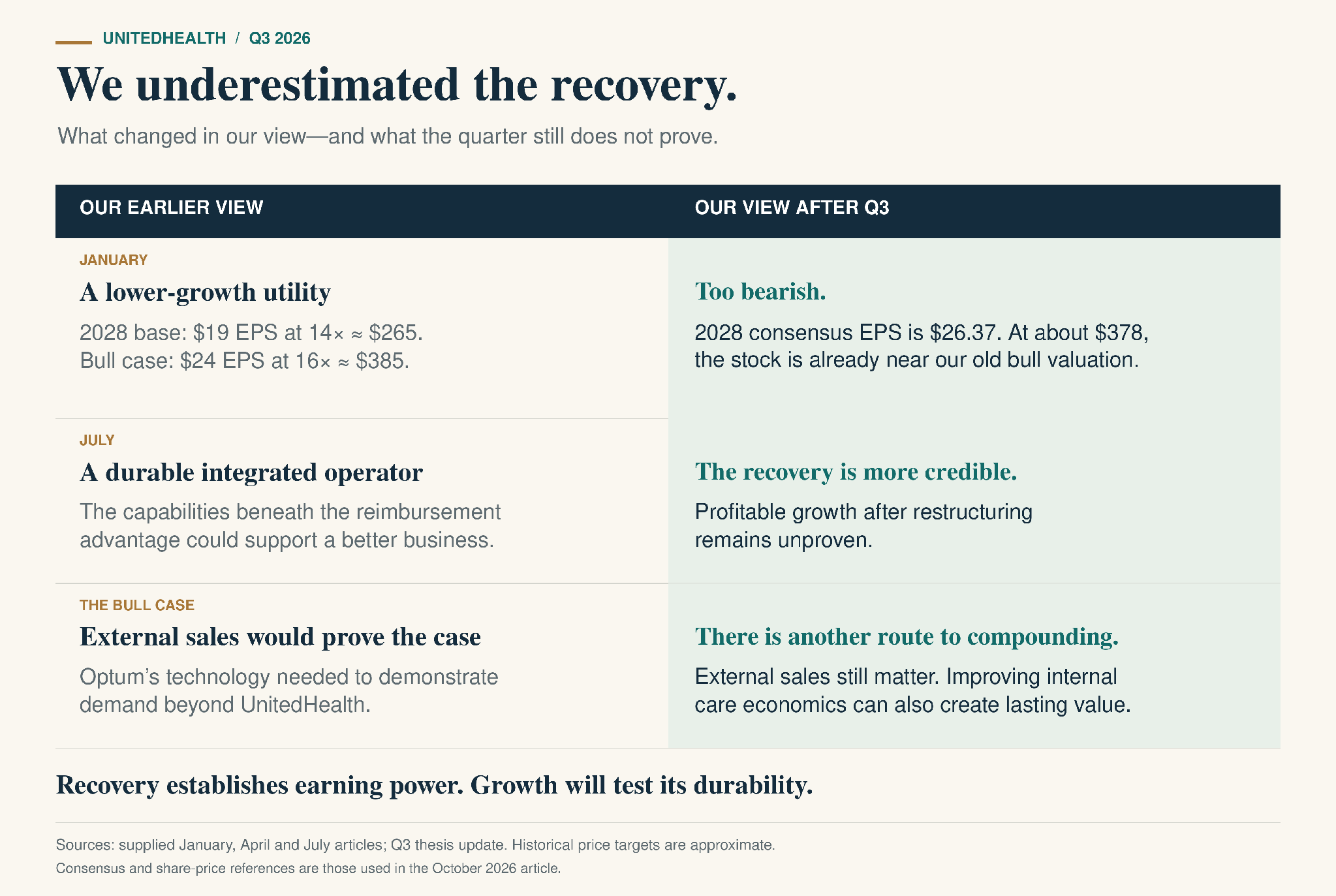
Source: our supplied January, April and July articles; current investment judgments.
The history makes the distinction visible:
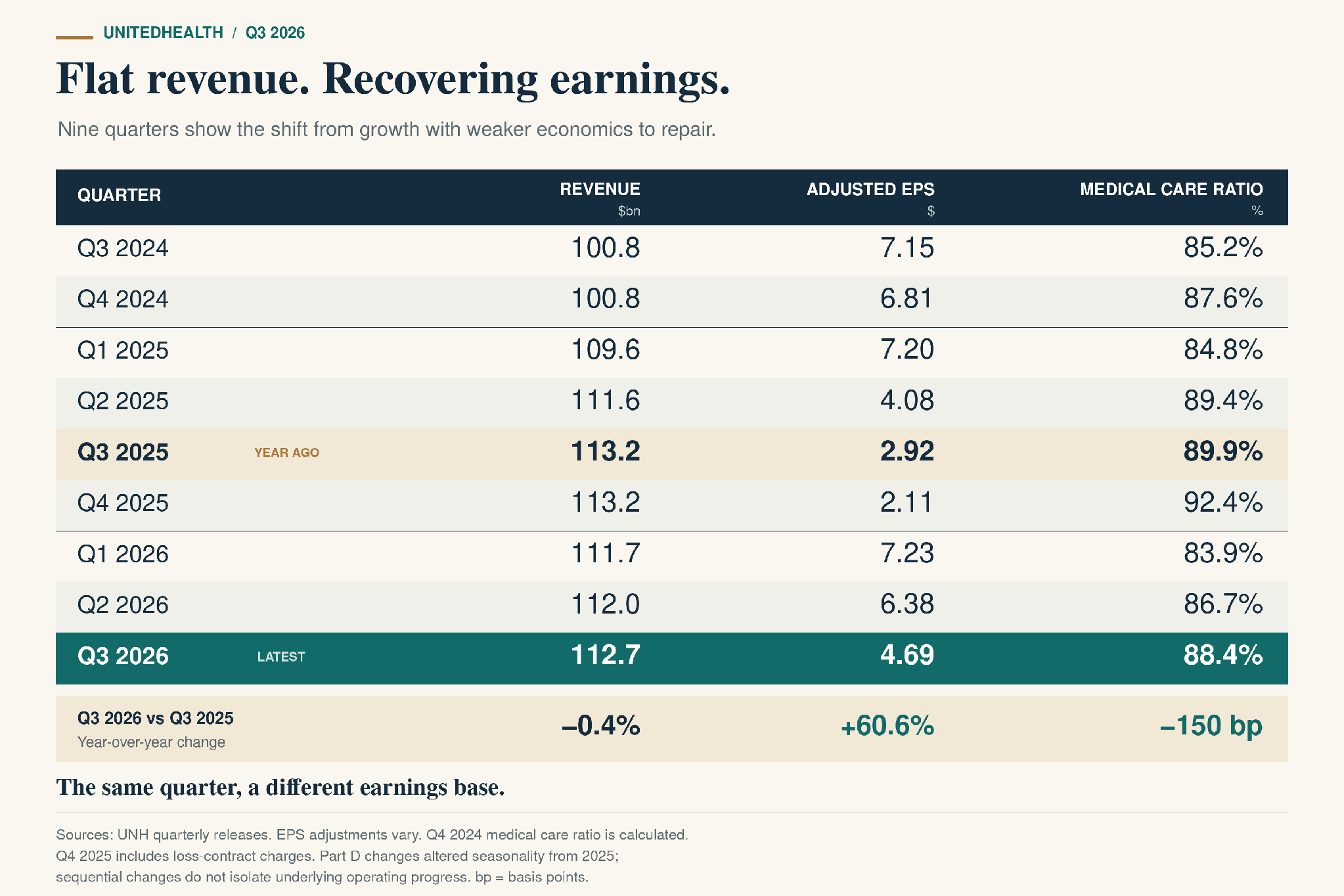
During 2025, growth accompanied deteriorating economics. Now, flat revenue accompanies repair. The business is earning more from the risks it chooses to retain.
The qualification is $610 million of favorable development on earlier-2026 medical claims. Adding it back takes Q3’s medical care ratio (the share of premiums spent on medical care) from 88.4% to approximately 89.1%. Its earnings equivalent is roughly $0.53 per share, close to the $0.55 consensus beat. But we do not know analysts’ reserve assumptions, so this does not establish that reserves explain the entire surprise. The separate $95 million loss-contract benefit was already excluded from adjusted earnings.
Cash strengthens the recovery argument. Nine-month operating cash flow of $25.1 billion already exceeds July’s approximately $24 billion full-year outlook, although Q4 can absorb cash. After capital spending, $22.7 billion equals 137% of adjusted net income. Removing the entire $4.3 billion working-capital inflow still leaves roughly 110% conversion. This is substantial cash generation, although regulated subsidiaries’ cash is not all freely distributable.
There is room in the earnings floor, too: $20.50 less $18.30 earned through September implies Q4 of at least $2.20, only 4% above last year. Seasonality warrants caution, but that is a low hurdle after Q3’s 61% growth. A floor is not a forecast.
The Economics of the Next Patient

In July’s The Layer Beneath, we wrote:
A move from losses to 5% margins after aggressive restructuring may therefore demonstrate effective triage rather than a durable competitive advantage. That distinction is critical because triage is finite. Once the worst contracts and markets are removed, further improvement must come from better operations or renewed growth. Cutting away mistakes cannot compound indefinitely.
The opportunity begins with fragmentation. A hospital discharges a patient, a physician changes a prescription and a pharmacy sees an adherence problem. Each sees part of it.
UnitedHealth can potentially connect the information and the response. Coordinating medication, arranging follow-up and identifying deterioration after hospitalization may prevent a readmission. Under a suitable risk contract, avoiding that hospital stay benefits both patient and business.
Experience across more patients can refine the process, and better care at lower cost wins coverage and retention that fund further improvement. That is the compounding mechanism we should be testing.
Information must change clinical decisions, and intervention must cost less than the problem it prevents. Owning every participant does not guarantee coordination.
Q3 offers evidence about the earlier steps. Management reported that AI chart summarization reduced review time by 33%, while home-health visits increased 10%. These indicate improved capacity and access; the disclosures do not establish lower medical costs and better outcomes for comparable patients.
Optum Health’s adjusted margin fell from 5.0% in Q2 to 2.6%. July’s call anticipated nearly all annual earnings in the first half, modest Q3 profit and modest Q4 losses. We put too much weight on first-half margins as evidence of annual earning power. Equally, an expected seasonal decline is not evidence of a fresh deterioration.
Nine-month adjusted profit is $3.07 billion. Illustratively, a $300 million Q4 loss on $23 billion revenue would leave an annual margin near 3%. Those Q4 inputs are our assumptions, not guidance. First-half margins therefore cannot yet establish that Optum Health has recovered its earning power.
The competitive test is equally demanding. The second quarter is the latest period the four large Medicare insurers have all reported, and it shows both how copyable the repair is and what growth can cost:
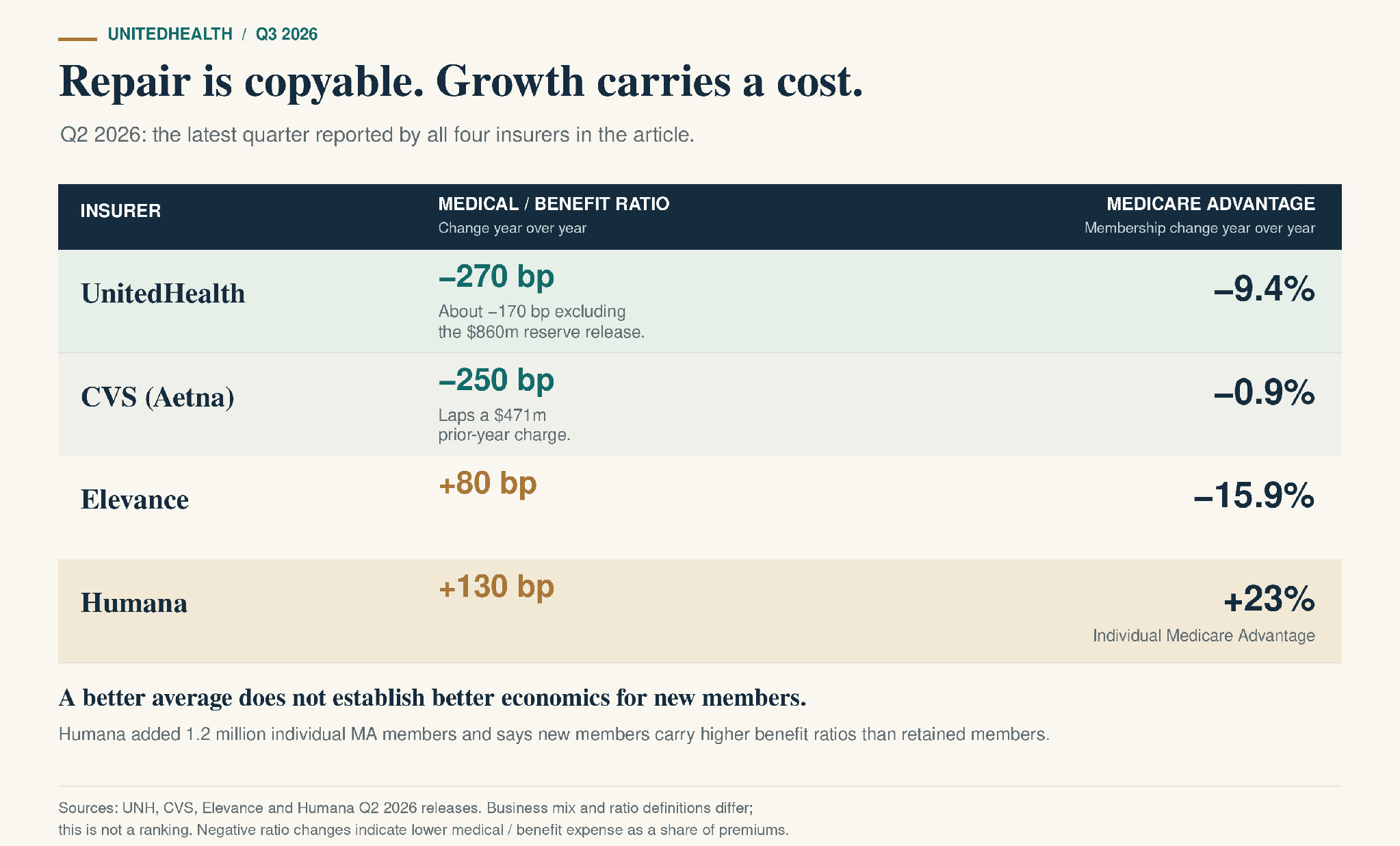
CVS, which also combines insurance, pharmacy benefits and care delivery, improved almost as much as UnitedHealth, so selectivity can be copied. Humana is the more important case for our question. It pairs insurance with CenterWell, whose profits rose, yet it added 1.2 million individual Medicare Advantage members in a year and says new members run at higher benefit ratios than retained ones. That is the clearest evidence this year of what the next patient costs a Medicare insurer, and it points the wrong way.
Exiting expensive contracts improves the average. Treating the next patient at lower cost than would otherwise be possible, without compromising care, demonstrates a capability UnitedHealth can carry into new business.
Who Keeps the Savings
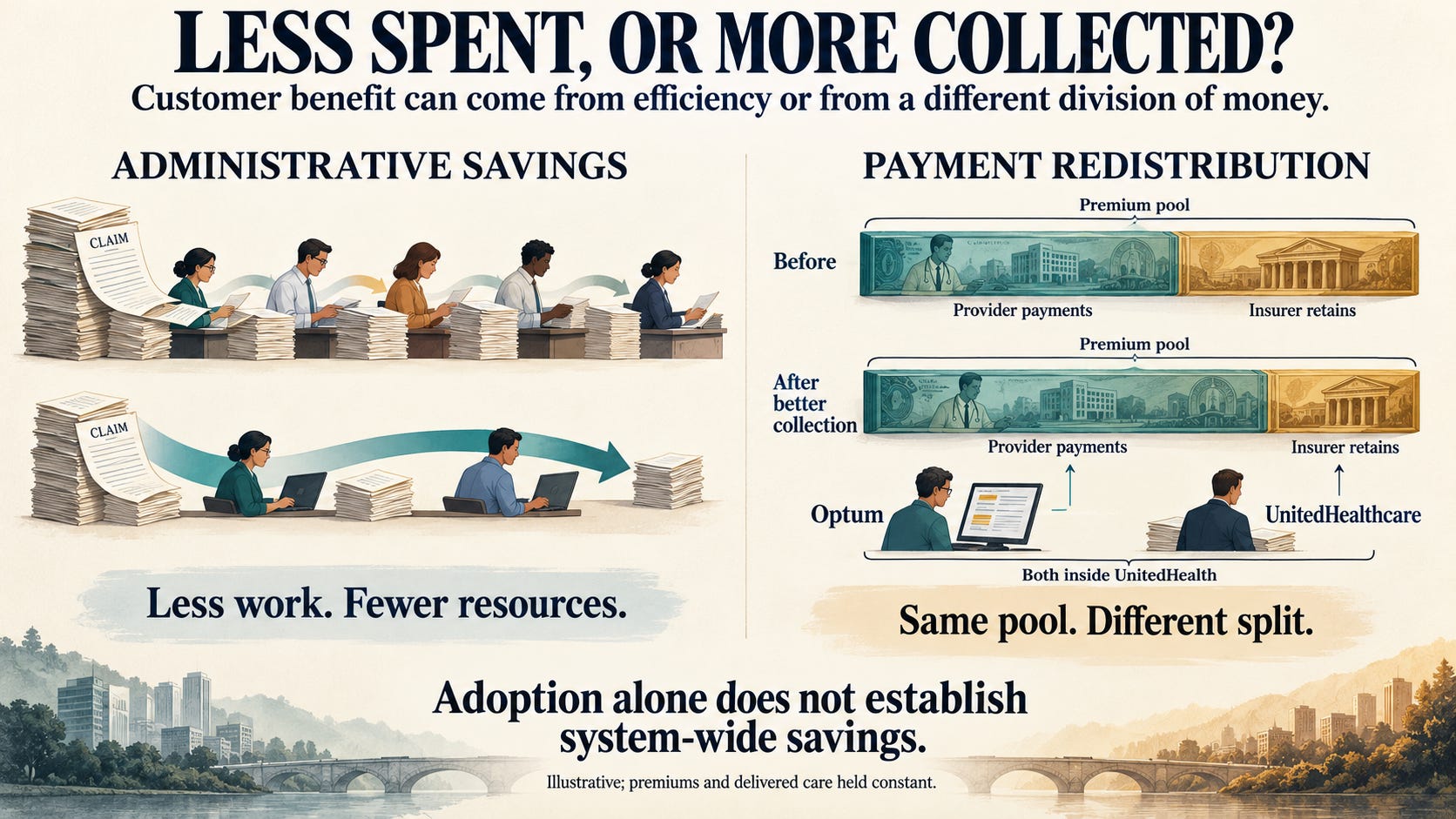
Healthcare technology introduces another complication: one customer’s gain can be another customer’s expense.
Optum Integrity One’s product materials describe less manual work, more accurate coding and fewer denials, alongside improved providers’ reimbursement. Automating documentation can save real administrative expense. Capturing a larger payment changes the distribution of money between provider and payer; it does not, by itself, reduce total care costs.
Hospital billing and Medicare Advantage risk adjustment work differently, but the question is the same: where does the benefit come from? The tension reaches inside UnitedHealth: UnitedHealthcare pays providers while Optum sells tools that help them collect. Tim Noel still described commercial medical cost trends exceeding 11%, partly reflecting greater clinician cost intensity.
This is why we broadened our July bull case: selling these capabilities is an additional opportunity, not the test of the whole company.
The external opportunity remains early. Insight revenue grew 2.9% to $5.47 billion. Patrick Conway described “accelerating growth” in 2028 and beyond. Our late-2026 test of growth toward 8% remains open until Q4 results. Q3 offers little support for meeting it; moving the deadline to 2028 would conceal the shortfall in progress.
Sandeep Dadlani, who runs Optum Insight, offered the most concrete adoption measure:
As 2026 is on plan, I want you to think about Insight as a multi-year investment and execution journey. There is a few moving parts here. We are continuing to rationalize existing products and contracts where they do not make sense. We are infusing AI into our existing offerings that help make them more competitive and profitable, then launching new AI first products and platforms. To give you some examples of the momentum there, our Optum AI consulting firm, with a Medicaid plan, is helping them adjudicate their most complex claims in seconds instead of days using agentic AI. Another example is a product called Optum Integrity One, which automates claims coding in the revenue cycle space. We launched this at the end of 2025. We had two clients at the end of 2025. Today, we have 15 clients implemented and another 24 clients implementing.
That is encouraging progress for Integrity One. Implementations still tell us little about contract size, profitability or renewal.
Optum Rx already demonstrates external reach: more than half its membership now comes from outside UnitedHealthcare. However, internal membership is shrinking; an external share above 50% does not establish external growth.
Adoption also leaves value capture unresolved: competitors can buy similar tools and purchasers can push back on price.
What We Are Paying For
CFO Wayne DeVeydt supplied the clearest statement of management’s confidence:
We would offer that current analyst consensus for 2027 may understate the opportunity ahead, and we see the lower end of our long-term 13%-16% growth rate as a more reasonable starting point. As we think about 2027 more broadly, we continue to see a balanced set of tailwinds and headwinds. Tailwinds include continued enterprise-level performance progress, share repurchases, value-based care performance improvements, and further gains from AI and modernization that improve both consumer and clinician experiences, drive productivity benefits, reduce costs, and create sustainable performance improvement opportunities for our business and those we serve, as well as product opportunities for Optum Insight.
Thirteen percent on $20.50 implies $23.17, versus pre-results FactSet consensus of $22.62. This is directional commentary, not formal guidance. It also reveals the timetable: management expects earnings growth before Insight’s hoped-for acceleration.
The shares reached $399.88 on results day before closing at $377.76, down 0.2%. That reversal establishes the limits of the market’s enthusiasm, not its cause.
Our variant perception: UnitedHealth can become more valuable through better care economics even if Insight disappoints. But low-teens earnings growth during repair does not establish a low-teens compounder afterward. At approximately 16.3 times the implied 2027 starting point, the actual share price already pays for meaningful recovery. Our disagreement concerns the durability of growth, not whether next year’s earnings rise.
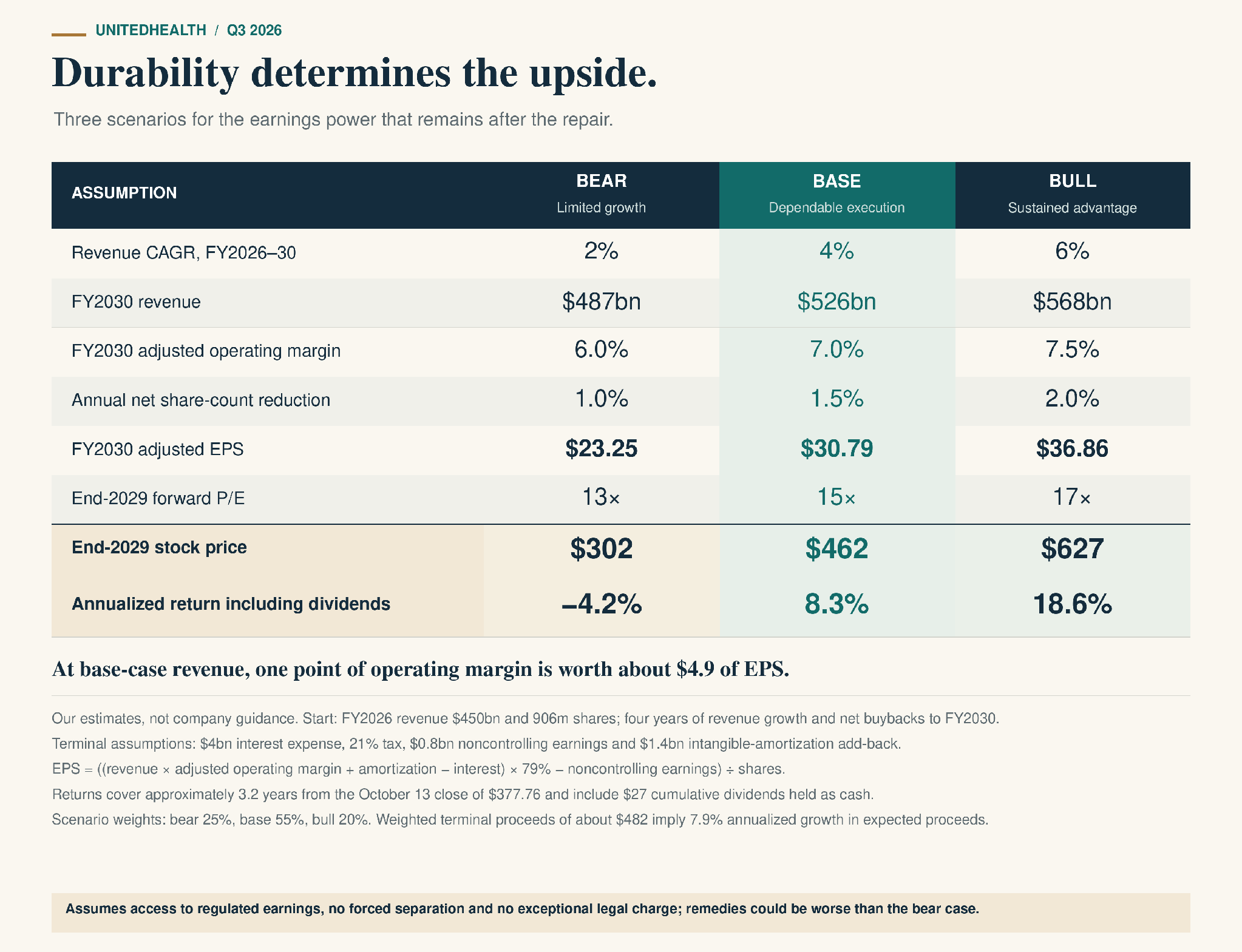
The multiples price limited growth, dependable execution and sustained advantage. At base-case revenue, one point of operating margin changes EPS by about $4.9.
Weighting bear, base and bull at 25%, 55% and 20% produces approximately $482 of terminal proceeds including dividends, equivalent to 7.9% annualized growth in expected proceeds. That supports holding an existing position around $378. It offers limited room for disappointment for new capital; around $350, the same assumptions exceed 10% annualized.
These scenarios assume continuing access to regulated businesses’ earnings and no forced separation or exceptional legal charge. A regulatory remedy could be worse than our bear case.
The evidence that would change our view is observable:
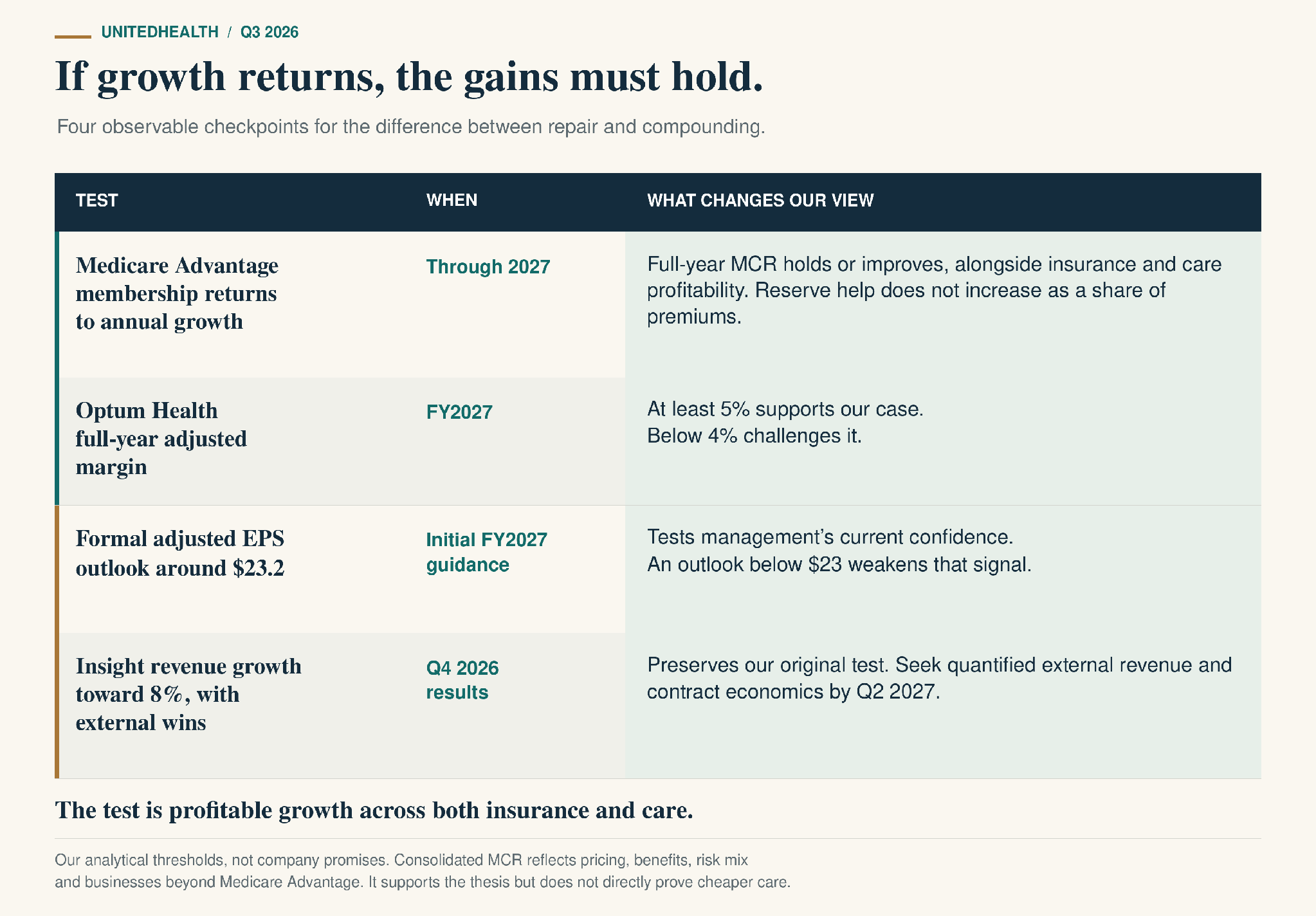
The bear case has named challenges. “Only pruning works” weakens if membership grows, annual Health margin reaches 5% and earnings hold without greater reserve support. “External demand is immaterial” weakens if Insight accelerates and discloses material external revenue. Those outcomes would reduce the bear case’s probability; they would not eliminate regulatory risk.
July changed our view of what survived. Q3 increases our confidence that it can earn money again. The next patient will determine whether that recovery can compound.
Disclaimer:
The content does not constitute any kind of investment or financial advice. Kindly reach out to your advisor for any investment-related advice. Please refer to the tab “Legal | Disclaimer” to read the complete disclaimer.