


TL; DR
Both companies entered the deal from positions of strength: CrowdStrike’s net-new ARR reached $419 million, up 58%, while Zscaler’s organic net-new ARR growth accelerated to 22%. The transaction is not a rescue; it is a strategic combination of two businesses whose standalone demand is improving.
The strategic logic is strongest in an agentic world where seat-based pricing becomes too small: agents create far more activity than employees, and the cost of inspecting that activity can rise faster than invoices tied to seats. Combining endpoint and network enforcement gives CrowdStrike more places to monetize protection, while Flex provides a broader commercial wrapper.
But ownership only creates value if integration improves outcomes and economics: shared context, coordinated policy and faster deployment could make the combined platform better than the existing partnership. Yet dilution, capital intensity, integration risk and a still-rich valuation mean a better business does not automatically produce a better stock.
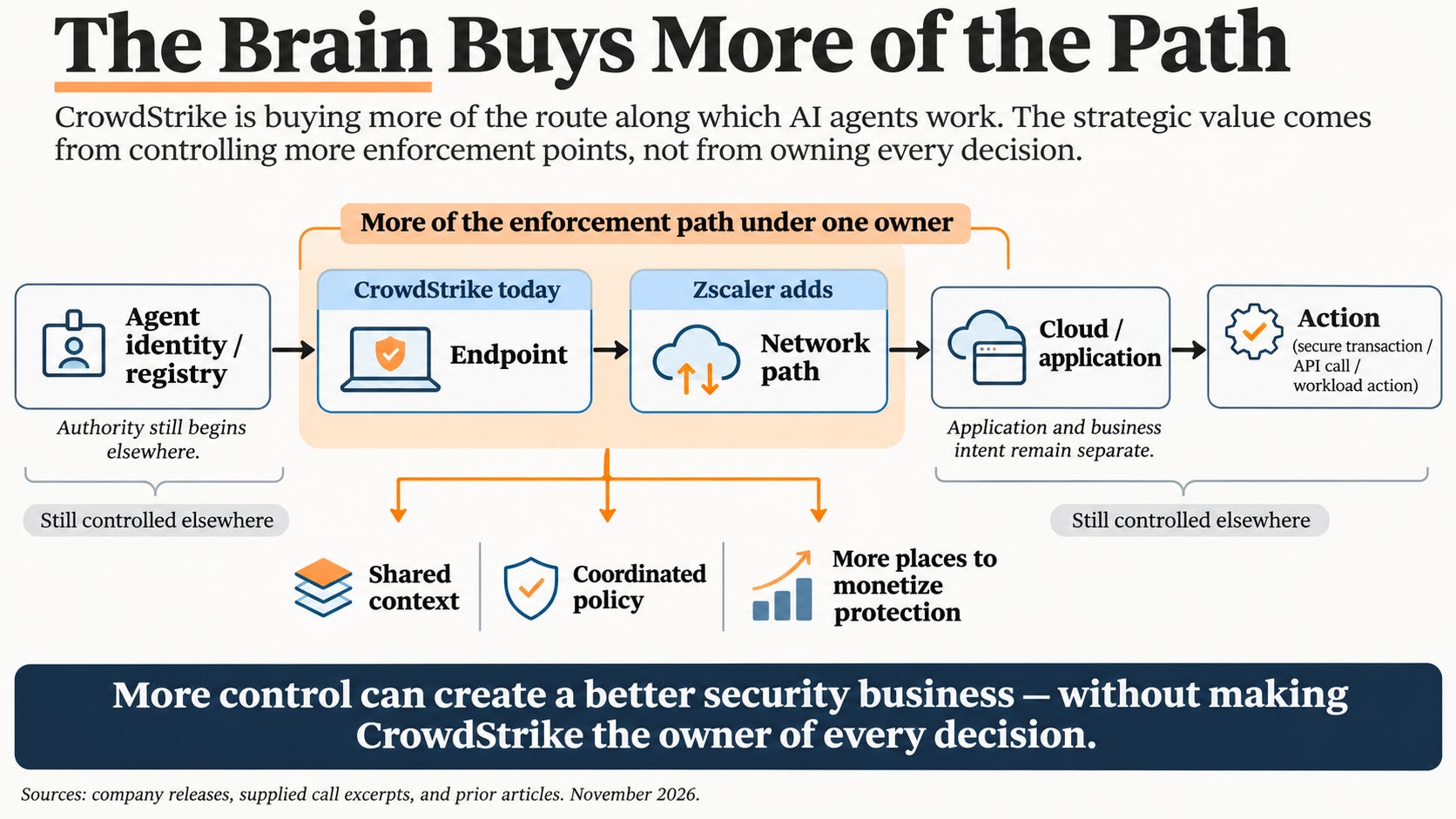
On 11 June, I published “Upstream of the Wire”, arguing that valuable security decisions were moving toward identity, endpoints and code. One week later, CrowdStrike and Zscaler signed a confidentiality agreement. Five months later, on the morning both companies reported accelerating new business, CrowdStrike agreed to acquire Zscaler at approximately $43.9 billion in enterprise value.
By September, my Zscaler argument had become more precise. It could remain the enterprise’s circulatory system without becoming its brain: decisions made elsewhere still needed somewhere to be enforced. Our August CrowdStrike article approached the same problem from the device. The installed Falcon sensor made new products easier to deploy; Falcon Flex made them easier to buy. The two arguments have now met in one transaction.
Why combine when both businesses are demonstrating that they can prosper independently? My answer is that agents are changing what security protects, what customers pay for and what protection costs. Common ownership gives CrowdStrike a stronger position in that transition. I expect the combination to become a better business. At the November 23 reference price of approximately $209, I would still not add the stock.
Two Tests Passed
In August, I wrote that CrowdStrike needed to make $333 million of quarterly net-new annual recurring revenue, or ARR, look ordinary. November delivered $419 million, up 58% and $72 million above the top of guidance. Revenue reached $1.583 billion, against the announcement-time Bloomberg consensus of approximately $1.53 billion. Fourth-quarter revenue guidance also exceeded consensus, while free cash flow rose 60% to $474 million.
Zscaler passed its own test. Our September article contrasted 17% organic net-new ARR growth with annual guidance implying roughly 4%. This quarter delivered 22%. That strengthens the recovery thesis; management subsequently withdrew guidance because of the transaction.
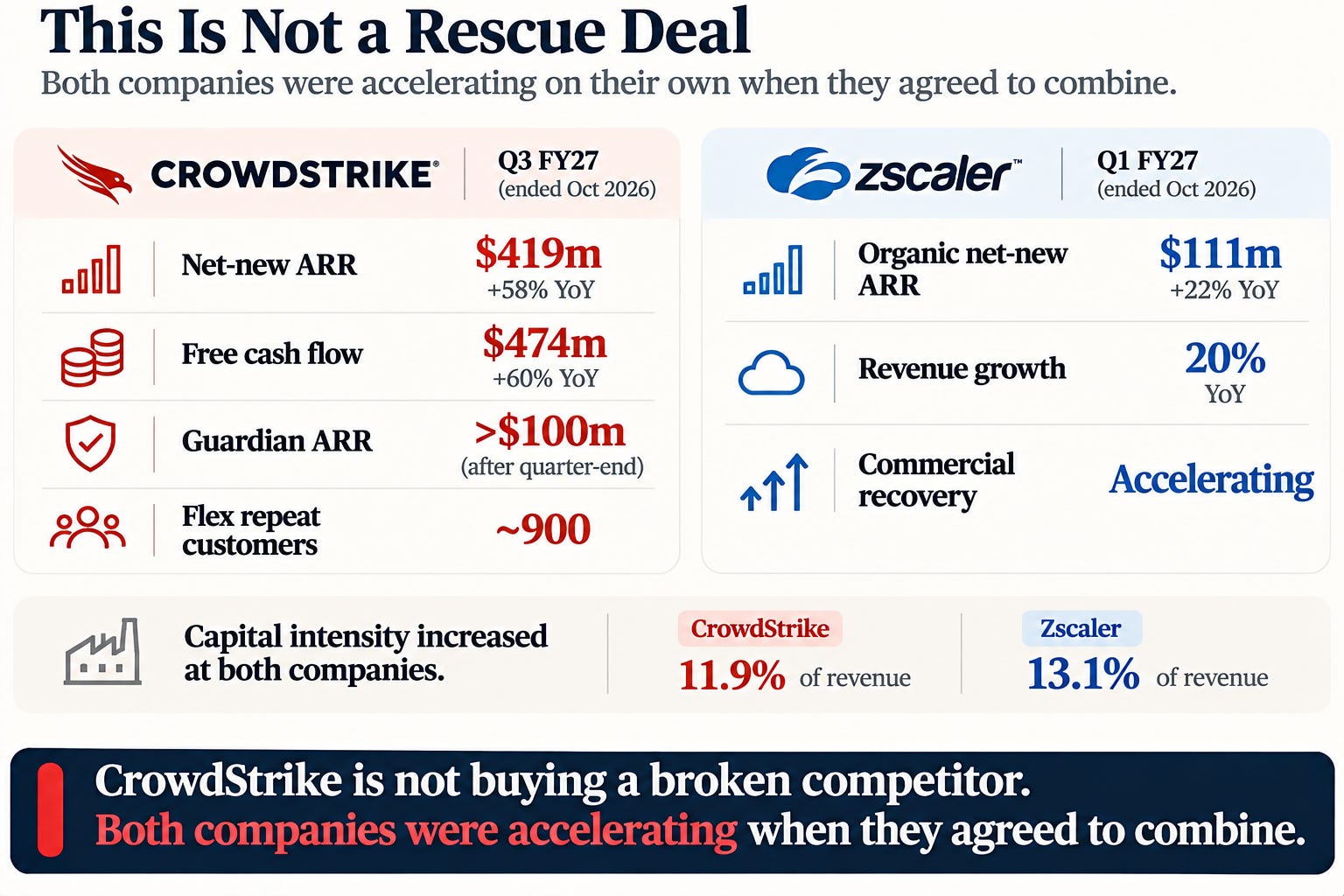
Flex customers expanding repeatedly now carry ARR 64% above their initial subscription, versus 53% last quarter. Their return for larger commitments weakens the explanation that Flex merely borrows demand from the future.
I underestimated the pace of CrowdStrike’s expansion in August. I also treated rising capital intensity too narrowly as Zscaler’s problem. CrowdStrike’s equipment and capitalized-software spending rose to 11.9% of revenue from 8.1%. Zscaler’s 13.1% compares with 4.4% a year earlier, although below the previous quarter’s 24.3% spike. Zscaler’s free cash flow was almost unchanged at $416 million despite 20% revenue growth. Its commercial recovery is running ahead of cash generation. Equipment prices and purchasing timing also matter; these figures do not isolate the cost of agents.
CrowdStrike’s margin improvement also contains an accounting benefit. Extending commission amortization from four years to five reduced quarterly expense by $22.8 million. Adjusted operating margin would otherwise have been approximately 24.2%, against the reported 25.6%. Profitability improved, but the underlying gain was smaller. The growth thesis has strengthened; the assumption that serving each new security problem costs almost nothing has weakened.
The Seat Is Too Small
CrowdStrike was founded in 2011, between Microsoft’s introduction of free Security Essentials in 2009 and the inclusion of antivirus protection in Windows 8. Microsoft made baseline protection an operating-system feature. CrowdStrike built a business around the visibility, detection and response that enterprises still needed beyond it.
Microsoft is applying the same commercial logic to agents. Its Microsoft 365 E7 offering bundles E5, Copilot, Agent 365 and Entra Suite for $99 per user monthly. Its licensing documents say agents require no separate licences and Agent 365 currently has no consumption charges. Service limits still apply. Google brings comparable distribution through its cloud business and Wiz, which continues to protect competing clouds. Independent vendors must persuade customers to pay separately for protection that the larger suppliers can subsidize through other products.
Microsoft’s deeper advantage is the agent registry. The supplier maintaining identities, ownership and permissions influences the rules that enforcement systems execute. Microsoft includes basic agent identity and registry capabilities with its cloud subscriptions. CrowdStrike’s announced Agentic Identity Provider contests that authority, but Microsoft starts inside the corporate directory. This sharpens my September Zscaler argument: the place where a decision is enforced can remain indispensable while another supplier controls its terms. Buying the network strengthens CrowdStrike’s reach; winning authority over agents requires a separate product victory.
The economics of finding flaws are changing too. Anthropic’s Mythos Preview listed at $25/$125 per million input/output tokens; Mythos 5.2 starts at $8/$40, a 68% reduction in list prices. Token prices alone do not measure the cost of a validated fix, but I expect routine vulnerability discovery to face sustained pricing pressure. My June argument gave code too much credit as a durable destination for value. Better analysis can become cheaper while increasing demand for protection: every newly exposed flaw creates work until a fix is safely deployed. George Kurtz described how that demand reaches CrowdStrike:
Multiple Fortune 50 CrowdStrike customers called the Frontier Labs, pausing full deployment until Cowork and Codex could be secured by CrowdStrike. This prompted the Frontier Labs to collaborate deeply with us, and now the Falcon sensor runs inside AI containers from day one, giving enterprises the visibility, control, protection, and lifecycle management they need to deploy AI safely. The role of security in the AI wave has expanded beyond protection, focused on preventing and stopping adversaries, to safety, enabling safe AI adoption.
This is management’s account. Its economic significance is that protection becomes a condition for deploying useful AI. CrowdStrike participates in the customer’s decision to authorize more work, broadening its role beyond responding to attacks.
The labs can also reach into enforcement. OpenAI and Cisco’s Shirudo project demonstrates runtime protection for Linux through a partnership. CrowdStrike’s advantage is therefore its installed reach, operating experience and customer trust. Assuming model companies cannot enter would mistake today’s division of labour for a permanent boundary.
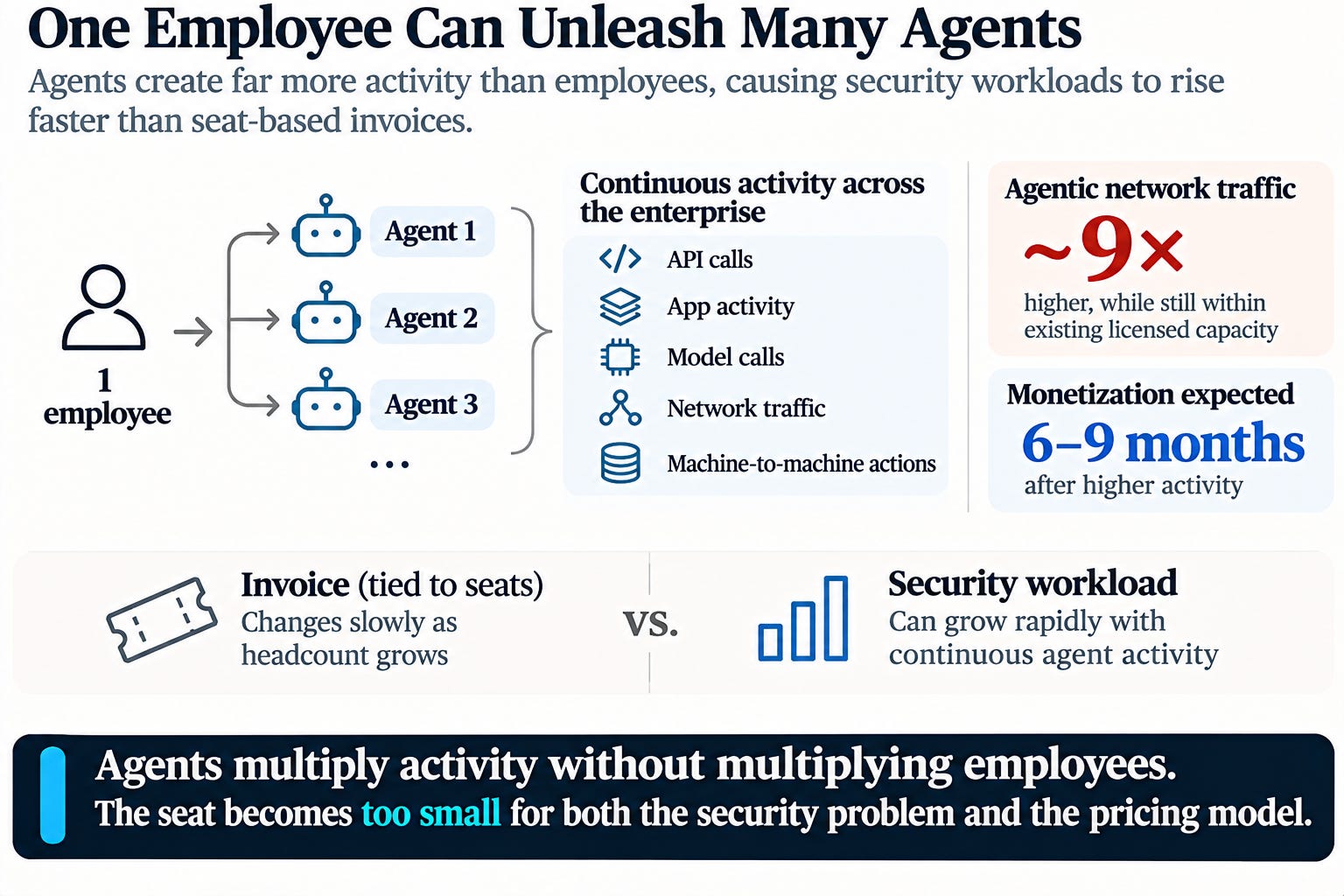
The more immediate pressure comes from the seat. An employee has limits on how much software they can use in a day. An agent can call applications, models and other agents continuously. Activity expands without a corresponding increase in employees. If the supplier inspects that activity but charges by employee, its cost can grow faster than its invoice.
Palo Alto made the problem tangible five days before this deal. Management reported roughly ninefold growth in agentic traffic on its network-security service, still within customers’ licensed capacity, and put incremental traffic monetization six to nine months away. More traffic had created an opportunity to charge; the extra revenue had not yet arrived.
This is where Flex matters, and where its significance needs precision. A committed spending pool makes purchasing easier. Revenue then depends on the products and usage the customer pays for; profitability depends on their delivery cost. An eight-month repeat purchase is strong evidence of expansion. It does not establish that every additional agent action is billable or profitable.
Zscaler was already adapting. In September, we highlighted more than $770 million of quarterly Z-Flex commitments and a roughly 30% non-seat contribution to new annual contract value. Workloads, branches and data were already changing its commercial mix. CrowdStrike is buying an opportunity to accelerate that transition through a larger customer relationship.
I think this is the acquisition’s strongest economic argument. Customers will pay for protection that lets them deploy more agents safely across different vendors’ systems. Combining the device and network gives CrowdStrike more places to deliver that protection, and Flex gives it a familiar way to sell it. The opportunity is larger contracts and deeper adoption; a separate toll on every agent action is unnecessary.
What Ownership Buys
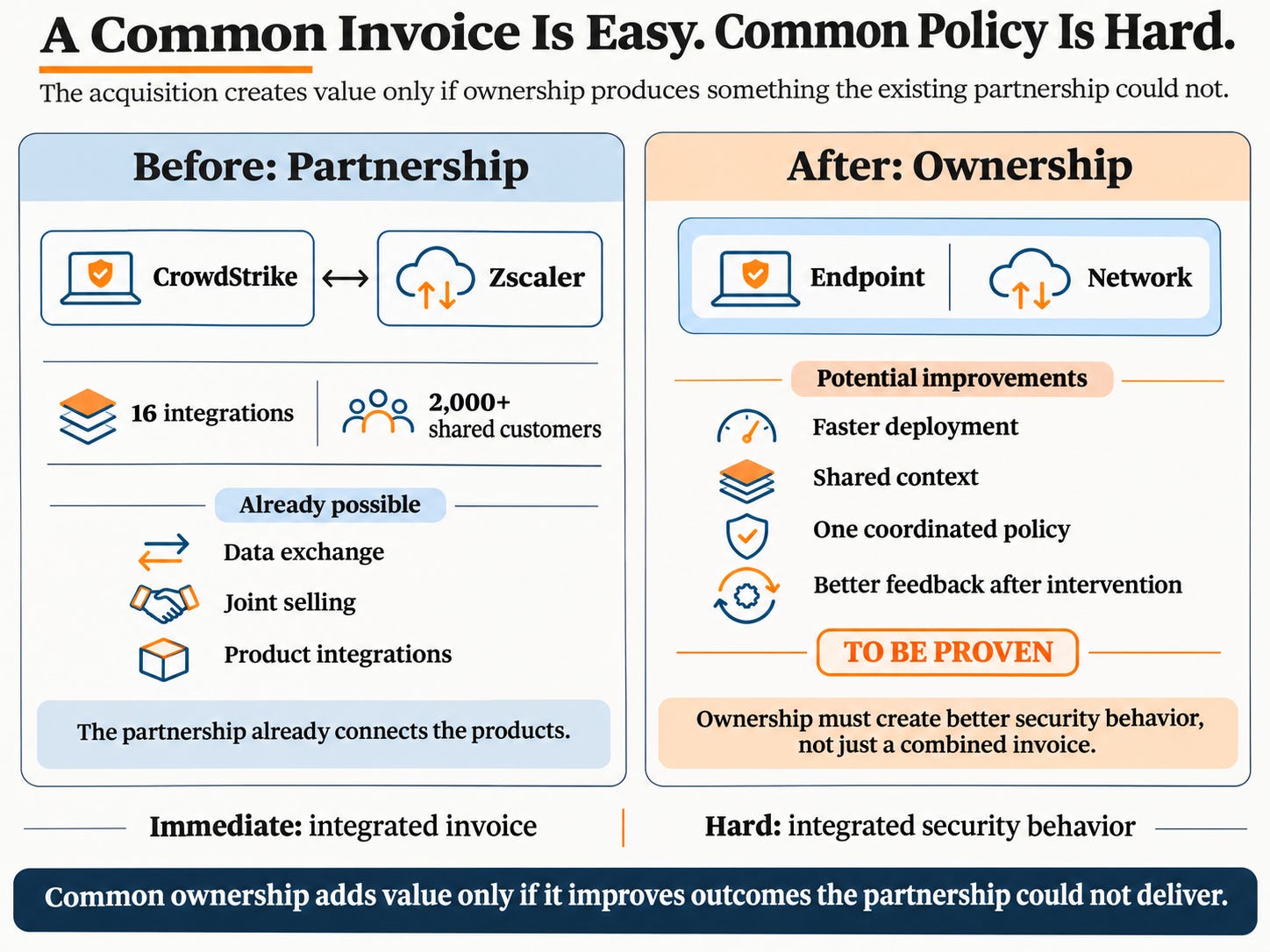
The companies already have 16 integrations and more than 2,000 shared customers. Ownership has to improve on that arrangement. I expect its advantage to come from coordinating product development, sharing security context and removing the commercial negotiation between two suppliers whenever a customer wants a combined capability.
That should make deployment faster and intervention more consistent. It should also improve learning from what happened: whether an intervention stopped an attack, disrupted legitimate work or failed. Such feedback becomes valuable when customers permit its use and it improves subsequent decisions. Simply collecting more telemetry does not complete that process.
Jay Chaudhry supplied the right standard while criticizing a competitor:
Yes. First of all, the so-called platform term has become a little bit hijacked. I was talking to a customer last year. He said, “I was sold a platform by a firewall vendor, but I tried to deploy it. I found that it was eight separate products underneath with eight policy engines.” Then he laughed and said, “I got one benefit. I got an integrated invoice.” Why is that? That is because a firewall technology is 30 years old. It is evolving a little bit, but it is 30-year-old technology. George built a new technology, new platform when he started the company. I did the same thing. Zero Trust, the opposite of firewalls and the like. We built an integrated platform.
ARR at Palo Alto’s SASE network-security business grew 30%, versus 21% for Zscaler overall. The scopes differ, but customers are clearly buying bundled security. Chaudhry’s criticism identifies what the combined company must do better. A common invoice will arrive quickly; common policy requires engineering. After July 2024, reliability is particularly important: combining device and network controls must preserve separate failure paths so one defective update cannot disable both.
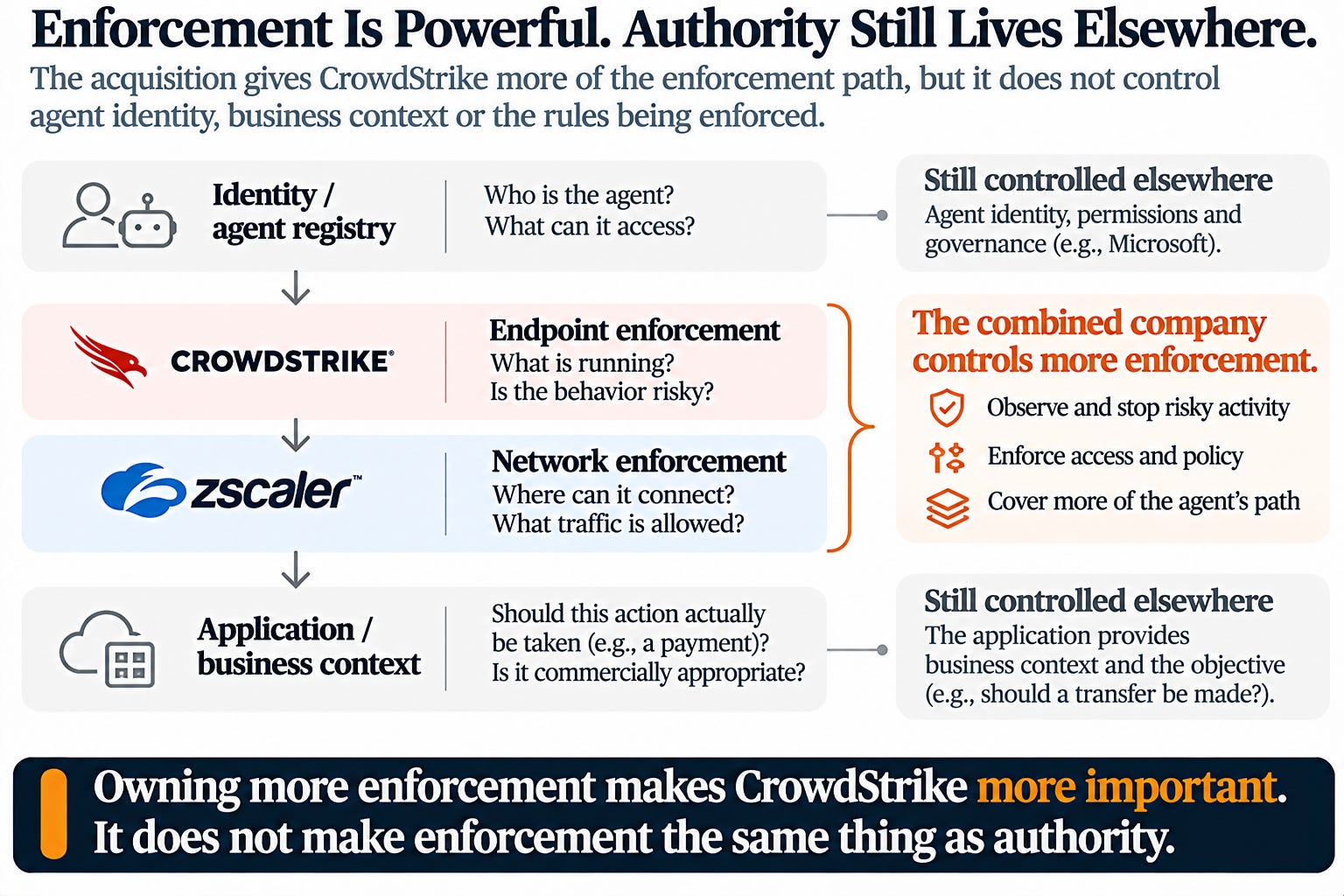
Owning enforcement also leaves room for other suppliers to retain valuable authority. An agent preparing invoices may have a valid identity and secure connection while attempting an inappropriate payment. The application still supplies business context and permission. A kill switch prevents the next action; it does not reverse a completed transfer. CrowdStrike can become more important without owning every decision.
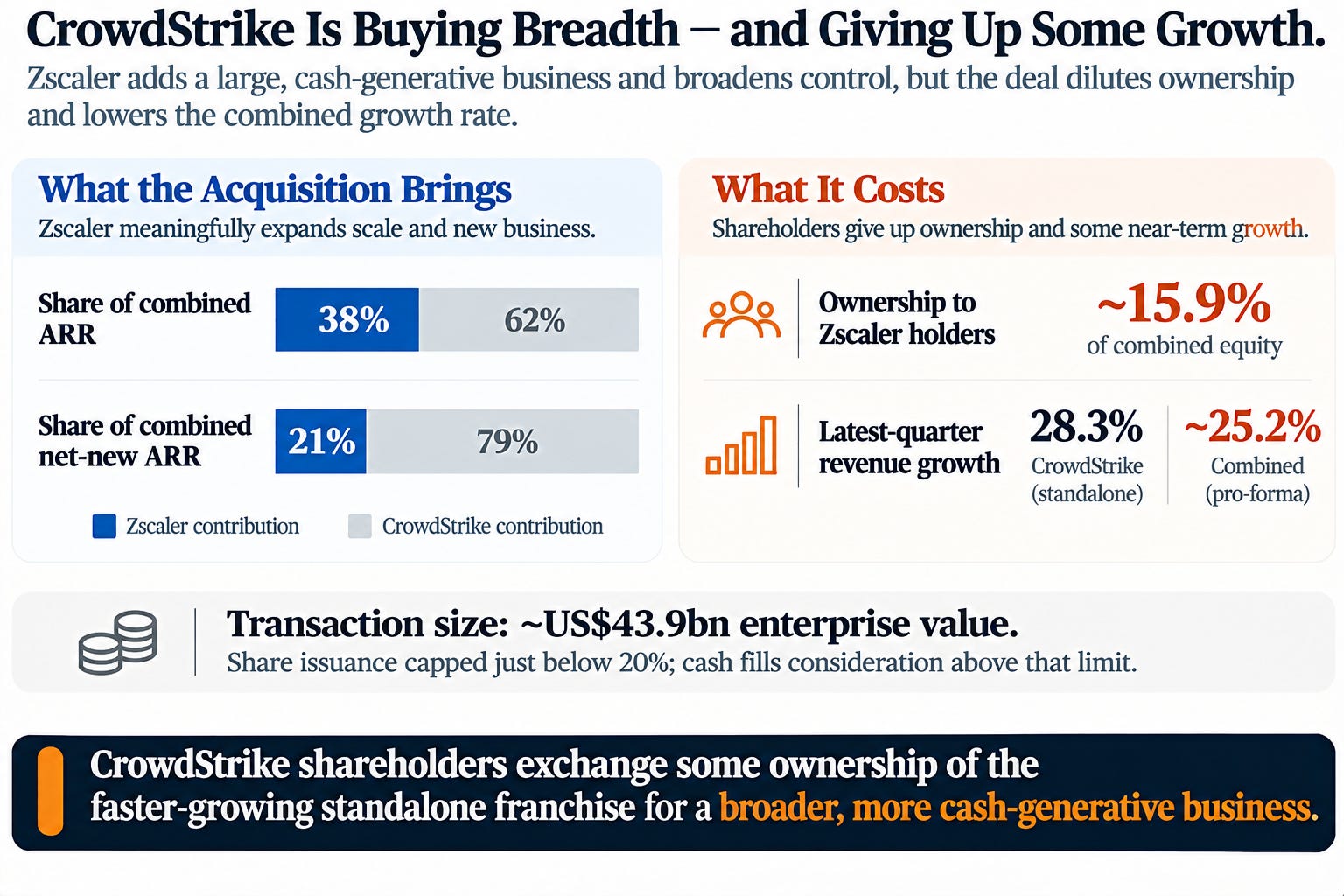
The transaction’s structure raises the importance of board judgment. Share issuance is capped one share below 20% of the relevant pre-issuance base, avoiding the corresponding mandatory CrowdStrike shareholder vote. Cash replaces shares above that limit. Both boards have approved the agreement; Zscaler shareholders still vote. The cap constrains dilution in shares, rather than the economic purchase price.
The terms also allocate negotiating power. Zscaler owes $1.4 billion if it terminates for a superior offer; CrowdStrike has no equivalent regulatory breakup fee and can refuse structural remedies demanded by regulators. Before closing, agreed capital budgets and consent requirements constrain Zscaler’s flexibility. Consent cannot be unreasonably withheld, but preserving momentum during the wait becomes an operating task. Shareholders need the improving business to survive the process of buying it.
The June confidentiality agreement predates the 51% and 58% ARR-growth quarters. It does not establish when price negotiations began; the proxy should settle that. It does establish that November’s competitive announcements alone cannot explain the relationship.
Zscaler supplies approximately 38% of combined ARR but 21% of the latest quarter’s combined net-new ARR, while its shareholders receive approximately 15.9% of the combined company. Those proportions explain how the acquisition can add cash generation while slowing growth. They also clarify what CrowdStrike’s shareholders are exchanging: some ownership of a faster-growing franchise for a broader, more cash-generative business.
CFO Burt Podbere separated the financial promises:
Finally, we expect the transaction will be significantly and immediately accretive to free cash flow per share before factoring any synergies. We also expect it will be accretive to revenue growth, operating margin, and free cash flow margin after synergies within the first fiscal year after close.
Immediate cash-flow accretion is easier to achieve when highly valued shares buy a business at a lower cash-flow multiple. Growth accretion requires operating improvement: combining the latest quarters produces approximately 25.2% revenue growth, below CrowdStrike’s standalone 28.3%. And even a 25% lift in cash flow per share is cancelled by a 20% reduction in its valuation multiple.
I expect financial accretion to arrive before convincing evidence of superior customer outcomes. The strategic opportunity justifies pursuing the combination. It does not make the purchase price self-justifying.
The Return Must Reach the Share
The market’s concern about slower blended growth and integration costs is reasonable. My disagreement is with treating Zscaler principally as purchased growth. CrowdStrike is buying a broader position in the activity that AI creates. That position is valuable even while some individual security functions become cheaper or enter larger bundles.
Our August argument was that CrowdStrike repeatedly postpones maturity: new products become significant before older ones slow. Zscaler extends that opportunity, but also adds capital requirements, integration work and shareholders. Valuation must carry all four.
The following cases value the shares in November 2029 using FY30, ending January 2030. The comparable starting revenue is $9.73 billion: CrowdStrike’s approximately $6.08 billion FY27 guidance plus a $3.65 billion January-year estimate for Zscaler. These are three-year growth assumptions, with the companies’ different fiscal calendars aligned.
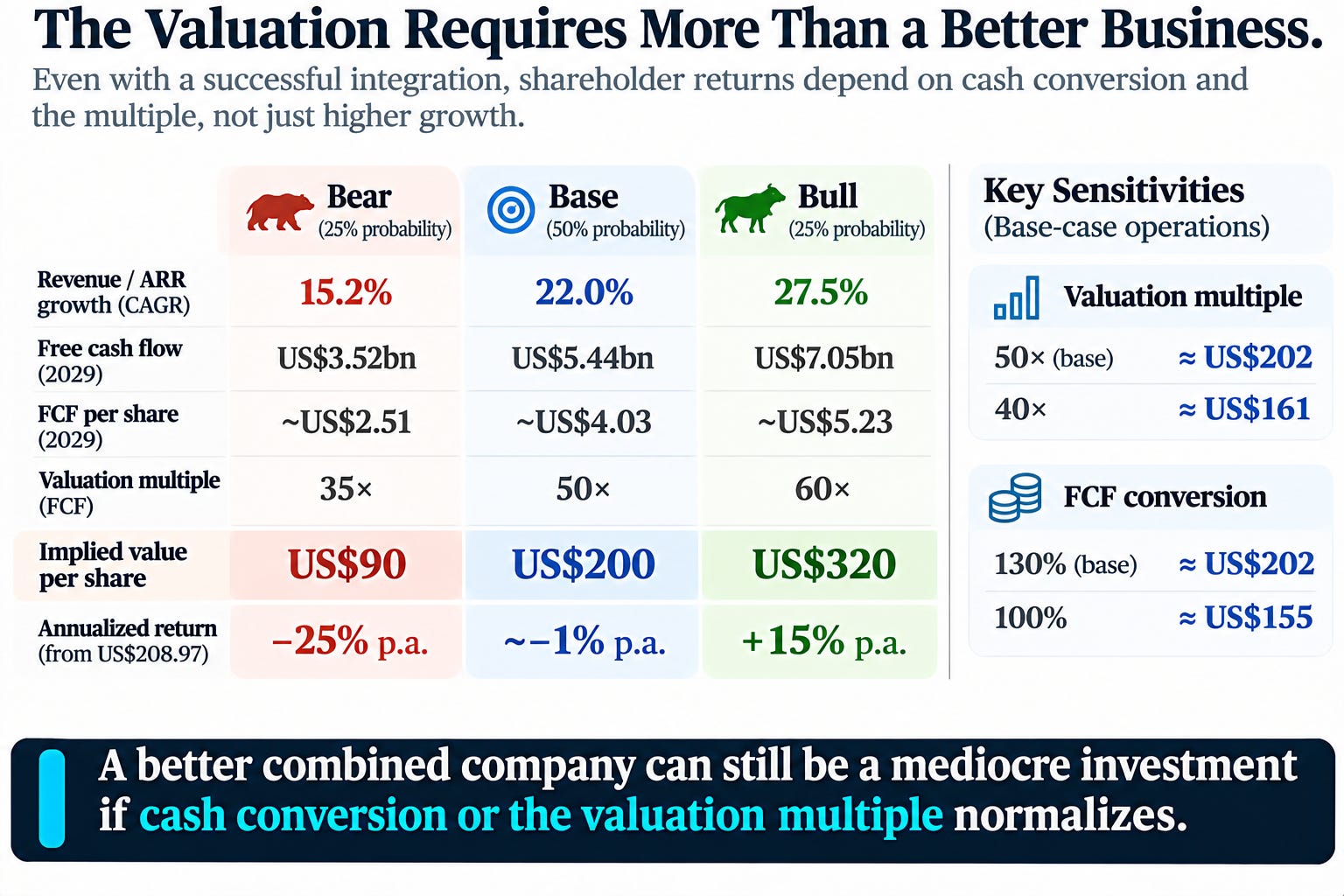
Source: our assumptions; weights express judgment. All cases assume completion and 21% tax. Cost savings are embedded in margins; conversion includes capital spending, working capital and cash integration costs. Shares include transaction issuance and compensation dilution. No separate net-cash value or interest income is added. Returns use unrounded outputs.
The base produces $5.44 billion of annual cash flow, or approximately $4.03 per share. At 50 times, that is about $202. This already assumes a substantial premium survives. At 40 times, the same operating result supports roughly $161. If cash conversion reaches only 100% rather than 130%, keeping the 50-times multiple produces approximately $155.
Those sensitivities matter more than a precise target. The base requires upfront billing and other cash-flow adjustments to provide a net benefit after investment. Stock compensation also separates reported cash generation from the owners’ economics. CrowdStrike recorded approximately $350 million this quarter, about 22% of revenue. Paying employees in shares preserves cash while transferring ownership. Our model captures that cost through roughly 200 million transaction shares and approximately 2.5% annual ongoing dilution; it does not treat reported free cash flow as belonging indefinitely to today’s shareholders.
June’s split-adjusted standalone CrowdStrike ranges were $69–94 bear, $125–181 base and $263–350 bull. The new middle case reflects stronger growth evidence and acquired cash flow, alongside a 50-times terminal multiple above June’s 35–45-times base range. Dilution and a roughly 31% cash margin, below June’s 35–37%, absorb part of the improvement. This is already a more generous valuation judgment.
Timing also limits the synergies. Closing is expected between August 2027 and January 2028. Management targets $500 million of annualized cost savings within 18–24 months afterward and $1 billion of annualized revenue synergies by month 30. The revenue target reaches into 2030; it cannot simply be inserted as a full-year FY30 contribution.
What Would Change My Mind
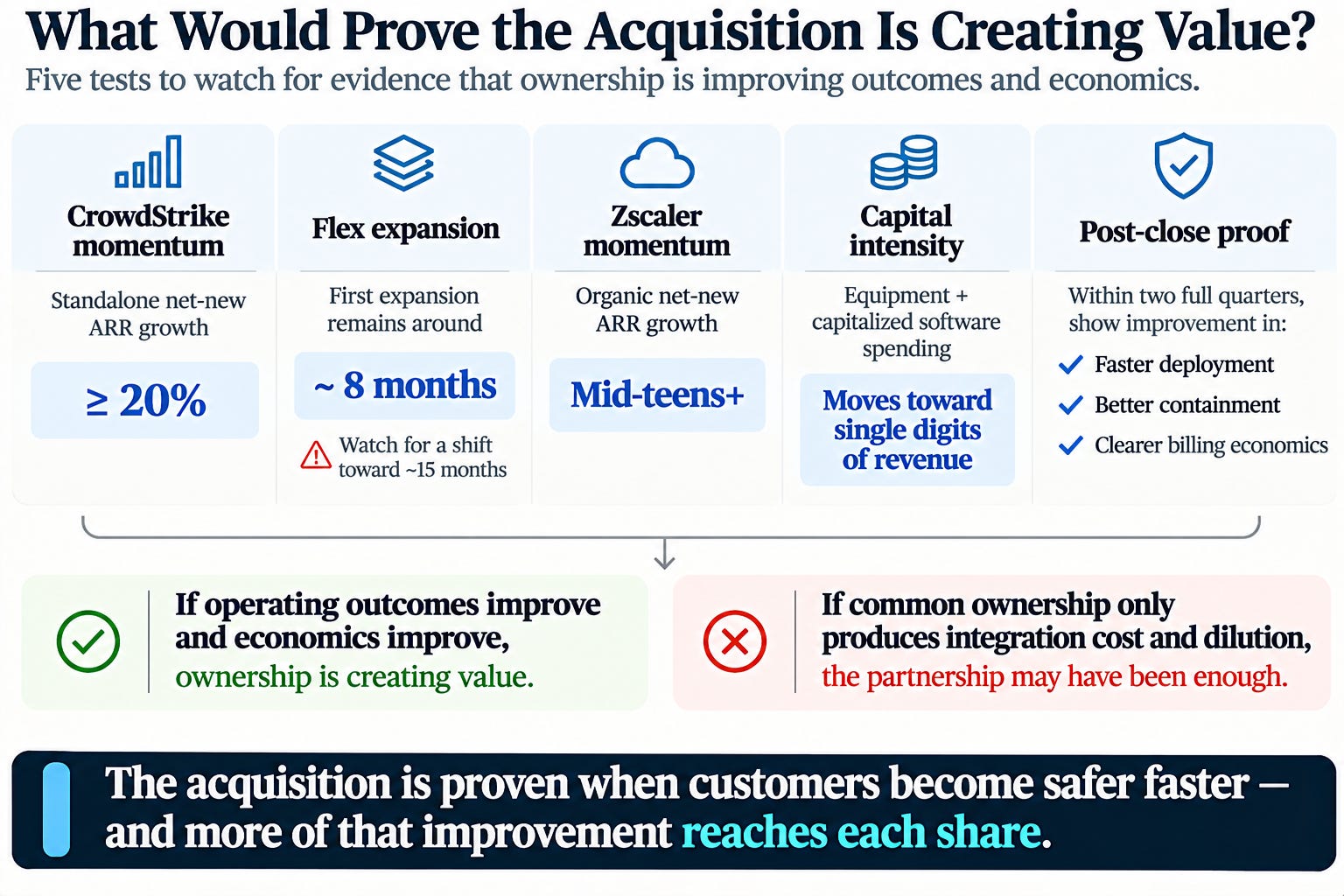
By the FY28 outlook around March 2027, CrowdStrike should preserve at least 20% standalone net-new ARR growth, with acquisition contributions identified separately. First Flex expansion should remain near eight months; a sustained move toward 15 would weaken the consumption argument. Zscaler should sustain at least mid-teens organic net-new ARR growth through its next two reports.
By August 2027, Palo Alto’s expected traffic charges should reveal customers’ willingness to pay beyond seats. Microsoft retaining its current pricing would keep pressure on independent suppliers. During FY28, I want capital intensity moving toward single digits alongside durable subscription margins. Within two full quarters after closing, CrowdStrike should demonstrate faster deployment or better containment than the existing partnership, with clearer billing economics. Failure on either economics or outcomes would lower my valuation.
CrowdStrike built a valuable business as Microsoft made basic protection commonplace. It is now buying more of the path along which agents work. I expect that broader reach to strengthen its competitive position and customer relationships. The investment return depends on how much of that advantage reaches each share. I believe in the business being assembled; I want a better price for owning it.
$ZS $CRWD
General Disclaimer: The information presented in this communication reflects the views of the author and does not necessarily represent the views of any other individual or organization. It is provided for informational purposes only and should not be construed as investment advice, a recommendation, an offer to sell, or a solicitation to buy any securities or financial products.
While the information is believed to be obtained from reliable sources, its accuracy, completeness, or timeliness cannot be guaranteed. No representation or warranty, express or implied, is made regarding the fairness or reliability of the information presented. Any opinions or estimates are subject to change without notice.
Past performance is not a reliable indicator of future performance. All investments carry risk, including the potential loss of principal. This communication does not consider the specific investment objectives, financial situation, or particular needs of any individual.
The author and any associated parties disclaim any liability for any direct or consequential loss arising from the use of this material and undertake no obligation to update or revise it.
Disclaimer:
The content does not constitute any kind of investment or financial advice. Kindly reach out to your advisor for any investment-related advice. Please refer to the tab “Legal | Disclaimer” to read the complete disclaimer.