


TL; DR
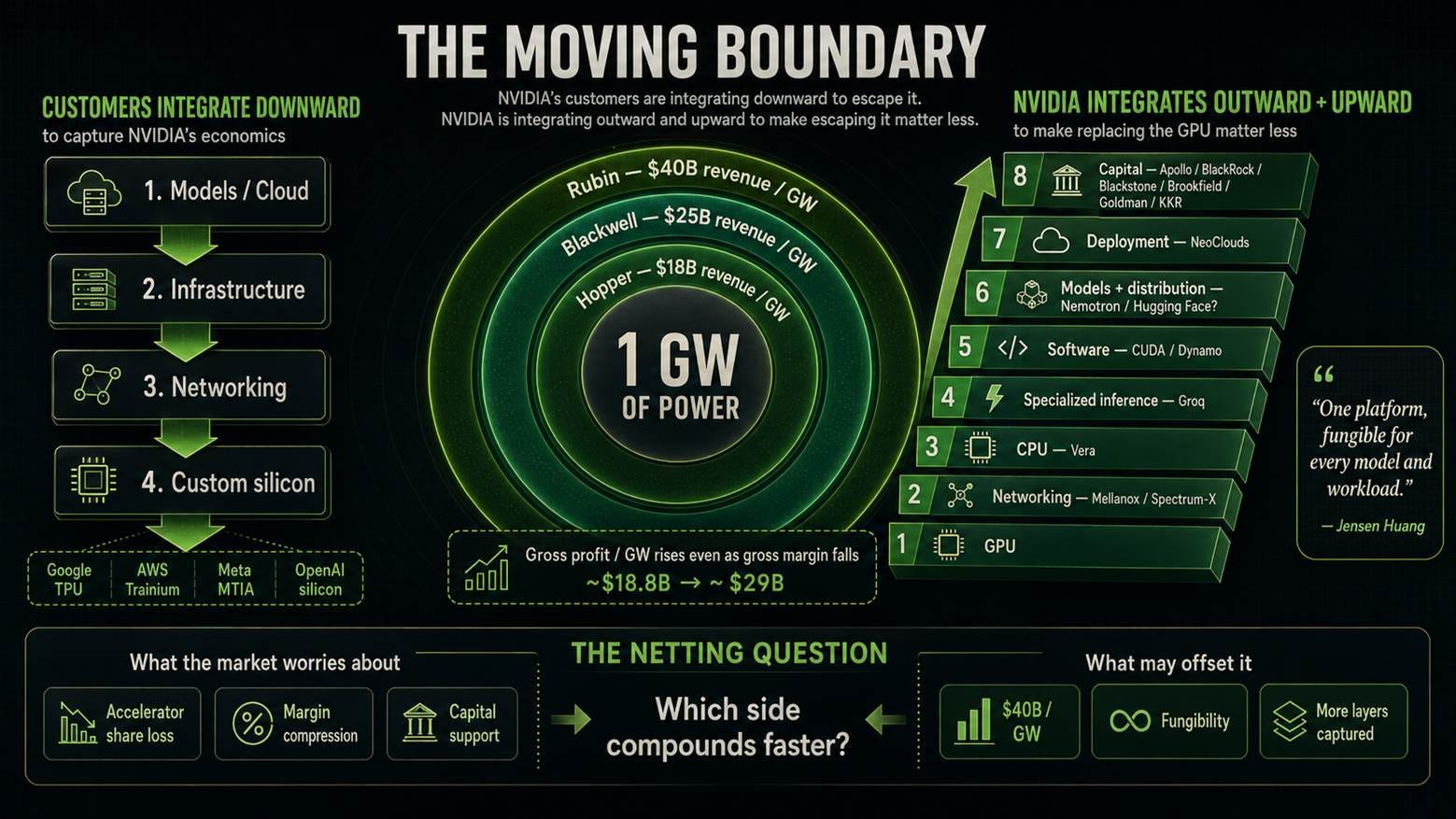
The unit of analysis is shifting from the GPU to the AI factory: NVIDIA says its revenue opportunity per gigawatt has risen from roughly $18 billion with Hopper to $25 billion with Blackwell and $40 billion with Vera Rubin.
Custom silicon is not the whole threat: hyperscalers may take accelerator share while NVIDIA captures more of the CPU, networking, systems, software and surrounding infrastructure.
The counterweight is increasingly financial: receivables, guarantees, investments and extended terms are rising. The key test is whether NVIDIA support grows slower than the economically productive infrastructure it enables.
Two different NVIDIA earnings reports appeared on Wednesday evening, and for the first hour the market could not decide which one mattered.
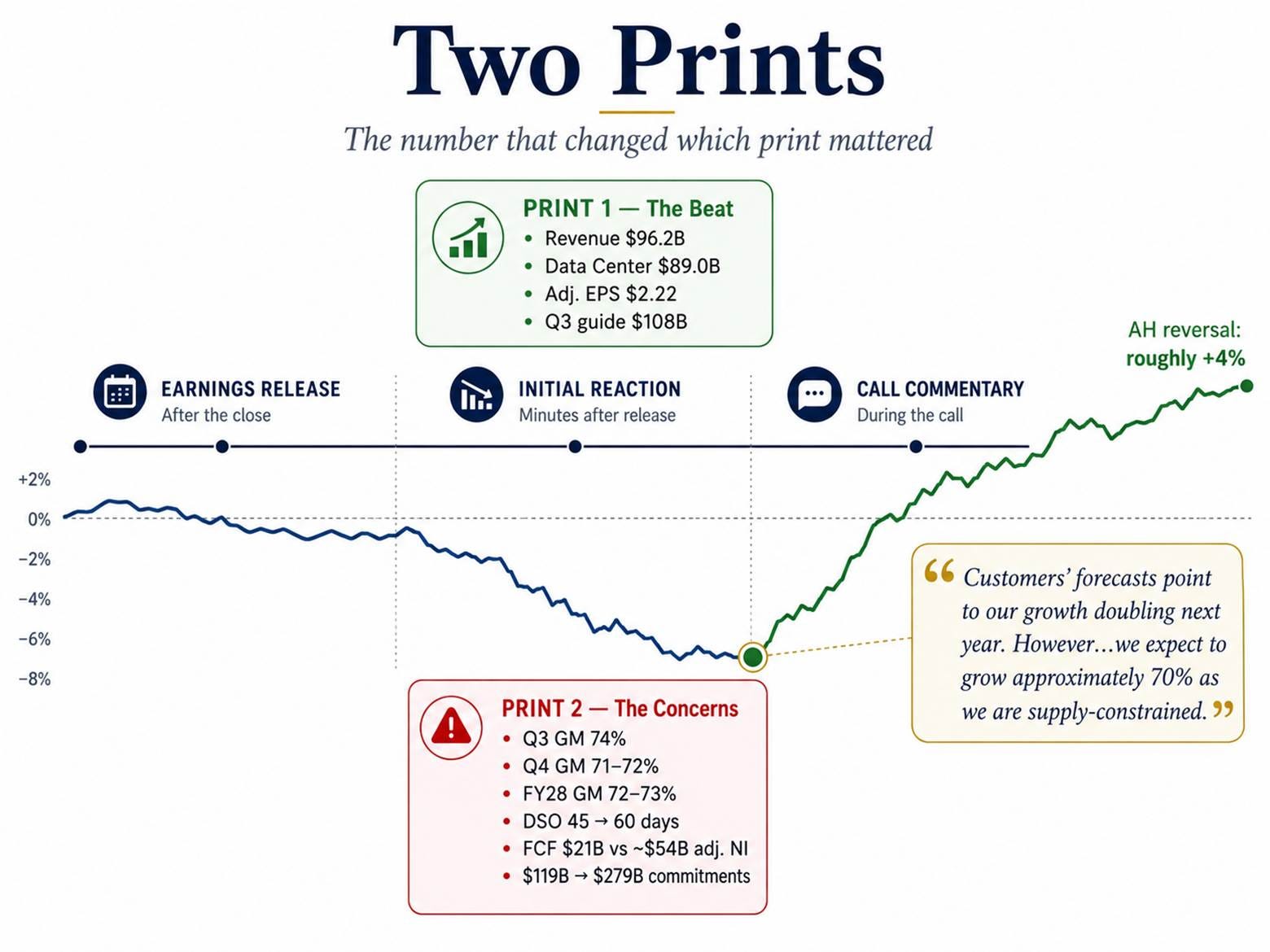
The first was the familiar NVIDIA print. Revenue was $96.2 billion, up 106% year-over-year and nearly $4 billion above consensus. Data Center revenue reached $89 billion, up 117%. Adjusted EPS was $2.22 versus $2.09 expected, and Q3 revenue guidance of $108 billion was about $4 billion above the Street.
The second print was less comfortable. Gross margin, still 75% in Q2, is guided to 74% next quarter; management expects memory costs to push it down to 71–72% in Q4 before recovering to 72–73% in fiscal 2028. Accounts receivable reached $63.1 billion and DSO increased from 45 to 60 days because NVIDIA extended payment terms on large multi-quarter purchases. Free cash flow was only $21.3 billion against nearly $54 billion of adjusted net income, while future supply and capacity commitments more than doubled to $279 billion.
The stock initially traded the second report and fell. Then CFO Colette Kress said:
“Customers’ forecasts point to our growth doubling next year. However…we expect to grow approximately 70% as we are supply-constrained.”
The stock reversed to finish the call roughly 4% higher.
That reversal captures the NVIDIA debate better than another discussion of whether $96 billion was a beat. Investors know AI demand is extraordinary; a company this large does not double revenue by accident. What they are trying to determine is what should be netted against the increasingly visible costs of sustaining that growth: custom silicon, falling margins, working capital and NVIDIA’s expanding financial involvement in its own ecosystem.
The answer, I think, begins with a different number.
The Chip Isn’t Enough
Kress said:
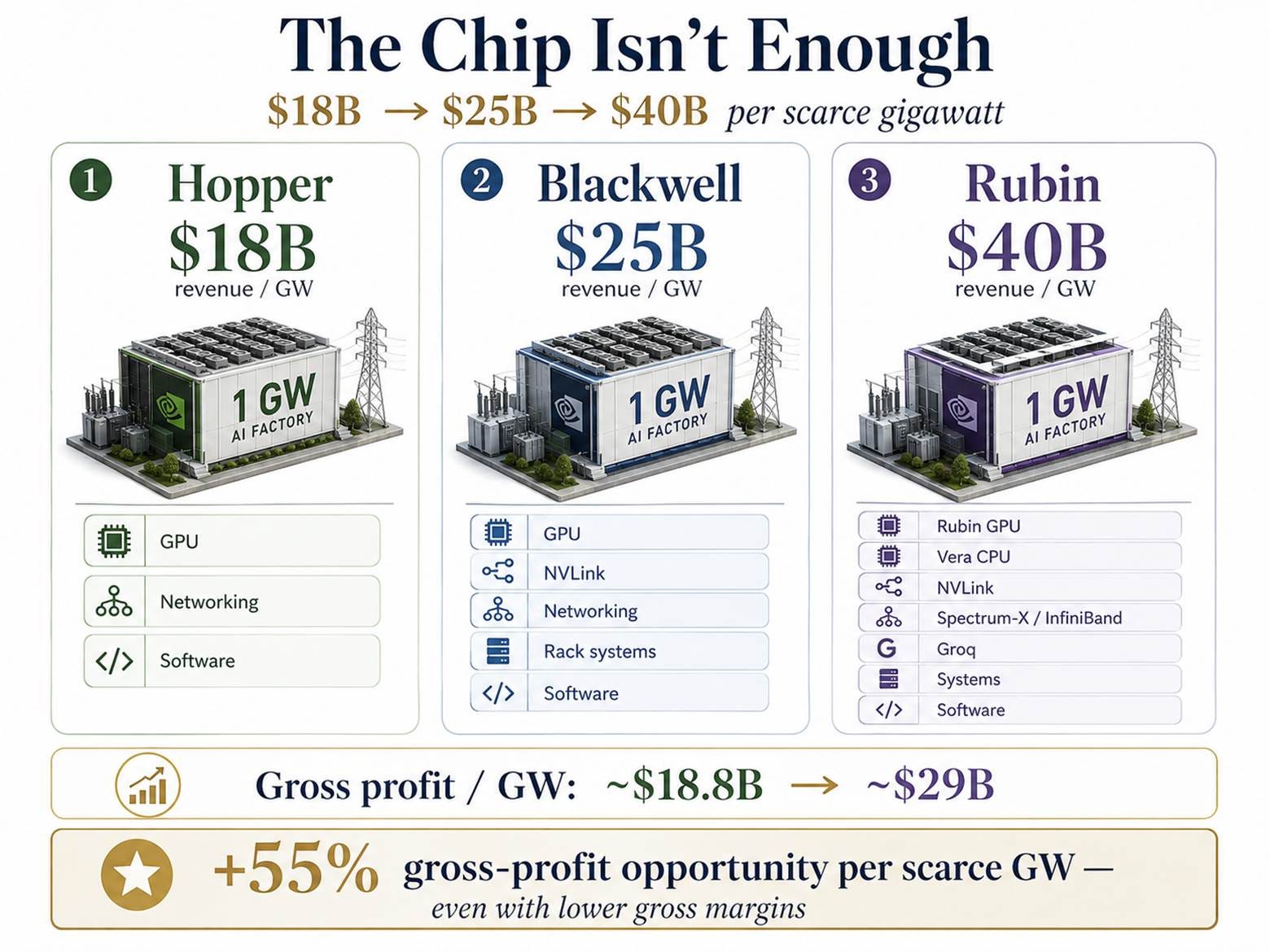
“Since Hopper, our revenue opportunity has grown from roughly $18 billion per gigawatt to $25 billion with Blackwell, to $40 billion with Vera Rubin.”
This is the most useful way to understand what NVIDIA has been building.
Power is increasingly the fixed resource in AI. NVIDIA cannot manufacture new gigawatts, but it can extract more intelligence from each one while increasing the amount of NVIDIA technology inside it. Hopper was principally about the accelerator. Blackwell expanded the rack. Rubin increasingly means Vera CPU, Rubin GPUs, NVLink, Ethernet or InfiniBand networking, systems, software and Groq LPUs.
The margin reset looks rather different through this lens. Blackwell at $25 billion of NVIDIA revenue per gigawatt and 75% gross margin implies about $18.8 billion of gross profit per gigawatt. Rubin at $40 billion and a 72.5% margin would imply roughly $29 billion. Even if mid-70s margins do not return, NVIDIA can potentially increase gross-profit capture from every scarce gigawatt by more than 50%.
This is also Jensen Huang’s answer to custom silicon. NVIDIA’s largest customers have powerful incentives to design their own chips: when compute is one of your largest expenses, NVIDIA’s gross margin is your potential savings. Amazon has Trainium, Google has TPUs, Meta has MTIA, and model companies are pursuing silicon of their own.
Huang did not argue that these efforts will fail. Instead he emphasized what NVIDIA sells that a specialized accelerator does not:
“One platform, fungible for every model and workload. Durable for the entire life cycle of AI.”
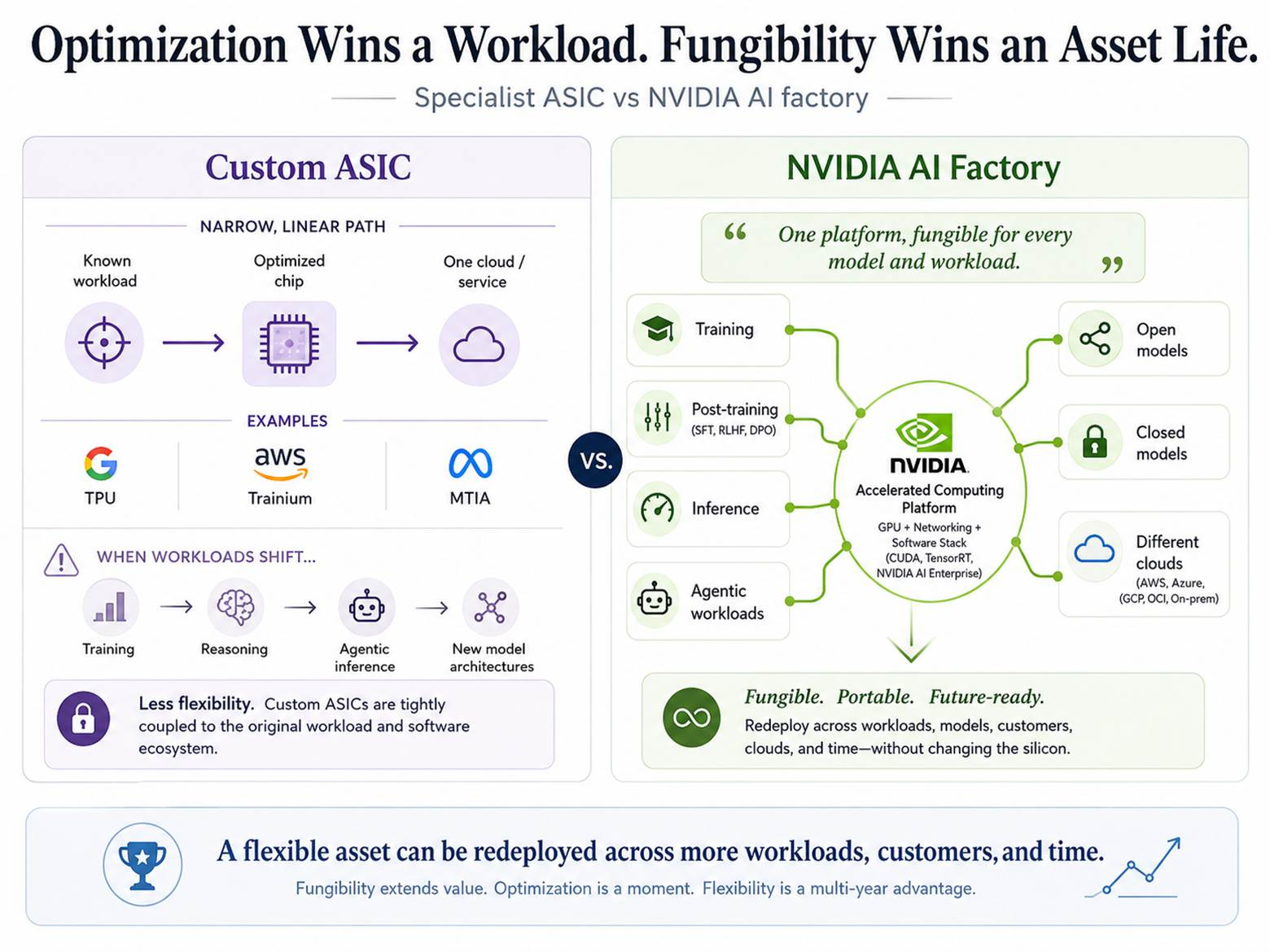
He made the contrast more explicitly in Q&A: many XPUs are optimized for a particular service or cloud, while NVIDIA is trying to build an AI-factory architecture that can run across clouds, models and stages of the AI lifecycle. That distinction matters because a multi-billion-dollar factory is not merely buying today’s inference workload; it is buying an asset that needs to remain useful when the workload changes.
Fungibility therefore has economic value. AWS can expand Trainium while simultaneously committing to two million additional NVIDIA GPUs and adopting Vera CPUs. Custom silicon may take accelerator share without taking an equivalent share of NVIDIA’s economics if NVIDIA captures more of the networking, CPU, software and system surrounding the accelerator.
That is the netting question in its first form: what should GPU share loss be netted against?
The morning after earnings supplied another clue. Reuters reported, citing The Information, that NVIDIA had agreed to acquire Hugging Face for $12.9 billion; NVIDIA and Hugging Face declined to comment. Hugging Face matters less because NVIDIA needs another model than because it sits between models and developers, hosting the open-model ecosystem and helping developers discover and deploy it.
This move fits a pattern that is becoming difficult to ignore. Networking threatened to become the constraint on GPU clusters, so NVIDIA bought Mellanox. CPU orchestration became more important, so Grace became Vera. Specialized decode created an architectural opening, so NVIDIA incorporated Groq. AI clouds lacked capacity, so NVIDIA helped develop NeoClouds. Model distribution is becoming strategically important, and NVIDIA may now be buying Hugging Face.
Each move looks adjacent on its own. Together they reveal the strategy: whenever a layer either constrains NVIDIA’s growth or offers customers a route around NVIDIA, the company moves sufficiently far into that layer to keep the larger system centered on NVIDIA.
NVIDIA’s customers are integrating downward to escape NVIDIA. NVIDIA is integrating outward and upward to make escaping NVIDIA matter less.
Capital Is a Component
The most unusual extension of this strategy is not Hugging Face. It is finance.
Kress said the frontier AI labs have enormous compute demand but are “growing faster than what their balance sheets and credit profiles can support.” This is an important distinction. NVIDIA is not describing weak demand; it is describing demand that cannot yet finance itself at the rate customers would like to grow.
NVIDIA’s response is strikingly similar to its response to every other bottleneck: remove it.
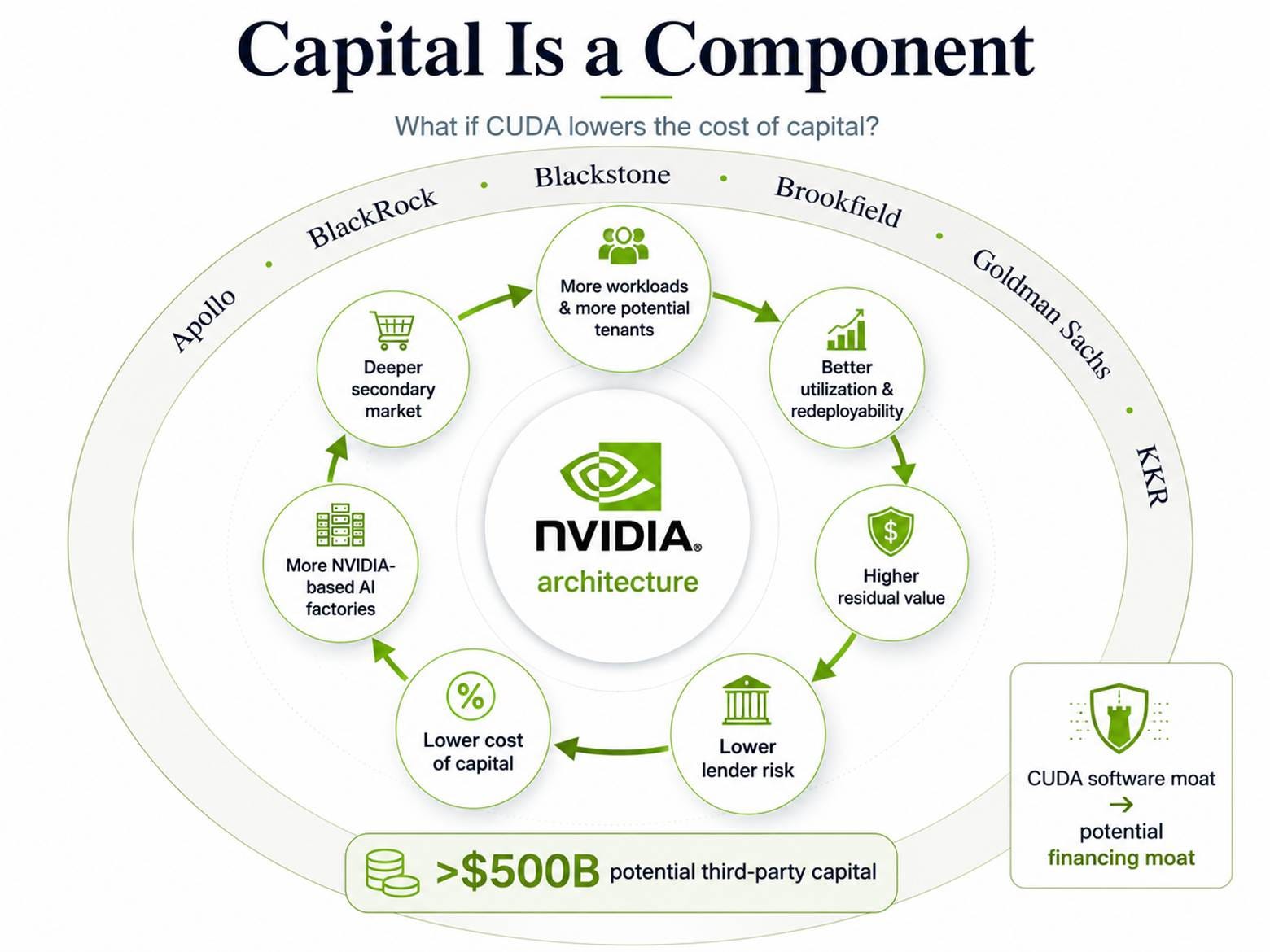
The company has invested nearly $50 billion in frontier labs and has brought Apollo, BlackRock, Blackstone, Brookfield, Goldman Sachs and KKR together around financing platforms intended to mobilize more than $500 billion of third-party capital. For some NeoCloud projects NVIDIA can provide a minimum revenue or take-or-pay commitment that helps independent lenders finance the facility, while NVIDIA participates in rental revenue above the floor.
Financing, in other words, has become another component of the AI factory.
The logic is compelling. NVIDIA can use the extraordinary profits from today’s installed base to accelerate tomorrow’s installed base, keep that capacity on NVIDIA architecture and potentially earn a recurring share of the revenue generated by the equipment it sold.
Fungibility matters here as well. A system capable of running many models and workloads for many potential customers ought to be easier to re-lease if the original customer fails. Better redeployability should support higher residual values; higher residual values reduce lender risk; lower risk lowers the customer’s cost of capital. More NVIDIA installations then deepen the secondary market that makes the next NVIDIA deployment still easier to finance.
CUDA could become a financing advantage as well as a software advantage.
This is where the argument becomes uncomfortable. NVIDIA generated nearly $54 billion of adjusted earnings this quarter but only $21 billion of free cash flow. Some of that gap is perfectly explainable by taxes, Rubin inventory and the extraordinary scale of the ramp. The more interesting number is 60-day DSO because management explicitly linked it to extended customer terms at the same time it acknowledged that parts of the AI ecosystem are growing faster than their financial capacity.
None of this proves the demand is circular. Demand can be completely real and still arrive faster than customers can finance it. The question is whether NVIDIA is providing temporary scaffolding around a young economic system or whether progressively more scaffolding is required to keep reported demand growing.
In The AI Handoff, we described this progression as Scarcity → Sponsorship → Conversion → Self-funding. Self-funding was never meant to imply that NVIDIA would stop investing; it meant that customer-generated cash and independent credit would increasingly finance each subsequent infrastructure cycle.
Q2 suggests the architecture is moving faster than the handoff.
The Netting Question
Last quarter I wrote that “a flywheel compounds; a circle spins.” My expectation was that ACIE would help distinguish the two: broadening non-hyperscaler demand combined with moderating NVIDIA support would suggest the ecosystem was increasingly standing on its own.
Instead, ACIE grew 25% sequentially and 138% year-over-year while NVIDIA’s financial involvement increased as well. There was some messiness: the $40.3 billion ACIE result missed consensus even as Hyperscale drove the Data Center beat but the broader demand signal is difficult to dismiss. The operating flywheel and financial scaffolding are not alternatives; at least for now, the latter is helping the former move faster.
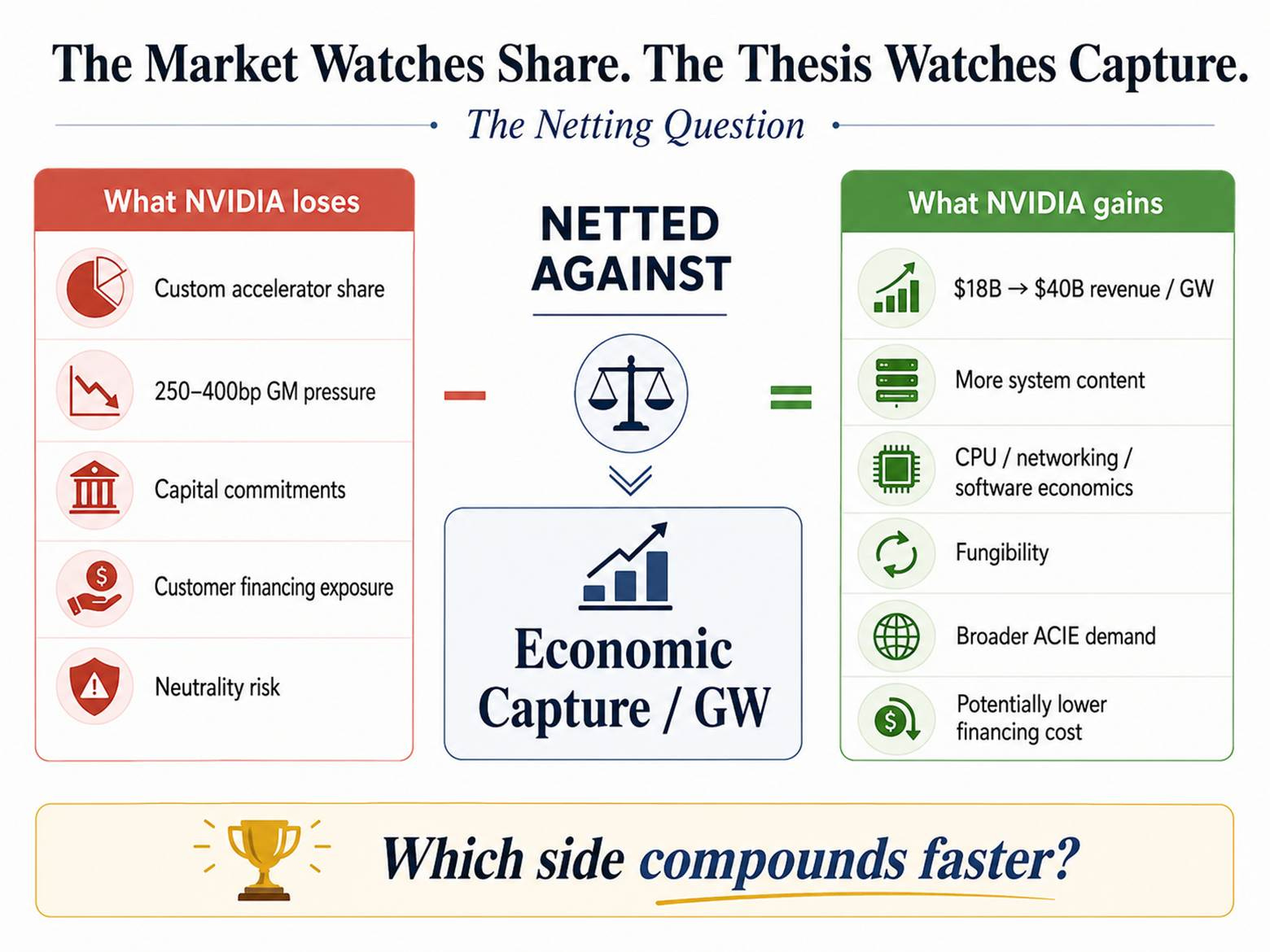
My variant perception is therefore not that custom silicon does not matter, or that financing risk is imaginary. It is that the market is too focused on NVIDIA’s share of accelerators and not focused enough on NVIDIA’s expanding economic claim on each AI factory.
The $18 billion-to-$40 billion progression per gigawatt is the evidence. NVIDIA can lose something in GPUs, something in gross margin and something in financing support, yet still create substantially more economic value per scarce unit of infrastructure.
The real question is what must be netted against that expansion. If NVIDIA’s customers gradually become self-funding while NVIDIA continues increasing content per gigawatt, the company’s outward integration can more than offset accelerator-share erosion. If support requirements, receivables and guarantees rise as quickly as revenue while custom silicon takes the most profitable workloads, then orchestration starts looking more like subsidy.
Hugging Face adds a second risk. The orchestrator benefits from neutrality: NVIDIA is valuable because OpenAI, Anthropic, Meta, sovereigns and every cloud can all use it. Hugging Face is valuable for a similar reason. NVIDIA ownership could make the route from an open model to NVIDIA deployment much easier, but it could also make competing hardware vendors and model companies more interested in building an alternative. The more layers NVIDIA controls, the more valuable the architecture becomes and the greater the incentive for everyone else to route around it.
That tension defines the three-year range.
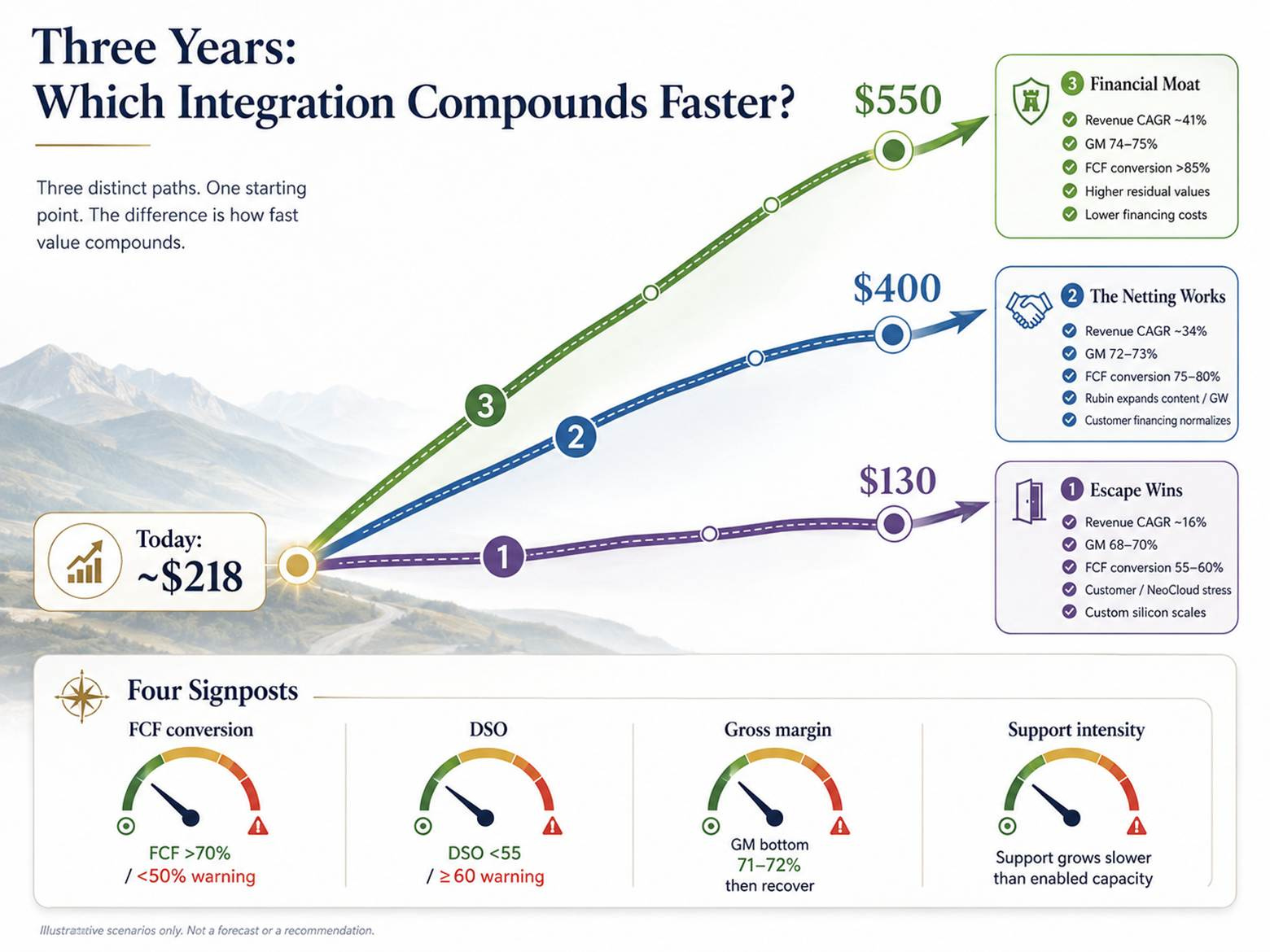
The bear case is not simply slower AI growth. One major customer or NeoCloud runs into financing difficulty, NVIDIA’s guarantees or equity exposure become economically relevant, DSO remains elevated, custom silicon captures standardized workloads and gross margin settles below 70%. AI can still succeed while NVIDIA’s equity does not.
The base case assumes management is broadly right about FY28: revenue grows around 70%, Rubin continues increasing NVIDIA content per gigawatt, ACIE broadens the customer base and hyperscalers use custom silicon without escaping the rest of the NVIDIA stack. Margins stabilize around 72–73%, cash conversion normalizes and financial support grows more slowly than the infrastructure it enables.
The bull case does not require NVIDIA to eliminate custom silicon. It requires NVIDIA systems to become measurably better assets: more fungible, easier to re-lease and consequently cheaper to finance. If the architecture earns a residual-value and cost-of-capital premium, the technical flywheel gains a financial counterpart.
There are four numbers I would watch to distinguish these outcomes. Free-cash-flow conversion should recover toward 70% or better of adjusted earnings; persistent conversion below 50% would make the financing concern structural. DSO should move back below roughly 55 days rather than remain above 60. Gross margins need to bottom around the promised 71–72% and recover thereafter. Finally, ACIE and independently financed capacity need to grow faster than the guarantees, equity and extended terms NVIDIA uses to support them.
The last measure is the one NVIDIA does not yet give us, and ultimately the one I care most about: how much NVIDIA support is required for each additional dollar of economically productive AI infrastructure?
NVIDIA’s customers will keep integrating downward because the economics are simply too important for them not to. NVIDIA does not need to stop them; it needs to keep moving the boundary of competition so that replacing the NVIDIA chip means replacing an ever-smaller portion of what NVIDIA provides.
Q2 was the first quarter to put a compelling number on that strategy: $40 billion per gigawatt.
The next few years will tell us what needs to be netted against it.
Disclaimer:
The content does not constitute any kind of investment or financial advice. Kindly reach out to your advisor for any investment-related advice. Please refer to the tab “Legal | Disclaimer” to read the complete disclaimer.
HSBC says it will run to $360?