


TL; DR
AI infrastructure is entering a new financing phase: Nvidia and major capital providers are building repeatable structures to mobilise hundreds of billions of dollars beyond hyperscaler balance sheets.
The key metric is no longer just capex, but support: if each new dollar of AI capacity requires less vendor backing, the system is moving from Sponsorship toward genuine Self-funding.
Nvidia may be building a financial moat: if Nvidia-based projects consistently secure better financing terms than competing architectures, CUDA’s advantage extends beyond software into the cost of capital itself.
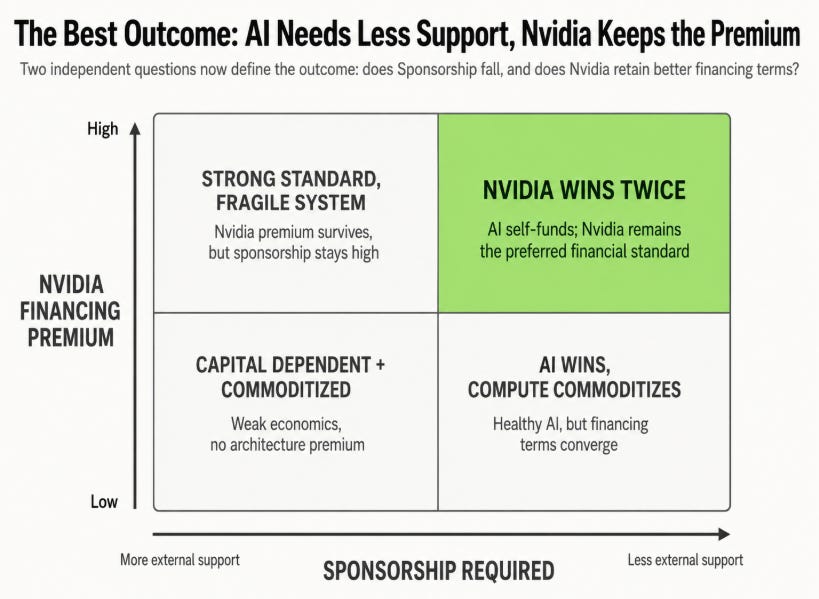
Six weeks ago, in The AI Handoff, we argued that the AI buildout was moving through four stages: Scarcity → Sponsorship → Conversion → Self-funding. Scarcity had produced extraordinary supplier economics. Sponsorship was emerging as vendors, strategic investors and capital providers helped customers build infrastructure before the applications using it generated enough cash to pay for it independently. Conversion would arrive when those applications produced durable revenue and savings. Self-funding would begin when the returns on one generation of infrastructure financed the next.
The central question was whether falling costs and improving capability could create enough broad, independently financed end-user demand before the physical capacity and financial obligations built in anticipation of that demand outran the resulting cash flows.
This week Nvidia put a number on the next stage of that experiment.
The company announced partnerships with Apollo, BlackRock, Blackstone, Brookfield, Goldman Sachs and KKR intended to mobilise more than $500 billion of third-party capital for AI infrastructure. Nvidia says it may provide residual-value support of up to 25% on individual opportunities. Two months earlier, Apollo and Blackstone had structured a $35 billion Broadcom AI financing with materially more extensive residual protection for senior capital.
The structures are not identical enough to declare that the difference is simply “the price of CUDA”. Borrower quality, tranche seniority, tenor, customer commitments and collateral assumptions matter. But the comparison gives us something we did not have six weeks ago: the beginnings of an observable market price for how much financial value investors attach to different compute architectures.
That matters because Nvidia and its financing partners are not necessarily trying to create the same end state.
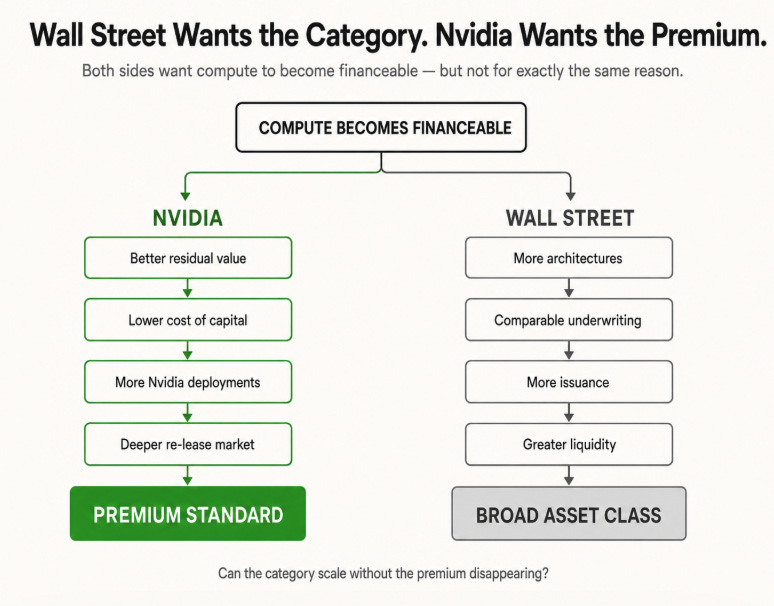
Nvidia benefits if its architecture remains differentiated enough that Nvidia-based infrastructure receives lower financing costs, requires less vendor support and retains higher residual values. Capital markets benefit from something broader: a liquid, standardised asset class in which Nvidia, Broadcom, Google TPUs and eventually other architectures can all be financed and compared.
The strategic question is therefore no longer simply whether compute can be financed. It is whether Nvidia can financialise compute without helping commoditise it — while the wider AI system reduces its dependence on sponsorship and moves toward genuine self-funding.
Seven Men on Television
The unusual thing about Nvidia’s CNBC appearance was not the size of the number. It was the people sitting around Jensen Huang.
Goldman Sachs CEO David Solomon, BlackRock CEO Larry Fink, Blackstone President Jon Gray, Apollo President Jim Zelter, Brookfield CEO Bruce Flatt and KKR’s global head of digital infrastructure joined Huang to explain the new financing platforms. These institutions compete for capital and transactions, yet Nvidia had assembled them to describe different parts of what increasingly looks like a new financial system.
Huang started with the technology.
“The computer is now part of the infrastructure like electricity, like the internet.”
His argument was that Nvidia had crossed from selling components into supplying productive infrastructure. AI factories generate revenue, can run many workloads, serve multiple potential users and retain economic value beyond the credit quality of the original buyer.
His partners talked increasingly about the asset.
Gray compared compute finance with houses and aircraft: lenders underwrite the borrower, but also the value of the underlying asset. Brookfield said investors had lacked the proper “format” through which to invest and described Nvidia’s architecture and support as part of what makes the infrastructure transferable to another operator. Fink compared the moment with the early mortgage-backed-securities market. KKR described the value chain as running “from molecule to token”.
There is no contradiction yet. Nvidia may genuinely represent the highest-quality collateral in an emerging market. The divergence is in where each participant wants the market to end up.
Nvidia wants Nvidia compute to become a financial standard.
Wall Street wants compute to become a financial asset class.
The first depends on differentiation. The second eventually benefits from standardisation.
That tension is the most interesting part of the announcement.
Sponsorship, Institutionalised
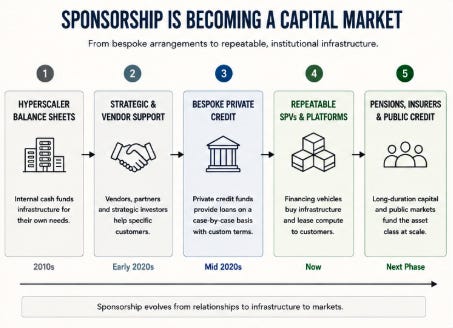
The mechanics are relatively simple. Financing vehicles can raise third-party capital, purchase AI infrastructure and lease the resulting compute to customers. Goldman can structure and distribute the debt. Infrastructure and private-capital firms can provide equity or credit. Nvidia supplies the systems and may provide limited support against residual-value risk.
What has changed is the investor base.
The first phase of AI infrastructure was largely financed by capital close to the technology: hyperscaler retained earnings, venture capital, strategic equity and corporate investment-grade debt. Nvidia’s coalition is designed to reach capital that does not need to believe a particular AI stock will rise. Pension funds, insurers and long-duration credit investors want contracted cash flows, recoverable collateral and yield.
That turns Sponsorship from a series of bespoke arrangements into something closer to a repeatable capital market.
This does not make the underlying demand fake. Young infrastructure systems often require capital before customers can fully fund themselves. A model company needs compute before it can create the product and revenue that make the compute affordable. A data-centre developer needs a committed tenant before lenders will finance construction.
But financing changes what demand proves. As we wrote in July:
“A vendor-supported purchase says the supplier believes strongly enough in the customer’s future to help create the purchasing power. The second may be an excellent investment. It is not independent validation.”
The $500 billion announcement does not mark the end of Sponsorship.
It marks its institutionalisation.
25% Versus 100%
This is where the financing terms become more interesting than the headline amount.
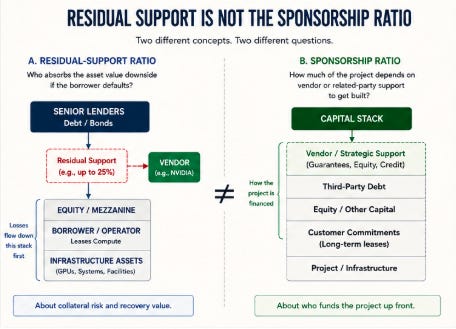
Nvidia has described potential residual-value support of up to 25% on qualifying projects. In the earlier Broadcom financing, Broadcom provided much broader protection against residual shortfalls for senior capital.
Two different concepts need to remain separate.
The sponsorship ratio measures how much incremental infrastructure relies on vendor guarantees, strategic equity or related-party financing rather than independent customer cash and credit.
The residual-support ratio measures how much collateral downside the vendor agrees to absorb if the borrower fails and the equipment has to be recovered or re-leased.
The second may tell us something important about the first, but they are not interchangeable.
What the comparison may eventually reveal is an architecture financing premium.
If comparable Nvidia projects consistently require less residual support, lower coupons, less equity, smaller collateral haircuts or longer maturities than competing architectures, then Nvidia’s ecosystem has become more than a software moat. It has become a financial moat.
This is a much stronger proposition than saying CUDA makes GPUs valuable collateral. It means Nvidia’s installed base, software compatibility and secondary-user ecosystem reduce the cost of capital for anyone deploying Nvidia systems.
That advantage could reinforce itself. Lower financing costs create more Nvidia installations. More installations deepen the potential re-lease market. A deeper secondary market improves residual values. Better residual values lower financing costs again.
The opposite outcome is equally important. If economically comparable Nvidia, Broadcom and TPU projects eventually require similar enhancement and clear at similar spreads, compute is becoming financeable while Nvidia’s architecture premium is disappearing.
The executed deals, not the MOUs, will tell us which world is emerging.
Three Clocks
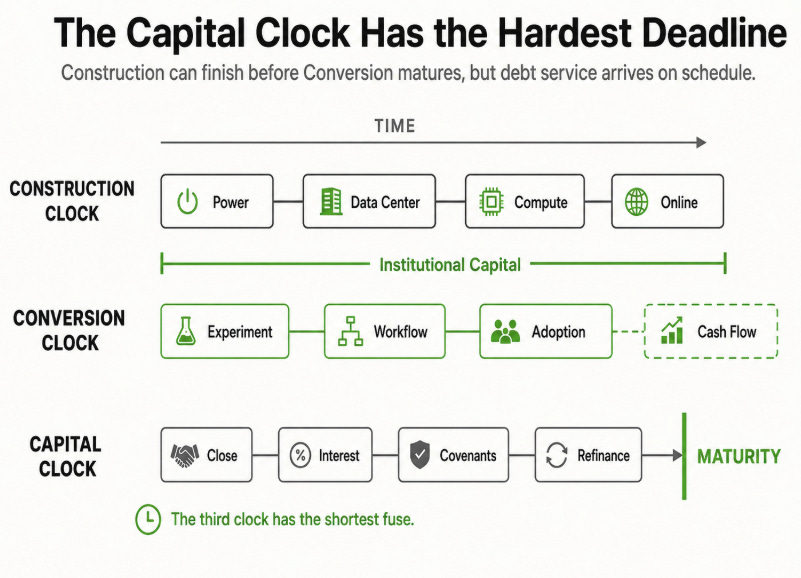
The financing initiative also extends the framework from The AI Handoff.
The construction clock runs on engineering. Chips have to be manufactured, power secured, substations built, data centres completed, networks installed and systems commissioned.
The conversion clock runs on enterprises. Companies must connect models to proprietary data, establish permissions, redesign workflows, test reliability, change budgets and persuade humans to work differently.
The capital clock runs on debt service.
Interest has a due date. Leases must be paid. Covenants have test dates. Refinancing windows open and close. Equipment depreciates. Debt matures.
The third clock has the hardest deadline.
A technology can be right over twenty years while the security financing it is wrong over five.
This is where Liaquat Ahamed’s 1873, the book Satya Nadella recently called “the book to be read”, becomes useful. Ahamed notes that roughly $500 million a year flowed into US railway bonds during the early 1870s, equivalent to around $600 billion relative to the size of the modern economy.
The railway itself was not the mistake. Northern Pacific eventually completed its line after multiple bankruptcies and ultimately became part of the system that formed BNSF. The infrastructure survived. Some of the securities used to finance it did not.
The parallel is not the outcome. It is the financing problem.
Capital must arrive before the full economic activity that justifies the infrastructure.
Nvidia’s coalition is designed to give Conversion more time before the capital clock runs out.
There is also a feedback loop. More financing creates more infrastructure. More infrastructure lowers the price of intelligence. Lower prices make new workloads economical. Those workloads accelerate Conversion.
Finance can therefore do more than wait for demand.
It can help create it.
The Great Elasticity Bet
That feedback loop contains the deepest assumption in the entire structure.
KKR noted that token prices have fallen dramatically even as usage has risen.
This makes AI an unusual infrastructure asset. It has the fixed-capital intensity of a utility but the output deflation of software. Investors are being asked to provide long-duration capital against a product whose unit price may decline by orders of magnitude while the equipment producing it is itself improving rapidly.
The financing works only if demand for intelligence is extraordinarily elastic.
If useful intelligence becomes ten times cheaper, society must consume substantially more than ten times as much for the aggregate revenue pool to expand strongly enough to support a growing infrastructure base.
There are good reasons to believe that will happen. Human cognition has historically been expensive, so companies rationed it. They reviewed some transactions rather than all transactions, ran a limited number of experiments, produced periodic analysis rather than continuous analysis and assigned finite numbers of people to tasks where dozens of digital agents might eventually operate in parallel.
Cheaper cognition can create workloads that did not exist at all at previous prices.
But rising token volume is not sufficient. What matters to infrastructure investors is revenue density: the economic output generated per unit of deployed capacity after utilisation, power, operating expense and depreciation.
If prices fall faster than paid usage expands, AI can become extraordinarily successful for users while infrastructure owners earn poor returns.
The technology and the securities can reach different verdicts.
Follow the Payer
This is why the same earnings season matters.
Palantir produced rapid revenue growth and strong free-cash-flow conversion. Atlassian showed expanding contracted demand and improving economics around AI-connected products. At the same time, several hardware companies reported extraordinary growth and still sold off.
This was not simply a rotation from hardware to software.
The market was separating capacity from economic conversion.
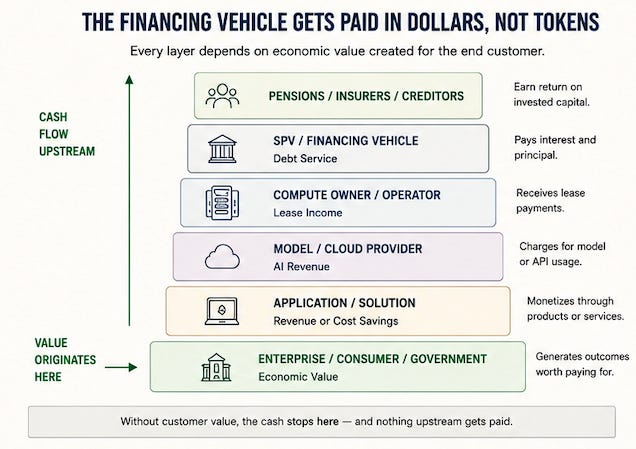
Ultimately, the financing vehicle does not get paid in tokens. It gets paid in dollars.
Those dollars must originate with an enterprise, consumer or government receiving enough economic value from AI to support the chain beneath it. That value may come from new revenue, substitution for existing expenditure or productivity savings. Whatever the mechanism, customer economics must ultimately fund model revenue, which funds infrastructure payments, which service the capital.
Huang’s claim that AI tokens are “incredibly profitable” therefore needs one further distinction.
A token may generate an attractive gross margin after inference cost. A lab may generate operating profit after salaries and product expenses. Yet the capital structure ultimately needs free cash flow after the company funds the next model, secures future compute and maintains its competitive capability.
Token profitability validates the product.
Free cash flow validates the infrastructure.
That makes a future OpenAI or Anthropic IPO important for a different reason than the valuation headline.
An IPO is a financial handoff. It can broaden the investor base and reduce the cost of capital.
Self-funding is an economic handoff. It occurs when customer-generated cash can support the next infrastructure cycle without ever-larger injections of external capital.
A company can achieve the first without achieving the second.
Public filings will finally allow investors to distinguish them.
Nvidia, Wall Street and Google
The financing coalition also exposes a longer-term strategic tension around who defines the asset class.
Apollo has already participated in the Broadcom structure. Blackstone is involved with Nvidia, Broadcom and a large Google TPU joint venture. Its own underwriting analogy focused on the economic value of compute rather than on Nvidia specifically.
These firms do not need Nvidia to dominate AI. They need AI infrastructure to become financeable.
Google makes that distinction particularly important.
Google can monetise AI through Gemini, Google Cloud, advertising, security, storage and its own TPU infrastructure. It can also earn money supplying compute to laboratories that compete with Gemini. It therefore has reasons to make TPUs broadly usable even if the leading model is produced elsewhere.
As non-Nvidia systems acquire independent customers, rental histories and financing transactions, capital markets gain something they previously lacked: comparables.
At that point Nvidia’s financing advantage becomes measurable.
Does an Nvidia project receive a lower coupon than a TPU project with the same borrower? Does the lender require less first-loss protection? Is the advance rate higher? Is the equipment assigned a better residual curve? Can the debt mature later?
Nvidia may win all of those comparisons.
But the existence of the comparison itself changes the market.
Nvidia is helping create an enormous financing category while simultaneously betting that its own systems remain the premium asset inside it.
Wall Street wants the category.
Nvidia wants the premium.
The Scorecard
We now have enough evidence to track the handoff rather than merely describe it.
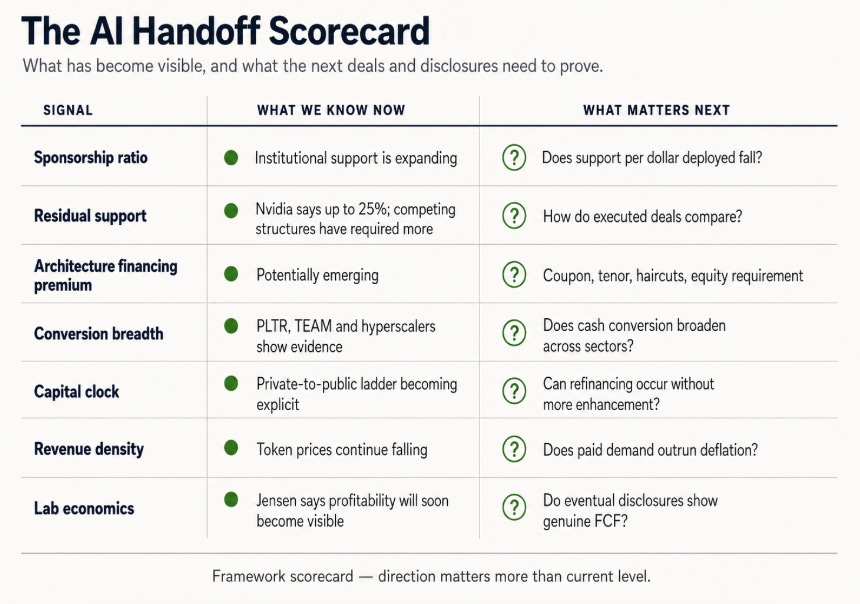
The direction matters more than the current level.
Five Calls
First, watch hyperscaler capex. The largest buyers still fund substantial infrastructure from their own economics. A meaningful capex-guide reduction from a major hyperscaler would be the clearest signal that the construction clock is encountering an economic constraint rather than a physical one.
Second, watch long-term memory commitments. A material cancellation or roll-down in contracted HBM or memory demand would turn the oversupply thesis from narrative into operating evidence.
Third, watch lab disclosure rather than IPO valuation. A spectacular IPO accompanied by persistent dependence on outside capital is financial graduation, not economic graduation. The real test is gross margin, free cash flow and compute obligations.
Fourth, watch Nvidia’s financing premium. If comparable Nvidia projects clear with materially less support and better terms than competing architectures, Nvidia has created a financial moat. If the terms converge, the compute asset class is standardising faster than Nvidia would prefer.
Fifth, and most importantly, watch the Sponsorship Ratio. If the first $100 billion of financed capacity requires 25% support and the next $100 billion requires 35%, the system is becoming more dependent on external support as it grows. If the requirement falls toward 15%, 10% and eventually zero because customers increasingly finance projects using their own cash and credit, the handoff is working.
The View
The Nvidia announcement is bullish for the pace of the AI buildout. It opens pools of capital to customers that do not possess hyperscaler balance sheets, accelerates infrastructure construction and should push the price of intelligence lower.
It is also the clearest evidence yet that AI has entered a new financial phase.
The question is no longer whether Wall Street can finance AI. It clearly can.
The first question is whether the amount of sponsorship required declines as the system scales. That tells us whether Conversion is producing enough independent cash flow for AI to move toward Self-funding.
The second is whether Nvidia retains structurally better financing terms than competing architectures. That tells us whether CUDA and Nvidia’s installed ecosystem can remain differentiated as compute itself becomes increasingly standardised and financeable.
The best outcome for Nvidia is straightforward: the Sponsorship Ratio falls while the architecture financing premium remains high. AI becomes increasingly self-funding, and Nvidia remains the preferred asset inside the capital market built around it.
The weaker outcome is the reverse: sponsorship rises while financing terms converge across architectures. AI may still transform the economy, but infrastructure remains dependent on external capital while compute commoditises underneath Nvidia.
That is why the executed transactions matter more than the $500 billion headline.
Six weeks ago, the Sponsorship Ratio was a framework.
This week, we began to see what might price it.
The next deals will tell us whether the number is going down.
Disclaimer:
The content does not constitute any kind of investment or financial advice. Kindly reach out to your advisor for any investment-related advice. Please refer to the tab “Legal | Disclaimer” to read the complete disclaimer.